Galaxies as Ecosystems
Section 5 of 9
Star Formation and Support
Part 4: Star Formation Is a Local Failure of Support
Stars form when part of a gas cloud becomes dense and cold enough for gravity to win locally. That sentence is short, but it contains the central physics. Gas has pressure, turbulence, magnetic fields, and radiation acting against collapse. Gravity has to overcome those forms of support. Cooling helps because cooler gas has lower thermal pressure. Higher density helps because gravity becomes more effective when more mass is packed into a smaller region.
One compact way to express gravity’s clock is the dynamical timescale:
Here is an order-of-magnitude collapse or rearrangement time, is the gravitational constant, and is the average density of the region. The equation says that denser regions have shorter gravitational response times. It is not a promise that every dense clump will form stars, because pressure, turbulence, magnetic fields, radiation, and feedback can slow or stop collapse. It is a way to read the competition: density helps gravity act faster.
Problem
A molecular cloud has mean number density of hydrogen, so . Estimate its dynamical timescale , and compare it to the few-million-year life of a massive star. Use , , .
StepBuild the mean density in CGS
.
StepEvaluate the timescale
, so .
Dimensional check
, so has units of seconds — a time, as a timescale must.
Result
— comparable to the lifetime of a massive star. Gravitational collapse and the feedback those stars deliver act on the same clock, which is why star formation regulates itself instead of running away.
This is why star formation is not spread smoothly through a galaxy. It is concentrated in clouds, filaments, shells, and clumps. The
Interstellar medium
The gas and dust between stars inside a galaxy. Far from an empty background, it is structured into clouds, filaments, shells, and clumps — and it is the reservoir out of which new stars form.
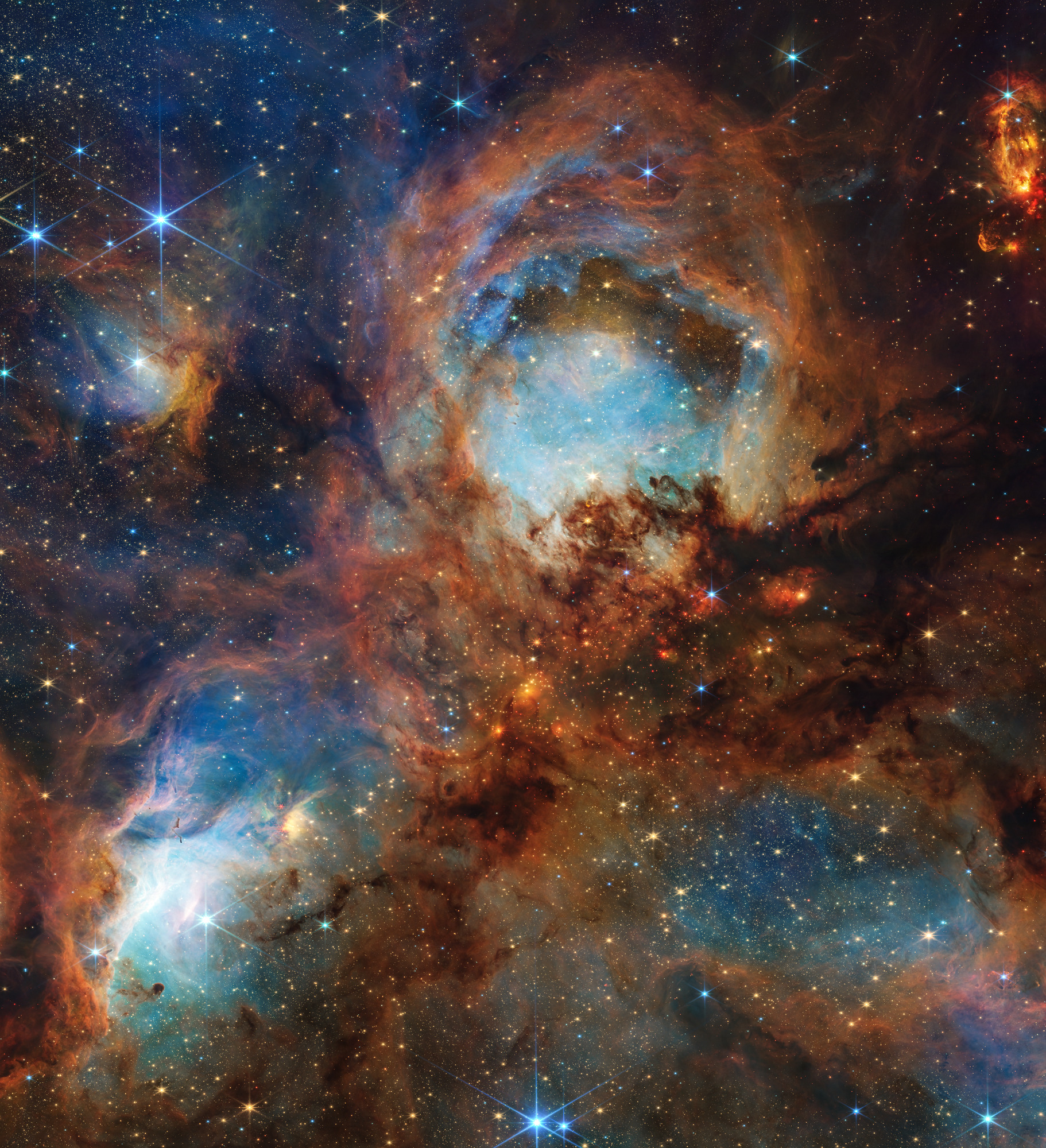
Infrared images of star-forming regions are especially revealing because young stars are often born inside dusty clouds. Visible light from those stars may be blocked or scattered, while infrared light can escape more easily. When we see embedded infrared sources, glowing dust, and sculpted cavities, we are seeing the early stages of the baryon cycle: gas collecting, collapsing, forming stars, and being reshaped by the stars it just made.
The word
Baryon
Ordinary matter made mostly of protons and neutrons — gas, stars, planets, dust, and people — as distinct from dark matter or radiation. When astronomers say “normal matter,” they mean baryons.
Cold gas
Gas with low enough thermal pressure that gravity can more easily compress it into dense star-forming regions. Cooling lowers the pressure that resists collapse, so cold gas is the raw material for star formation.
Baryon cycle
The movement of ordinary matter through gas, stars, dust, remnants, outflows, inflows, and later generations of star formation. It is the population-level bookkeeping that connects stellar evolution to galaxy evolution.
That cycle connects stellar evolution (Modules 3–4) directly to galaxy evolution. A massive star does not only live and die for itself. Its radiation, winds, and supernova drive
Metal enrichment
The process by which stars and stellar explosions add elements heavier than helium (“metals,” in astronomers’ usage) to the surrounding gas. Each generation of stars enriches the gas the next generation forms from.
Quick check
A galaxy forms a generation of massive stars. Within a few million years they explode as supernovae. Name two distinct ways this changes the gas that the next generation of stars will form from.
First, chemical: the supernovae enrich the gas with heavy elements, so the next generation forms from more metal-rich material. Second, energetic: supernova feedback injects energy and momentum — heating, stirring, compressing, or expelling gas — which changes how much cold gas is available and where it can collapse. The first generation rewrites both the composition and the supply of the raw material the next one inherits.
Multiple choice
Which change would make gravity act faster in the dynamical-timescale estimate?
Increasing the gas density. Since , a larger mean density shortens the dynamical timescale, so gravity rearranges the region faster. The choice of observing wavelength changes what we see, not how fast gravity acts.
Quick check
If a cloud is bright in infrared but partly hidden in visible light, what does that suggest about the material around young stars?
It suggests that young stars are embedded in dusty gas. Dust blocks or scatters much of the visible light, while infrared light can escape more easily and can also trace warm dust heated by young stars.