Galaxies as Ecosystems
Section 8 of 9
The Star-Formation History of the Universe
Part 7: The Universe Has a Star-Formation History
If we zoom out from individual galaxies to the whole observable universe, we find that star formation itself has a history. The universe did not form stars at a constant rate. The global star-formation rate rose, peaked billions of years ago, and then declined toward the present.
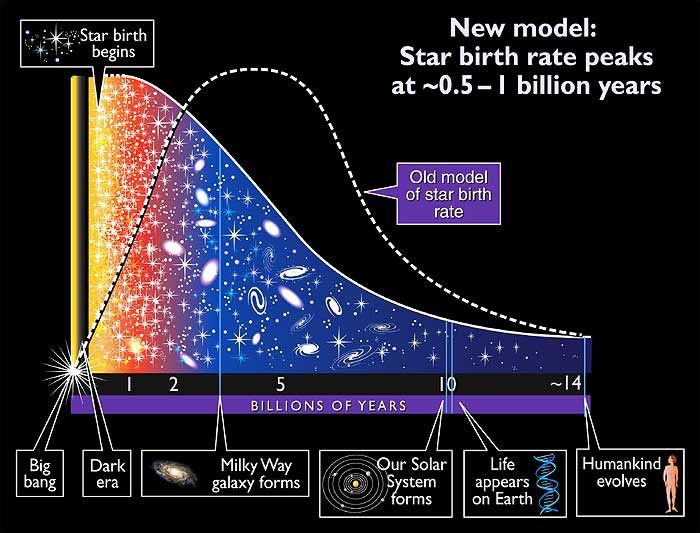
This trend is one of the cleanest ways to end the first reading. It tells us that galaxies evolve, and they evolve together with the universe around them. Early galaxies had more gas available for rapid star formation. Over time, gas was consumed, heated, expelled, locked into long-lived stars, or rearranged by environment. The cosmic star-formation history is the population-level version of the baryon cycle.
Quick check
If the cosmic star-formation rate was higher in the past than it is today, what does that suggest about the average gas supply and galaxy conditions at earlier cosmic times?
It suggests that earlier galaxies, on average, had more available cold gas or more conditions that drove gas into star-forming regions. Over time, gas can be consumed, heated, expelled, or locked into long-lived stars and remnants.
This sets up the next reading. If galaxies are ecosystems, then the next question is: what organizes the ecosystem? The answer is gravity. Gravity collects gas, binds galaxies, drives mergers, shapes clusters, and reveals dark matter through motion. In the next reading, we will use dynamics to weigh what light cannot show.