Galaxies as Ecosystems
Complete lesson
Concept Throughline
By the end of this reading, you will be able to:
Concept Throughline
A galaxy is not a container of stars. A galaxy is an ecosystem. Gas falls in, cools, forms stars, gets heated, stirred, enriched, and sometimes expelled. Stars are not just inhabitants of galaxies; they reshape the future of the galaxy that made them.
This is the first reading in the final module of ASTR 201. We are zooming out from individual stars to the environments that make stars possible. The same course method still applies: observe → model → infer. We observe light at many wavelengths. We model which physical component produces that light. Then we infer what the galaxy is doing now and what it has been doing over cosmic time.
Light at many wavelengths
A galaxy’s color and structure, and above all its brightness in each waveband — 21-cm radio, infrared, optical, X-ray. Each band acts as a physical filter, isolating one component of the system.
A galaxy is a self-regulating baryon cycle
Gas falls in, cools into dense clouds, and forms stars; the stars heat, stir, and enrich the surrounding gas through feedback; some gas is driven out, some cools and returns to form the next generation. The ecosystem is this cycle of ordinary matter — not a fixed container of stars.
What the galaxy is doing, and what it has done
From the light we infer the galaxy’s present state — actively forming stars, disturbed by an interaction, or running low on fuel — and the history recorded in its baryon cycle over cosmic time.
This is the gentlest rung of a climb that runs through the whole module. Here you can still see the source: the light comes straight from the gas and stars you are modeling. In the next reading you will weigh mass that gives off no light at all. By the finale you will read a past you can never observe directly. The move never changes — measure a proxy, infer what you cannot see — but each lecture reaches further past the visible.
The Observable Is Diversity
Part 1: The Observable Is Diversity
The first thing to notice is that galaxies are not all the same. Some are blue and clumpy. Some are smooth and yellow-red. Some have grand spiral arms; others look disturbed, stretched, or shredded by interaction. Some are bright in the infrared because dust is being heated by young stars. Some have faint outer halos that are easier to miss than their spectacular centers.
That diversity is not decoration. It is evidence.
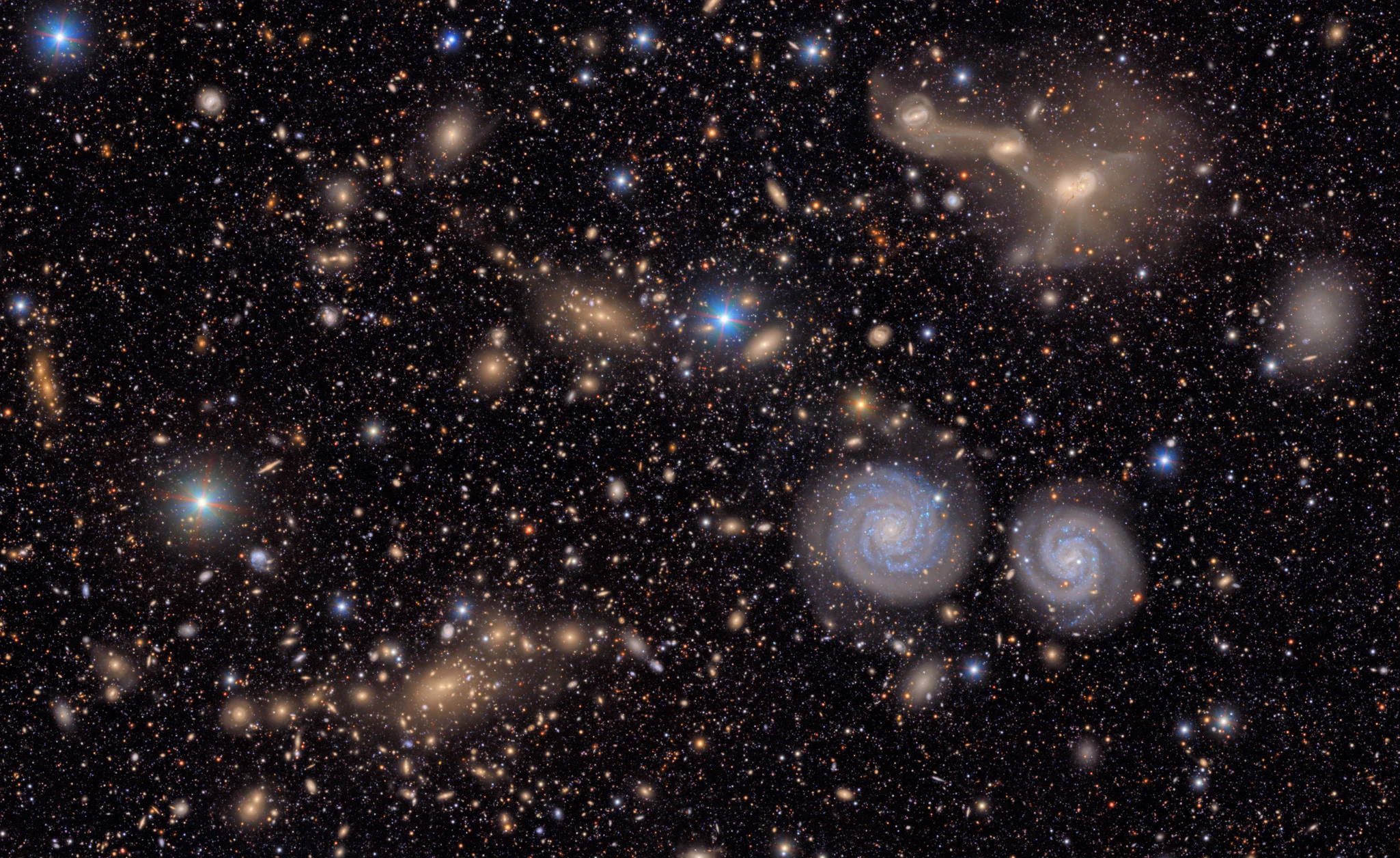
When you look at a deep field, you are seeing many galaxies at once, but not all at the same distance or the same age. Some are nearby enough that their structure is clear. Others are so far away that their light has been traveling for billions of years. In one image, astronomy gives us a mixed archive: different shapes, different colors, different distances, and different moments in cosmic history.
This is where our course throughline matters. If we stopped at observation, we would have only a catalog: spiral, elliptical, irregular, peculiar. Useful, but not enough. To turn the catalog into astrophysics, we need a model for why these differences exist.
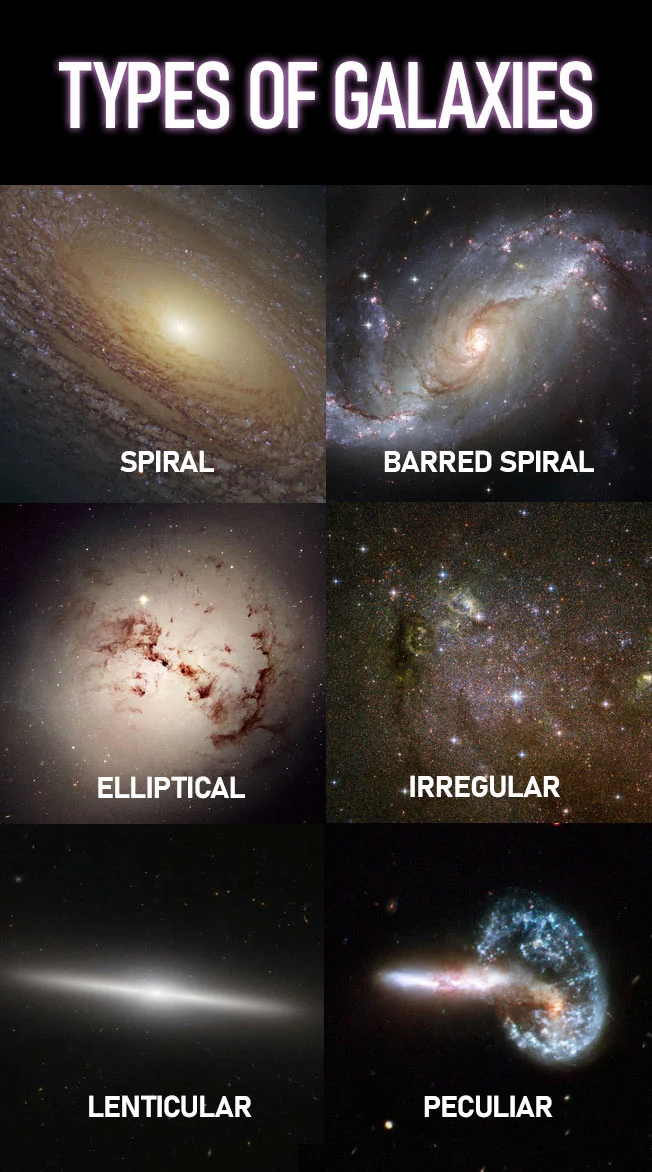
Galaxy morphology
The observed shape or structure of a galaxy, such as spiral, elliptical, irregular, or peculiar. Morphology is a classification of appearance — a starting point for inferring history, not an explanation by itself.
Quick check
Two galaxies have the same total brightness. One is smooth and yellow-red; the other is blue, patchy, and dusty. Which one is more likely to be forming stars right now, and what observable clues support that inference?
The blue, patchy, dusty galaxy is more likely to be actively forming stars. Blue light points to hot, massive, short-lived stars, which means recent star formation. Patchy structure and dust often mark gas-rich regions where stars are forming or have recently formed.
The Milky Way as a Close-Up Laboratory
Part 2: The Milky Way Is Our Close-Up Laboratory
The Milky Way is the galaxy we know best and the one we know most awkwardly. We live inside its disk, which means we cannot simply step outside and take a clean photograph of the whole structure. Instead, we infer the Milky Way’s anatomy from star counts, gas maps, dust extinction, stellar motions, and multiwavelength observations.
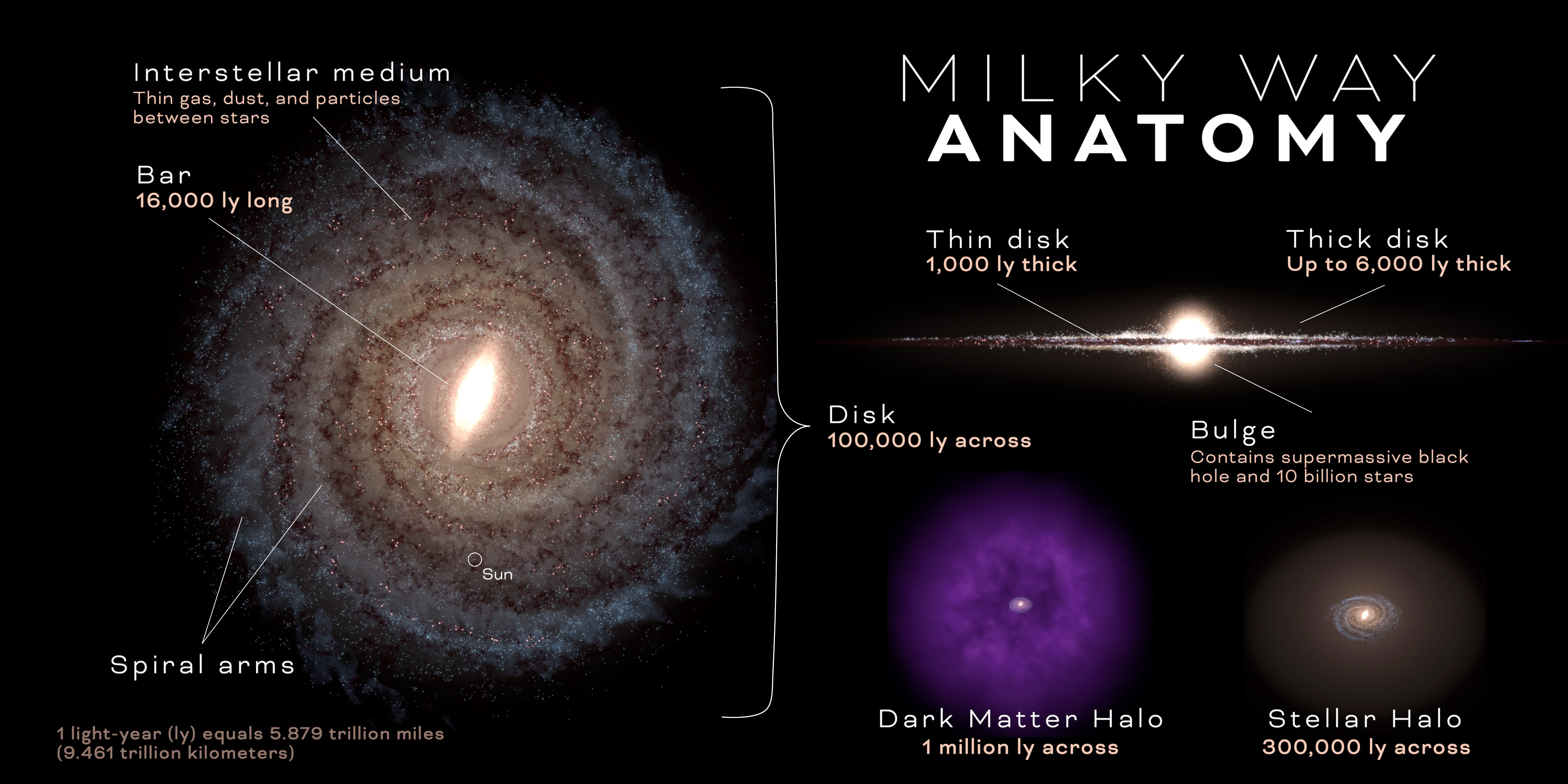
This figure is useful, but it can also mislead if we read it as a static object. A labeled galaxy diagram can make the Milky Way look like a machine with fixed parts: disk, bulge, bar, spiral arms, halo. A better reading is that these are components of an evolving system. The disk contains gas and young stars. The bulge and halo contain older stellar populations. The spiral arms are not rigid material arms like the blades of a fan; they are patterns where gas and stars respond to gravity. The
Dark matter
Matter that does not emit, absorb, or scatter light but contributes most of a galaxy’s gravitating mass. We do not see it directly; we infer it from its gravitational effect on visible matter and motions — the central thread of the next reading, which is its canonical home.
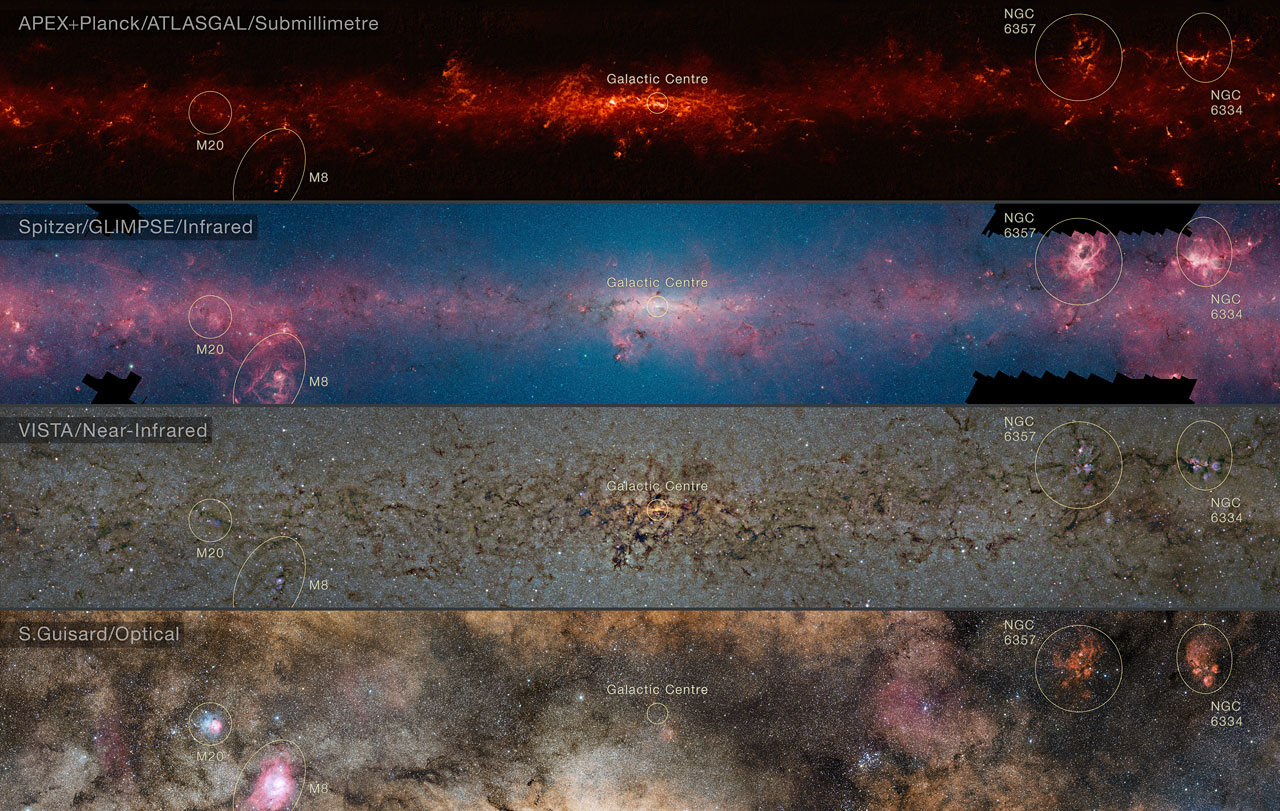
We should also be honest about the challenge: the Milky Way is partly hidden from us by its own dust. Optical light cannot pass cleanly through the Galactic plane. That means visible-light maps alone are incomplete. To map a galaxy from the inside, we need wavelengths that reveal components optical light misses.
Quick check
Why is the Milky Way both our best-studied galaxy and one of the hardest galaxies to map cleanly?
It is best-studied because we can measure individual stars, gas clouds, and motions from inside it. It is hard to map because we are embedded in its dusty disk, so optical light gives an incomplete view of the full structure.
Multiwavelength Ingredients
Part 3: Different Wavelengths Reveal Different Ingredients
In Module 1, we learned that light is information. Here that idea becomes practical. A galaxy looks different at different wavelengths because different physical components emit, absorb, or scatter different kinds of light.
Radio observations are especially powerful for mapping cold
Neutral hydrogen
Hydrogen atoms that are not ionized. Neutral hydrogen can be mapped using the 21-cm radio line, which passes through dust that blocks visible light — making it one of the most powerful tracers of cold gas in galaxies.
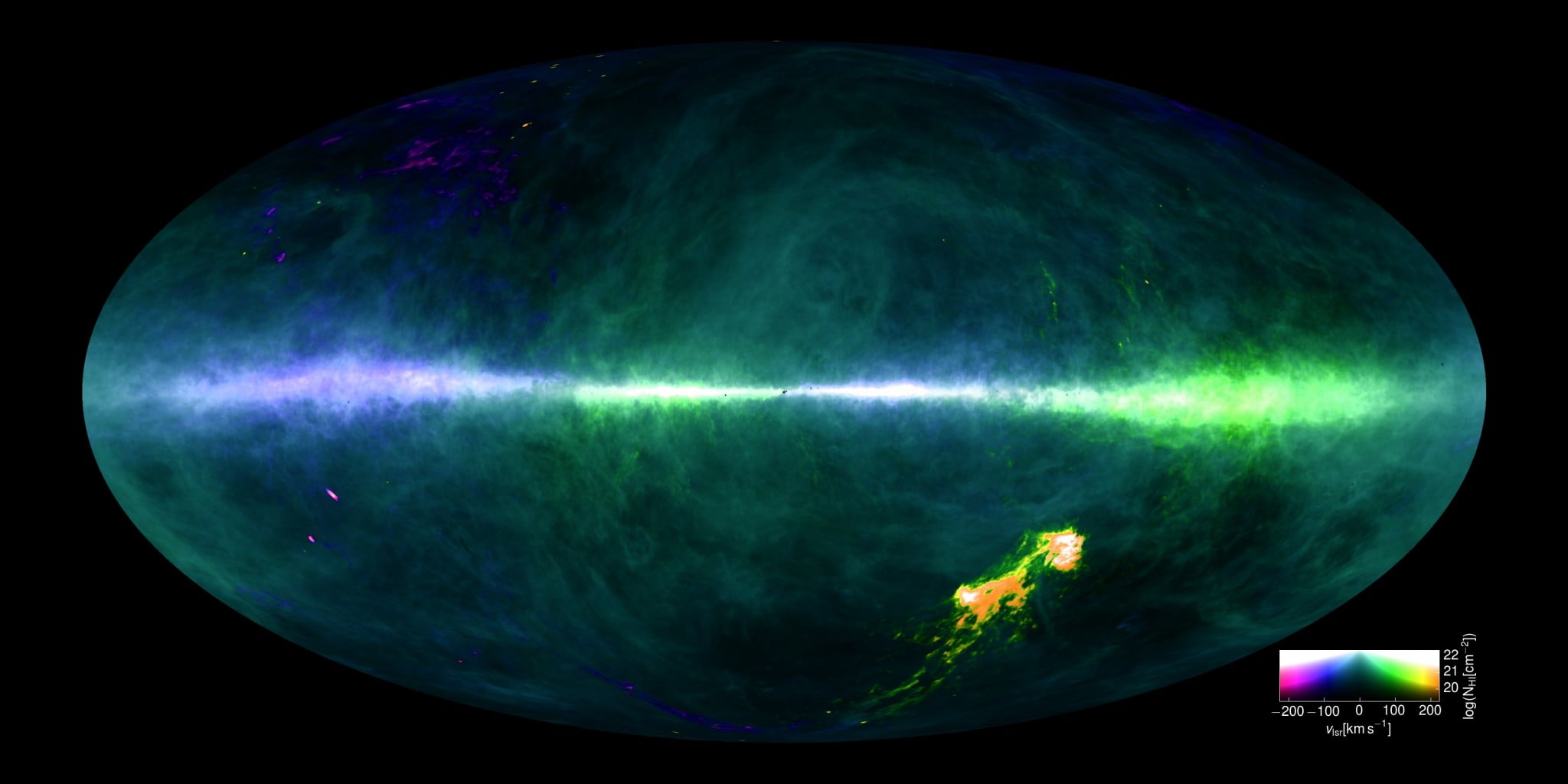
The key inference is not simply “radio sees gas.” The deeper point is that a wavelength can be a physical filter. If you choose the right wavelength, you can isolate a component of the galaxy that would otherwise be hidden. Radio gives one kind of map. Infrared gives another. X-rays give another. Each map is partial; together they become a model.
The Galactic center is the perfect example. In visible light,
Dust
Tiny solid grains in interstellar space that absorb, scatter, and re-emit light. Dust is especially important for interpreting optical and infrared observations: it hides starlight in the visible but glows in the infrared when heated.
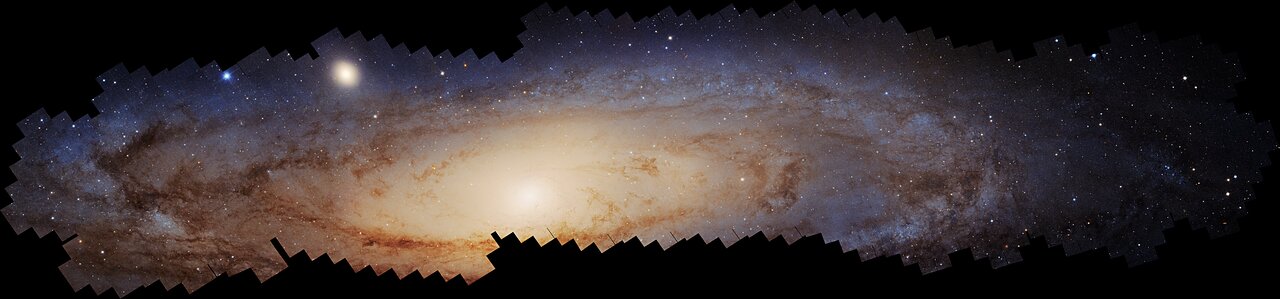
Nearby galaxies let us connect the inside-out Milky Way view to a more external perspective. Andromeda is close enough that we can study structure across its disk, but far enough that we can see the disk as a galaxy. It is a bridge between “our galaxy from the inside” and “galaxies as a population.”
Quick check
Why is a radio map of neutral hydrogen not just a lower-resolution version of an optical image?
Because it is mapping a different physical component. Optical light is mostly starlight plus emission or absorption from gas and dust. A 21-cm radio map traces neutral hydrogen gas directly, including gas hidden behind dust or extending beyond the bright stellar disk.
Star Formation and Support
Part 4: Star Formation Is a Local Failure of Support
Stars form when part of a gas cloud becomes dense and cold enough for gravity to win locally. That sentence is short, but it contains the central physics. Gas has pressure, turbulence, magnetic fields, and radiation acting against collapse. Gravity has to overcome those forms of support. Cooling helps because cooler gas has lower thermal pressure. Higher density helps because gravity becomes more effective when more mass is packed into a smaller region.
One compact way to express gravity’s clock is the dynamical timescale:
Here is an order-of-magnitude collapse or rearrangement time, is the gravitational constant, and is the average density of the region. The equation says that denser regions have shorter gravitational response times. It is not a promise that every dense clump will form stars, because pressure, turbulence, magnetic fields, radiation, and feedback can slow or stop collapse. It is a way to read the competition: density helps gravity act faster.
Problem
A molecular cloud has mean number density of hydrogen, so . Estimate its dynamical timescale , and compare it to the few-million-year life of a massive star. Use , , .
StepBuild the mean density in CGS
.
StepEvaluate the timescale
, so .
Dimensional check
, so has units of seconds — a time, as a timescale must.
Result
— comparable to the lifetime of a massive star. Gravitational collapse and the feedback those stars deliver act on the same clock, which is why star formation regulates itself instead of running away.
This is why star formation is not spread smoothly through a galaxy. It is concentrated in clouds, filaments, shells, and clumps. The
Interstellar medium
The gas and dust between stars inside a galaxy. Far from an empty background, it is structured into clouds, filaments, shells, and clumps — and it is the reservoir out of which new stars form.
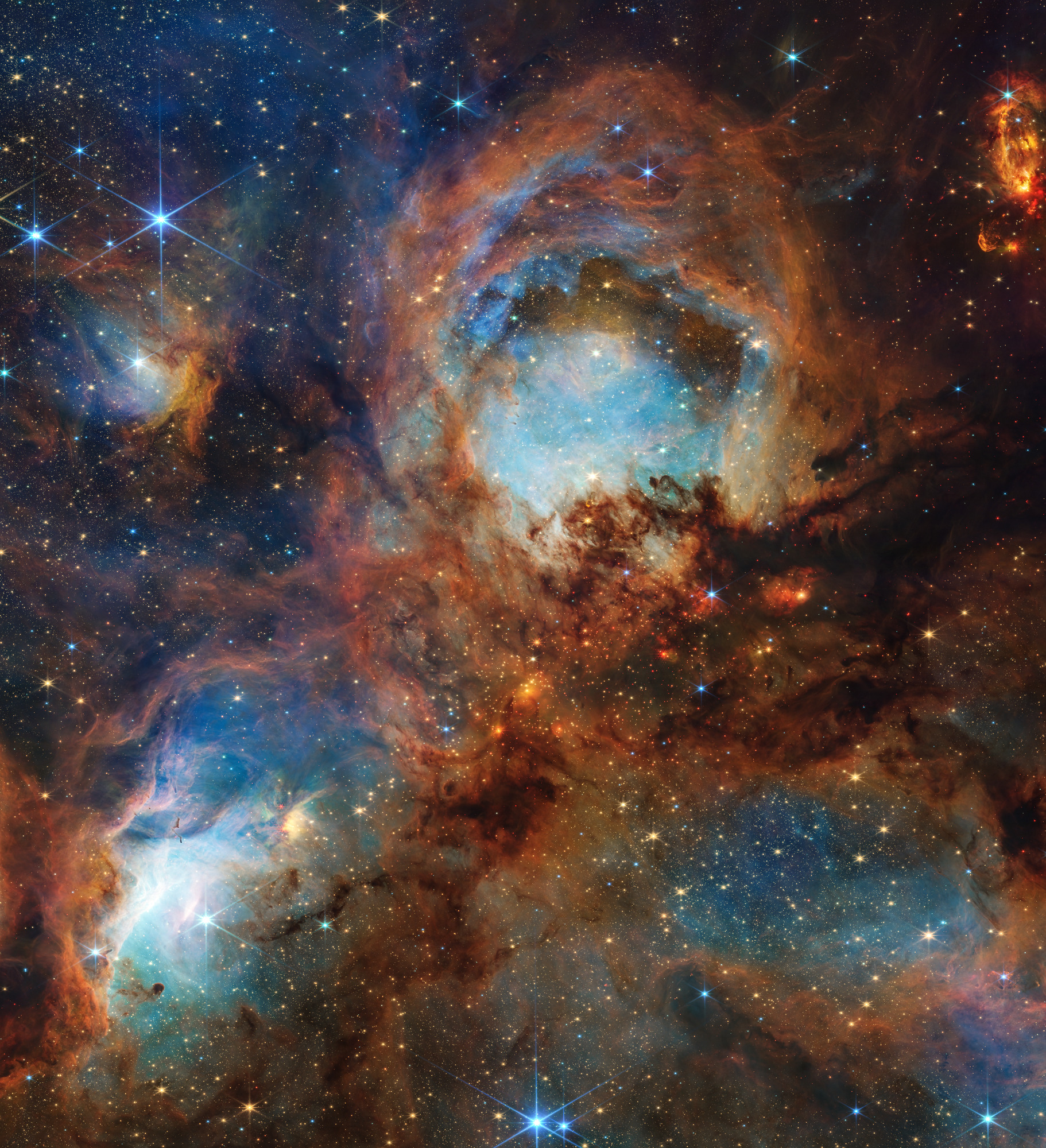
Infrared images of star-forming regions are especially revealing because young stars are often born inside dusty clouds. Visible light from those stars may be blocked or scattered, while infrared light can escape more easily. When we see embedded infrared sources, glowing dust, and sculpted cavities, we are seeing the early stages of the baryon cycle: gas collecting, collapsing, forming stars, and being reshaped by the stars it just made.
The word
Baryon
Ordinary matter made mostly of protons and neutrons — gas, stars, planets, dust, and people — as distinct from dark matter or radiation. When astronomers say “normal matter,” they mean baryons.
Cold gas
Gas with low enough thermal pressure that gravity can more easily compress it into dense star-forming regions. Cooling lowers the pressure that resists collapse, so cold gas is the raw material for star formation.
Baryon cycle
The movement of ordinary matter through gas, stars, dust, remnants, outflows, inflows, and later generations of star formation. It is the population-level bookkeeping that connects stellar evolution to galaxy evolution.
That cycle connects stellar evolution (Modules 3–4) directly to galaxy evolution. A massive star does not only live and die for itself. Its radiation, winds, and supernova drive
Metal enrichment
The process by which stars and stellar explosions add elements heavier than helium (“metals,” in astronomers’ usage) to the surrounding gas. Each generation of stars enriches the gas the next generation forms from.
Quick check
A galaxy forms a generation of massive stars. Within a few million years they explode as supernovae. Name two distinct ways this changes the gas that the next generation of stars will form from.
First, chemical: the supernovae enrich the gas with heavy elements, so the next generation forms from more metal-rich material. Second, energetic: supernova feedback injects energy and momentum — heating, stirring, compressing, or expelling gas — which changes how much cold gas is available and where it can collapse. The first generation rewrites both the composition and the supply of the raw material the next one inherits.
Multiple choice
Which change would make gravity act faster in the dynamical-timescale estimate?
Increasing the gas density. Since , a larger mean density shortens the dynamical timescale, so gravity rearranges the region faster. The choice of observing wavelength changes what we see, not how fast gravity acts.
Quick check
If a cloud is bright in infrared but partly hidden in visible light, what does that suggest about the material around young stars?
It suggests that young stars are embedded in dusty gas. Dust blocks or scatters much of the visible light, while infrared light can escape more easily and can also trace warm dust heated by young stars.
Interactions Rearrange the Fuel
Part 5: Interactions Rearrange the Fuel
Galaxies are not isolated islands. They tug on one another through gravity. When galaxies pass near each other or merge, their stars mostly pass by without colliding because stars are tiny compared with the spaces between them. Gas behaves differently. Gas can shock, compress, cool, and flow. That makes interactions especially important for star formation.
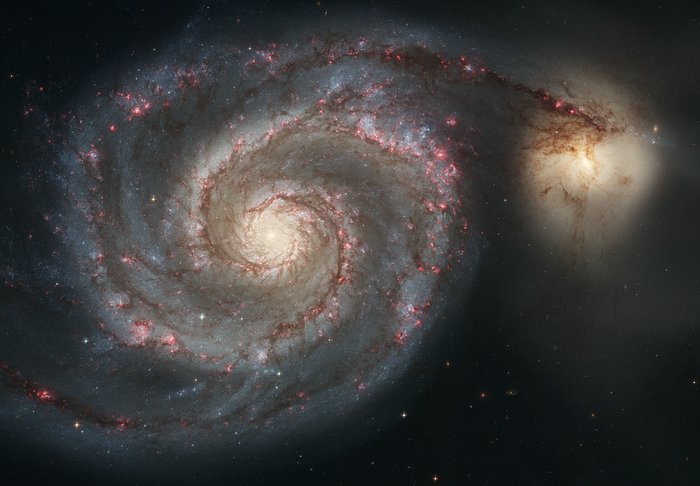
The Whirlpool Galaxy shows this idea in a form you can see. Its spiral pattern is not just a pretty shape. The companion galaxy is part of the gravitational story.
Tidal interaction
Gravitational distortion caused by a close passage or merger between galaxies. Tides stretch and pull material into streams and tails, reshape disks, and compress gas — rearranging where future star formation can happen.
The Antennae galaxies show a more dramatic case. Two galaxies in the middle of a merger contain enormous reservoirs of gas and dust. Where gas is compressed, star formation can surge. This is why mergers can produce
Starburst
A short-lived episode in which a galaxy forms stars much faster than its long-term average rate, often triggered when an interaction or merger compresses large reservoirs of gas.
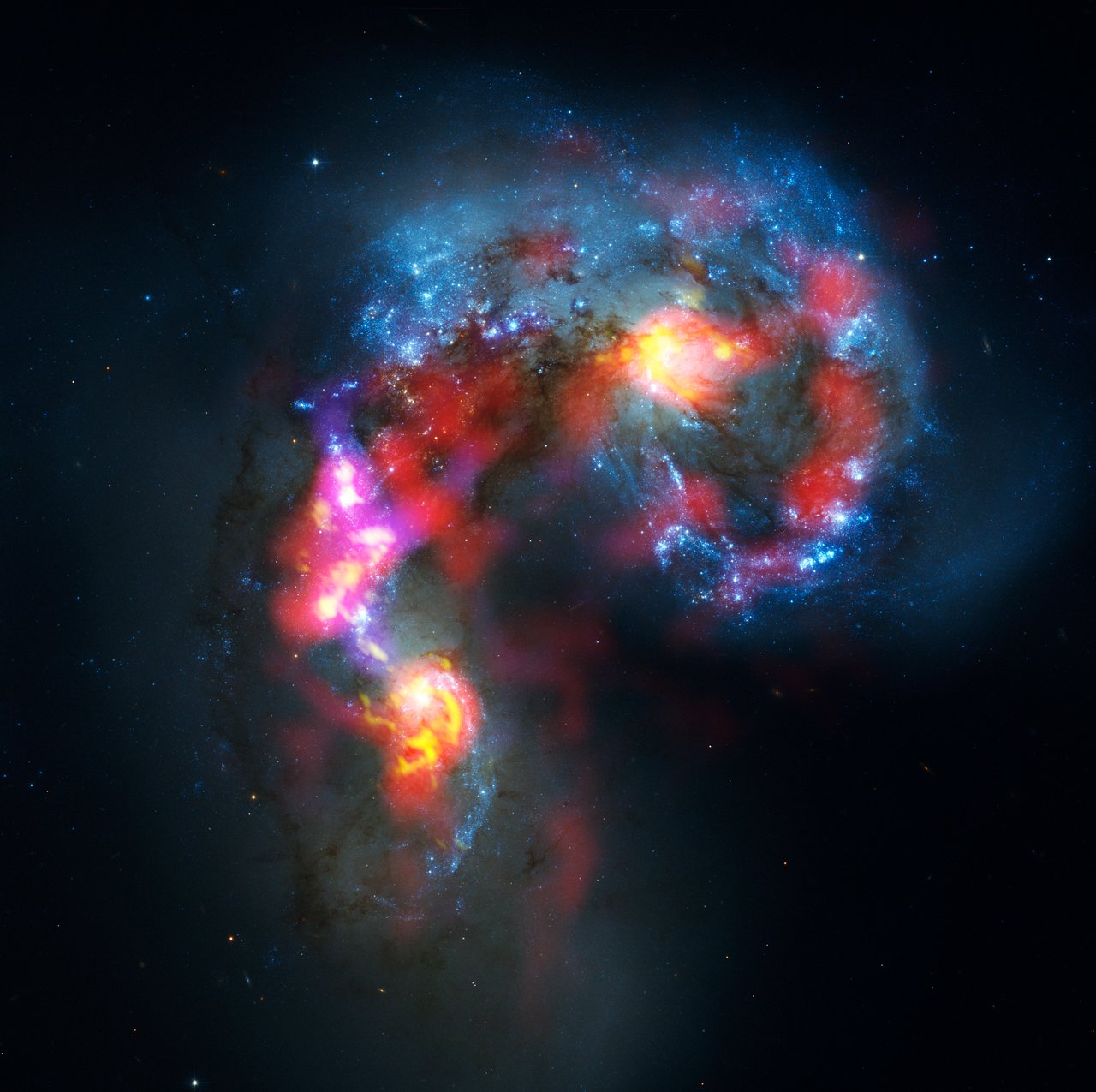
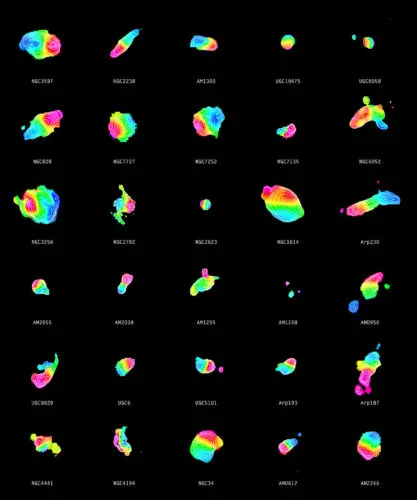
Multiwavelength observations matter here because stars and gas do not always occupy the same places. A visible-light image emphasizes stars and dust lanes. Millimeter and radio observations can trace molecular gas — the dense cold material out of which stars form. If we want to know where future stars may form, we need to find the fuel, not just the stars that already exist.
Quick check
Why can a galaxy interaction trigger star formation even though individual stars almost never collide?
Because the gas is extended and collisional in a way stars are not. During an interaction, gravity can compress gas, drive gas flows, and create shocks. Dense compressed gas is more likely to cool and collapse into stars.
Feedback and Self-Regulation
Part 6: Feedback Makes the Ecosystem Self-Regulating
Star formation does not simply continue forever once it begins. Young massive stars produce ultraviolet radiation, powerful winds, and supernova explosions. These processes inject energy and momentum into surrounding gas. Sometimes that
Feedback
Energy and momentum returned to surrounding gas by stars, supernovae, stellar winds, radiation, or accreting black holes. Feedback can both trigger star formation (by compressing gas) and suppress it (by heating or expelling gas) — which is what makes a galaxy self-regulating.
M82 is a vivid example of feedback on galaxy scales. Its central starburst drives material out of the disk in a wind. That outflow carries gas, dust, and heavy elements away from the regions where they formed.
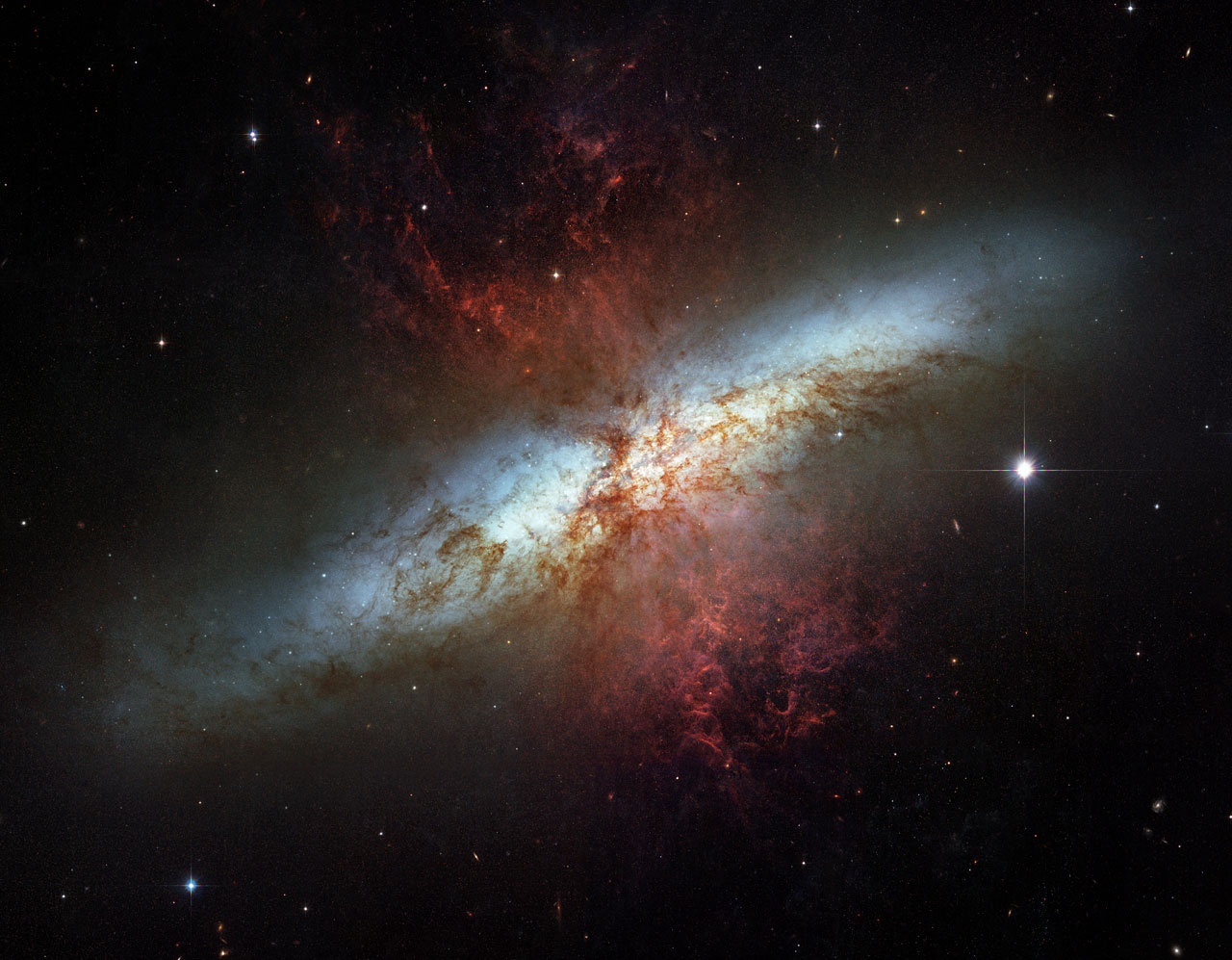
This is the moment where the ecosystem metaphor earns its keep. A forest is not just trees. It includes soil, water, climate, fire, decay, and regrowth. A galaxy is not just stars. It includes gas reservoirs, dust, radiation fields, gravity, shocks, outflows, accretion, and recycling. Feedback is one of the processes that keeps the system from being a one-way collapse of gas into stars.
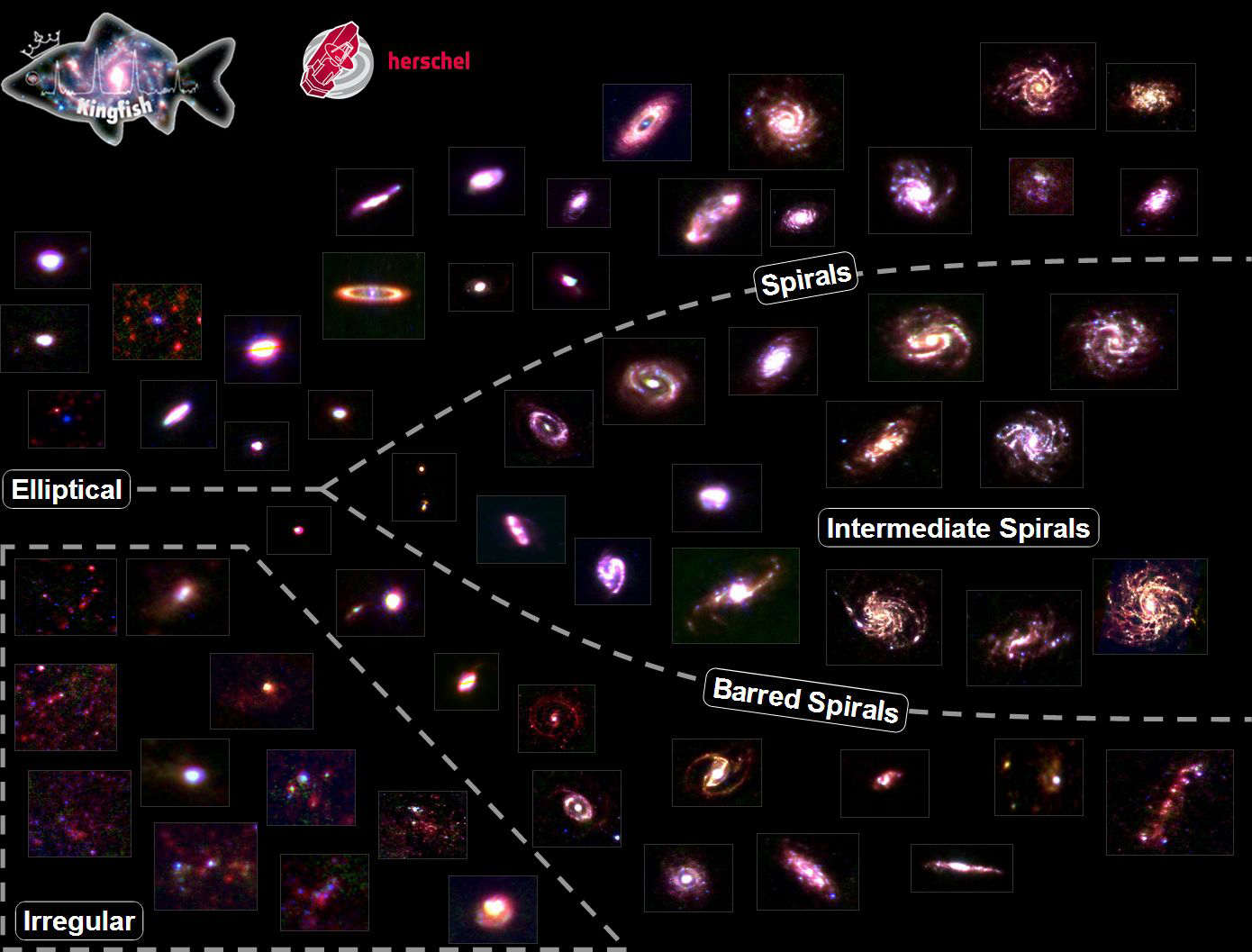
The classification schemes we use for galaxies are therefore only the first layer of explanation. A tuning fork diagram can help us describe what we see, but a galaxy’s physical story requires us to ask about gas supply, stellar populations, environment, and history.
Quick check
Why is feedback not simply “stars stopping star formation”?
Feedback can suppress star formation by heating or expelling gas, but it can also compress nearby gas and help trigger collapse. The effect depends on the local environment, timing, and how much gas is available.
The Star-Formation History of the Universe
Part 7: The Universe Has a Star-Formation History
If we zoom out from individual galaxies to the whole observable universe, we find that star formation itself has a history. The universe did not form stars at a constant rate. The global star-formation rate rose, peaked billions of years ago, and then declined toward the present.
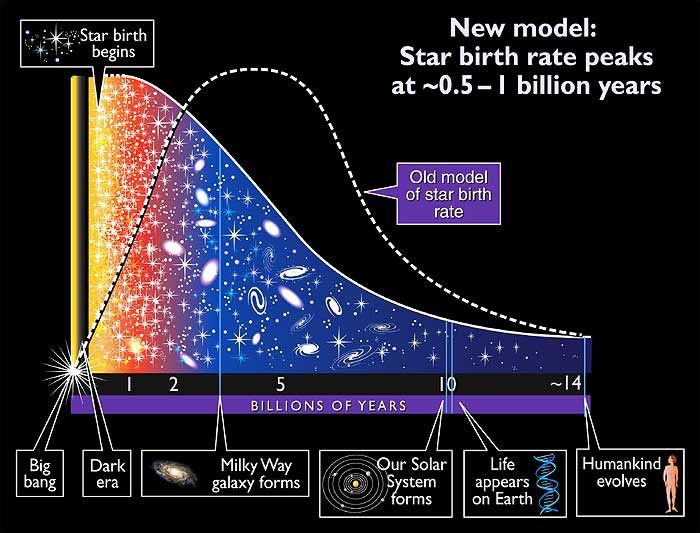
This trend is one of the cleanest ways to end the first reading. It tells us that galaxies evolve, and they evolve together with the universe around them. Early galaxies had more gas available for rapid star formation. Over time, gas was consumed, heated, expelled, locked into long-lived stars, or rearranged by environment. The cosmic star-formation history is the population-level version of the baryon cycle.
Quick check
If the cosmic star-formation rate was higher in the past than it is today, what does that suggest about the average gas supply and galaxy conditions at earlier cosmic times?
It suggests that earlier galaxies, on average, had more available cold gas or more conditions that drove gas into star-forming regions. Over time, gas can be consumed, heated, expelled, or locked into long-lived stars and remnants.
This sets up the next reading. If galaxies are ecosystems, then the next question is: what organizes the ecosystem? The answer is gravity. Gravity collects gas, binds galaxies, drives mergers, shapes clusters, and reveals dark matter through motion. In the next reading, we will use dynamics to weigh what light cannot show.
Summary
Summary
Galaxies are evolving systems, not static collections of stars. We observe them through many wavelength windows because each window reveals a different ingredient: stars, dust, neutral gas, molecular gas, hot plasma, and energetic feedback. By modeling how gas cools, collapses, forms stars, and is reshaped by stellar feedback, we can infer galaxy histories from present-day observations. The same stars we studied in Modules 3–4 now become agents of galaxy evolution.
A galaxy is blue, patchy, and dusty, with a disturbed companion nearby. In one sentence each, give the observable, the model, and the inference — and explain why the dynamical timescale says a denser gas cloud responds to gravity faster.
Observable: blue light, patchy/dusty structure, and a tidal companion. Model: galaxies are gas-stars-dust-gravity systems, and interactions compress gas. Inference: recent or ongoing star formation, likely triggered by the interaction. The dynamical timescale shrinks as mean density rises, so denser gas rearranges under gravity faster — which is why compressed gas is more prone to collapse.
Glossary
- Baryon
Ordinary matter made mostly of protons and neutrons — gas, stars, planets, dust, and people — as distinct from dark matter or radiation. When astronomers say “normal matter,” they mean baryons.
- Baryon cycle
The movement of ordinary matter through gas, stars, dust, remnants, outflows, inflows, and later generations of star formation. It is the population-level bookkeeping that connects stellar evolution to galaxy evolution.
- Cold gas
Gas with low enough thermal pressure that gravity can more easily compress it into dense star-forming regions. Cooling lowers the pressure that resists collapse, so cold gas is the raw material for star formation.
- Dark matter
Matter that does not emit, absorb, or scatter light but contributes most of a galaxy’s gravitating mass. We do not see it directly; we infer it from its gravitational effect on visible matter and motions — the central thread of the next reading, which is its canonical home.
- Dust
Tiny solid grains in interstellar space that absorb, scatter, and re-emit light. Dust is especially important for interpreting optical and infrared observations: it hides starlight in the visible but glows in the infrared when heated.
- Feedback
Energy and momentum returned to surrounding gas by stars, supernovae, stellar winds, radiation, or accreting black holes. Feedback can both trigger star formation (by compressing gas) and suppress it (by heating or expelling gas) — which is what makes a galaxy self-regulating.
- Galaxy morphology
The observed shape or structure of a galaxy, such as spiral, elliptical, irregular, or peculiar. Morphology is a classification of appearance — a starting point for inferring history, not an explanation by itself.
- Interstellar medium
The gas and dust between stars inside a galaxy. Far from an empty background, it is structured into clouds, filaments, shells, and clumps — and it is the reservoir out of which new stars form.
- Metal enrichment
The process by which stars and stellar explosions add elements heavier than helium (“metals,” in astronomers’ usage) to the surrounding gas. Each generation of stars enriches the gas the next generation forms from.
- Neutral hydrogen
Hydrogen atoms that are not ionized. Neutral hydrogen can be mapped using the 21-cm radio line, which passes through dust that blocks visible light — making it one of the most powerful tracers of cold gas in galaxies.
- Starburst
A short-lived episode in which a galaxy forms stars much faster than its long-term average rate, often triggered when an interaction or merger compresses large reservoirs of gas.
- Tidal interaction
Gravitational distortion caused by a close passage or merger between galaxies. Tides stretch and pull material into streams and tails, reshape disks, and compress gas — rearranging where future star formation can happen.