Lecture 1: The Clock Is Ticking — Stellar Ages and Lifetimes
How long do stars live, and how do we know?
Learning Objectives
After completing this reading, you should be able to:
- Identify the three fundamental stellar timescales (dynamical, thermal, nuclear) and explain what physical process each describes
- Estimate the dynamical timescale \(\tau_\text{dyn} \sim 1/\sqrt{G\bar{\rho}}\) from a star’s mean density
- Calculate the Kelvin-Helmholtz timescale \(\tau_\text{KH} \sim GM^2/(RL)\) and explain why it fails as the Sun’s age
- Derive the nuclear timescale \(\tau_\text{nuc} \sim \varepsilon f_M Mc^2/L\) and explain why massive stars live shorter lives
- Describe the historical Kelvin-Helmholtz controversy and how nuclear physics resolved it
- Use scaling relations to compare lifetimes: \(\tau_\text{nuc} \propto M^{-2.5}\)
Concept Throughline
Every star is a clock, and its mass sets the alarm. In Module 2 you measured stellar luminosities, temperatures, radii, and masses — the HR diagram became a familiar landscape. But a snapshot doesn’t tell you how long anything lasts. A star shining at \(10^4\,L_\odot\) is burning through its fuel far faster than one at \(0.1\,L_\odot\). How much faster? What fuel? How long until it runs out? These questions demand a new kind of reasoning — timescale reasoning — and the answers will launch us into the physics of stellar structure and evolution.
Track A (Core, ~25 min): Read Parts 1–5 in order — the main text, all worked examples, and Check Yourself prompts. Skip any box marked Enrichment. This gives you every concept and equation you need for homework and exams.
Track B (Full, ~35 min): Read everything, including the Enrichment box on the energy-ratio comparison. This deepens the historical argument and connects the timescale story to the size of the available energy reservoirs.
Both tracks cover all core learning objectives.
A star’s lifetime is set by two numbers: how much fuel it has and how fast it burns it. Mass determines both — more massive stars have more fuel, but their luminosities rise even faster (roughly \(L \propto M^{3.5}\)), so they burn through that fuel much more quickly. The result is a steep inverse relationship: \(\tau_\text{nuc} \propto M^{-2.5}\). A \(10\,M_\odot\) star lives only \(\sim 30~\text{Myr}\) — about \(1/300\) of the Sun’s nuclear lifetime. This single scaling relation explains why O and B stars are rare, why star-forming regions glow blue, and why the Galaxy’s oldest stars are all low-mass. Understanding why requires understanding what powers stars — and that is the story of Module 3.
Part 1: What We Know — and What We Don’t
The HR Diagram Is a Snapshot
In Module 2, you built the Hertzsprung-Russell diagram piece by piece — measuring distances, luminosities, temperatures, and masses for hundreds of stars. The result is a map of the stellar population: most stars sit on the main sequence, with a scattering of giants above and white dwarfs below.
But the HR diagram is a snapshot — a single frame from a movie you haven’t seen. It shows where stars are, not how they got there or where they’re going. When you look at a star cluster, you see stars of different masses all born at the same time. The massive ones are already gone from the main sequence (they’ve evolved into giants or exploded), while the low-mass ones are still happily burning hydrogen. That difference in lifetime is the first clue that mass controls a star’s fate.
That cluster pattern is also our first age indicator. If the most massive star still on the main sequence is only about \(2\,M_\odot\), the cluster must be old enough for \(10\,M_\odot\) stars to have already died. If a bright blue \(10\,M_\odot\) star is still on the main sequence, the cluster must be young. The observational clue is the main-sequence turnoff; the job of this reading is to build the physics that turns that clue into an age.
This is the central inference of the reading: observe a turnoff mass, map that mass to a nuclear lifetime, and infer the cluster age.
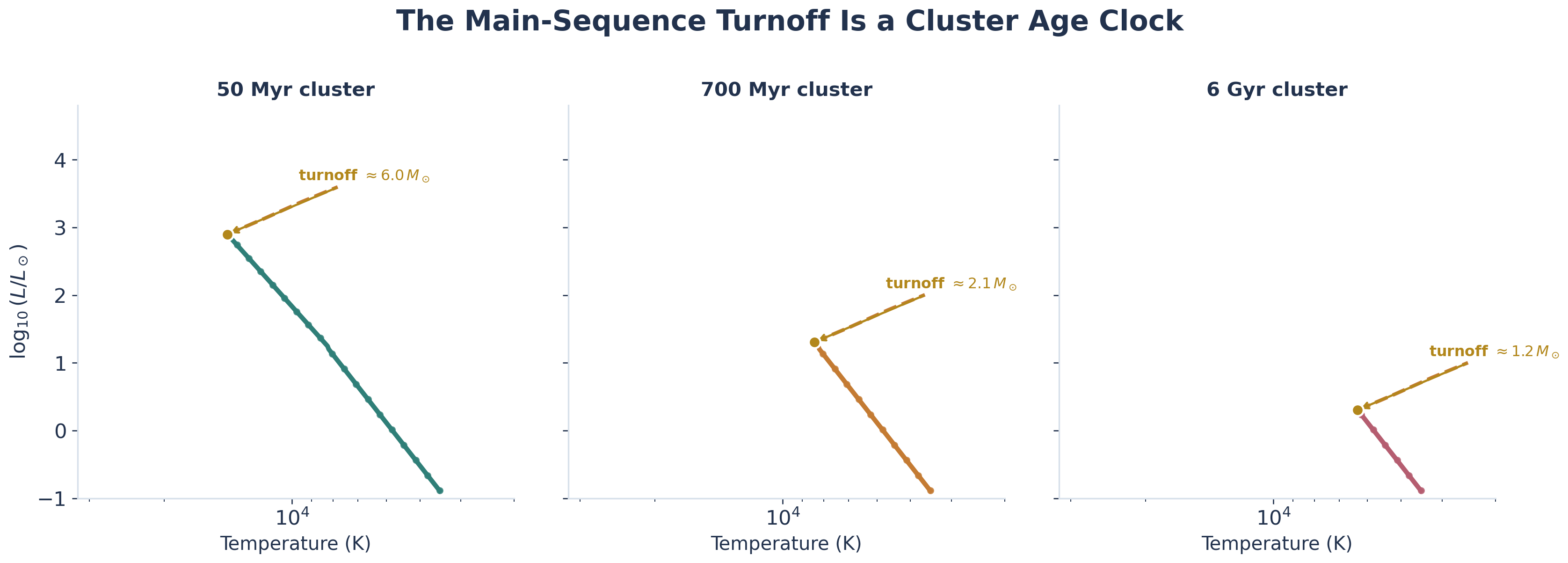
What to notice: coeval clusters lose their hottest, most massive main-sequence stars first. The turnoff mass moves downward with age, which is why the turnoff acts like a clock. (Credit: ASTR 201 (generated))
The Module 3 Question
In Module 2, you asked: What can we measure about a star from its light? Now we ask the deeper question:
Why does a star with mass \(M\) have that particular luminosity, temperature, and radius — and how long can it last?
This starts from an observational clue, but answering it requires physics. We need to understand what holds a star up against gravity, what generates its energy, and what happens when the energy source runs out. Before we can get to any of that, we need to establish the timescales — because the first thing a physicist asks about any system is: how long does each process take?
You already know the mass-luminosity relation: \(L \propto M^{3.5}\) for main-sequence stars. If a star’s total fuel supply is proportional to its mass, but its burn rate is proportional to \(M^{3.5}\), how should the lifetime scale with mass?
Lifetime \(\propto\) fuel / burn rate \(\propto M / M^{3.5} = M^{-2.5}\). More massive stars live much shorter lives. A factor of 10 in mass means a factor of \(10^{2.5} \approx 300\) shorter lifetime.
Part 2: Three Timescales That Govern a Star
Stars are governed by three fundamental timescales, each associated with a different physical process. Their hierarchy — which is shortest, which is longest — tells you what a star is doing at any given moment.
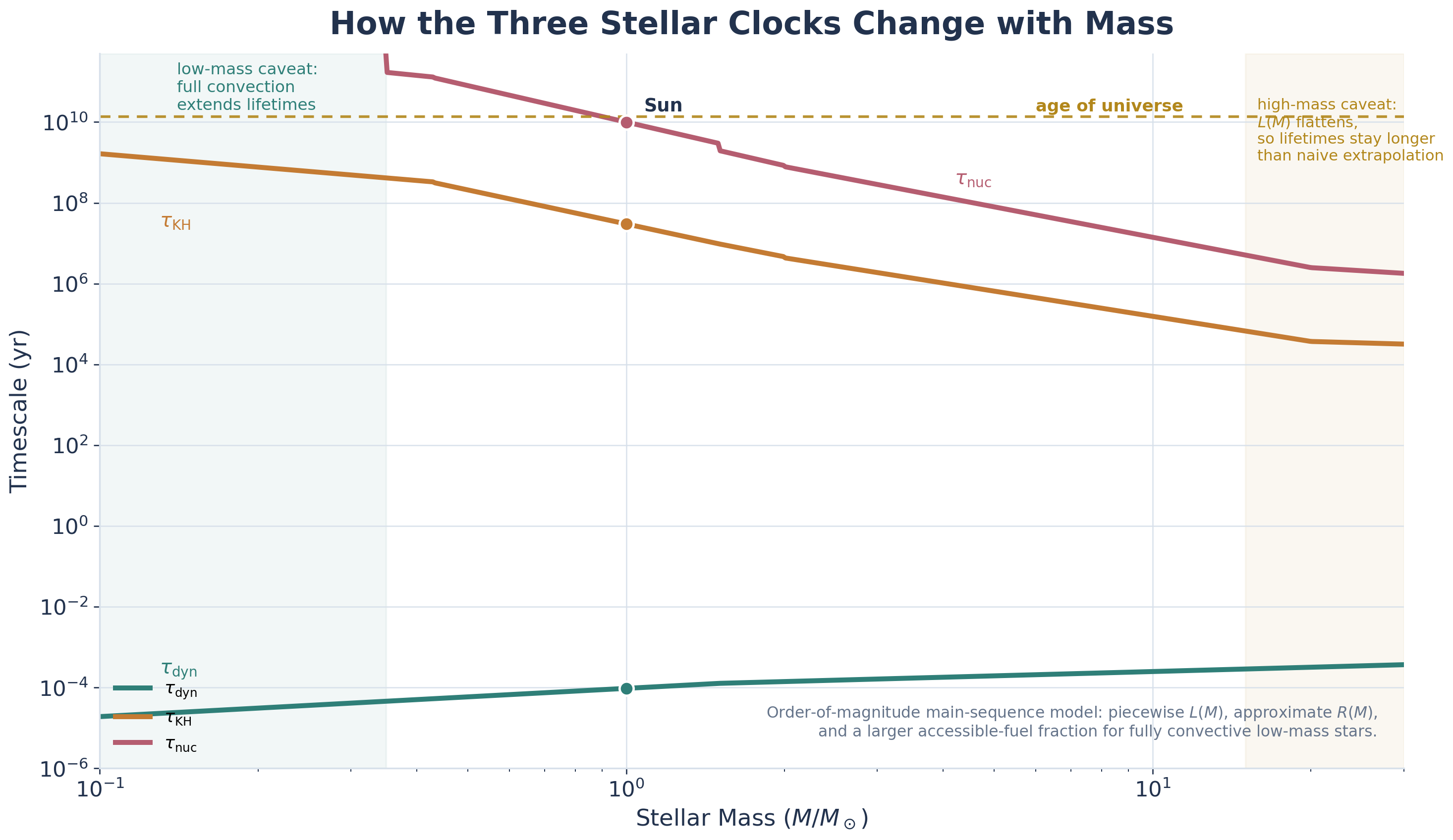
What to notice: the hierarchy $ {} {} _{} $ survives across the main sequence. Massive stars still adjust quickly, but their thermal and nuclear clocks shrink drastically. Low-mass and high-mass caveat bands remind us where simple scaling laws bend. (Credit: ASTR 201 (generated))
A useful pattern in astrophysics is
\[ \tau \sim \frac{\text{something stored}}{\text{something spent per second}}. \]
For the Kelvin-Helmholtz timescale, the “something stored” is the star’s gravitational/thermal energy reservoir and the “something spent per second” is the luminosity. For the nuclear timescale, the stored quantity is usable fusion energy and the spending rate is again the luminosity.
The dynamical timescale is the odd one out. It is not “energy divided by luminosity.” Instead, it is set by how quickly gravity can rearrange matter, so it depends on the star’s mean density.
| Timescale | Question it answers |
|---|---|
| $ _{} $ | How fast would gravity rearrange the star if pressure support failed? |
| $ _{} $ | How long could the star shine if gravity were its only long-term energy source? |
| $ _{} $ | How long can nuclear fusion sustain the star’s luminosity? |
This is the core logic of the reading: three different physical processes, three different clocks.
The Dynamical Timescale: How Fast Could a Star Collapse?
Imagine you could suddenly “turn off” all the internal pressure holding a star up. How long would it take the star to collapse under its own gravity?
This is the dynamical timescale \(\tau_\text{dyn}\) — the characteristic time for gravity to rearrange the star’s matter. Dimensionally, the only timescale you can build from Newton’s gravitational constant \(G\) and the mean density \(\bar{\rho}\) is
\[ \tau_\text{dyn} \sim \frac{1}{\sqrt{G\bar{\rho}}} \tag{1}\]
What it predicts
Given mean density \(\bar{\rho}\), it predicts the timescale for gravitational rearrangement.
What it depends on
Scales as \(\tau_\text{dyn} \propto \bar{\rho}^{-1/2}\). Denser objects respond faster.
What it’s saying
If pressure support were removed, gravity would rearrange or collapse a self-gravitating object in roughly this time. The Sun’s dynamical time is ~50 minutes.
Assumptions
- Uniform density approximation (order-of-magnitude estimate)
- Free-fall timescale — actual collapse is modified by pressure response
See: the equation
Here \(G = 6.674 \times 10^{-8}~\text{cm}^3~\text{g}^{-1}~\text{s}^{-2}\) is Newton’s gravitational constant and \(\bar{\rho}\) is the star’s mean density. The equation is not predicting what a healthy star is doing right now. It is predicting how fast gravity would win if pressure support suddenly failed.
More exact free-fall calculations introduce numerical factors of order unity; here we care about the scaling and physical meaning.
Worked Example: The Sun’s Dynamical Timescale
The Sun’s mean density is \[ \bar{\rho}_\odot \approx 1.4\,\mathrm{g\,cm^{-3}}, \] about 1.4 times the density of water. Using \[ \tau_{\rm dyn} \sim \frac{1}{\sqrt{G\bar{\rho}}}, \] we get \[ \tau_{\rm dyn,\odot} \sim \frac{1}{\sqrt{(6.674\times10^{-8}\,\mathrm{cm^3\,g^{-1}\,s^{-2}})(1.4\,\mathrm{g\,cm^{-3}})}}. \]
First multiply inside the square root: \[ G\bar{\rho}_\odot \approx 9.3\times10^{-8}\,\mathrm{s^{-2}}. \]
Now take the square root: \[ \sqrt{G\bar{\rho}_\odot} \approx 3.1\times10^{-4}\,\mathrm{s^{-1}}. \]
So \[ \tau_{\rm dyn,\odot} \sim \frac{1}{3.1\times10^{-4}\,\mathrm{s^{-1}}} \approx 3.2\times10^3\,\mathrm{s} \approx 50\,\mathrm{min}. \]
Thus, \[ \tau_{\rm dyn,\odot} \approx 50\,\mathrm{min}. \]
Sanity check: if pressure support were suddenly removed, the Sun would collapse on a timescale of about an hour. Since the Sun is clearly not collapsing, something must be holding it up. That something is pressure — and understanding that balance is the subject of the next reading.
Units check: \[ [G\bar{\rho}] = \left[\mathrm{cm^3\,g^{-1}\,s^{-2}}\right] \left[\mathrm{g\,cm^{-3}}\right] = \mathrm{s^{-2}}. \] Taking the inverse square root gives seconds. ✓
A white dwarf has roughly the mass of the Sun (\(M \approx M_\odot\)) but the radius of the Earth (\(R \approx R_\oplus \approx 6{,}400~\text{km} \approx 0.009\,R_\odot\)). Estimate its mean density and dynamical timescale. How does it compare to the Sun’s?
Mean density scales as \[ \bar{\rho} \propto \frac{M}{R^3}. \]
With \(M \approx M_\odot\) and \(R \approx 0.009\,R_\odot\), \[ \frac{\bar{\rho}_{\rm WD}}{\bar{\rho}_\odot} \approx \frac{M_\odot/(0.009\,R_\odot)^3}{M_\odot/R_\odot^3} = \frac{1}{(0.009)^3} \approx 1.4\times10^6. \]
So \[ \bar{\rho}_{\rm WD} \approx (1.4\times10^6)(1.4\,\mathrm{g\,cm^{-3}}) \approx 2\times10^6\,\mathrm{g\,cm^{-3}}. \]
That is about two million times denser than water.
The dynamical timescale scales as \[ \tau_{\rm dyn} \propto \bar{\rho}^{-1/2}, \] so \[ \tau_{{\rm dyn,WD}} \approx \frac{50\,\mathrm{min}}{\sqrt{1.4\times10^6}} \approx \frac{50\,\mathrm{min}}{1200} \approx 2.5\,\mathrm{s}. \]
A white dwarf’s dynamical timescale is only a few seconds. If its pressure support failed, it would collapse almost instantly. This extreme density is a preview of the compact-object physics we will study later in Module 3.
The Thermal (Kelvin-Helmholtz) Timescale: How Long Could Gravity Alone Power a Star?
Before anyone knew about nuclear reactions, the best guess for the Sun’s energy source was gravitational contraction — the idea that the Sun shines by slowly shrinking, converting gravitational potential energy into heat and light.
A powerful way to think about this is with the same grammar we just introduced:
\[ \tau \sim \frac{\text{energy reservoir}}{\text{energy-loss rate}}. \]
For the Kelvin-Helmholtz timescale, the relevant reservoir is the star’s gravitational binding-energy reservoir. As an order-of-magnitude estimate, a self-gravitating star has
\[ |E| \sim \frac{GM^2}{R}. \]
This is a scaling statement, not an exact structural model. A more careful treatment using the virial theorem changes only the numerical prefactor, not the dependence on \(M\), \(R\), and \(L\).
If the star has no long-term nuclear energy source, then its luminosity must come from leaking away that bound energy. Luminosity is an energy-loss rate, so the sign matters:
\[ L = -\frac{dE}{dt}. \]
That minus sign is not decoration. If the star is losing energy, then \(dE/dt < 0\), while the outward luminosity \(L\) is positive.
Putting those ideas together gives the Kelvin-Helmholtz timescale:
\[ \tau_\text{KH} \sim \frac{GM^2}{RL} \tag{2}\]
What it predicts
Given \(M\), \(R\), and \(L\), it predicts how long gravitational contraction alone could power the star.
What it depends on
Scales as \(\tau_\text{KH} \propto M^2/(RL)\). More massive = more gravitational energy; more luminous = faster depletion.
What it’s saying
The time a star could shine by slowly contracting — converting gravitational potential energy to radiation. For the Sun, ~30 Myr.
Assumptions
- Only energy source is gravitational contraction
- Luminosity stays approximately constant during contraction
- Order-of-magnitude: uses \(E_\text{grav} \sim GM^2/R\)
See: the equation
Here \(G\) is Newton’s gravitational constant, \(M\) is the star’s mass, \(R\) is its radius, and \(L\) is its luminosity. The hidden assumption is important: this is the lifetime if gravitational contraction is the only long-term energy source.
You can also see the same result from a contraction-rate argument. If
\[ E \sim -\frac{GM^2}{R}, \]
then for approximately constant mass,
\[ \frac{dE}{dt} \sim \frac{GM^2}{R^2}\frac{dR}{dt}. \]
For a contracting star, \(dR/dt < 0\), so
\[ L = -\frac{dE}{dt} \sim \frac{GM^2}{R^2}\left|\frac{dR}{dt}\right|. \]
Rearranging gives
\[ \left|\frac{dR}{dt}\right| \sim \frac{LR^2}{GM^2}, \]
so the characteristic contraction time is
\[ \frac{R}{|dR/dt|} \sim \frac{GM^2}{RL} = \tau_\text{KH}. \]
That interpretation matters. The Kelvin-Helmholtz timescale is not a free-fall time. It is the time for a star to contract quasi-statically as it radiates away energy.
Worked Example: The Sun’s Kelvin-Helmholtz Timescale
\[ \tau_\text{KH} \sim \frac{GM_\odot^2}{R_\odot L_\odot} \]
Plugging in solar values (\(M_\odot = 2.0 \times 10^{33}~\text{g}\), \(R_\odot = 7.0 \times 10^{10}~\text{cm}\), \(L_\odot = 3.8 \times 10^{33}~\text{erg}/\text{s}\)):
\[ \tau_\text{KH} \sim \frac{(6.674 \times 10^{-8})(2.0 \times 10^{33})^2}{(7.0 \times 10^{10})(3.8 \times 10^{33})}~\text{s} \]
\[ \tau_\text{KH} \sim \frac{2.67 \times 10^{59}}{2.66 \times 10^{44}}~\text{s} \approx 1.0 \times 10^{15}~\text{s} \approx 30~\text{Myr} \]
Units check:
\[ \left[\frac{GM^2}{RL}\right] = \frac{\left(\text{cm}^3\,\text{g}^{-1}\,\text{s}^{-2}\right)\left(\text{g}^2\right)} {\left(\text{cm}\right)\left(\text{erg}\,\text{s}^{-1}\right)} \]
\[ = \frac{\text{g}\,\text{cm}^2\,\text{s}^{-2}}{\text{erg}\,\text{s}^{-1}} = \frac{\text{erg}}{\text{erg}\,\text{s}^{-1}} = \text{s} \]
\(\checkmark\)
\[ \boxed{\tau_{\text{KH},\odot} \approx 30~\text{Myr}} \]
Result: \(\tau_\text{KH} \approx 30~\text{Myr}\) — about 30 million years.
This was Lord Kelvin’s answer. In the 1860s, he calculated essentially this number and concluded that the Sun could not be much older than about 20–30 million years. This seemed perfectly reasonable — until the geologists objected.
If a star has the same mass and radius as the Sun but twice the luminosity, would its Kelvin-Helmholtz timescale be longer or shorter? What does that tell you about the basic logic of “available energy divided by burn rate”?
It would be shorter by a factor of 2, because \(\tau_\text{KH} \propto 1/L\) when \(M\) and \(R\) are fixed. This is the same logic we will use again for the nuclear timescale: lifetime is set not only by how much energy a star has available, but by how fast it spends that energy.
Part 3: The Great Controversy — Lord Kelvin vs. The Geologists
When Physics and Geology Collide
In the late 19th century, Lord Kelvin (William Thomson) was one of the most respected physicists alive. His calculation of the Sun’s age — based on the best physics available — gave \(\tau_\text{KH} \approx 20\text{–}30~\text{Myr}\).
But geologists had a problem. Charles Darwin’s theory of evolution required hundreds of millions of years for natural selection to produce the diversity of life on Earth. Geologists studying rock layers, erosion rates, and sedimentation had independently concluded that the Earth was at least hundreds of millions of years old — possibly billions.
Lord Kelvin’s response was blunt: the physics was clear, and if the geologists disagreed, the geologists were wrong. He even published increasingly strident papers arguing that Darwin’s theory must be flawed because there simply wasn’t enough time.
The Resolution: New Physics
Kelvin was wrong — but not because his physics was wrong. His calculation was perfectly correct given his assumptions. This is a useful warning sign in science: correct math does not guarantee a complete model. Kelvin assumed gravitational contraction was the Sun’s only energy source. He didn’t know — couldn’t know — that there was an energy source far more efficient than gravity: nuclear fusion.
The resolution came in the early 20th century, after the discovery of radioactivity (1896) and Einstein’s \(E = mc^2\) (1905). By the 1920s, Arthur Eddington proposed that stars are powered by converting mass to energy via nuclear reactions. By the late 1930s, Hans Bethe worked out the specific reaction chain (the proton-proton chain) that powers the Sun.
Nuclear fusion converts about \(0.7\%\) of the hydrogen rest-mass energy into radiation — and that \(0.7\%\) of \(Mc^2\) is enormous compared to the gravitational energy \(GM^2/R\).
How much more energy is available from core hydrogen fusion than from gravitational contraction? Compare the accessible nuclear reservoir to the gravitational reservoir: \[ \frac{E_{\rm nuc}}{E_{\rm grav}} \sim \frac{\epsilon f_M M c^2}{GM^2/R} = \frac{\epsilon f_M c^2 R}{GM}. \]
Here \(f_M M\) is the accessible fuel mass for main-sequence hydrogen burning: \(M\) is the total stellar mass, and \(f_M\) is the fraction of that mass that actually participates in core fusion. For a Sun-like star, a useful estimate is \(f_M \approx 0.10\), but this is not universal.
Now substitute solar values: \[ \frac{E_{\rm nuc}}{E_{\rm grav}} \sim \frac{(0.007)(0.10)(3.0\times10^{10}\,\mathrm{cm\,s^{-1}})^2(7.0\times10^{10}\,\mathrm{cm})} {(6.674\times10^{-8}\,\mathrm{cm^3\,g^{-1}\,s^{-2}})(2.0\times10^{33}\,\mathrm{g})}. \]
Using \[ (3.0\times10^{10}\,\mathrm{cm\,s^{-1}})^2 = 9.0\times10^{20}\,\mathrm{cm^2\,s^{-2}}, \] the numerator is \[ (0.007)(0.10)(9.0\times10^{20})(7.0\times10^{10}) \approx 4.4\times10^{28}\,\mathrm{cm^3\,s^{-2}}. \]
The denominator is \[ GM_\odot \approx (6.674\times10^{-8})(2.0\times10^{33}) \approx 1.33\times10^{26}\,\mathrm{cm^3\,s^{-2}}. \]
So \[ \frac{E_{\rm nuc}}{E_{\rm grav}} \approx \frac{4.4\times10^{28}}{1.33\times10^{26}} \approx 3.3\times10^2. \]
Units check: the ratio is dimensionless. The numerator has units \(\mathrm{cm^3\,s^{-2}}\) and the denominator has the same units, so they cancel. ✓
Result: the accessible nuclear reservoir exceeds the gravitational reservoir by a factor of about \(300\). That is why the Sun’s nuclear lifetime is hundreds of times longer than the Kelvin-Helmholtz timescale: nuclear burning extends the Sun’s lifetime from \(\sim 30\,\mathrm{Myr}\) to \(\sim 10\,\mathrm{Gyr}\).
For the Sun, \(f_M \approx 0.10\) is a useful back-of-the-envelope estimate. But \(f_M\) can vary with stellar mass and internal mixing. Massive stars often mix more of their interior into the burning region than low-mass stars, so treat \(f_M\) as an approximate main-sequence scaling parameter, not a universal constant.
This ratio, \(\epsilon f_M c^2 R/(GM)\), compares usable nuclear energy per unit mass to gravitational binding energy per unit mass inside a star; it is not a statement about the relative strengths of the forces themselves.
Lord Kelvin’s estimate of the Sun’s age (\(\sim 30~\text{Myr}\)) was too short by a factor of a few hundred compared with the Sun’s true main-sequence lifetime. What assumption was wrong, and what physical discovery resolved the discrepancy?
Kelvin assumed that gravitational contraction (converting potential energy to heat) was the Sun’s only energy source. This gives \(\tau_\text{KH} \approx 30~\text{Myr}\). The actual energy source is nuclear fusion, which converts \(\sim 0.7\%\) of the rest-mass energy of hydrogen to radiation via \(E = mc^2\). Once you account for the fact that only the core hydrogen is available as fuel, the usable nuclear reservoir still exceeds the gravitational reservoir by a factor of a few hundred, giving a nuclear timescale of \(\sim 10~\text{Gyr}\) — consistent with the geologists’ estimates and the radiometric age of the Earth (\(4.6~\text{Gyr}\)).
The lesson: when observations contradict your best physical model, the model may be missing physics — not the observations may be wrong. Kelvin’s calculation was correct given his assumptions; the assumptions were incomplete.
Part 4: The Nuclear Timescale — The True Clock
How Long Can a Star Burn Hydrogen?
Nuclear fusion converts a fraction \(\varepsilon \approx 0.007\) (about \(0.7\%\)) of the rest-mass energy of hydrogen into radiation. Not all of the star’s mass is available for fusion — only the core hydrogen participates, roughly \(\sim 10\%\) of the total mass for a Sun-like star. We label that accessible fuel fraction \(f_M\), so the actual mass available to burn is \(f_M M\). Dividing that accessible nuclear reservoir by the luminosity gives the nuclear timescale:
\[ \tau_\text{nuc} \sim \frac{\varepsilon f_M M c^2}{L} \tag{3}\]
What it predicts
Given \(M\) and \(L\), it predicts how long nuclear fusion can sustain the star’s luminosity.
What it depends on
Scales as \(\tau_\text{nuc} \propto M/L\). Using \(L \propto M^{3.5}\): \(\tau_\text{nuc} \propto M^{-2.5}\).
What it’s saying
Fuel divided by burn rate. The Sun’s nuclear lifetime is ~10 Gyr. Massive stars live much shorter lives because L grows faster than M.
Assumptions
- Hydrogen fusion with efficiency \(\varepsilon \approx 0.007\)
- Only accessible core fraction \(f_M \approx 0.10\) participates in fusion for a Sun-like star
- The accessible fuel fraction \(f_M\) is not universal; it varies with stellar mass and internal mixing
- Luminosity approximately constant during main-sequence phase
See: the equation
In this equation, \(\varepsilon \approx 0.007\) is the mass-to-energy conversion efficiency for hydrogen fusion, \(f_M \approx 0.10\) is the fraction of the star’s mass available as fuel for a Sun-like main-sequence star, \(M\) is the star’s total mass, and \(c = 3.0 \times 10^{10}~\text{cm}/\text{s}\) is the speed of light. The equation is meant for main-sequence hydrogen burning, not for every possible stellar phase, and the exact value of \(f_M\) can vary with stellar mass and internal mixing.
Worked Example: The Sun’s Nuclear Lifetime
\[ \tau_\text{nuc} \sim \frac{(0.007)(0.10)(2.0 \times 10^{33}~\text{g})(3.0 \times 10^{10}~\text{cm}/\text{s})^2}{3.8 \times 10^{33}~\text{erg}/\text{s}} \]
\[ \tau_\text{nuc} \sim \frac{(0.007)(0.10)(1.8 \times 10^{54}~\text{erg})}{3.8 \times 10^{33}~\text{erg}/\text{s}} = \frac{1.26 \times 10^{51}~\text{erg}}{3.8 \times 10^{33}~\text{erg}/\text{s}} \]
\[ \tau_\text{nuc} \approx 3.3 \times 10^{17}~\text{s} \approx 10~\text{Gyr} \]
Units check:
\[ \frac{\left[\text{g}\right]\left[\text{cm}^2\,\text{s}^{-2}\right]} {\left[\text{erg}\,\text{s}^{-1}\right]} = \frac{\left[\text{erg}\right]}{\left[\text{erg}\,\text{s}^{-1}\right]} = \left[\text{s}\right] \]
\(\checkmark\)
\[ \boxed{\tau_{\text{nuc},\odot} \approx 10~\text{Gyr}} \]
Sanity check: \(10~\text{Gyr}\) is about twice the current age of the Sun (\(4.6~\text{Gyr}\)). The Sun is roughly halfway through its hydrogen-burning lifetime. This is consistent with solar models and with the age of the Earth from radiometric dating. ✓
Why Normalize to the Sun?
Students often make lifetime problems harder than they need to be by plugging in constants from scratch every time. Usually the cleaner move is to normalize to the Sun. That means you write the equation for the star, write the same equation for the Sun, and divide. The constants cancel, and the answer comes out as a dimensionless comparison to a star you already know.
For the nuclear timescale, this looks like:
\[ \frac{\tau_\text{nuc}}{\tau_{\text{nuc},\odot}} \approx \left(\frac{\varepsilon}{\varepsilon_\odot}\right) \left(\frac{f_M}{f_{M,\odot}}\right) \left(\frac{M}{M_\odot}\right) \left(\frac{L}{L_\odot}\right)^{-1} \]
For similar hydrogen-burning stars, \(\varepsilon\) is the same and the first factor is 1. If you are doing a rough scaling comparison and the accessible fuel fraction is also similar, this simplifies to:
\[ \frac{\tau_\text{nuc}}{\tau_{\text{nuc},\odot}} \approx \left(\frac{M}{M_\odot}\right) \left(\frac{L}{L_\odot}\right)^{-1} \]
This is why normalization is so useful: the left side is dimensionless, the right side is dimensionless, and the answer is immediately interpretable. A value of \(0.2\) means “one-fifth of the Sun’s lifetime.” A value of \(5\) means “five times the Sun’s lifetime.”
Notice how closely this mirrors the Kelvin-Helmholtz logic. There, the reservoir was gravitational/thermal energy and the loss rate was luminosity. Here, the reservoir is nuclear energy and the loss rate is still luminosity. Same grammar, different reservoir.
Quick Ratio Example
Suppose a star has \(M = 2\,M_\odot\) and \(L = 10\,L_\odot\). Then
\[ \frac{\tau_\text{nuc}}{\tau_{\text{nuc},\odot}} \approx \left(\frac{2\,M_\odot}{M_\odot}\right) \left(\frac{10\,L_\odot}{L_\odot}\right)^{-1} = \frac{2}{10} = 0.2 \]
So the star’s main-sequence lifetime is about \(0.2\) times the Sun’s:
\[ \tau_\text{nuc} \approx 0.2 \times 10~\text{Gyr} \approx 2~\text{Gyr} \]
Notice the math grammar here: the scaling factor \(0.2\) is dimensionless, and the units appear at the end of the final expression.
The Scaling That Explains Everything
Now here’s where the mass-luminosity relation — the crown jewel of Module 2 — pays off. For main-sequence stars, \(L \propto M^{3.5}\). Substituting into the nuclear timescale gives:
\[ \frac{\tau_\text{nuc}}{\tau_{\text{nuc},\odot}} \approx \left(\frac{M}{M_\odot}\right)^{-2.5} \tag{4}\]
What it predicts
Given a star’s mass relative to the Sun, it predicts its main-sequence lifetime relative to the Sun’s.
What it depends on
Scales as \(\tau \propto M^{-2.5}\). Doubling the mass reduces lifetime by \(2^{2.5} \approx 5.7\times\).
What it’s saying
Massive stars burn fast and die young. A \(10\,M_\odot\) star lives only ~30 Myr; a \(0.1\,M_\odot\) star outlasts the universe.
Assumptions
- Star is on the main sequence (core hydrogen burning)
- Uses \(L \propto M^{3.5}\) (exponent varies somewhat with mass range)
See: the equation
This is one of the most important scaling relations in all of astrophysics. Let’s see what it predicts:
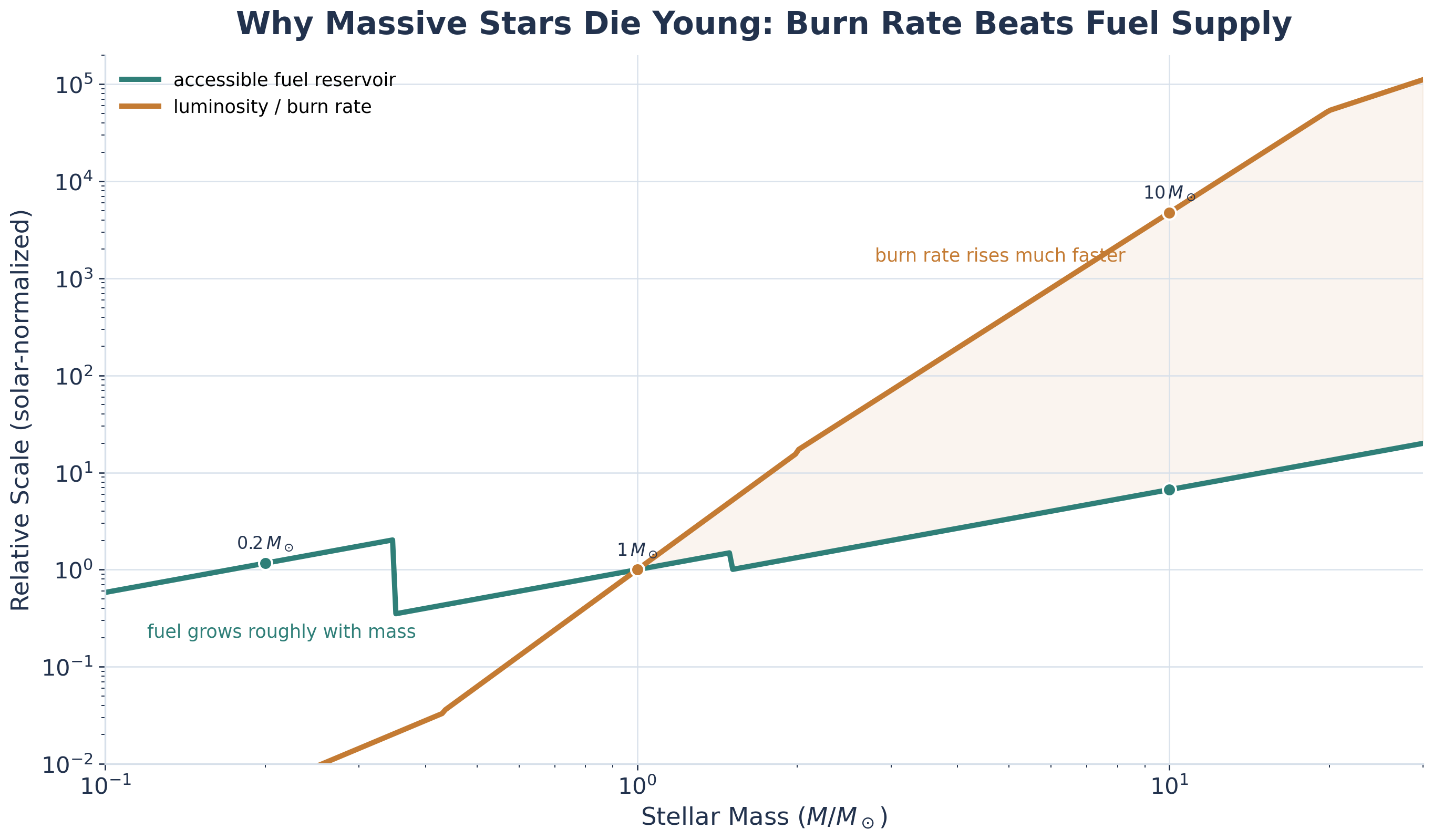
What to notice: the accessible fuel reservoir increases with stellar mass, but the luminosity increases much faster. That is the visual reason massive stars die young. (Credit: ASTR 201 (generated))
| Star Mass (\(M/M_\odot\)) | Lifetime (\(\tau_\text{nuc}\)) | Comparison |
|---|---|---|
| \(0.1\) | \(\sim 3 \times 10^{12}~\text{yr}\) | Simple scaling only; still \(\gg\) age of universe |
| \(0.5\) | \(\sim 56~\text{Gyr}\) | \(>\) age of universe — still on MS |
| \(1.0\) | \(\sim 10~\text{Gyr}\) | Sun: halfway through |
| \(2.0\) | \(\sim 1.8~\text{Gyr}\) | Short enough to see evolution in clusters |
| \(10\) | \(\sim 32~\text{Myr}\) | Geologically brief |
The pattern is dramatic. A \(10\,M_\odot\) star has 10 times the fuel but burns it \(10^{3.5} \approx 3{,}000\) times faster. Its lifetime is \(10/3{,}000 \approx 1/300\) of the Sun’s. A \(0.1\,M_\odot\) red dwarf, on the other hand, has only \(1/10\) the fuel but burns it \(10^{3.5} \approx 3{,}000\) times slower — it will outlive the current age of the universe by a factor of a thousand.
Two caveats matter here. At low mass, the luminosity scaling changes and fully convective stars can access a larger fraction of their hydrogen than the Sun can. That means the very lowest-mass stars can live even longer than the simple \(M^{-2.5}\) estimate suggests. At high mass, the mass-luminosity relation also bends away from \(L \propto M^{3.5}\), so blindly extrapolating the table to \(50\,M_\odot\) or \(100\,M_\odot\) would predict lifetimes that are too short. The scaling is still powerful because it gets the right qualitative story and the right order of magnitude across the broad middle of the main sequence.
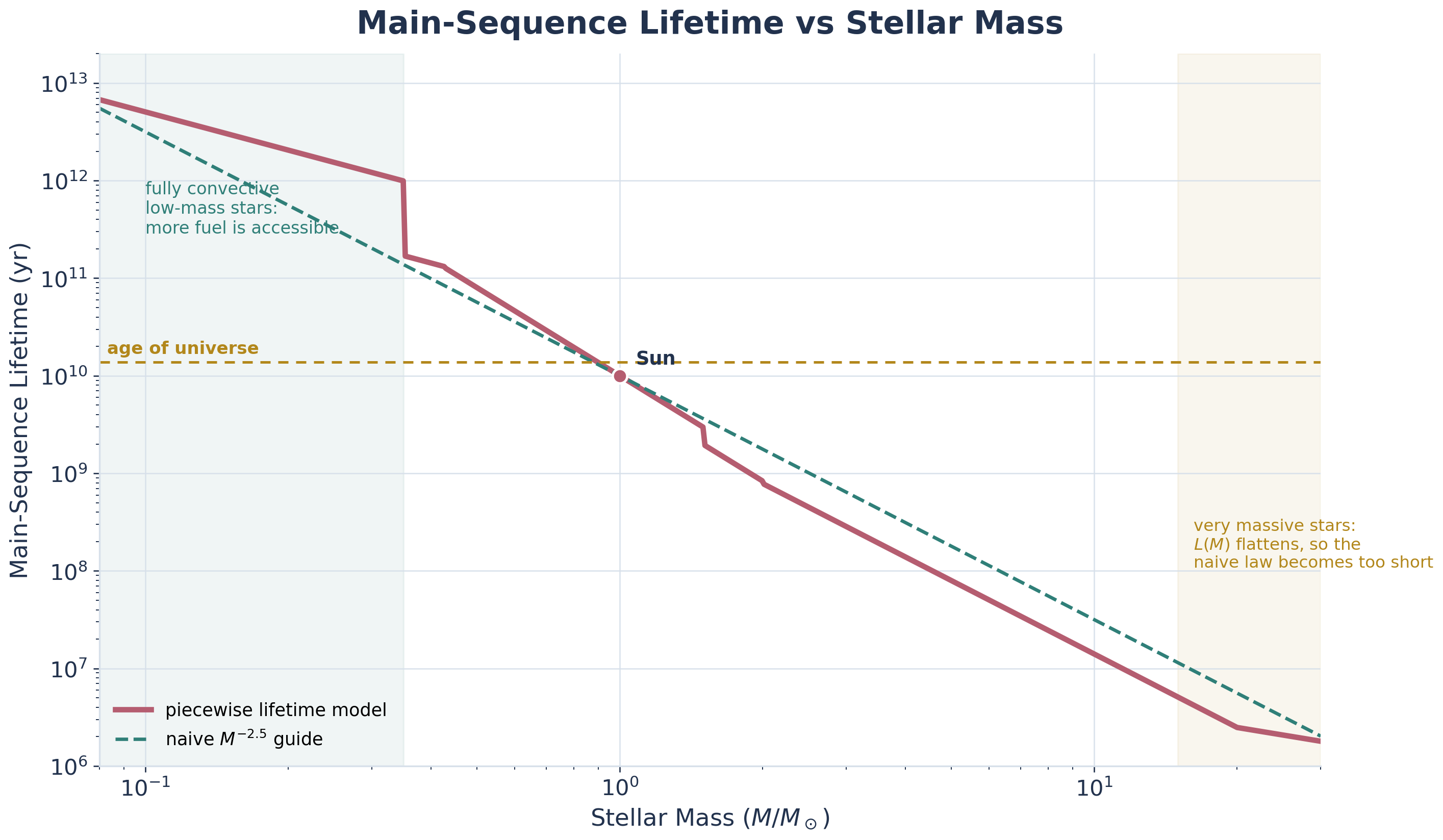
What to notice: the naive $ M^{-2.5} $ guide captures the broad trend, but real low-mass stars live even longer because they access more of their fuel, while very massive-star lifetimes are longer than a blind high-mass extrapolation would predict. (Credit: ASTR 201 (generated))
Worked Example: Why M Dwarfs Live So Long
Now let’s use the ratio method for one of the most important qualitative results in stellar evolution: low-mass M dwarfs can live for trillions of years.
Take an idealized fully convective M dwarf with
\[ \frac{M}{M_\odot} = 0.2 \qquad \text{and} \qquad \frac{L}{L_\odot} \approx (0.2)^{3.5} \approx 0.0036 \]
For a fully convective star, most of the hydrogen can eventually be mixed through the whole star rather than being trapped outside the core. That means the accessible fuel fraction can be much larger than in the Sun. A simple order-of-magnitude comparison is:
\[ \frac{f_M}{f_{M,\odot}} \approx \frac{1}{0.1} = 10 \]
Then the solar-normalized nuclear lifetime is
\[ \frac{\tau_\text{nuc}}{\tau_{\text{nuc},\odot}} \approx \left(\frac{f_M}{f_{M,\odot}}\right) \left(\frac{M}{M_\odot}\right) \left(\frac{L}{L_\odot}\right)^{-1} \approx 10 \times 0.2 \times (0.0036)^{-1} \approx 560 \]
So the star’s main-sequence lifetime is
\[ \tau_\text{nuc} \approx 560 \times 10~\text{Gyr} \approx 5.6 \times 10^{12}~\text{yr} \]
That is about 5.6 trillion years — far longer than the current age of the universe. This is why the faintest red dwarfs are the Galaxy’s long-term survivors.
This number should not be treated as an exact prediction for every low-mass star. We deliberately combined two approximations: the simple luminosity scaling and the idea that full convection raises the accessible fuel fraction. Real stellar models handle both effects more carefully. But the conclusion is robust: the lowest-mass stars live enormously longer than Sun-like stars.
True or false: A more massive star should live longer because it contains more hydrogen fuel. Explain.
False. A more massive star does contain more total fuel, but its luminosity increases much faster than its mass. Roughly, \[ \tau_{\rm nuc} \propto \frac{M}{L} \propto M^{-2.5}, \] so increasing mass shortens the lifetime. Mass helps by increasing the fuel reservoir, but luminosity wins harder by increasing the burn rate even more.
A star in a young cluster has spectral type B2 (corresponding to \(M \approx 10\,M_\odot\)). It is still on the main sequence. What can you conclude about the cluster’s age?
If a \(10\,M_\odot\) star is still on the main sequence, the cluster must be younger than the nuclear timescale of a \(10\,M_\odot\) star:
\[ \tau_\text{nuc} \approx 10 \times \left(\frac{10}{1}\right)^{-2.5}~\text{Gyr} \approx 10 \times 3.2 \times 10^{-3}~\text{Gyr} \approx 32~\text{Myr} \]
The cluster is younger than \(\sim 30~\text{Myr}\). In fact, this is exactly how astronomers date star clusters: find the most massive star still on the main sequence, and the cluster’s age is approximately that star’s nuclear timescale. This technique is called the main-sequence turnoff.
Part 5: The Hierarchy of Timescales
Putting It All Together
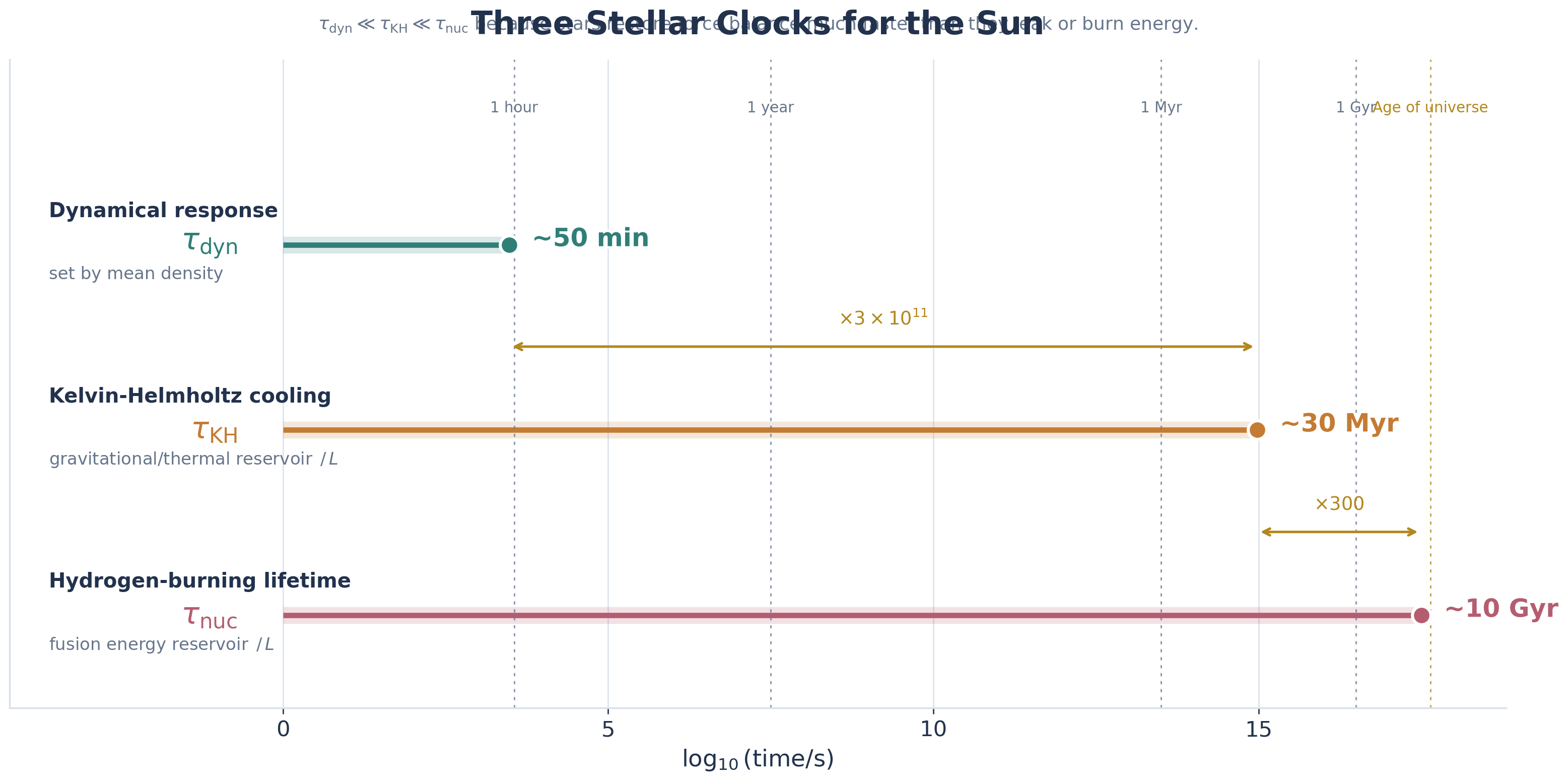
What to notice: the three stellar clocks are not just different; they are separated by enormous factors. The Kelvin-Helmholtz and nuclear timescales both follow the ‘reservoir divided by luminosity’ logic, while the dynamical clock is set by mean density. (Credit: ASTR 201 (generated))
For the Sun, the three timescales span an enormous range:
Each one answers a different physical question: mechanical response, thermal depletion, and fuel exhaustion.
| Timescale | Symbol | Value (Sun) | Physical Process |
|---|---|---|---|
| Dynamical | \(\tau_\text{dyn}\) | \(\sim 50~\text{min}\) | Free-fall / pressure response |
| Thermal (KH) | \(\tau_\text{KH}\) | \(\sim 30~\text{Myr}\) | Quasi-static contraction powered by the binding-energy reservoir |
| Nuclear | \(\tau_\text{nuc}\) | \(\sim 10~\text{Gyr}\) | Hydrogen fusion |
The hierarchy \(\tau_\text{dyn} \ll \tau_\text{KH} \ll \tau_\text{nuc}\) has profound consequences:
The star is in dynamical equilibrium. Because \(\tau_\text{dyn}\) is so short (minutes), any departure from pressure-gravity balance is corrected almost instantly. The star adjusts its structure on a timescale far shorter than anything else happening. This is why stars are (nearly) in hydrostatic equilibrium at all times — a concept we’ll formalize in the next reading.
Thermal adjustments are slow but finite. If the nuclear energy source were suddenly turned off, the star wouldn’t collapse instantly (that would take \(\tau_\text{dyn} \sim\) minutes). Instead, it would slowly contract and radiate its stored thermal energy over \(\tau_\text{KH} \sim 30~\text{Myr}\).
Nuclear burning sets the true lifetime. Because \(\tau_\text{nuc} \gg \tau_\text{KH}\), the star has plenty of time to establish thermal equilibrium while burning fuel. The star shines steadily for billions of years — its luminosity set by the rate of nuclear energy generation in the core.
Why This Hierarchy Matters
The separation of timescales is not just a curiosity — it’s why stars exist as stable, luminous objects. If \(\tau_\text{dyn}\) were comparable to \(\tau_\text{nuc}\), stars would pulsate wildly. If \(\tau_\text{KH}\) were comparable to \(\tau_\text{nuc}\), stars wouldn’t have time to establish thermal equilibrium before their fuel ran out. The enormous separation \(\tau_\text{dyn} \ll \tau_\text{KH} \ll \tau_\text{nuc}\) means stars can be treated as quasi-static objects — evolving slowly through a sequence of equilibrium states. This simplification makes stellar physics tractable.
Observable: Main-sequence turnoff point in a star cluster (the most luminous star still on the MS).
Model: \(\tau_\text{nuc} \propto M^{-2.5}\) — nuclear lifetime from the mass-luminosity relation.
Inference: Cluster age \(\approx \tau_\text{nuc}\) of the turnoff star. Clusters with blue (massive) turnoff stars are young; clusters with red (low-mass) turnoff stars are old.
Rank the following events from fastest to slowest: (a) the Sun responding to a sudden pressure disturbance, (b) the Sun exhausting its hydrogen fuel, (c) a hypothetical Sun (with no nuclear energy source) radiating away its stored gravitational energy. What timescale governs each?
Fastest: Pressure response → dynamical timescale \(\tau_\text{dyn} \sim 50~\text{min}\)
Middle: Radiating gravitational energy → Kelvin-Helmholtz timescale \(\tau_\text{KH} \sim 30~\text{Myr}\)
Slowest: Exhausting nuclear fuel → nuclear timescale \(\tau_\text{nuc} \sim 10~\text{Gyr}\)
The hierarchy spans a factor of \(\sim 10^{10}\) from fastest to slowest. This enormous separation is what allows stars to exist as stable objects — the star reaches hydrostatic and thermal equilibrium long before its fuel runs out.
Practice Problems
Use these values unless a problem states otherwise:
- \(G = 6.674 \times 10^{-8}~\text{cm}^3~\text{g}^{-1}~\text{s}^{-2}\)
- \(M_\odot = 2.0 \times 10^{33}~\text{g}\)
- \(R_\odot = 7.0 \times 10^{10}~\text{cm}\)
- \(L_\odot = 3.8 \times 10^{33}~\text{erg/s}\)
- \(c = 3.0 \times 10^{10}~\text{cm/s}\)
- \(\tau_{\text{nuc},\odot} \approx 10~\text{Gyr}\)
- Age of the universe \(\approx 13.8~\text{Gyr}\)
Conceptual
- ⭐⭐ Fuel is not lifetime. A student says, “A more massive main-sequence star should live longer because it has more hydrogen fuel.”
- Explain why this statement is incomplete.
- In the lifetime logic \(\tau_{\text{nuc}} \sim \text{fuel}/\text{burn rate}\), which term grows faster with stellar mass along the main sequence?
- Use the scaling \(\tau_{\text{nuc}} \propto M/L\) to explain why high-mass stars die young.
- ⭐ Which clock answers which question? Match each question to the most relevant stellar timescale, and justify each match in one sentence.
- How quickly would the Sun respond if pressure support suddenly failed?
- How long could the Sun shine if gravity were its only energy source?
- How long can core hydrogen fusion sustain the Sun’s present luminosity?
- ⭐⭐ Turnoff color as an age clue. Cluster A still has blue main-sequence turnoff stars, while Cluster B’s turnoff is much redder and cooler.
- Which cluster is older?
- What is the direct observable in this comparison?
- What model connects that observable to the cluster age?
Calculation
- ⭐ The Sun’s dynamical timescale. The Sun’s mean density is \(\bar{\rho}_\odot \approx 1.4~\text{g/cm}^3\).
- Use \[ \tau_{\text{dyn}} \sim \frac{1}{\sqrt{G\bar{\rho}}} \] to estimate the Sun’s dynamical timescale in seconds.
- Convert your answer to minutes.
- Explain in one sentence what this timescale means physically.
- ⭐⭐ Kelvin-Helmholtz timescale for the Sun.
- Use \[ \tau_{\text{KH}} \sim \frac{GM_\odot^2}{R_\odot L_\odot} \] to estimate the Sun’s Kelvin-Helmholtz timescale in seconds.
- Convert your answer to Myr.
- If the Sun had the same mass and radius but twice the luminosity, by what factor would \(\tau_{\text{KH}}\) change?
- ⭐⭐ Nuclear lifetime, from the Sun to a heavier star.
- For a Sun-like star, use \[ \tau_{\text{nuc}} \sim \frac{\varepsilon f_M M c^2}{L} \] with \(\varepsilon = 0.007\) and \(f_M = 0.10\) to estimate the Sun’s nuclear lifetime.
- Use solar normalization to estimate the main-sequence lifetime of a star with \(M = 2\,M_\odot\) and \(L = 10\,L_\odot\).
- Compare your answer in part (b) to the Sun’s lifetime.
Synthesis
- ⭐⭐ Why M dwarfs live so long. An idealized fully convective M dwarf has \[
\frac{M}{M_\odot} = 0.2,
\qquad
\frac{L}{L_\odot} \approx (0.2)^{3.5} \approx 0.0036,
\qquad
\frac{f_M}{f_{M,\odot}} \approx 10.
\]
- Estimate its nuclear lifetime in units of the Sun’s lifetime.
- Convert that result to years.
- Compare the result to the age of the universe and explain what that implies about the faintest red dwarfs.
- ⭐⭐ Turnoff as a clock. A young cluster still contains a B2 main-sequence star with mass \(M \approx 10\,M_\odot\).
- Use the scaling \[ \tau_{\text{nuc}} \propto M^{-2.5} \] to estimate the star’s main-sequence lifetime and therefore the cluster age scale.
- State the observable, model, and inference in this dating method.
- Explain why the star can remain close to hydrostatic equilibrium while still evolving over millions of years.
Reference Tables
The Three Stellar Timescales
| Timescale | Formula | Physical Meaning | Sun Value |
|---|---|---|---|
| Dynamical \(\tau_\text{dyn}\) | \(\sim 1/\sqrt{G\bar{\rho}}\) | Free-fall time; how fast gravity rearranges matter | \(\sim 50~\text{min}\) |
| Thermal \(\tau_\text{KH}\) | \(\sim GM^2/(RL)\) | Time to radiate the star’s binding-energy reservoir | \(\sim 30~\text{Myr}\) |
| Nuclear \(\tau_\text{nuc}\) | \(\sim \varepsilon f_M Mc^2/L\) | Time to exhaust nuclear fuel | \(\sim 10~\text{Gyr}\) |
Symbol Legend
| Symbol | Meaning | CGS Units |
|---|---|---|
| \(G\) | Newton’s gravitational constant | \(6.674 \times 10^{-8}~\text{cm}^3~\text{g}^{-1}~\text{s}^{-2}\) |
| \(\bar{\rho}\) | Mean density | \(\text{g}/\text{cm}^3\) |
| \(M\) | Stellar mass | g (or \(M_\odot = 2.0 \times 10^{33}~\text{g}\)) |
| \(R\) | Stellar radius | cm (or \(R_\odot = 7.0 \times 10^{10}~\text{cm}\)) |
| \(L\) | Luminosity | \(\text{erg}/\text{s}\) (or \(L_\odot = 3.8 \times 10^{33}~\text{erg}/\text{s}\)) |
| \(c\) | Speed of light | \(3.0 \times 10^{10}~\text{cm}/\text{s}\) |
| \(\varepsilon\) | Nuclear mass-energy conversion efficiency | Dimensionless (\(\approx 0.007\) for H→He) |
| \(f_M\) | Accessible fuel fraction, so \(f_M M\) is the mass that actually burns | Dimensionless (\(\approx 0.10\) for a Sun-like star) |
Summary: Stars Are Clocks
The most important ideas from this reading:
Three timescales govern stellar physics — dynamical (\(\sim\) minutes), thermal (\(\sim\) millions of years), and nuclear (\(\sim\) billions of years) — and their hierarchy \(\tau_\text{dyn} \ll \tau_\text{KH} \ll \tau_\text{nuc}\) makes stars stable, quasi-static objects.
The Kelvin-Helmholtz controversy demonstrated that observations (geological ages) can demand new physics (nuclear energy). Kelvin’s calculation was correct — his assumptions were incomplete.
Nuclear lifetime scales as \(\tau_\text{nuc} \propto M^{-2.5}\) — massive stars burn far faster than they accumulate extra fuel. A \(10\,M_\odot\) star lives only \(\sim 30~\text{Myr}\); a \(0.1\,M_\odot\) star outlasts the universe.
The main-sequence turnoff in star clusters gives cluster ages: the most massive star still on the MS sets the clock.
┌──────────────────────────────────────────────────────┐
│  Gravity Scoreboard — Reading 1                      │
├──────────────────────────────────────────────────────┤
│  Attacker:    Gravity (always)                       │
│  Defender:    ??? (We don't know yet!)                │
│  Status:      UNKNOWN — gravity has been pulling on  │
│               the Sun for 4.6 Gyr. Something has     │
│               been fighting back. We now know the    │
│               fight has a nuclear clock of about     │
│               10 Gyr, but we do not yet know WHO    │
│               is fighting.                           │
│  Retrieval:   If a cluster still has blue turnoff    │
│               stars, it must be young.               │
│  Next battle: What holds a star up? → Reading 2      │
└──────────────────────────────────────────────────────┘
We’ve established the timescales — the when of stellar physics. But we haven’t yet asked the how. What force balances gravity? What physical mechanism holds a star in equilibrium for billions of years? The answer begins with the simplest question in stellar physics: what holds a star up? That’s the subject of Reading 2: Hydrostatic Equilibrium.
You now know that stars live for \(\tau_\text{nuc} \propto M^{-2.5}\) — but why do they live this long? What holds them up against gravity, and what generates the energy that maintains the balance? In Reading 2, we’ll discover that the answer is hydrostatic equilibrium — the precise balance between the inward pull of gravity and the outward push of pressure. And in Reading 3, we’ll find that the energy source maintaining this balance demands all four fundamental forces of nature — including quantum mechanics.