Lecture 5: The Stellar Blueprint — Structure Equations and Main-Sequence Scalings
Why is the mass-luminosity relation so steep? The four equations that determine everything.
For main-sequence stars of similar composition, observations suggest that mass is the dominant control parameter. But that statement is only scientifically useful if we can build a model that explains why changing the mass changes luminosity, radius, temperature, and interior structure so dramatically. In this reading, we assemble the stellar structure equations, show why they must be solved as a coupled system, and then use carefully stated scaling arguments to derive the leading-order physics behind the main sequence. The goal is not to memorize four equations. The goal is to understand why the observed mass-luminosity relation is so steep, why more massive stars are larger and hotter, and why different stars transport energy in different ways.
This reading includes derivations and differential equations because those tools are central to how astrophysics describes stars. You are not expected to solve the full stellar-structure ODE system on your own for this course.
What you are responsible for is understanding what the scalings mean, what physical ideas each equation represents, what assumptions enter the toy model, and why this kind of math is useful for turning observations into physical inference. The goal here is to make this mathematical language feel more familiar and less mysterious, not to turn the reading into a formal ODE exercise.
Learning Objectives
After completing this reading, you should be able to:
- state the four stellar structure equations and identify the physical principle behind each one,
- explain why stellar structure is a coupled ODE problem rather than a single algebra problem,
- derive the leading-order toy scaling \(L \propto M^3/\kappa\) from the structure equations,
- derive a toy mass-radius relation for pp-chain, radiative main-sequence stars,
- derive the nuclear-lifetime scaling \(\tau_{\rm nuc} \propto M/L\) and explain why massive stars live much shorter lives,
- state the Schwarzschild criterion and explain physically when convection begins,
- distinguish among fully convective very low-mass stars, solar-like stars with convective envelopes, and high-mass stars with convective cores,
- connect the observed main sequence to the underlying stellar-structure physics.
Concept Throughline
In Module 2, you measured the empirical trend that more massive main-sequence stars are much more luminous. In Readings 1–4, you built the ingredients needed to explain that trend: gravity sets the pressure scale, hydrostatic equilibrium sets the force balance, fusion sets the energy source, and radiation transport sets how hard it is for energy to escape. This reading puts those ingredients together.
The logic chain is:
- stars are described by radial profiles, so we need differential equations,
- four coupled structure equations determine how mass, pressure, temperature, and luminosity vary with radius,
- order-of-magnitude versions of those equations reveal the main-sequence scaling relations,
- radiative transport can fail when the required temperature gradient becomes too steep,
- the resulting interior structures explain why different kinds of main-sequence stars look and evolve differently.
The main sequence is not just an observational pattern. It is a structural consequence of stellar physics.
Track A (Core, \(\sim 30\) min): Read Parts 1–4 in order. Track B (Full, \(\sim 40\) min): Read everything, including the extra checkpoints and enrichment box.
Both tracks cover the core learning objectives.
The main sequence is a mass sequence because stellar structure is a self-consistent physics problem. For stars of similar composition, changing the mass changes the gravity, which changes the pressure scale, which changes the core temperature, which changes the fusion rate and the transport requirements.
The deepest result in this reading is not a single formula. It is the causal chain
\[ \rho \sim \frac{M}{R^3} \;\rightarrow\; P_c \sim \frac{G M^2}{R^4} \;\rightarrow\; T_c \sim \frac{M}{R} \;\rightarrow\; L \propto \frac{M^3}{\kappa}. \]
That is why the mass-luminosity relation is steep, and that is why massive stars burn out so quickly.
Part 1: The Problem We Are Trying to Explain
Astronomers do not begin this topic from theory alone. We begin from an observable pattern:
- main-sequence stars occupy a narrow band in the HR diagram,
- more massive main-sequence stars are much more luminous,
- the empirical mass-luminosity relation is steep, roughly \[ L \propto M^{3} \text{ to } M^{3.5} \] over much of the main sequence.
That is the observable we want to explain. The rest of the reading builds the model and then asks what we can infer from it.
The surprising part is not just that more massive stars are brighter. It is that luminosity increases much faster than mass — that is what we need to explain.
A factor-of-two increase in mass produces roughly an eightfold increase in luminosity. That is not a small effect — it is a structural change. Before reading further, ask yourself: do you expect gravity, temperature, or energy transport to be responsible for this steepness?
Why should a factor-of-two increase in mass produce an increase of roughly one order of magnitude in luminosity? Why are massive stars not just a little brighter, but dramatically brighter?
To answer that, we need a theory of stellar interiors.
Suppose two main-sequence stars have similar composition, but one has twice the mass of the other.
Before seeing any derivation, predict:
- Is the core temperature likely to be a little higher or a lot higher?
- Is the luminosity likely to be a little higher or a lot higher?
- Which quantity do you expect to be more sensitive to mass: \(T_c\) or \(L\)?
Commit to a prediction before reading on.
Part 2: Why Stellar Structure Requires Differential Equations
A star is not described by a single temperature or a single pressure. Those quantities vary continuously from center to surface:
\[ M(r), \qquad P(r), \qquad T(r), \qquad L(r), \qquad \rho(r). \]
That means stellar structure is a profile problem. We are not asking for one number. We are asking how each quantity changes with radius.
That is why ordinary algebra is not enough. We need a dynamical profile model: a set of differential equations that describes how stellar properties vary with radius.
Why ODEs?
If you want to know the structure of a star, you are really asking: how does each quantity change as you move outward? That is a question about rates of change — and rates of change are what derivatives describe.
If a quantity changes continuously with radius, then the natural question is not “what is its value?” but “how fast is it changing?” That is what a derivative tells us.
The stellar structure equations therefore relate:
- how enclosed mass grows with radius,
- how pressure changes with radius,
- how temperature changes with radius,
- how luminosity changes with radius.
Each equation gives one radial rate of change.
“We can solve stellar structure by plugging numbers into a few formulas.”
False.
Each structure equation depends on quantities determined by the others. So the problem is not “plugging into formulas.” The problem is finding a self-consistent interior profile that satisfies all equations, closure relations, and boundary conditions at the same time.
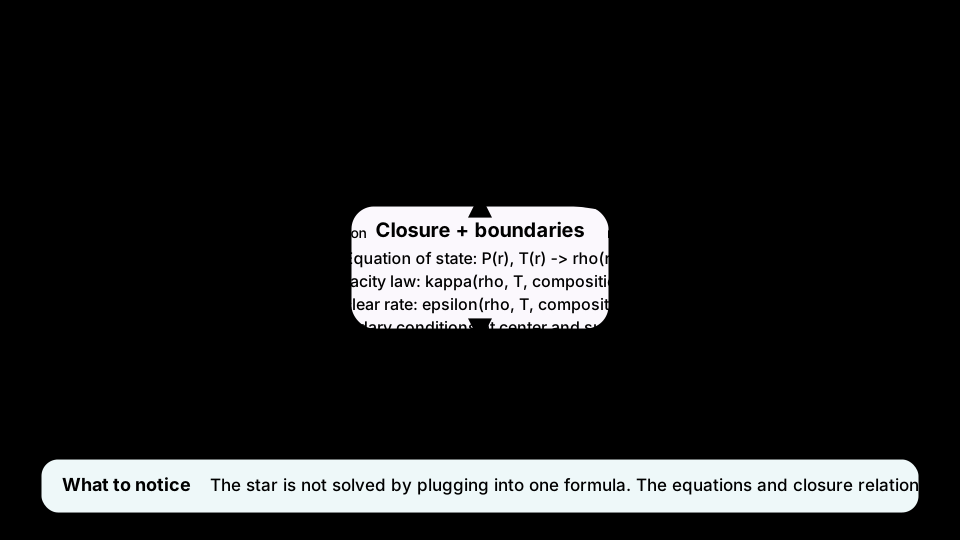
What to notice: the four stellar structure equations form a coupled loop. Mass and luminosity profiles feed the pressure and radiative gradients, while the equation of state, opacity law, nuclear rate, and boundary conditions close the system. (Credit: ASTR 201 (generated))
The important point is that the structure equations are not independent recipes. Each equation needs quantities that are determined by the others, so the solution must be self-consistent. A star is not defined by numbers — it is defined by a solution.
“A star can be modeled well enough by one average temperature and one average pressure.”
False.
Average quantities can be useful for scaling arguments, but the real stellar-structure problem is a profile problem. Pressure, temperature, density, luminosity, and enclosed mass all vary with radius.
Part 3: The Four Equations — The Stellar Blueprint
We now write the four structure equations in their standard spherical form.
Equation 1: Mass conservation
\[ \frac{dM}{dr} = 4\pi r^2 \rho(r) \]
Here:
- \(M(r)\) is the mass enclosed inside radius \(r\),
- \(\rho(r)\) is the local density.
This equation is geometry. A thin shell of radius \(r\) and thickness \(dr\) has volume
\[ dV = 4\pi r^2\,dr, \]
so its mass is
\[ dM = \rho\,dV = 4\pi r^2 \rho\,dr. \]
Divide by \(dr\) and you get the differential form above.
Equation 2: Hydrostatic equilibrium
\[ \frac{dP}{dr} = -\frac{G M(r)\rho(r)}{r^2} \]
Here:
- \(P(r)\) is the pressure,
- \(G\) is Newton’s gravitational constant.
This is force balance. The pressure must decrease outward so that the pressure gradient can support the weight of the overlying gas against gravity.
Equation 3: Energy generation
\[ \frac{dL}{dr} = 4\pi r^2 \rho(r)\,\epsilon(r) \]
Here:
- \(L(r)\) is the luminosity passing through radius \(r\),
- \(\epsilon(r)\) is the nuclear energy generation rate per unit mass, with units \({\rm erg\ g^{-1}\ s^{-1}}\).
This is energy conservation inside the star. As you move outward through a shell, the luminosity increases by the energy produced in that shell.
Equation 4: Radiative transport
From Reading 4, radiative diffusion gives the flux
\[ F_{\rm rad} = -\frac{4acT^3}{3\kappa\rho}\frac{dT}{dr}, \]
where:
- \(a\) is the radiation constant,
- \(c\) is the speed of light,
- \(\kappa\) is the opacity.
Since luminosity is flux times area,
\[ L(r) = 4\pi r^2 F_{\rm rad}, \]
so the radiative temperature gradient can be written as
\[ \left(\frac{dT}{dr}\right)_{\rm rad} = -\frac{3\kappa\rho L(r)}{16\pi a c\,r^2 T^3}. \]
Using \(a = 4\sigma/c\), this is equivalently
\[ \left(\frac{dT}{dr}\right)_{\rm rad} = -\frac{3\kappa\rho L(r)}{64\pi \sigma r^2 T^3}. \]
This equation tells you how steep the temperature gradient must be if radiation alone carries the luminosity.
At this point, you might think: “I have four equations — I can just use them.” But each equation contains quantities defined by the others. That means none of them can be solved independently.
This is not four problems. This is one coupled problem.
Do not try to memorize these equations. Focus on what each one controls in the star.
The four structure equations are necessary, but not sufficient. To close the system, you also need constitutive relations:
Equation of state \[ P = \frac{\rho k_B T}{\mu m_H} \]
Opacity law \[ \kappa = \kappa(\rho, T, \text{composition}) \]
Nuclear energy generation law \[ \epsilon = \epsilon(\rho, T, \text{composition}) \]
You also need boundary conditions, such as
\[ M(0)=0, \qquad L(0)=0 \]
at the center, plus appropriate surface boundary conditions.
This is why stellar structure is a coupled system, not just four standalone formulas.
Unit check: the energy-generation equation
Verify that
\[ \frac{dL}{dr} = 4\pi r^2 \rho \epsilon \]
has the correct units.
Use:
- \([r^2] = {\rm cm^2}\),
- \([\rho] = {\rm g\ cm^{-3}}\),
- \([\epsilon] = {\rm erg\ g^{-1}\ s^{-1}}\).
Then the right-hand side has units
\[ {\rm cm^2} \times {\rm g\ cm^{-3}} \times {\rm erg\ g^{-1}\ s^{-1}} = {\rm erg\ cm^{-1}\ s^{-1}}, \]
which matches
\[ \left[\frac{dL}{dr}\right] = \frac{{\rm erg\ s^{-1}}}{{\rm cm}} = {\rm erg\ cm^{-1}\ s^{-1}}. \]
Look back at the four equations and the closure relations.
Which equation needs information supplied by another equation? Give at least two examples.
Do not answer with “all of them” unless you can explain specifically how.
Two examples:
- Hydrostatic equilibrium needs \(M(r)\), which is determined by the mass-conservation equation.
- The radiative gradient needs \(L(r)\), which is determined by the energy-generation equation.
More broadly, the opacity \(\kappa\) and nuclear rate \(\epsilon\) both depend on local conditions such as \(T\) and \(\rho\), while the equation of state ties \(P\), \(T\), and \(\rho\) together. That is why the full solution must be self-consistent.
Part 4: Deriving the Main-Sequence Scalings
In the next section, keep three categories separate:
- Observable: the steep main-sequence mass-luminosity trend,
- Model ingredients: hydrostatic equilibrium, ideal-gas pressure, radiative diffusion, and similar composition,
- Inference: a toy scaling close to \[ L \propto \frac{M^3}{\kappa}. \]
The purpose of the derivation is not to get exact exponents. It is to show why steepness is expected from the structure equations at all.
We will not solve the full ODE system exactly. Instead, we will build a controlled toy model that extracts the leading-order physics by replacing full radial profiles and local gradients with characteristic scales.
This is not the exact stellar solution. It is a deliberately simplified model designed to answer one question: why is the mass-luminosity relation steep at all?
In the scaling argument below, we assume:
- spherical symmetry,
- stars of similar composition,
- ideal-gas pressure dominates,
- radiative transport sets the temperature gradient in the region controlling the scaling,
- characteristic central or mean values can replace full radial profiles,
- for the simplest luminosity scaling, opacity \(\kappa\) is treated as slowly varying or approximately constant,
- for the toy mass-radius scaling, pp-chain burning is approximated by \[ \epsilon \propto \rho T^4. \]
These assumptions are not exact. They are what let us convert the full structure problem into a physics-first scaling argument.
Step 1: Mass conservation gives the density scale
From
\[ \frac{dM}{dr} = 4\pi r^2 \rho, \]
replace the derivative by a characteristic ratio:
\[ \frac{M}{R} \sim R^2 \rho. \]
Therefore,
\[ \rho \sim \frac{M}{R^3}. \]
This is the mean-density scaling: mass divided by volume.
Step 2: Hydrostatic equilibrium gives the pressure scale
Start from
\[ \frac{dP}{dr} = -\frac{GM\rho}{r^2}. \]
Replace the derivative by a characteristic ratio:
\[ \frac{P_c}{R} \sim \frac{GM\rho}{R^2}. \]
Now insert the density scaling from Step 1:
\[ \frac{P_c}{R} \sim \frac{GM}{R^2}\frac{M}{R^3} = \frac{GM^2}{R^5}. \]
Multiply by \(R\):
\[ P_c \sim \frac{GM^2}{R^4}. \]
This is the hydrostatic pressure scale.
The relation
\[ P_c \sim \frac{GM^2}{R^4} \]
is an order-of-magnitude scaling, not an exact equality. Numerical factors of order unity are dropped, but the dimensional dependence is physically meaningful.
Step 3: The ideal gas law gives the temperature scale
Use the ideal-gas equation of state:
\[ P \sim \frac{\rho k_B T}{\mu m_H}. \]
At the core scale,
\[ P_c \sim \frac{\rho k_B T_c}{\mu m_H}. \]
Substitute the results from Steps 1 and 2:
\[ \frac{GM^2}{R^4} \sim \frac{M}{R^3}\frac{k_B T_c}{\mu m_H}. \]
Cancel one factor of \(M\) and simplify:
\[ \frac{GM}{R} \sim \frac{k_B T_c}{\mu m_H}. \]
So the core temperature scaling is
\[ T_c \sim \frac{G M \mu m_H}{k_B R}. \]
The key takeaway is
\[ T_c \propto \frac{M}{R}. \]
More massive stars tend to have hotter cores, but the radius also matters. That is why we should not assign a single temperature-mass exponent until we know how \(R\) depends on \(M\).
Up to this point, we have not used anything about energy transport or nuclear physics. This is purely gravity, pressure support, and the equation of state. That is why the temperature scale emerges from the structure alone.
From
\[ T_c \sim \frac{G M \mu m_H}{k_B R} \]
check units:
- \(GM/R\) has units of energy per mass,
- multiplying by \(m_H\) gives energy,
- dividing by \(k_B\) converts energy to temperature.
So the expression has units of kelvin, as required.
At this point in the derivation, we have shown that
\[ T_c \propto \frac{M}{R}. \]
Before going further, predict:
- If radius increased in direct proportion to mass, would the core temperature change much across the main sequence?
- Could luminosity still change a lot even if the core temperature changed only moderately?
Explain physically before calculating anything else.
Step 4: Radiative transport gives a transport-limited luminosity scaling
This step is the heart of the derivation. This is where the steepness enters.
Start from the radiative flux form:
\[ F_{\mathrm{rad}} = - \frac{4acT^3}{3\kappa\rho}\,\frac{dT}{dr}. \]
For a scaling argument, replace the gradient by a characteristic ratio:
\[ \left| \frac{dT}{dr} \right| \sim \frac{T_c}{R}. \]
So the characteristic radiative flux is
\[ F_{\mathrm{rad}} \sim \frac{4acT_c^3}{3\kappa\rho}\,\frac{T_c}{R} \sim \frac{T_c^4}{\kappa \rho R}, \]
where the constants have been dropped because we only want the scaling.
Now convert flux to luminosity:
\[ L \sim 4\pi R^2 F_{\mathrm{rad}} \sim R^2 \frac{T_c^4}{\kappa \rho R}. \]
Therefore,
\[ L \sim \frac{R T_c^4}{\kappa \rho}. \]
Now substitute the density scaling from Step 1:
\[ \rho \sim \frac{M}{R^3}. \]
Then
\[ L \sim \frac{R T_c^4}{\kappa (M/R^3)} = \frac{T_c^4 R^4}{\kappa M}. \]
Now substitute the temperature scaling from Step 3:
\[ T_c \propto \frac{M}{R}. \]
So
\[ L \sim \frac{(M/R)^4 R^4}{\kappa M} = \frac{M^4}{\kappa M} = \frac{M^3}{\kappa}. \]
This is the clean transport-limited toy luminosity scaling:
\[ L \propto \frac{M^3}{\kappa}. \]
At this stage, we have not yet shown that the star actually produces exactly this luminosity. We have shown the luminosity that radiative diffusion can carry for the assumed characteristic structure.
Pause here.
Notice what just happened: the radius has dropped out of the scaling entirely.
That does not mean radius is irrelevant to stellar structure. It means that under these specific toy assumptions, the leading-order radiative luminosity scaling can be expressed without an explicit radius dependence.
That means luminosity is no longer controlled primarily by size. It is controlled primarily by mass.
That is the key reason luminosity depends so steeply on mass — gravity, pressure, temperature, and transport combine in a way that leaves mass as the dominant control parameter.
This result depends on the assumptions above, especially that radiative transport sets the temperature gradient and that opacity varies slowly. If those assumptions change, the exponent will change, but the logic linking mass to luminosity remains.
Higher opacity makes it harder for radiation to escape, so for fixed structure it reduces the luminosity. That is why the scaling carries \(\kappa\) in the denominator, not the numerator.
If \(\kappa\) is approximately constant, then
\[ L \propto M^3. \]
That is already close to the observed steep main-sequence relation.
The steep mass-luminosity relation is not arbitrary.
- Gravity sets the pressure scale: \(P_c \sim GM^2/R^4\)
- Pressure sets the temperature scale: \(T_c \sim M/R\)
- Temperature controls both nuclear burning and radiative transport
- Radiative transport limits how easily energy can escape
So increasing the mass forces the star into a new structural state where:
- the core is hotter,
- energy is produced more rapidly,
- and the star must increase its luminosity dramatically to transport that energy outward.
The steep relation \(L \propto M^3/\kappa\) is therefore a structural consequence of the stellar equations, not a fit to data.
Hold \(M\), \(R\), and the characteristic core temperature fixed.
- If the opacity \(\kappa\) doubles, does the transport-limited luminosity increase or decrease?
- By what factor does it change in the toy scaling?
- What is the physical reason for that direction?
Write your prediction before doing any algebra.
From the toy scaling,
\[ L \propto \frac{1}{\kappa} \]
when the other structural quantities are held fixed.
So if \(\kappa\) doubles, the transport-limited luminosity decreases by a factor of \(2\).
Physically, larger opacity makes the stellar material less transparent. Radiation then escapes less easily, so the luminosity that can be carried by radiative diffusion is smaller for the same characteristic structure.
Why the real exponent is often steeper
The toy result
\[ L \propto M^3 \]
for similar opacity is not the final word.
Real stars do not all have constant opacity, and they do not all burn hydrogen with the same temperature sensitivity. As the opacity law and nuclear physics change across the main sequence, the exponent shifts. Over much of the observed main sequence, the empirical relation is closer to
\[ L \propto M^{3.5} \]
than to \(M^3\).
That is a success, not a failure of the model. The toy derivation is doing the correct scientific job: it explains why the relation is steep, even though the exact exponent requires more realistic microphysics.

What to notice: the toy scaling \(L \propto M^3\) already captures the steepness of the mass-luminosity trend, while the empirical relation is often somewhat steeper because real opacity laws and nuclear physics vary across the main sequence. (Credit: ASTR 201 (generated))
Step 5: A toy mass-radius relation
To get a radius scaling, we now impose a new physical requirement: in a long-lived main-sequence star, energy production in the core must match energy transport out of the star.
A crude scaling for the luminosity generated in the core is
\[ L \sim R^3 \rho \epsilon. \]
For pp-chain hydrogen burning, use the toy scaling
\[ \epsilon \propto \rho T^4. \]
Then
\[ L \sim R^3 \rho (\rho T_c^4) = R^3 \rho^2 T_c^4. \]
Now substitute the density and temperature scalings:
\[ \rho \sim \frac{M}{R^3}, \qquad T_c \sim \frac{M}{R}. \]
So
\[ L \sim R^3 \left(\frac{M}{R^3}\right)^2 \left(\frac{M}{R}\right)^4. \]
Work through the powers carefully:
\[ L \sim R^3 \frac{M^2}{R^6} \frac{M^4}{R^4} = \frac{M^6}{R^7}. \]
But from Step 4, the toy transport scaling gave
\[ L \propto \frac{M^3}{\kappa}. \]
At this stage we have two independent estimates of luminosity:
- a transport-limited luminosity from radiative diffusion,
- a production-limited luminosity from nuclear burning.
A long-lived main-sequence star must satisfy both simultaneously:
- the core must produce energy at some rate,
- the star must transport that energy outward at the same rate.
Main-sequence equilibrium requires those two rates to match.
This is the same logic as equilibrium in other systems: a stable system must balance what goes in and what comes out.
Set the two luminosity scalings equal:
\[ \frac{M^6}{R^7} \propto \frac{M^3}{\kappa}. \]
So
\[ R^7 \propto \kappa M^3. \]
For stars of similar opacity, treat \(\kappa\) as approximately constant. Then
\[ R^7 \propto M^3, \]
which gives the toy mass-radius relation
\[ R \propto M^{3/7} \approx M^{0.43}. \]
This is shallower than the observed main-sequence radius trend, which is often closer to
\[ R \propto M^{0.6} \text{ to } M^{0.8} \]
over much of the main sequence. That is expected. The toy model uses simplified opacity and energy-generation laws and ignores structural changes across the sequence.
Still, it gets the crucial qualitative point right:
- more massive stars are larger,
- but luminosity rises more steeply than radius.
That inference depends on the toy assumptions above, especially radiative transport dominance, similar composition, and the simplified pp-chain scaling. A more realistic model changes the exponent, but not the basic logic that mass drives both structure and transport demands.
Step 6: The nuclear lifetime scaling
The nuclear lifetime is approximately the available nuclear fuel divided by the luminosity, where luminosity acts as a proxy for the rate at which the star is spending its usable energy supply.
\[ \tau_{\rm nuc} \sim \frac{\text{available fuel}}{\text{luminosity}}. \]
For stars of similar composition, the available fuel scales roughly with mass:
\[ \text{fuel} \propto M. \]
The burn rate is the luminosity:
\[ \text{burn rate} \propto L. \]
Therefore,
\[ \tau_{\rm nuc} \propto \frac{M}{L}. \]
Using the toy luminosity scaling,
\[ L \propto M^3, \]
we get
\[ \tau_{\rm nuc} \propto \frac{M}{M^3} = M^{-2}. \]
Using the more empirical scaling
\[ L \propto M^{3.5}, \]
we get
\[ \tau_{\rm nuc} \propto M^{-2.5}. \]
That is why massive stars live much shorter lives. They do have more fuel, but the burn rate rises much faster than the fuel supply.
More mass means more fuel, but luminosity grows even faster. That is why massive stars die young.
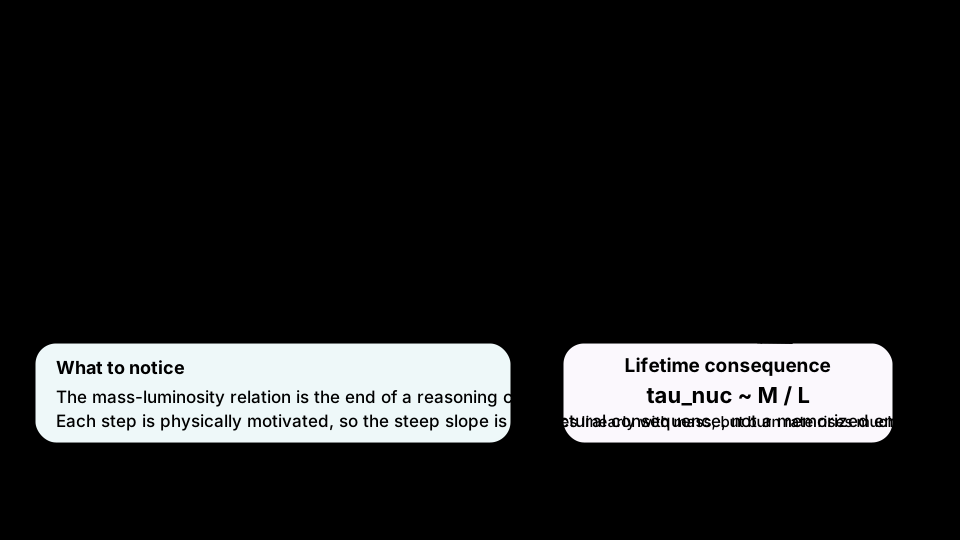
What to notice: this is a causal chain, not a list of formulas. Each step follows from a physical principle — mass conservation sets density, hydrostatic equilibrium sets pressure, the equation of state sets temperature, and radiative transport forces a steep luminosity scaling. The result is \(L \propto M^3/\kappa\), not by assumption, but by necessity. (Credit: ASTR 201 (generated))
The mass-luminosity relation is not an isolated empirical fact. It is the end of a chain of physical reasoning.
“Massive stars live shorter lives because they run out of fuel.”
That sentence is incomplete and therefore misleading.
Massive stars live shorter lives because their luminosities rise much more steeply than their fuel supply. The problem is not a lack of fuel. It is an enormous burn rate.
Use the toy scaling
\[ L \propto M^3. \]
for stars of similar opacity.
- Predict qualitatively: if mass doubles, does luminosity increase linearly, quadratically, or more steeply?
- Now compute the luminosity ratio explicitly.
- Use \(\tau_{\rm nuc} \propto M/L\) to predict the lifetime ratio.
- Explain in one sentence why the lifetime decreases even though the star has more fuel.
If mass doubles, the luminosity rises more steeply than linearly or quadratically because it scales like the cube of the mass.
Explicitly,
\[ \frac{L_2}{L_1} = \left(\frac{M_2}{M_1}\right)^3 = 2^3 = 8. \]
So the more massive star is about eight times more luminous in the toy model.
For the lifetime,
\[ \tau_{\rm nuc} \propto \frac{M}{L} \propto M^{-2}, \]
so
\[ \frac{\tau_2}{\tau_1} = \left(\frac{M_2}{M_1}\right)^{-2} = 2^{-2} = \frac{1}{4}. \]
So the star with twice the mass has only about one quarter of the nuclear lifetime.
The lifetime decreases because the fuel supply grows only in proportion to mass, while the burn rate grows much more rapidly through the luminosity.
Part 5: When Radiation Fails — Convection
The radiative-transport equation does more than tell us how energy flows. It also tells us when radiation is no longer able to carry the required luminosity stably by itself. When that happens, convection can begin.
The physical idea
Imagine a small blob of gas displaced upward inside a star.
As it rises, the pressure around it drops. The blob expands and cools. Now compare two temperature gradients:
- the adiabatic gradient: how fast the blob cools as it expands without exchanging heat,
- the radiative gradient: how fast the background star’s temperature would drop if radiation alone carried the luminosity.
If the surroundings cool more rapidly than the blob does, then the blob remains warmer and less dense than its environment. It stays buoyant and continues to rise.
That is convective instability.
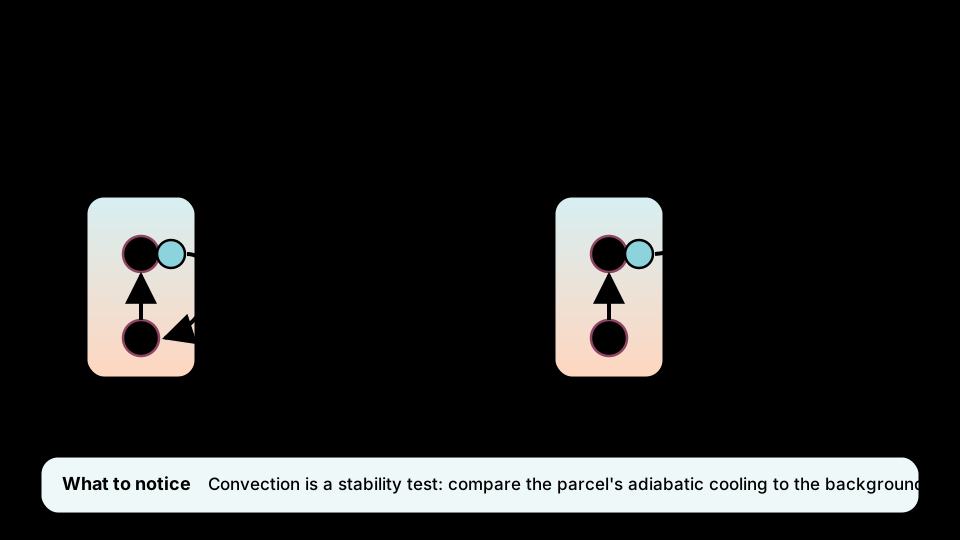
What to notice: convection is a stability problem. In a stable radiative layer the displaced parcel cools more than its surroundings and sinks back, but when the radiative gradient is steeper than the adiabatic gradient the parcel stays warmer and keeps rising. (Credit: ASTR 201 (generated))
This is why convection is a stability problem, not just the slogan “hot gas rises.” What matters is the comparison between the parcel’s adiabatic cooling and the background radiative gradient.
The question is not “is the gas hot?” The question is “does the environment cool faster than the parcel?”
The Schwarzschild criterion
The standard criterion is written in logarithmic form:
\[ \nabla_{\rm rad} > \nabla_{\rm ad}, \qquad \nabla \equiv \frac{d\ln T}{d\ln P}. \]
At the level of physical intuition, this means the radiative temperature drop is too steep for stability, so a displaced parcel remains buoyant instead of returning to its original position.
In words:
- if radiation can carry the luminosity with a gentle enough gradient, the region stays radiative,
- if radiation would require too steep a gradient, convection begins.
What makes the radiative gradient steep?
From the radiative-transport equation, the required radiative gradient scales as
\[ \left|\frac{dT}{dr}\right|_{\rm rad} \propto \frac{\kappa \rho L}{T^3 r^2}. \]
The relation
\[ \left| \frac{dT}{dr} \right|_{\rm rad} \propto \frac{\kappa \rho L}{T^3 r^2} \]
assumes:
- radiative diffusion is the dominant transport mechanism,
- local thermodynamic equilibrium,
- opacity can be treated as a local function.
When these assumptions fail, convection replaces radiation as the dominant transport process.
So the radiative gradient becomes steeper when:
- opacity \(\kappa\) is high,
- density \(\rho\) is high,
- luminosity \(L\) is high,
- temperature \(T\) is low,
- radius \(r\) is small.
That already suggests two places where convection might appear:
- cool, opaque outer layers, where radiation struggles to get through,
- very luminous cores, where too much energy must pass through a small area.
If you had to guess, where should convection be more likely:
- in a cool, opaque outer envelope, or
- in a very luminous stellar core?
Explain your answer using the radiative-gradient scaling before looking at the three regimes.
Three main-sequence interior regimes
1. Very low-mass stars: often fully convective
At the lowest main-sequence masses, the combination of cool temperatures, high opacity, and structural properties can make convection efficient throughout most or all of the star.
Result: many stars below roughly
\[ M \lesssim 0.35\,M_\odot \]
are close to fully convective.
2. Solar-like stars: radiative cores and convective envelopes
For stars like the Sun, the core is hot and fully ionized, so the opacity is relatively low and radiation can carry the energy without requiring an unstable gradient.
But the outer envelope is cooler and more opaque. There, radiative transport becomes inefficient and convection takes over.
Result: stars of roughly solar mass typically have
- radiative cores,
- convective envelopes.
3. Higher-mass stars: convective cores and radiative envelopes
In more massive stars, the core temperature becomes high enough that the CNO cycle dominates hydrogen burning. The CNO cycle is much more temperature-sensitive than the pp chain, so energy generation becomes strongly concentrated toward the center.
That concentrates a large luminosity into a small inner region, making the required radiative gradient very steep. The core becomes convective.
Meanwhile, the envelope is hot and relatively transparent, so radiation can often carry the energy there.
Result: stars above roughly
\[ M \gtrsim 1.3 \text{ to } 1.5\,M_\odot \]
typically have
- convective cores,
- radiative envelopes.
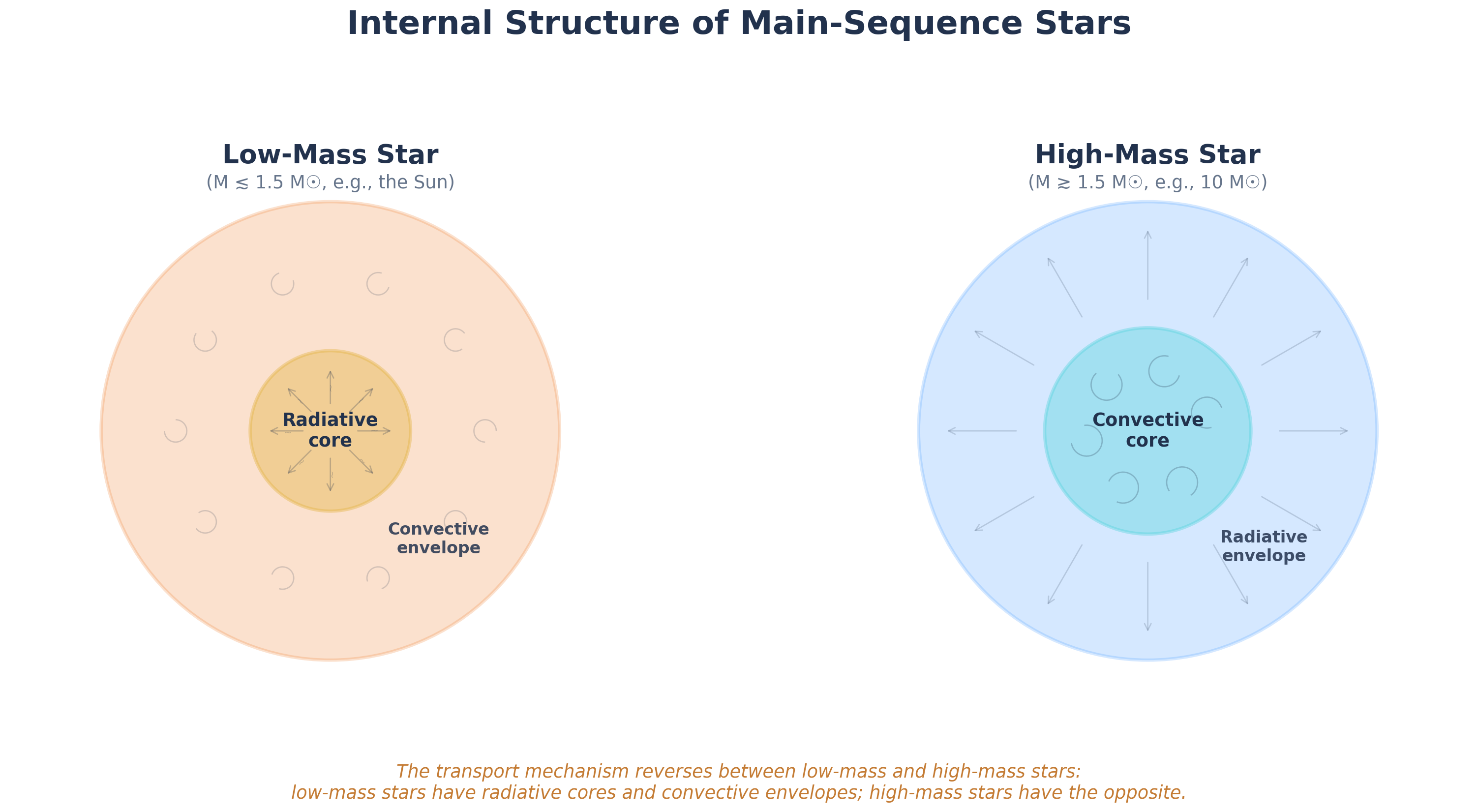
What to notice: this schematic compares the two non-fully-convective archetypes on the main sequence. Solar-like stars have radiative cores and convective envelopes, while higher-mass stars reverse that pattern and develop convective cores with radiative envelopes. The very lowest-mass stars are a third regime and are often nearly fully convective. (Credit: ASTR 201 (generated))
This schematic compares the solar-like and high-mass archetypes. The very lowest-mass main-sequence stars are a third regime: many are nearly fully convective and are therefore not represented by the Sun-like panel.
“Convection happens because the gas is hot.”
False.
Convection happens because the temperature gradient is unstable, not because the gas is merely hot. Hot gas can still be radiatively stable if the required temperature gradient is shallow enough.
Use
\[ \left|\frac{dT}{dr}\right|_{\rm rad} \propto \frac{\kappa \rho L}{T^3 r^2}. \]
Predict which change is more likely to trigger convection:
- increasing the opacity in an outer envelope,
- decreasing the opacity in that same envelope.
Explain the direction of the effect before answering.
Increasing the opacity makes radiative transport less efficient, so the required radiative temperature gradient becomes steeper. That pushes the star closer to convective instability.
Decreasing the opacity makes radiative transport easier, so the required gradient becomes shallower and convection becomes less likely.
Convection mixes stellar material. In a convective core, fresh hydrogen can be carried into the burning region, while helium ash is redistributed throughout the convective zone. That means high-mass main-sequence stars can use a larger fraction of their core hydrogen supply than a radiative-core star can.
This matters later for post-main-sequence evolution:
- convective-core stars build larger, more uniform helium cores,
- solar-like stars build steeper composition gradients in their cores,
- those different internal profiles lead to different evolutionary paths after core hydrogen exhaustion.
Part 6: The Main Sequence Explained
We can now connect the whole argument.
Observable \(\rightarrow\) Model \(\rightarrow\) Inference
Observable: The main sequence is a narrow band in the HR diagram, and more massive stars are much more luminous.
Model: The stellar structure equations, plus the equation of state, opacity law, and nuclear energy generation law, determine the profiles \(M(r)\), \(P(r)\), \(T(r)\), \(L(r)\), and \(\rho(r)\) for a given stellar mass and composition.
Inference: The main sequence is a structural sequence controlled primarily by mass. The steep mass-luminosity relation reflects how gravity, pressure support, nuclear burning, and energy transport fit together inside stars.
Why stars spend most of their lives there
Main-sequence stars are in long-lived thermal balance:
- fusion in the core generates energy,
- that energy is transported to the surface,
- the luminosity leaving the surface matches the energy production rate on long timescales.
This balance is stable because hydrogen-burning stars have a self-regulating thermal feedback:
- if the core produces too much energy, the star expands,
- expansion lowers the core temperature,
- fusion weakens.
If the core produces too little energy:
- the star contracts,
- contraction raises the core temperature,
- fusion strengthens.
That self-regulation is why hydrogen burning can last for billions of years.
The main sequence is not just an observational catalog of stellar properties.
It is the observable signature of a coupled interior physics problem.
Mass sets the gravity scale. Gravity sets the pressure scale. Pressure and the equation of state set the temperature scale. Temperature and opacity determine how energy is produced and transported. That chain forces the steep mass-luminosity relation — it is not optional, and it is not empirical coincidence.
The HR diagram is not just an observational pattern. It is the visible consequence of underlying physical laws operating inside stars.
Reference Tables
The four stellar structure equations
| # | Equation | What it determines | Physical principle |
|---|---|---|---|
| 1 | \[\frac{dM}{dr}=4\pi r^2\rho\] | mass profile | geometry |
| 2 | \[\frac{dP}{dr}=-\frac{GM(r)\rho}{r^2}\] | pressure profile | force balance |
| 3 | \[\frac{dL}{dr}=4\pi r^2\rho\epsilon\] | luminosity profile | energy conservation |
| 4 | \[\left(\frac{dT}{dr}\right)_{\rm rad}=-\frac{3\kappa\rho L(r)}{16\pi a c\,r^2 T^3}\] | radiative temperature gradient | energy transport |
Closure relations
| Relation | Role |
|---|---|
| \[P=\frac{\rho k_B T}{\mu m_H}\] | equation of state |
| \[\kappa=\kappa(\rho,T,\text{composition})\] | opacity law |
| \[\epsilon=\epsilon(\rho,T,\text{composition})\] | nuclear energy generation |
Main-sequence scaling relations
| Relation | Status | Physical meaning |
|---|---|---|
| \(\rho \sim \dfrac{M}{R^3}\) | toy scaling | mean density scale |
| \(P_c \sim \dfrac{G M^2}{R^4}\) | toy scaling | hydrostatic pressure scale |
| \(T_c \sim \dfrac{M}{R}\) | robust leading-order scaling | hotter cores in more massive, more compact stars |
| \(L \propto \dfrac{M^3}{\kappa}\) | toy radiative scaling | steep luminosity trend from transport + gravity |
| \[R \propto M^{3/7}\] | toy pp-chain, radiative result | qualitative mass-radius trend |
| \(\tau_{\mathrm{nuc}} \propto \dfrac{M}{L}\) | general lifetime scaling | fuel divided by burn rate |
Interior regimes across the main sequence
| Regime | Typical mass range | Interior structure | Main reason |
|---|---|---|---|
| very low mass | \[M \lesssim 0.35\,M_\odot\] | nearly fully convective | cool, opaque interiors favor convection |
| solar-like | \[0.35 \lesssim M/M_\odot \lesssim 1.3\] | radiative core, convective envelope | cool outer layers are opaque |
| high mass | \[M \gtrsim 1.3 \text{ to } 1.5\,M_\odot\] | convective core, radiative envelope | CNO burning concentrates luminosity in the core |
Starting from gravity, explain the following causal chain in your own words. For each arrow, identify:
- the physical principle being used,
- the new assumption introduced, and
- the inference that follows.
\[ \rho \sim \frac{M}{R^3} \rightarrow P_c \sim \frac{G M^2}{R^4} \rightarrow T_c \sim \frac{M}{R} \rightarrow L \propto \frac{M^3}{\kappa}. \]
Your explanation should make clear why each step depends on the previous one.
Summary: From Equations to the HR Diagram
The most important ideas from this reading are:
- Stars require differential equations because they are described by radial profiles, not single numbers.
- The four stellar structure equations govern mass, pressure, temperature, and luminosity as functions of radius.
- Those equations must be combined with closure relations such as the equation of state, opacity law, and nuclear energy generation law.
- A toy scaling analysis gives \(L \propto M^3/\kappa\), which explains why the main-sequence mass-luminosity relation is so steep.
- A toy pp-chain, radiative model gives \(R \propto M^{3/7}\), which captures the qualitative trend that more massive stars are larger.
- The nuclear lifetime scales as \(\tau_{\rm nuc} \propto M/L\), so massive stars live much shorter lives because luminosity rises more steeply than fuel supply.
- Convection appears when radiative transport would require too steep a temperature gradient.
- The main sequence is a mass sequence in thermal equilibrium, not just an observational catalog.
The main sequence has edges. Stars cannot be arbitrarily small and still ignite sustained hydrogen fusion, and they cannot be arbitrarily massive and remain stable against strong radiation forces and mass loss.
In the next reading, we will explore those mass limits and see how quantum mechanics and radiation pressure help set the boundaries of the stellar mass function.