Lecture 6: The Boundaries of Stardom — Mass Limits
Why can’t a star be any mass it wants?
Learning Objectives
After completing this reading, you should be able to:
- Explain why there is a minimum mass for hydrogen fusion (\(\sim 0.08\,M_\odot\)) using quantum confinement and electron degeneracy
- State the Heisenberg uncertainty principle and explain how confining particles gives them momentum
- Explain why there is a maximum stellar mass (\(\sim 100\text{–}150\,M_\odot\)) set by the Eddington luminosity
- Describe what brown dwarfs are and why they fail to sustain hydrogen fusion
- Calculate the Eddington luminosity and compare it to a main-sequence luminosity estimate
- Explain how both mass limits depend on fundamental constants of nature
Concept Throughline
The main sequence has edges. You can’t build a star of any mass — nature imposes two boundaries, each enforced by different physics. At the bottom, quantum mechanics prevents continued contraction before the core gets hot enough for sustained fusion. At the top, radiation becomes so important that the most massive stars drive extreme winds and approach a luminosity ceiling. Both limits depend on fundamental constants, which means the range of stellar masses is written into the laws of physics.
Observable: Real stars occupy a limited mass range, from the hydrogen-burning boundary near \(\sim 0.08\,M_\odot\) up to an extreme upper tail near \(\sim 100\text{–}150\,M_\odot\).
Model: Gravity compresses matter, quantum mechanics resists compression at high density, and radiation exerts an outward force in very luminous stars.
Inference: The allowed stellar mass range is not an astrophysical accident. It is set by fundamental physics: quantum support at the low-mass end and radiation-pressure limits at the high-mass end.
This page is required reading, but we will not lecture through it in full during class. I want you to read it because it ties together the full Module 3 story: gravity heats stars, quantum mechanics sets the lower mass limit, and radiation pressure helps set the upper mass limit. In class, I will likely highlight the big ideas and connections, but not walk through every derivation or enrichment section in detail.
Track A (Core, ~25 min): Read Parts 1–5 in order — the minimum mass, Heisenberg uncertainty, maximum mass, and the stellar mass range. Skip any box marked Enrichment.
Track B (Full, ~35 min): Read everything, including the enrichment boxes on brown dwarfs and pair-instability supernovae. These topics connect to Readings 7–10.
If you are short on time, prioritize the Big Idea boxes, the Observable → Model → Inference box, and the Summary at the end.
Both tracks cover all core learning objectives.
We will use three different kinds of mathematical statements, and they do not mean the same thing:
- \(X \propto Y\) means a scaling relation.
- \(X \sim Y\) means an order-of-magnitude estimate.
- \(X \approx Y\) means a numerical approximation after values have been inserted.
Part of the skill in this reading is noticing when we move from physical scaling to rough estimate to final number.
Part 1: The Mystery at the Bottom
The minimum stellar mass is set by quantum mechanics, not by a failure of gravity. Below \(\sim 0.08\,M_\odot\), electron degeneracy halts contraction before the core reaches sustained hydrogen-fusion temperatures.
Observationally, the main sequence ends near \(\sim 0.08\,M_\odot\). Below that boundary, we find brown dwarfs: objects that form like stars but cool and fade instead of sustaining hydrogen fusion. The puzzle is not whether gravity tries to compress them. It does. The puzzle is why gravity fails before fusion ignition.
Why Can’t Small Stars Get Hot Enough?
In Reading 2, we derived the core temperature estimate from the virial theorem:
\[ T_c \sim \frac{\mu G M m_p}{k_B R} \tag{1}\]
What it predicts
Given \(M\) and \(R\), it estimates the core temperature \(T_c\) of a star.
What it depends on
Scales as \(T_c \propto M/R\). Using \(R \propto M^{0.8}\): \(T_c \propto M^{0.2}\) (weak mass dependence).
What it’s saying
Gravity sets the core temperature — deeper potential wells require higher temperatures for pressure support. For the Sun: \(T_c \sim 15\) MK.
Assumptions
- Ideal gas in the core
- Virial theorem applies
- Uses the mean molecular weight \(\mu\) to connect thermal energy per particle to pressure support
- Order-of-magnitude estimate: real stellar structure adds order-unity corrections from central concentration and composition gradients
See: the equation
At first glance, this seems to say that any mass can reach any temperature — just make \(R\) small enough. A contracting protostar should get hotter and hotter until fusion ignites. And indeed, for solar-mass stars, this works: gravitational contraction heats the core to \(\sim 15~\text{MK}\) and fusion begins.
But there’s a hidden assumption: we treated the gas as classical particles — tiny billiard balls with well-defined positions and velocities. This works beautifully for the Sun, where the interparticle spacing is much larger than the particles’ quantum wavelengths. But as the star contracts and the density rises, the particles get squeezed closer and closer together. Eventually, a fundamental limit of quantum mechanics kicks in.
The relation \(T_c \propto M/R\) is a leading-order virial scaling during contraction. It tells us how gravity tends to heat the core.
It does not give us permission to import an empirical main-sequence relation like \(R \propto M^{0.8}\) while the object is still a contracting protostar or a brown dwarf. Different regimes require different assumptions.
The de Broglie Wavelength Revisited
In Reading 3, we introduced the de Broglie wavelength — the quantum wavelength associated with any particle:
\[ \lambda_{\mathrm{dB}} = \frac{h}{p} = \frac{h}{mv} \tag{2}\]
What it predicts
Given a particle’s momentum \(p\) (or mass \(m\) and velocity \(v\)), it predicts the spatial scale over which the particle behaves like a wave.
What it depends on
Scales as \(\lambda \propto 1/p\). Higher momentum means a shorter wavelength and more localized, more classical-looking behavior. Lower momentum means a longer wavelength and a more spatially extended, less classically localized state.
What it’s saying
A particle is not just a tiny hard sphere. When its de Broglie wavelength is not tiny compared with the physical scale of the problem, the classical trajectory picture fails and we must use wave mechanics instead.
Assumptions
- Non-relativistic if we rewrite momentum as \(p = mv\)
- Single particle (not a composite system)
See: the equation
For a particle with thermal energy \(\frac{1}{2}mv^2 \sim \frac{3}{2}k_BT\), the typical velocity is \(v \sim \sqrt{3k_BT/m}\), and the de Broglie wavelength becomes:
\[ \lambda_\text{dB} \sim \frac{h}{\sqrt{3mk_BT}} \]
At the Sun’s core (\(T_c \sim 1.5 \times 10^7~\text{K}\)), the de Broglie wavelength of a proton is:
\[ \lambda_\text{dB} \sim \frac{6.63 \times 10^{-27}~\text{erg}\cdot\text{s}} {\sqrt{3 \times 1.67 \times 10^{-24}~\text{g} \times 1.38 \times 10^{-16}~\text{erg}\,\text{K}^{-1} \times 1.5 \times 10^7~\text{K}}} \]
\[ \lambda_\text{dB} \sim 3 \times 10^{-10}~\text{cm} \]
The average interparticle spacing in the solar core is:
\[ d \sim n^{-1/3} \sim \left(\frac{\rho}{m_p}\right)^{-1/3} \sim \left(\frac{150~\text{g}\,\text{cm}^{-3}}{1.67 \times 10^{-24}~\text{g}}\right)^{-1/3} \]
\[ d \sim 2 \times 10^{-9}~\text{cm} \]
So in the Sun, \(\lambda_\text{dB} \sim 3 \times 10^{-10}~\text{cm} \ll d \sim 2 \times 10^{-9}~\text{cm}\) — the quantum wavelength is about \(7\times\) smaller than the particle spacing. The particles “fit” comfortably as classical objects. Quantum mechanics plays a role in nuclear reactions (tunneling), but the gas behavior is classical.
This proton calculation is an intuition check, not the actual brown-dwarf support mechanism. Brown dwarfs are supported by electron degeneracy pressure. Because electrons are much lighter than protons, they acquire much larger quantum wavelengths and become degenerate first.
We can make that statement more explicit. Start from \[ \lambda_\text{dB} = \frac{h}{mv}. \]
For particles in the same thermal environment, \[ v \sim \sqrt{\frac{3k_B T}{m}}, \] so \[ \lambda_\text{dB} \sim \frac{h}{m\sqrt{3k_B T/m}} \propto \frac{1}{\sqrt{m}}. \]
Therefore, \[ \frac{\lambda_e}{\lambda_p} \sim \sqrt{\frac{m_p}{m_e}} \approx \sqrt{1836} \approx 43. \]
So at the same temperature, electron quantum wavelengths are tens of times larger than proton quantum wavelengths. That is why electrons reach the overlap condition first and become degenerate first.
When Quantum Effects Take Over
Now imagine a lower-mass object — say \(0.05\,M_\odot\) — trying to contract toward fusion ignition. As it contracts:
- \(\rho\) increases, so the interparticle spacing \(d \propto \rho^{-1/3}\) decreases
- \(T\) increases (virial theorem), so \(\lambda_\text{dB} \propto T^{-1/2}\) decreases — but more slowly than \(d\)
Eventually, the electron de Broglie wavelength becomes comparable to the electron spacing. At that point, the gas is no longer classical. Electron wavefunctions overlap, and quantum mechanics fundamentally changes the gas’s behavior.
The critical condition:
\[ \lambda_{\text{dB},e} \sim n_e^{-1/3} \]
When this condition is reached, the electrons become degenerate — a state where quantum mechanical effects dominate the pressure. We’ll explore degeneracy pressure fully in Reading 8, but the key insight is this: degenerate matter resists further compression even without any thermal energy. Quantum mechanics generates pressure at zero temperature.
This is the logic chain so far:
- gravity compresses the object,
- compression reduces the particle spacing,
- electrons reach the quantum-overlap condition first,
- and once they do, the gas stops behaving classically.
That transition is the beginning of the minimum-mass story.
In the Sun’s core, we found \(\lambda_\text{dB}/d \sim 1/7\). Why does this ratio tell us the solar core is safely classical? What would happen if a star contracted enough that \(\lambda_\text{dB}/d \sim 1\)?
When \(\lambda_\text{dB} \ll d\), each particle’s wavefunction is much smaller than the space between particles — the particles behave as localized, classical objects that don’t “know” about each other’s quantum states. This is the regime where the ideal gas law (\(P = nk_BT\)) works perfectly.
When \(\lambda_\text{dB} \sim d\), the wavefunctions overlap. The particles can no longer be treated as independent classical objects. Quantum mechanics — specifically the Pauli exclusion principle (Reading 8) — demands that no two identical fermions (electrons, protons) can occupy the same quantum state. This generates a new kind of pressure (degeneracy pressure) that resists further compression, even at zero temperature. The ideal gas law breaks down and must be replaced by quantum statistics.
Part 2: The Heisenberg Uncertainty Principle
Confinement Creates Momentum
The de Broglie wavelength argument tells us when quantum effects matter. But why does confining particles generate pressure? The answer is one of the deepest results in quantum mechanics: the Heisenberg uncertainty principle.
\[ \Delta x \cdot \Delta p \geq \frac{\hbar}{2} \tag{3}\]
What it predicts
Given the uncertainty in position \(\Delta x\), it predicts the minimum uncertainty in momentum \(\Delta p\) (or vice versa).
What it depends on
Scales as \(\Delta p \propto 1/\Delta x\). Halving the confinement doubles the minimum momentum.
What it’s saying
Confining a particle to a smaller region forces it to have larger momentum — and therefore larger kinetic energy. This is the origin of degeneracy pressure: gravity confines electrons, but confinement creates pressure that resists further compression.
Assumptions
- Fundamental quantum mechanical relation — no approximations
- \(\hbar/2\) is the minimum product; actual uncertainties may be larger
- Applies to any conjugate pair (position-momentum, energy-time)
See: the equation
where \(\Delta x\) is the uncertainty in position and \(\Delta p\) is the uncertainty in momentum. The reduced Planck constant is
\[ \hbar = \frac{h}{2\pi} = 1.055 \times 10^{-27}~\text{erg}\cdot\text{s}. \]
What this says: You cannot simultaneously know a particle’s exact position and exact momentum. The more precisely you confine a particle (smaller \(\Delta x\)), the larger its momentum uncertainty (\(\Delta p\)) must be — and therefore the faster the particle moves.
This is not a limitation of measurement technology. It is a fundamental property of nature. A particle confined to a region of size \(\Delta x\) must have a minimum momentum of:
\[ p_\text{min} \sim \frac{\hbar}{\Delta x} \]
To get the corresponding kinetic-energy scale, substitute that momentum into the non-relativistic kinetic-energy relation
\[ E \sim \frac{p^2}{2m}. \]
Then
\[ E_\text{min} \sim \frac{1}{2m}\left(\frac{\hbar}{\Delta x}\right)^2 \sim \frac{\hbar^2}{2m(\Delta x)^2} \]
Now set the confinement scale by the interparticle spacing:
\[ \Delta x \sim d \sim n^{-1/3}. \]
Then
\[ E_\text{min} \sim \frac{\hbar^2}{2m d^2} \propto \frac{1}{d^2} \propto n^{2/3}. \]
Compression raises the density, and higher density forces higher momentum and higher kinetic energy. That is the origin of the quantum pressure trend.
Why This Matters for Stars
In a dense stellar core, the interparticle spacing \(d \sim n^{-1/3}\) sets the confinement scale. If you try to squeeze particles closer together (\(\Delta x \sim d\) decreasing), the uncertainty principle forces their momenta up:
\[ p \sim \frac{\hbar}{d} \sim \hbar\,n^{1/3} \]
These fast-moving particles exert pressure — even if the temperature is zero. This is degeneracy pressure, a fundamentally quantum mechanical effect with no classical analogue.
The critical insight: gravity tries to compress the star, but compression creates quantum momentum, which creates pressure that resists further compression. There’s a natural equilibrium point where gravitational squeezing balances quantum resistance.
“Degeneracy pressure comes from high temperature.”
No. Thermal pressure and degeneracy pressure come from different physics.
- Thermal pressure depends on random thermal motion and scales like \(P \propto nk_B T\).
- Degeneracy pressure comes from quantum confinement and state filling, and it exists even at \(T = 0\).
The star does not need to be hot for degeneracy pressure to exist. It needs to be dense.
We are building quantum mechanics step by step across Module 3:
| Reading | QM Concept | Stellar Application |
|---|---|---|
| R3 (Fusion) | Wave-particle duality, de Broglie \(\lambda\) | Tunneling through the Coulomb barrier |
| R6 (This reading) | Heisenberg uncertainty principle | Minimum stellar mass; confinement → momentum |
| R8 (Chandrasekhar) | Pauli exclusion principle | Degeneracy pressure; maximum white dwarf mass |
Each reading builds on the previous one. By Reading 8, you’ll have the three QM pillars needed to understand the endpoints of stellar evolution.
Worked Example: Zero-Point Energy of a Confined Electron
Suppose an electron is confined to a box of size \(\Delta x = 10^{-8}~\text{cm}\) (roughly atomic scale, about 1 angstrom). What is its minimum kinetic energy?
From the uncertainty principle:
\[ p_\text{min} \sim \frac{\hbar}{\Delta x} = \frac{1.055 \times 10^{-27}~\text{erg}\cdot\text{s}}{10^{-8}~\text{cm}} = 1.055 \times 10^{-19}~\text{g}\,\text{cm}/\text{s} \]
\[ E_\text{min} \sim \frac{p_\text{min}^2}{2m_e} = \frac{(1.055 \times 10^{-19})^2}{2 \times 9.11 \times 10^{-28}} \sim 6 \times 10^{-12}~\text{erg} \sim 4~\text{eV} \]
This is the zero-point energy — the minimum kinetic energy an electron must have when confined to atomic scales. The number matters less than the pattern: tighter confinement forces larger momentum and therefore larger kinetic energy. That same logic is what makes degeneracy pressure rise in dense stellar matter.
Unit sanity check
Check the units in the kinetic-energy estimate:
\[ [E] = \frac{[\text{g}\,\text{cm}/\text{s}]^2}{\text{g}} = \frac{\text{g}^2\,\text{cm}^2\,\text{s}^{-2}}{\text{g}} = \text{g}\,\text{cm}^2\,\text{s}^{-2} = \text{erg}. \]
So the expression has the correct energy units. \(\checkmark\)
If you squeeze the box to half its size (\(\Delta x \rightarrow \Delta x/2\)), what happens to the minimum kinetic energy?
\(E_\text{min} \propto 1/(\Delta x)^2\), so halving the box size quadruples the kinetic energy:
\[ E_\text{min}' = \frac{\hbar^2}{2m(\Delta x/2)^2} = 4 \times \frac{\hbar^2}{2m(\Delta x)^2} = 4\,E_\text{min} \]
This is why degeneracy pressure rises so steeply with density — squeezing particles closer gives them much more momentum. And it’s why quantum mechanics can halt gravitational collapse: the more gravity compresses, the harder quantum pressure pushes back.
Part 3: The Minimum Stellar Mass
The Physical Argument
For a collapsing gas cloud to become a hydrogen-burning star, its core must reach \(T_c \sim 3 \times 10^6~\text{K}\) — the minimum temperature for pp-chain fusion to sustain energy losses. (This is lower than the Sun’s \(15~\text{MK}\) because fusion rates have a steep temperature dependence — even a slow trickle of fusion at \(3~\text{MK}\) can sustain a very low-luminosity star.)
As the protostar contracts, the virial theorem tells us the core heats up: \(T_c \propto M/R\). But contraction also increases the density, and eventually the electrons become degenerate. Once that happens, the gas behaves differently:
- Pressure no longer depends on temperature. Degeneracy pressure is set by density, not \(T\). So adding heat doesn’t increase pressure — the star can’t expand in response to heating.
- Contraction halts. Degeneracy pressure balances gravity at a specific radius, regardless of temperature.
- The core may never get hot enough. If degeneracy kicks in before the core reaches \(\sim 3 \times 10^6~\text{K}\), the star is stuck — it has a cold, dense, quantum-pressure-supported core that will never achieve sustained fusion.
The Critical Mass
The hydrogen-burning minimum mass (HBMM) depends on when degeneracy sets in relative to the fusion ignition temperature. Detailed calculations give:
\[ M_\text{HBMM} \approx 0.08\,M_\odot \approx 80\,M_\text{Jupiter} \tag{4}\]
What it predicts
The minimum mass for sustained hydrogen fusion.
What it depends on
Set by when electron degeneracy halts contraction before core reaches \(T \sim 3 \times 10^6\) K.
What it’s saying
Below \(\sim 0.08\,M_\odot\), electron degeneracy halts contraction before the core reaches hydrogen-fusion temperatures. Objects below this limit are brown dwarfs.
Assumptions
- Solar composition (hydrogen-rich)
- Detailed value depends on opacity, composition, and equation of state
- Scales with fundamental constants: \(\hbar\), \(c\), \(G\), \(m_p\), \(\alpha_\text{EM}\)
See: the equation
Objects below this mass are called brown dwarfs — failed stars that glow faintly from residual gravitational contraction energy (Kelvin-Helmholtz) and possibly brief deuterium burning, but never achieve sustained hydrogen fusion.
Why 0.08 Solar Masses?
The minimum mass can be estimated by asking: at what mass does the electron degeneracy pressure equal the pressure needed for fusion ignition? The argument involves matching degeneracy pressure (which rises steeply with density) to the gravitational pressure needed to keep heating the core. The exact coefficient requires detailed modeling, but the scale depends on fundamental constants: quantum mechanics through \(\hbar\), gravity through \(G\), and microphysics through particle masses and electromagnetic interactions.
The minimum stellar mass is not a coincidence of astrophysics — it is built into the laws of physics.
This is the causal bridge to the rest of the reading: at the low-mass end, quantum mechanics stops gravity from finishing the job. At the high-mass end, gravity succeeds in making the star extremely luminous, but that luminosity creates a new opponent: radiation force.
The minimum-mass question is a race between two processes:
- virial heating trying to raise the core temperature toward hydrogen ignition
- electron degeneracy turning on as the gas becomes denser
If ignition wins first, the object becomes a star. If degeneracy wins first, the object becomes a brown dwarf. That is the causal structure behind the \(0.08\,M_\odot\) boundary.
Observable: The faintest, coolest main-sequence stars have spectral type around L0, \(T_{\text{eff}} \sim 2{,}000~\text{K}\), and \(L \sim 10^{-4}\,L_\odot\). Below this boundary, objects cool and fade over time instead of settling onto a stable hydrogen-burning main sequence.
Model: Virial heating gives the rough core-temperature trend, while quantum mechanics says sufficiently dense electrons become degenerate and generate pressure even without thermal support.
Inference: The star/brown-dwarf boundary near \(\sim 0.08\,M_\odot\) marks the mass where electron degeneracy halts contraction before sustained hydrogen fusion can take over.
Brown dwarfs with masses \(0.013\text{–}0.08\,M_\odot\) briefly burn deuterium (\(^2\text{H} + ^1\text{H} \rightarrow {^3\text{He}} + \gamma\)) but not hydrogen. Why is the deuterium-burning threshold lower than the hydrogen-burning threshold?
Deuterium fusion has a lower Coulomb barrier than the pp-chain’s first step. In the pp-chain, two protons must fuse — both are positively charged, and one must convert to a neutron via the weak force (the slowest step). In deuterium burning, a proton fuses with a deuteron (one proton + one neutron). The Coulomb barrier is the same charge (\(Z_1 Z_2 = 1\)), but the reduced mass is different and the strong force reaction (\(^2\text{H} + p\)) doesn’t require the weak force — it’s purely an electromagnetic + strong interaction.
The deuterium-burning threshold is \(T \sim 10^6~\text{K}\) vs. \(\sim 3 \times 10^6~\text{K}\) for sustained hydrogen burning. Objects between \(\sim 13\,M_\text{Jupiter}\) (\(0.013\,M_\odot\)) and \(\sim 80\,M_\text{Jupiter}\) (\(0.08\,M_\odot\)) can burn their initial deuterium supply (which is tiny — \(\sim 2 \times 10^{-5}\) by mass from Big Bang nucleosynthesis) but can’t sustain pp-chain hydrogen fusion.
Brown dwarfs occupy a fascinating middle ground between stars and giant planets:
| Property | Brown Dwarf (\(0.05\,M_\odot\)) | Low-mass Star (\(0.1\,M_\odot\)) | Jupiter |
|---|---|---|---|
| Core H fusion? | No | Yes | No |
| D burning? | Yes (briefly) | Yes (early) | No |
| Energy source | Gravitational contraction | Nuclear fusion | Gravitational contraction |
| Luminosity | \(\sim 10^{-5}\,L_\odot\) (fading) | \(\sim 10^{-3}\,L_\odot\) (stable) | \(\sim 10^{-9}\,L_\odot\) |
| \(T_\text{eff}\) | \(\sim 1{,}000~\text{K}\) (cooling) | \(\sim 3{,}000~\text{K}\) (stable) | \(\sim 130~\text{K}\) |
| Fate | Cools forever | Burns for trillions of yr | Cools forever |
Brown dwarfs were predicted theoretically in the 1960s but not discovered until 1995 (Gliese 229B, detected in the infrared). They are extremely common — possibly as numerous as stars — but very difficult to detect because they are so faint. Modern infrared surveys (e.g., the James Webb Space Telescope) have revealed that brown dwarfs bridge the gap between the smallest stars and the largest planets, with some brown dwarfs having atmospheres with clouds of iron and silicate droplets.
Part 4: The Maximum Stellar Mass
The maximum stellar mass is set by radiation pressure, not by a failure of gravity. Above roughly \(\sim 100\text{–}150\,M_\odot\), stars approach the Eddington regime, where radiation pressure and powerful winds make further stable growth difficult.
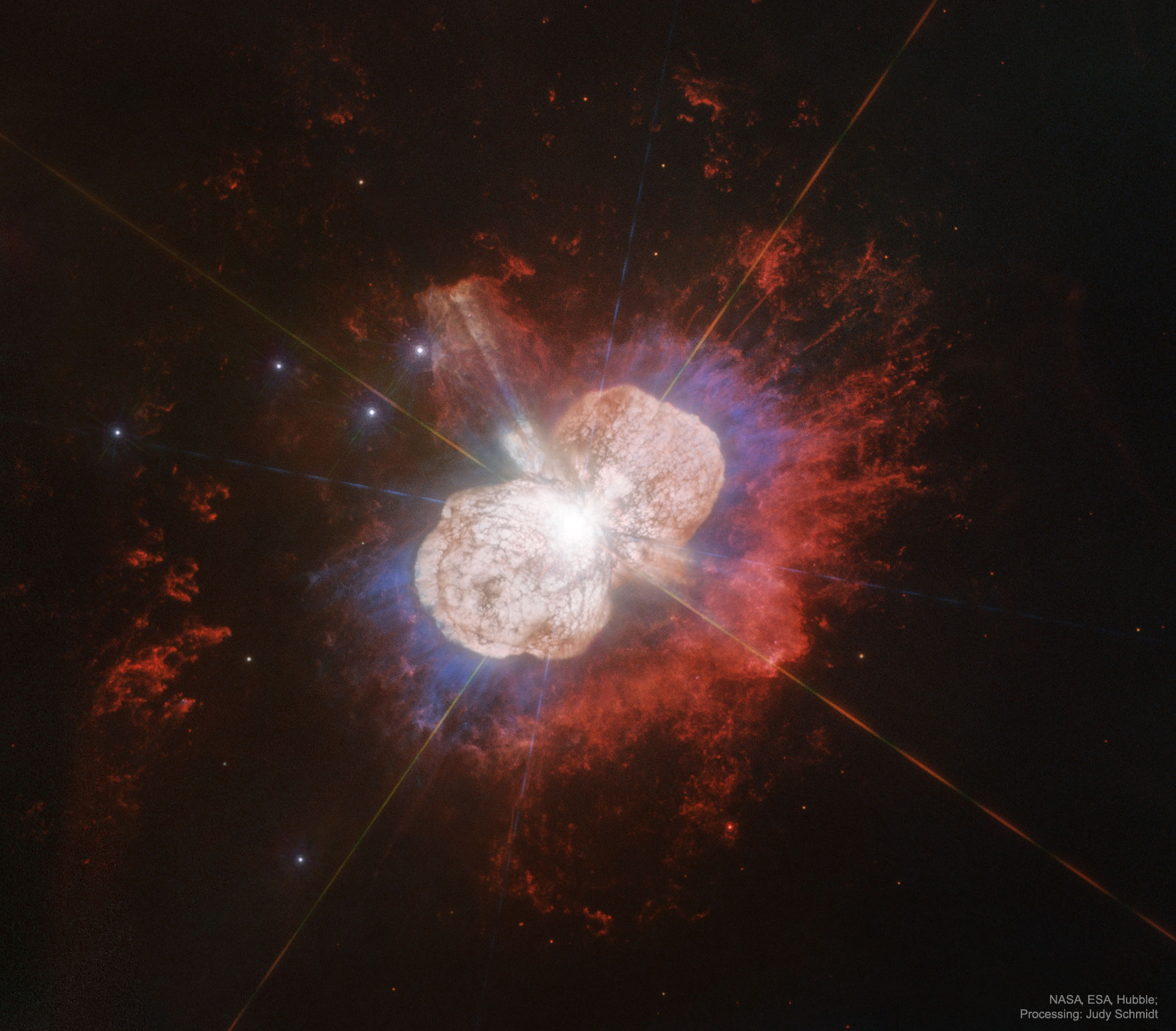
Eta Carinae — one of the most massive and luminous stars in the Milky Way (~100–150 M☉, ~5 × 10⁶ L☉). It sits at the Eddington limit, where radiation pressure nearly overwhelms gravity. The bipolar Homunculus Nebula was ejected during the ‘Great Eruption’ of the 1840s, when the star briefly became the second-brightest star in the sky. This is what happens when a star pushes against the maximum mass ceiling. (Credit: NASA/ESA/HST; Processing: Judy Schmidt)
The Eddington Limit Revisited
In Reading 4, we introduced the Eddington luminosity — the maximum luminosity a star can sustain in hydrostatic equilibrium:
\[ L_\text{Edd} = \frac{4\pi G M c}{\kappa} \tag{5}\]
What it predicts
Given stellar mass \(M\) and opacity \(\kappa\), it predicts the maximum luminosity a star can sustain in hydrostatic equilibrium.
What it depends on
Scales as \(L_\text{Edd} \propto M/\kappa\). More massive stars tolerate higher luminosities.
What it’s saying
When radiation force on the gas rivals gravity, stars approach a luminosity ceiling. Near that regime, radiation pressure and mass loss strongly reshape the structure and help set the upper stellar-mass scale.
Assumptions
- Spherically symmetric
- Electron-scattering opacity dominates (\(\kappa \approx 0.34~\text{cm}^2/\text{g}\))
- Steady state (no time-dependent effects)
See: the equation
This result comes from a direct force balance. Radiation pushes outward because photons transfer momentum to matter, while gravity pulls inward:
\[ f_{\text{rad}} = \frac{\kappa F}{c} \]
\[ F = \frac{L}{4 \pi r^2} \]
\[ f_{\text{grav}} = \frac{GM}{r^2} \]
Here \(f_{\text{rad}}\) and \(f_{\text{grav}}\) are forces per unit mass, \(F\) is the radiative flux, \(\kappa\) is the opacity in \(\text{cm}^2/\text{g}\), and \(c\) is the speed of light. If we substitute the flux into the radiation-force expression and then set outward and inward forces equal, we get
\[ \frac{\kappa L}{4 \pi r^2 c} = \frac{GM}{r^2} \]
The \(r^2\) cancels from both sides, which is why the Eddington limit depends on total mass and luminosity rather than on the radius at which we evaluate the balance:
\[ L_{\text{Edd}} = \frac{4 \pi GMc}{\kappa}. \]
This is the physical point to remember: the Eddington luminosity is not a mysterious formula to memorize. It is the luminosity at which radiation force can compete directly with gravity.
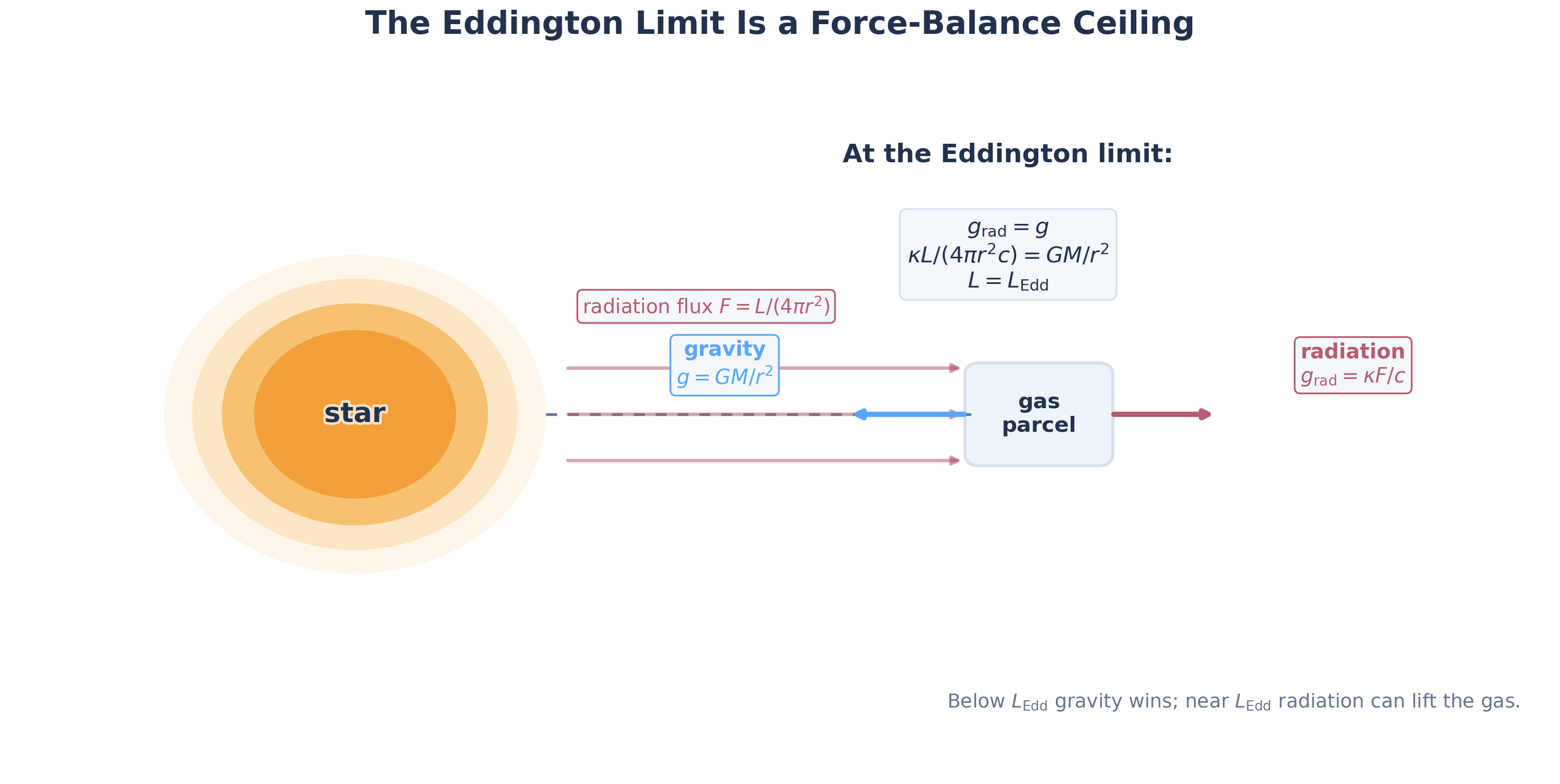
What to notice: the Eddington luminosity comes from a force balance on the same gas parcel. Gravity pulls inward with \(g = GM/r^2\), while radiation pushes outward with \(g_\text{rad} = \kappa L/(4\pi r^2 c)\). Setting those equal gives the luminosity at which radiation pressure can compete directly with gravity. (Credit: ASTR 201 (generated))
For electron-scattering opacity (\(\kappa \approx 0.34~\text{cm}^2/\text{g}\)), this gives:
\[ \frac{L_\text{Edd}}{L_\odot} \approx 3.8 \times 10^4 \left(\frac{M}{M_\odot}\right) \]
The Eddington luminosity scales linearly with mass: \(L_\text{Edd} \propto M\).
Reaching the Eddington regime does not mean the star instantly explodes.
It means radiation force has become dynamically important enough that the star cannot ignore it. In practice, the star responds by readjusting its structure and by driving strong winds that remove mass. The Eddington limit marks a stability threshold, not a cartoon moment where gravity suddenly turns off.
Why There’s a Maximum Mass
For moderate-mass main-sequence stars, the luminosity follows the mass-luminosity relation from Reading 5:
\[ \frac{L}{L_\odot} \approx \left(\frac{M}{M_\odot}\right)^{3.5} \tag{6}\]
What it predicts
Given a main-sequence star’s mass \(M\), it predicts its luminosity \(L\) (approximately).
What it depends on
Scales as \(L \propto M^{3.5}\) — a steep power law.
What it’s saying
Mass is the master variable for main-sequence stars. Doubling the mass increases luminosity by roughly \(2^{3.5} \approx 11\times\).
Assumptions
- Star is on the main sequence (core hydrogen burning)
- Exponent \(\approx 3.5\) is an approximation — actual slope varies from \(\sim 2.3\) for \(M < 0.43\,M_\odot\) to \(\sim 4\) for \(M > 2\,M_\odot\)
- Empirical relation derived from binary star mass measurements
See: the equation
If you naively extrapolate that moderate-mass trend, luminosity rises much faster than the Eddington limit:
| \(M/M_\odot\) | Naive \(L/L_\odot\) (\(\propto M^{3.5}\)) | \(L_\text{Edd}/L_\odot\) (\(\propto M\)) | Naive \(L/L_\text{Edd}\) |
|---|---|---|---|
| 1 | 1 | \(3.8 \times 10^4\) | \(2.6 \times 10^{-5}\) |
| 10 | \(3{,}200\) | \(3.8 \times 10^5\) | \(8.4 \times 10^{-3}\) |
| 50 | \(8.8 \times 10^5\) | \(1.9 \times 10^6\) | 0.46 |
| 100 | \(10^7\) | \(3.8 \times 10^6\) | 2.6 |
This table is useful because it shows why an upper limit appears at all. If luminosity rises faster than the Eddington limit, radiation becomes increasingly important. But this table is only an order-of-magnitude guide: at the highest masses, the mass-luminosity relation flattens, radiation pressure reshapes the interior, and the star responds by driving powerful radiation-driven winds that strip mass from the surface.
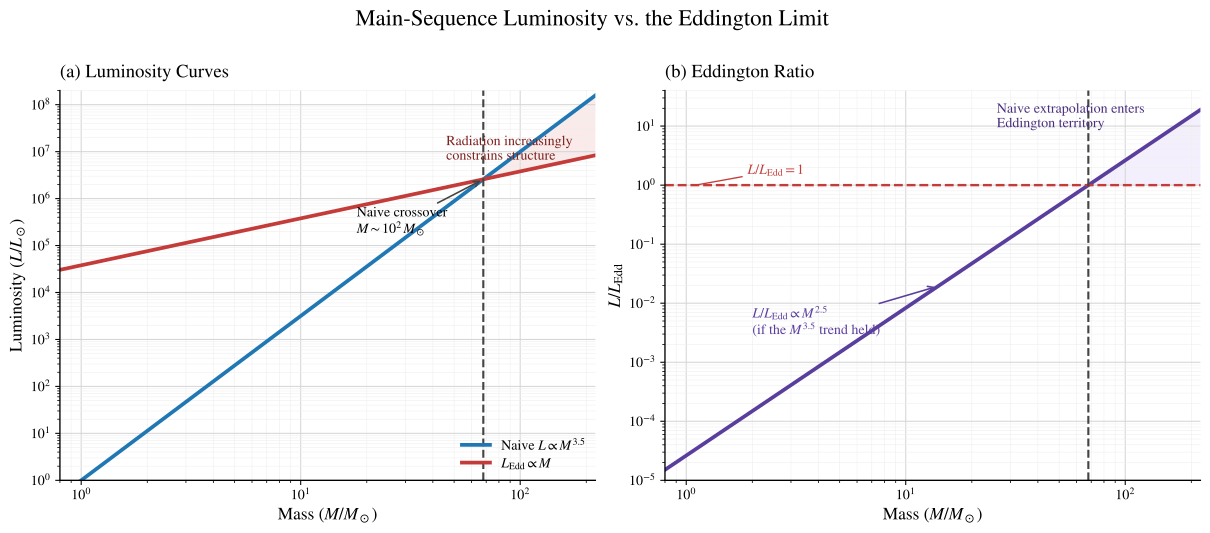
What to notice: the naive main-sequence relation rises much more steeply than the Eddington limit. In the left panel, the two curves approach each other near \(M \sim 10^2\,M_\odot\). In the right panel, the ratio \(L/L_{\mathrm{Edd}}\) rises as \(M^{2.5}\) if the moderate-mass trend were extrapolated blindly, which is why an upper-mass scale appears instead of arbitrarily luminous stable stars. (Credit: ASTR 201 (generated))
Finding the Maximum Mass
The crossover occurs when \(L = L_\text{Edd}\):
\[ \left(\frac{M}{M_\odot}\right)^{3.5} = 3.8 \times 10^4 \left(\frac{M}{M_\odot}\right) \]
\[ \left(\frac{M}{M_\odot}\right)^{2.5} = 3.8 \times 10^4 \]
\[ \frac{M}{M_\odot} = (3.8 \times 10^4)^{1/2.5} \]
\[ \frac{M}{M_\odot} = (3.8 \times 10^4)^{0.4} \approx 100 \]
So a naive crossover estimate gives an upper-mass scale of about \[ \boxed{M_\text{max} \sim 100\,M_\odot}. \]
In practice, stars up to roughly \(\sim 150\text{–}200\,M_\odot\) have been observed. The key lesson is not that stars hit a hard wall at exactly \(100\,M_\odot\), but that beyond this scale radiation increasingly constrains the structure, flattens the luminosity trend, and drives strong mass loss.
Pause and name the logic chain in words:
- Gravity makes very massive stars centrally compressed and extremely luminous.
- If luminosity rises too quickly, radiation can no longer be treated as a minor correction.
- Once radiation force becomes comparable to gravity, the star cannot keep growing in the same way.
That is why the maximum mass is an upper-mass scale rather than an arbitrary catalog fact.
The most massive known star, R136a1, has a current mass of \(\sim 170\,M_\odot\) and a luminosity of \(\sim 4 \times 10^6\,L_\odot\). Calculate its Eddington ratio \(L/L_\text{Edd}\) and explain why it hasn’t been blown apart.
\[ L_\text{Edd} = 3.8 \times 10^4 \times 170\,L_\odot \]
\[ L_\text{Edd} = 6.5 \times 10^6\,L_\odot \]
\[ \frac{L}{L_\text{Edd}} = \frac{4 \times 10^6}{6.5 \times 10^6} \approx 0.6 \]
R136a1 is at \(\sim 60\%\) of its Eddington limit — close, but not exceeding it. This is consistent with the star surviving, though it experiences strong radiation-driven mass loss. Its birth mass was likely higher (\(\sim 250\text{–}300\,M_\odot\)), with decades of mass loss having already stripped substantial material. The key subtlety: the simple \(L \propto M^{3.5}\) relation overestimates luminosities at very high masses. The actual mass-luminosity relation flattens (closer to \(L \propto M^{1\text{–}2}\)) near the Eddington limit, because radiation pressure modifies the star’s internal structure.
Why the Maximum Mass is Also Set by Constants
Just as the minimum mass depends on fundamental constants, so does the maximum mass. The Eddington limit comes from balancing radiation force (\(L\kappa/(4\pi r^2 c)\)) against gravity (\(GM/r^2\)), so the upper-mass scale depends on gravity through \(G\), on relativity through \(c\), and on opacity physics through \(\kappa\) (which in hot stars is tied to electron scattering).
The minimum mass is not arbitrary, and the maximum mass is not just an observational accident.
At the low-mass end, quantum mechanics prevents the core from heating indefinitely. At the high-mass end, radiation force prevents luminosity from remaining dynamically negligible. In both cases, the stellar mass range is constrained by physical laws, not by incomplete astronomical surveys.
Very massive stars (\(M \gtrsim 130\,M_\odot\) at the end of their lives) face an even more dramatic fate. In their extremely hot cores (\(T \gtrsim 10^9~\text{K}\)), photons become energetic enough to spontaneously create electron-positron pairs (\(\gamma \rightarrow e^+ + e^-\)). This process removes photons that were providing radiation pressure support. The core partially collapses, triggers explosive oxygen and silicon burning, and the resulting thermonuclear explosion can be powerful enough to completely obliterate the star — leaving no remnant at all.
These pair-instability supernovae are predicted to be among the most energetic explosions in the universe, outshining entire galaxies for weeks. They may have been common among the first generation of stars (which formed from pristine hydrogen and helium, with no metals to increase opacity and drive winds). Several candidate events have been observed (e.g., SN 2007bi), though confirmation remains challenging.
This is another case where quantum mechanics (pair creation from \(E = mc^2\)) has dramatic astrophysical consequences — a theme that runs through all of Module 3.
Part 5: The Stellar Mass Range
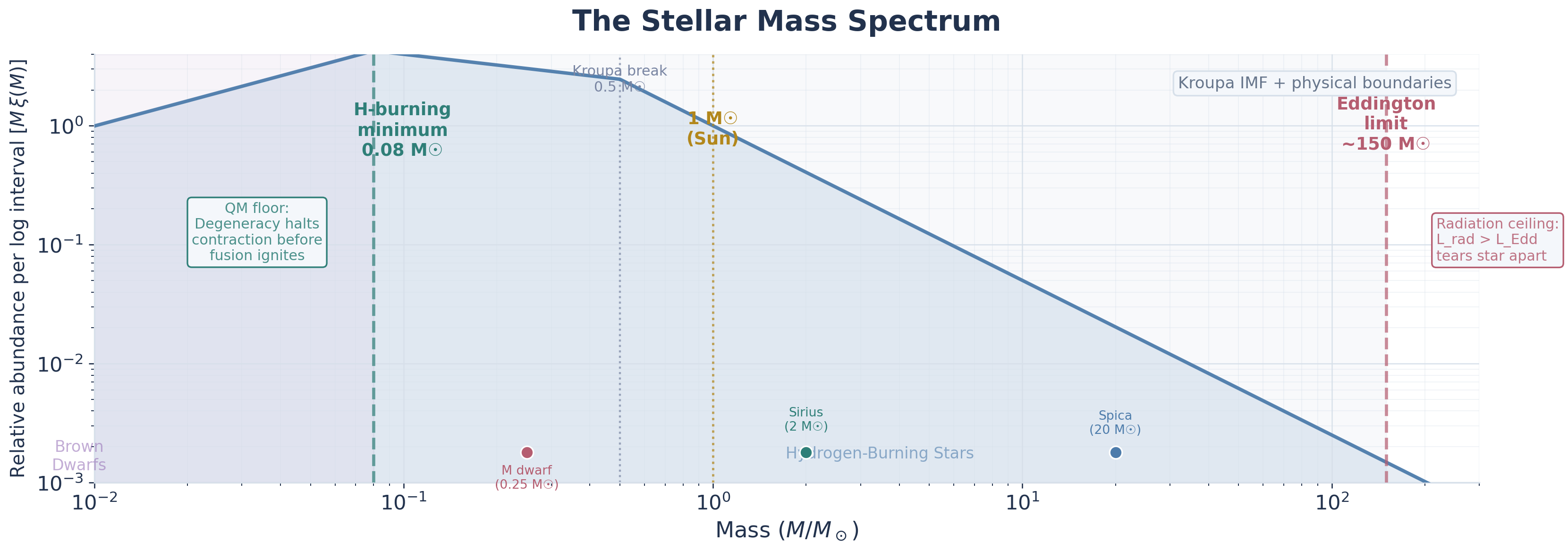
The stellar mass spectrum with its quantum floor and radiation ceiling. The underlying IMF is a schematic Kroupa broken power law with slopes \(\alpha = 0.3\) below \(0.08\,M_\odot\), \(\alpha = 1.3\) from \(0.08\) to \(0.5\,M_\odot\), and \(\alpha = 2.3\) above \(0.5\,M_\odot\). The y-axis shows abundance per logarithmic mass interval, \(M\,\xi(M)\), which is the right visual comparison for a log-mass x-axis. What to notice: the distribution bends across the brown-dwarf and low-mass-star regime, then declines steadily through the massive-star tail without dropping to zero before the Eddington upper-mass scale. (Credit: ASTR 201 (generated))
Nature’s Sweet Spot
Putting the minimum and maximum together:
\[ 0.08\,M_\odot \lesssim M_\star \lesssim 150\,M_\odot \]
This is a factor of \(\sim 2{,}000\) in mass — which sounds like a lot, but consider:
- The range of planetary masses spans a factor of \(\sim 6{,}000\) (Mercury to Jupiter)
- The range of galaxy masses spans a factor of \(\sim 10^{6}\)
- The range of atomic masses spans a factor of \(\sim 240\)
Stars occupy a remarkably narrow mass range, and both boundaries are set by fundamental physics:
| Boundary | Physics | Mechanism |
|---|---|---|
| Minimum (\(\sim 0.08\,M_\odot\)) | Quantum mechanics | Degeneracy halts contraction before fusion ignition |
| Maximum (\(\sim 150\,M_\odot\)) | Radiation pressure | Stars approach the Eddington regime, drive strong winds, and struggle to grow further |
The Mass Function: How Many Stars of Each Mass?
Not all stellar masses are equally likely. The initial mass function (IMF) — the distribution of birth masses — is observed to follow approximately:
\[ \frac{dN}{dM} \propto M^{-2.35} \]
This is the Salpeter IMF (Edwin Salpeter, 1955), and it works best as the high-mass slope. The full IMF flattens at lower masses, but the qualitative lesson is the same: low-mass stars vastly outnumber high-mass stars.
| Mass range | Birth abundance |
|---|---|
| Low-mass red dwarfs | Very common |
| Solar-mass stars | Common |
| Massive O/B stars | Rare |
| Extreme \(> 50\,M_\odot\) stars | Very rare |
The universe overwhelmingly favors making small stars — which, combined with their long lifetimes, means the most common stellar residents of the galaxy are faint, cool red dwarfs.
Using the Salpeter IMF (\(dN/dM \propto M^{-2.35}\)), estimate how many \(10\,M_\odot\) stars form for every one \(100\,M_\odot\) star.
The ratio of stars at two different masses is:
\[ \frac{N(10\,M_\odot)}{N(100\,M_\odot)} \sim \left(\frac{10}{100}\right)^{-2.35} = 10^{2.35} \approx 220 \]
For every star born at \(100\,M_\odot\), roughly \(220\) stars are born at \(10\,M_\odot\). This steep falloff explains why O and B stars are so rare despite being the most luminous and dramatic — the mass function strongly disfavors them.
Reference Tables
Mass Limits at a Glance
| Quantity | Value | Physical Origin |
|---|---|---|
| Minimum H-burning mass | \(\sim 0.08\,M_\odot\) (\(\sim 80\,M_\text{Jupiter}\)) | Quantum degeneracy halts contraction |
| Deuterium-burning limit | \(\sim 0.013\,M_\odot\) (\(\sim 13\,M_\text{Jupiter}\)) | Lower Coulomb barrier for D+H |
| Eddington luminosity | \(L_\text{Edd} \approx 3.8 \times 10^4 (M/M_\odot)\,L_\odot\) | Radiation force = gravity |
| Maximum stellar mass | \(\sim 100\text{–}150\,M_\odot\) | Radiation pressure and winds become dominant near the Eddington regime |
| Salpeter IMF slope | \(dN/dM \propto M^{-2.35}\) | Empirical (origin debated) |
Symbol Legend
| Symbol | Meaning | CGS Units |
|---|---|---|
| \(\Delta x\) | Position uncertainty | cm |
| \(\Delta p\) | Momentum uncertainty | \(\text{g}\,\text{cm}/\text{s}\) |
| \(\hbar\) | Reduced Planck constant (\(h/2\pi\)) | \(1.055 \times 10^{-27}~\text{erg}\cdot\text{s}\) |
| \(\alpha_\text{EM}\) | Fine-structure constant (\(e^2/\hbar c\)) | \(1/137\) (dimensionless) |
| \(\sigma_T\) | Thomson cross-section | \(6.65 \times 10^{-25}~\text{cm}^2\) |
| \(d\) | Interparticle spacing (\(\sim n^{-1/3}\)) | cm |
| \(\lambda_\text{dB}\) | de Broglie wavelength | cm |
Summary: Gravity’s Playground Has Walls
The most important ideas from this reading:
Quantum mechanics sets the minimum stellar mass — below \(\sim 0.08\,M_\odot\), electron degeneracy halts contraction before the core reaches fusion temperatures. Objects below this limit are brown dwarfs: slowly cooling, never truly shining.
The Heisenberg uncertainty principle (\(\Delta x \cdot \Delta p \geq \hbar/2\)) means confining particles to small spaces gives them momentum — and therefore pressure. This is the origin of degeneracy pressure, which we’ll explore fully in Reading 8.
Radiation pressure sets the maximum stellar mass — above \(\sim 100\text{–}150\,M_\odot\), stars approach the Eddington regime, the simple \(L \propto M^{3.5}\) scaling breaks down, and strong winds make further growth difficult.
Both limits are built from fundamental constants — the mass range of stars is not accidental but encoded in \(\hbar\), \(c\), \(G\), and \(m_p\). The universe permits stars only in a narrow sweet spot where quantum mechanics allows fusion and radiation allows stability.
┌──────────────────────────────────────────────────────┐
│  Gravity Scoreboard — Reading 6                      │
├──────────────────────────────────────────────────────┤
│  Attacker:    Gravity                                │
│  Defender:    Thermal pressure (nuclear fusion)       │
│  Referee:     Quantum mechanics + radiation pressure  │
│  Status:      CONSTRAINED. Gravity can only build    │
│               stars within about 0.08 to 150 M_sun. │
│               Too small: electron degeneracy         │
│               prevents fusion. Too large: radiation  │
│               and winds limit growth.                │
│                                                      │
│  New weapon:  Degeneracy pressure — quantum          │
│               momentum from confinement. Works even  │
│               at T = 0. We've met it briefly, but    │
│               it will become gravity's final         │
│               opponent (Readings 7-8).               │
│  Takeaway:    The lower limit is set by electron     │
│               degeneracy; the upper limit by the     │
│               Eddington regime and mass loss.        │
│  Next:        What happens when hydrogen runs out?   │
│               See Reading 7                          │
└──────────────────────────────────────────────────────┘
We’ve now mapped the boundaries of the main sequence. But what happens when a star within that range runs out of fuel? Fusion has been gravity’s opponent for billions of years. When hydrogen is exhausted, the star must find a new defender — or gravity wins. In Reading 7, we follow low-mass stars through their dramatic death: the red giant phase, helium burning, planetary nebulae, and the white dwarf graveyard.
When hydrogen fusion ends, the core contracts (virial theorem!), heats up, and ignites helium burning via the triple-alpha process. But the path is counterintuitive — the star simultaneously swells to \(100\times\) its original size while its core shrinks to Earth-sized. In Reading 7, we’ll follow low-mass stars through this dramatic transformation and meet the white dwarf — a dead stellar core held up by the very degeneracy pressure we introduced in this reading.