Lecture 9: The Death of Giants — High-Mass Evolution and Supernovae
Massive stars build iron cores and then catastrophically collapse. Why iron? Why collapse? And how does this build the rest of the periodic table?
Learning Objectives
After completing this reading, you should be able to:
- Describe onion-shell burning in massive stars and explain why each successive stage is shorter
- Explain why iron-group nuclei mark the endpoint of exothermic fusion using the binding energy per nucleon curve
- Describe the sequence of events in a core-collapse supernova
- Explain why \(\sim 99\%\) of the supernova energy is emitted as neutrinos, not light
- Trace key elements (C, O, Si, Fe, Ca, Au) back to their nucleosynthetic origins
- Explain how the r-process builds elements beyond iron through rapid neutron capture
Concept Throughline
A \(25\,M_\odot\) star lives fast and dies violently. It can burn hydrogen in its core for about \(7\times10^6\ \mathrm{yr}\), but the later stages shrink dramatically: helium burning lasts about \(5\times10^5\ \mathrm{yr}\), carbon burning about \(600\ \mathrm{yr}\), neon burning about \(1\ \mathrm{yr}\), oxygen burning about \(6\ \mathrm{months}\), and silicon burning about \(1\ \mathrm{day}\).
That pattern is the point. Each new fuel requires a higher temperature, releases less energy per unit mass, and is consumed while neutrino losses become increasingly severe. The star therefore builds an onion-like structure of burning shells around an inert iron-group core.
This reading follows one causal chain from beginning to end:
- successive burning stages build heavier elements;
- the binding-energy curve makes iron-group nuclei the endpoint of exothermic fusion;
- loss of pressure support triggers collapse;
- collapse releases gravitational energy, mostly in neutrinos;
- the explosion and neutron-capture processes enrich later generations of stars and planets.
The central question is not just what happens in a massive star, but why gravity eventually wins.
Track A (Core, ~30 min): Read Parts 1–5 in order — onion-shell burning, the iron catastrophe, core collapse, the explosion, and the nucleosynthesis capstone. Skip any box marked Enrichment.
Track B (Full, ~40 min): Read everything, including Enrichment boxes (SN 1987A and r-process in neutron star mergers). These connect the core model to frontier observations.
Both tracks cover all core learning objectives.
Part 1: Onion-Shell Burning
Massive stars burn through nuclear fuels on an accelerating timescale. Each successive fuel has a higher Coulomb barrier, requires higher temperatures, releases less energy per reaction, and is consumed at a higher luminosity. The result: an onion-shell structure with hydrogen on the outside and iron at the center.
The observational clue is that supernovae are not just bright flashes. Their spectra reveal heavy elements, their remnants reveal expanding layered ejecta, and in one famous case a burst of neutrinos arrived before the light. This reading explains how those measurements point back to an iron core, a collapse, and an explosion that rearranges the periodic table.
After the Main Sequence: Massive Stars
Low-mass stars (\(M \lesssim 8\,M_\odot\)) end as white dwarfs — they never get hot enough to burn carbon (Reading 7). But massive stars are different. Their larger gravitational potential wells compress the core to higher temperatures after helium exhaustion, igniting carbon fusion at \(T \sim 6 \times 10^8~\text{K}\).
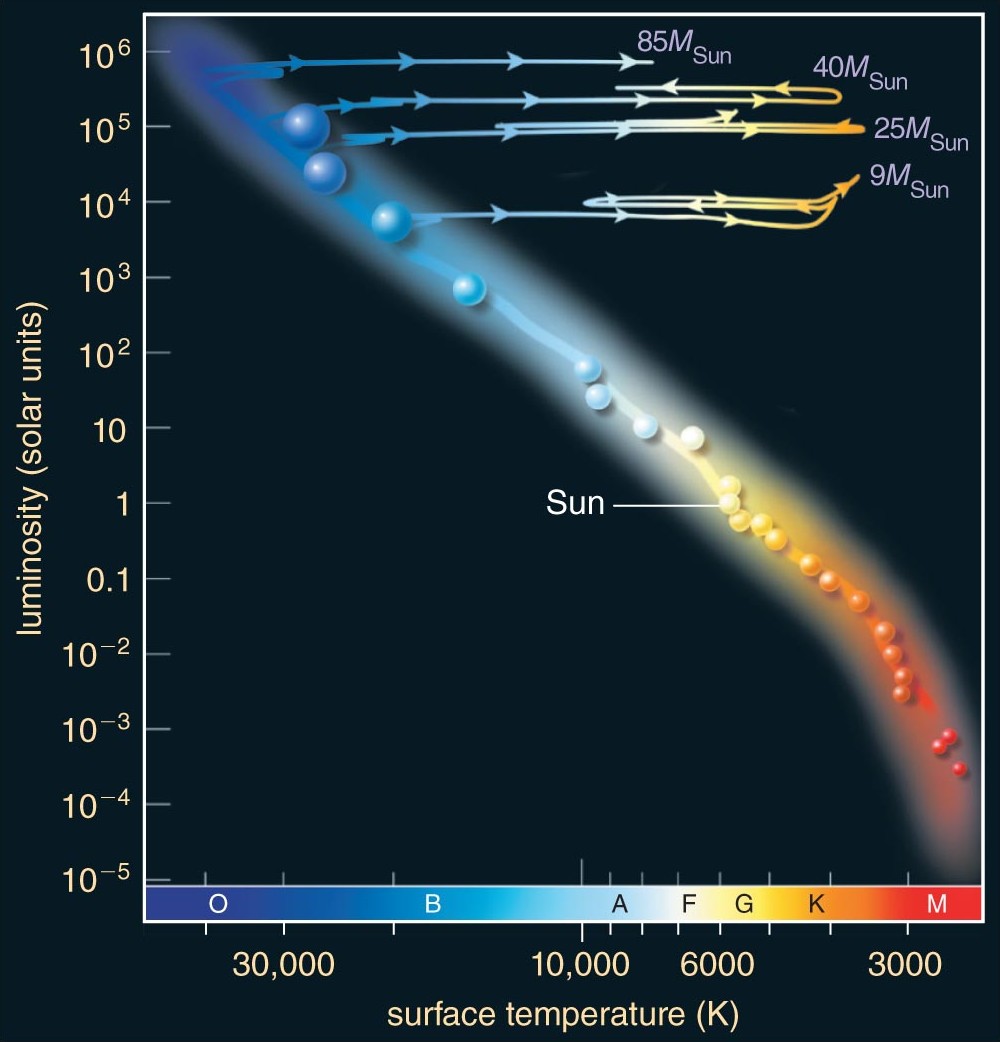
Evolutionary tracks of massive stars (9, 25, 40, and 85 M☉) on the HR diagram. All begin on the upper main sequence and evolve rightward toward lower temperatures as they become supergiants. The tracks loop back and forth as successive nuclear burning stages ignite and exhaust. The most massive stars stay at nearly constant luminosity — their cores are so hot that the luminosity is set by the Eddington limit, not by the details of nuclear burning.
And they don’t stop there. Each time a fuel is exhausted, the core contracts further (virial theorem), heats up, and ignites the next fuel. The star builds up a nested series of burning shells — like an onion, with the heaviest elements at the center:
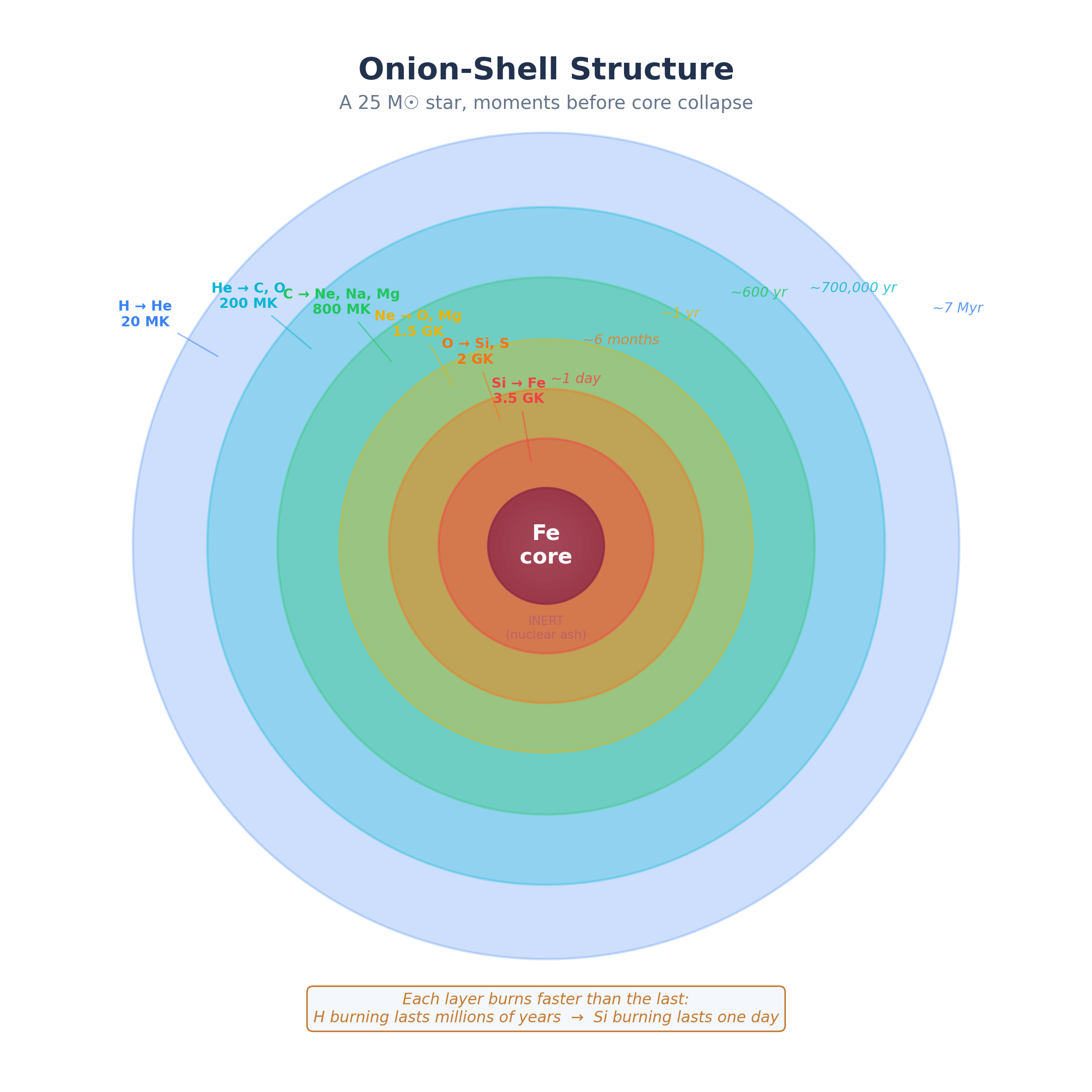
Onion-shell structure of a 25 M☉ star moments before core collapse. Each concentric shell burns a different fuel at a higher temperature, on a dramatically shorter timescale. Hydrogen burning lasts millions of years; silicon burning lasts about one day. The inert iron core at the center is nuclear ash — when it exceeds the Chandrasekhar limit, collapse is inevitable. (Credit: ASTR 201 (generated))
| Stage | Fuel to product | \(T_\text{ignition}\) | Duration (\(25\,M_\odot\) star) |
|---|---|---|---|
| 1. Hydrogen | \(\text{H} \rightarrow \text{He}\) | \(\sim 4 \times 10^7~\text{K}\) | \(\sim 7 \times 10^6~\text{yr}\) |
| 2. Helium | \(\text{He} \rightarrow \text{C}, \text{O}\) | \(\sim 2 \times 10^8~\text{K}\) | \(\sim 5 \times 10^5~\text{yr}\) |
| 3. Carbon | \(\text{C} \rightarrow \text{Ne}, \text{Na}, \text{Mg}\) | \(\sim 6 \times 10^8~\text{K}\) | \(\sim 600~\text{yr}\) |
| 4. Neon | \(\text{Ne} \rightarrow \text{O}, \text{Mg}\) | \(\sim 1.2 \times 10^9~\text{K}\) | \(\sim 1~\text{yr}\) |
| 5. Oxygen | \(\text{O} \rightarrow \text{Si}, \text{S}\) | \(\sim 1.5 \times 10^9~\text{K}\) | \(\sim 6~\text{months}\) |
| 6. Silicon | \(\text{Si} \rightarrow \text{Fe}, \text{Ni}\) | \(\sim 2.7 \times 10^9~\text{K}\) | \(\sim 1~\text{day}\) |
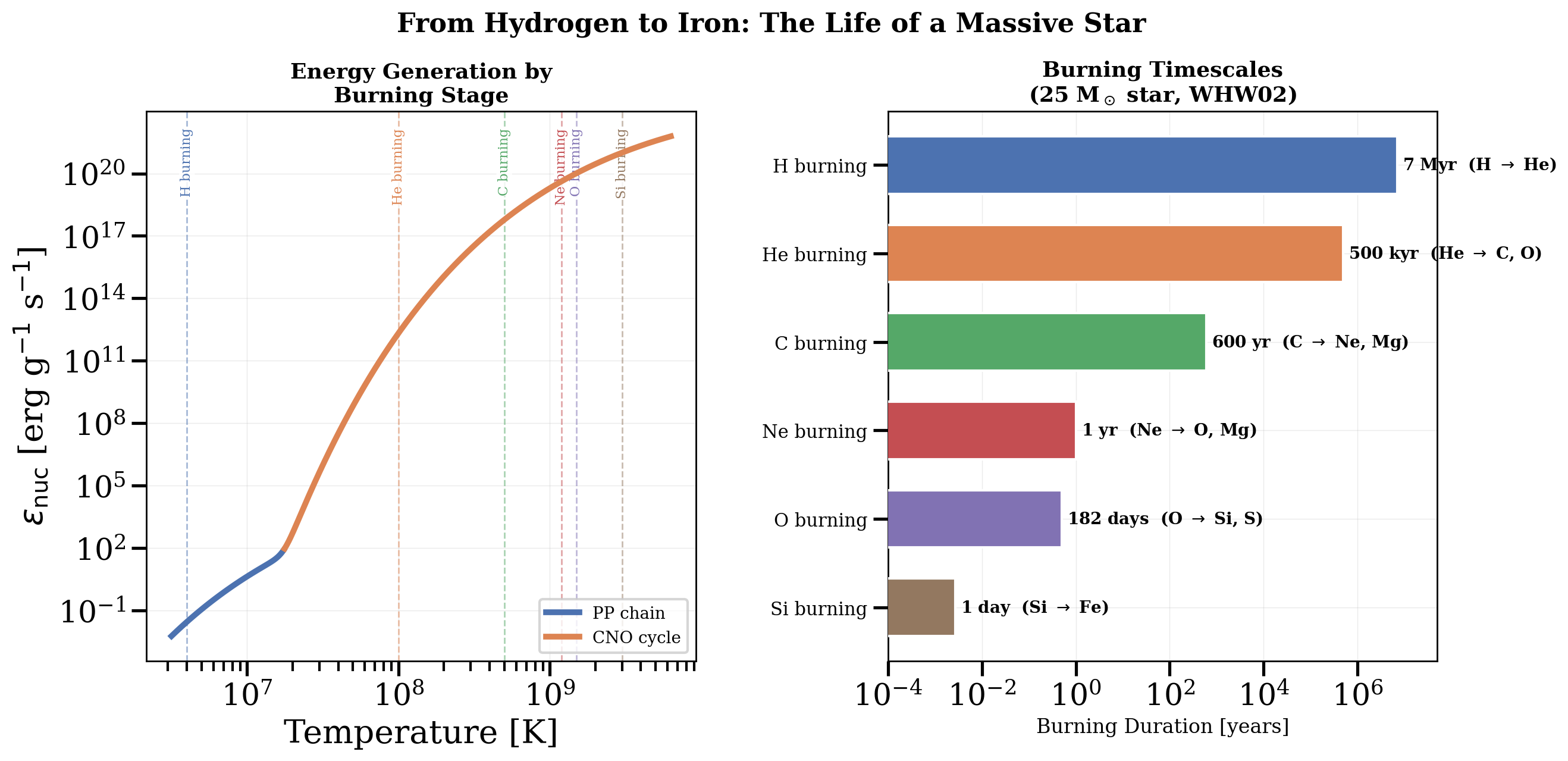
What to notice: each successive burning stage in a massive star occurs at higher temperature and lasts dramatically less time. Hydrogen burning lasts millions of years, but silicon burning lasts only about a day before iron halts exothermic fusion.
Why Each Stage Is Shorter
The accelerating timescale needs a causal explanation, not just a list of durations. A burning stage lasts roughly
\[ \tau_\text{fuel} \sim \frac{E_\text{available}}{L_\text{loss}} \sim \frac{q\,M_\text{fuel}}{L_\gamma + L_\nu}, \]
where:
- \(q\) is the energy released per unit mass of fuel, with units such as \(\mathrm{erg\,g^{-1}}\),
- \(M_\text{fuel}\) is the amount of fuel participating in that stage, in \(\mathrm{g}\),
- \(L_\gamma\) is the photon luminosity, in \(\mathrm{erg\,s^{-1}}\),
- \(L_\nu\) is the neutrino luminosity, in \(\mathrm{erg\,s^{-1}}\).
That means the numerator \(q\,M_\text{fuel}\) has units of energy:
\[ \left(\mathrm{erg\,g^{-1}}\right)\left(\mathrm{g}\right)=\mathrm{erg}, \]
while the denominator has units of power:
\[ \mathrm{erg\,s^{-1}}. \]
So the ratio has units of time:
\[ \frac{\mathrm{erg}}{\mathrm{erg\,s^{-1}}}=\mathrm{s}. \]
Each successive stage is shorter for three connected reasons:
- The Coulomb barrier is higher. Heavier nuclei have larger charge, so the core must reach a higher temperature before tunneling makes fusion fast enough to matter.
- The energy payoff is smaller. As nuclei approach the iron peak, the increase in binding energy per nucleon becomes smaller, so less energy is released per kilogram of fuel.
- Neutrino losses become enormous. In advanced burning stages, the core is hot enough that neutrino-producing processes carry energy away directly. Unlike photons, neutrinos escape almost immediately, so this energy is lost instead of helping support the star.
These effects all push \(\tau_\text{fuel}\) downward: the star gets less useful energy from each kilogram of fuel while losing energy faster.
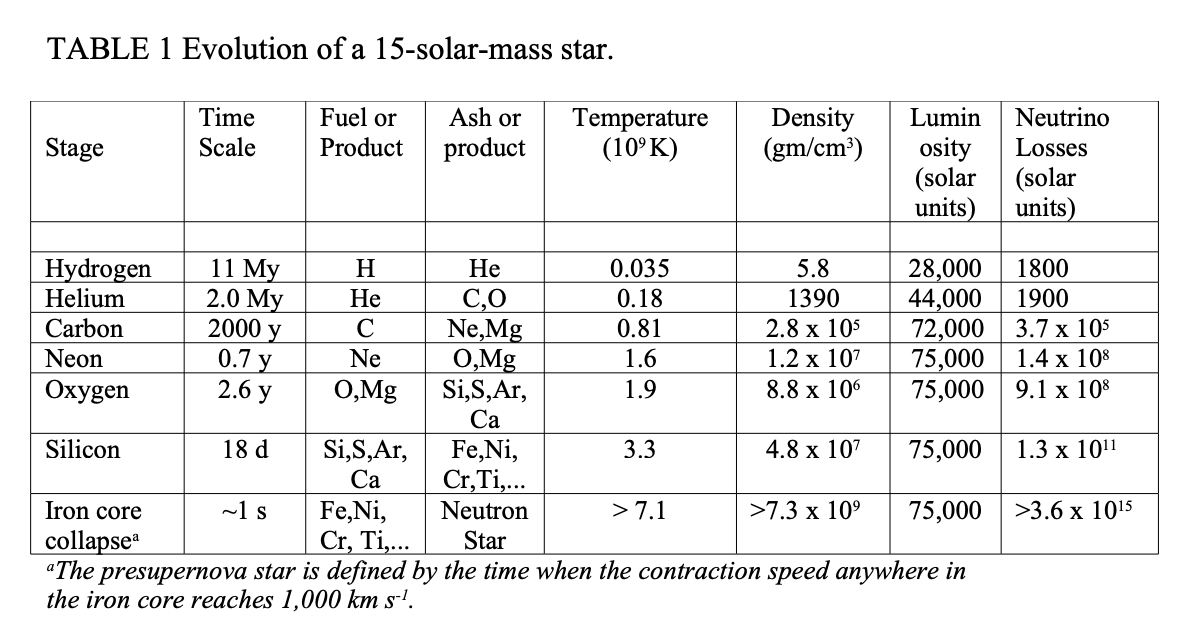
Evolution of a 15 M☉ star from hydrogen burning to iron core collapse. Each successive burning stage is shorter, hotter, and denser. The key column is the last one: neutrino losses (in solar luminosities). By carbon burning, neutrino losses exceed the photon luminosity. By silicon burning, the neutrino luminosity is ~10¹¹ L☉ — a million times brighter in neutrinos than in light. This is why the advanced stages are so short: the star is hemorrhaging energy through neutrinos that escape freely.
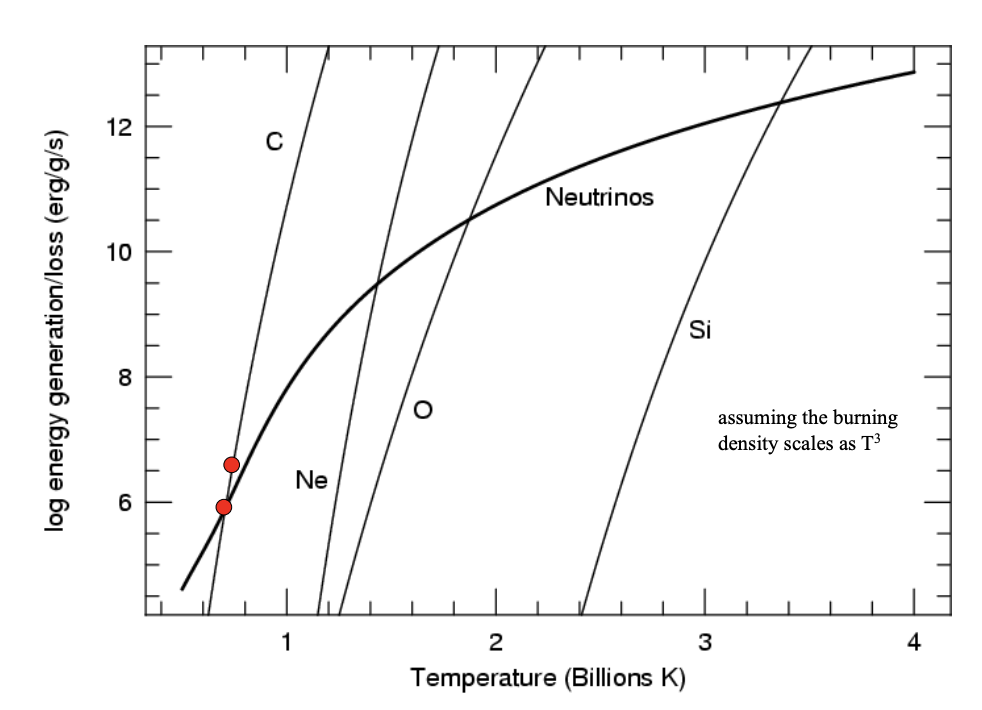
Why advanced burning stages are so short-lived. This plot shows energy generation rate (from nuclear burning) and energy loss rate (from neutrino emission) versus core temperature. At low temperatures, nuclear energy generation exceeds neutrino losses — the star can burn steadily. But neutrino losses rise steeply with temperature. By carbon and neon burning (~0.8–1 × 10⁹ K), neutrinos carry away energy faster than nuclear reactions can generate it. The star must burn its fuel at an accelerating rate just to maintain thermal equilibrium — a losing race that ends at iron.
For a \(25\,M_\odot\) star, the contrast is extreme. First convert one day to years using the identity trick:
\[ \begin{aligned} 1\ \text{day} \times \left(\frac{1\ \text{yr}}{365.25\ \text{day}}\right) &= 2.74\times10^{-3}\ \text{yr} \end{aligned} \]
\[ \begin{aligned} \frac{\tau_\text{Si}}{\tau_\text{H}} &\sim \frac{(1\ \text{day})\left(1\ \text{yr}/365.25\ \text{day}\right)}{7\times10^6\ \text{yr}} \\ &= \frac{2.74\times10^{-3}\ \text{yr}}{7\times10^6\ \text{yr}} \\ &\approx 3.9\times10^{-10} \end{aligned} \]
The years cancel, so this ratio is dimensionless:
\[ \boxed{\frac{\tau_\text{Si}}{\tau_\text{H}} \approx 3.9\times10^{-10}} \]
Silicon burning lasts less than one-billionth of the hydrogen-burning lifetime.
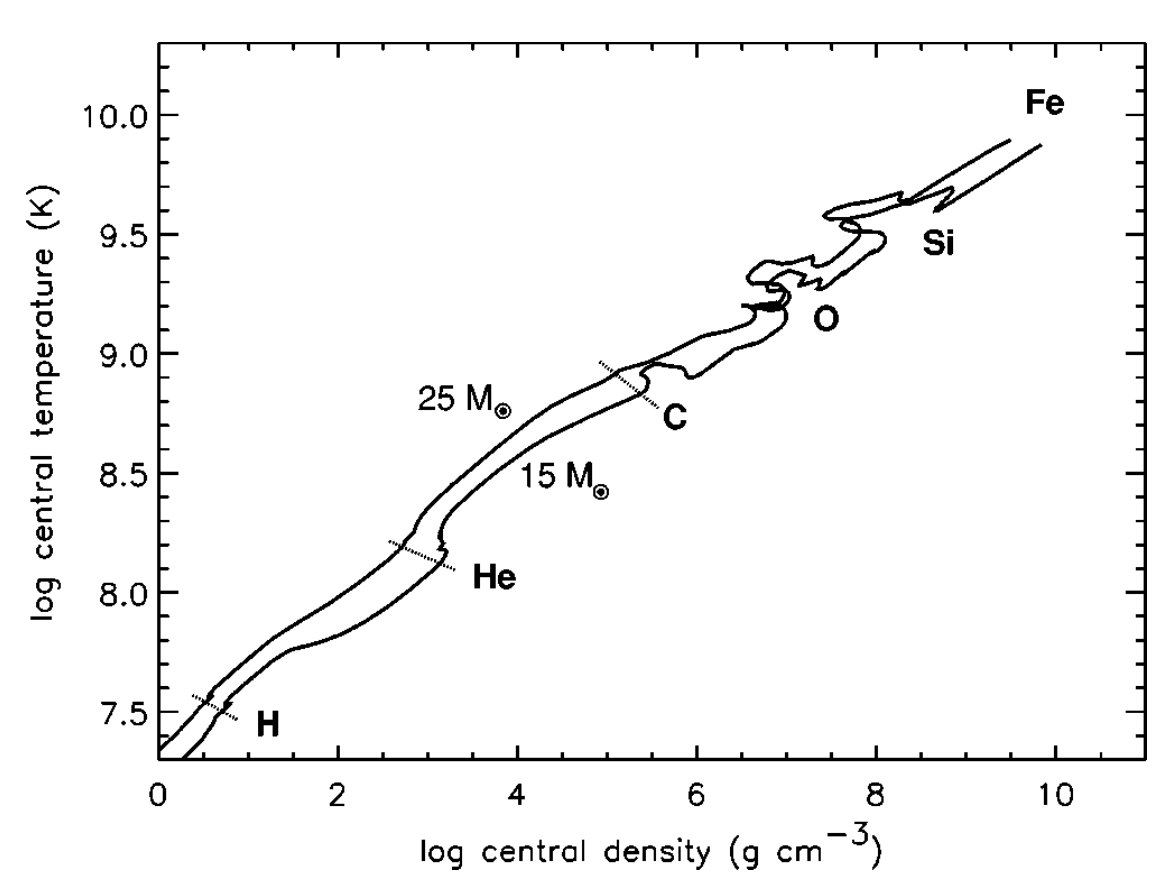
The core’s journey through burning stages, shown as central temperature versus central density for 15 M☉ and 25 M☉ stars. Each labeled point (H, He, C, O, Si, Fe) marks the ignition of a new fuel. The track climbs steadily toward higher temperatures and densities — each new fuel demands more extreme conditions. The near-vertical jump at Fe marks core collapse, when the iron core exceeds the Chandrasekhar limit and no further nuclear burning can halt the contraction.
Prediction first: if neutrino losses were somehow turned off during the late burning stages, would carbon, oxygen, and silicon burning last longer, shorter, or about the same amount of time? Explain before you calculate.
They would last longer. The key timescale is
\[ \tau_\text{fuel}\sim \frac{q\,M_\text{fuel}}{L_\gamma+L_\nu}. \]
In advanced stages, \(L_\nu \gg L_\gamma\), so neutrinos dominate the denominator. If neutrino losses were removed, the star would not need to burn fuel so rapidly to maintain pressure support. The late stages would still be shorter than hydrogen burning because the Coulomb barrier is higher and the energy release is smaller, but they would not be nearly as compressed in time.
The unit logic is the same either way: \(q\,M_\text{fuel}\) is still an energy reservoir, but removing \(L_\nu\) makes the denominator much smaller, so the time \(\tau_\text{fuel}\) becomes longer.
The later stages do not become shorter because the star is “running out of mass.” The dominant reason is that the energetics get worse: smaller energy release per unit mass and much larger neutrino losses.
Why does each successive burning stage require a higher ignition temperature?
Each successive fuel has nuclei with larger atomic number \(Z\) — carbon (\(Z = 6\)), oxygen (\(Z = 8\)), silicon (\(Z = 14\)). The Coulomb barrier between two nuclei scales as \(Z_1 Z_2\):
\[ E_\text{Coulomb} \propto \frac{Z_1 Z_2 e^2}{r} \]
For carbon-carbon fusion: \(Z_1 Z_2 = 36\) (vs. \(Z_1 Z_2 = 1\) for proton-proton). The Coulomb barrier is therefore much higher, so the core must reach substantially higher temperatures before tunneling makes the reaction rate astrophysically significant.
Even with quantum tunneling, the probability drops exponentially with barrier height, so each stage needs a substantially higher temperature to achieve a meaningful fusion rate. This is why the onion layers go inside-out: heavier elements require hotter conditions, and the hottest region is the center.
Part 2: The Iron Catastrophe
Why Iron Is the End of the Line
The relevant graph is the binding energy per nucleon, \(B/A\), versus mass number \(A\). A nuclear reaction releases energy only if the final nuclei have a larger value of \(B/A\) than the initial nuclei.
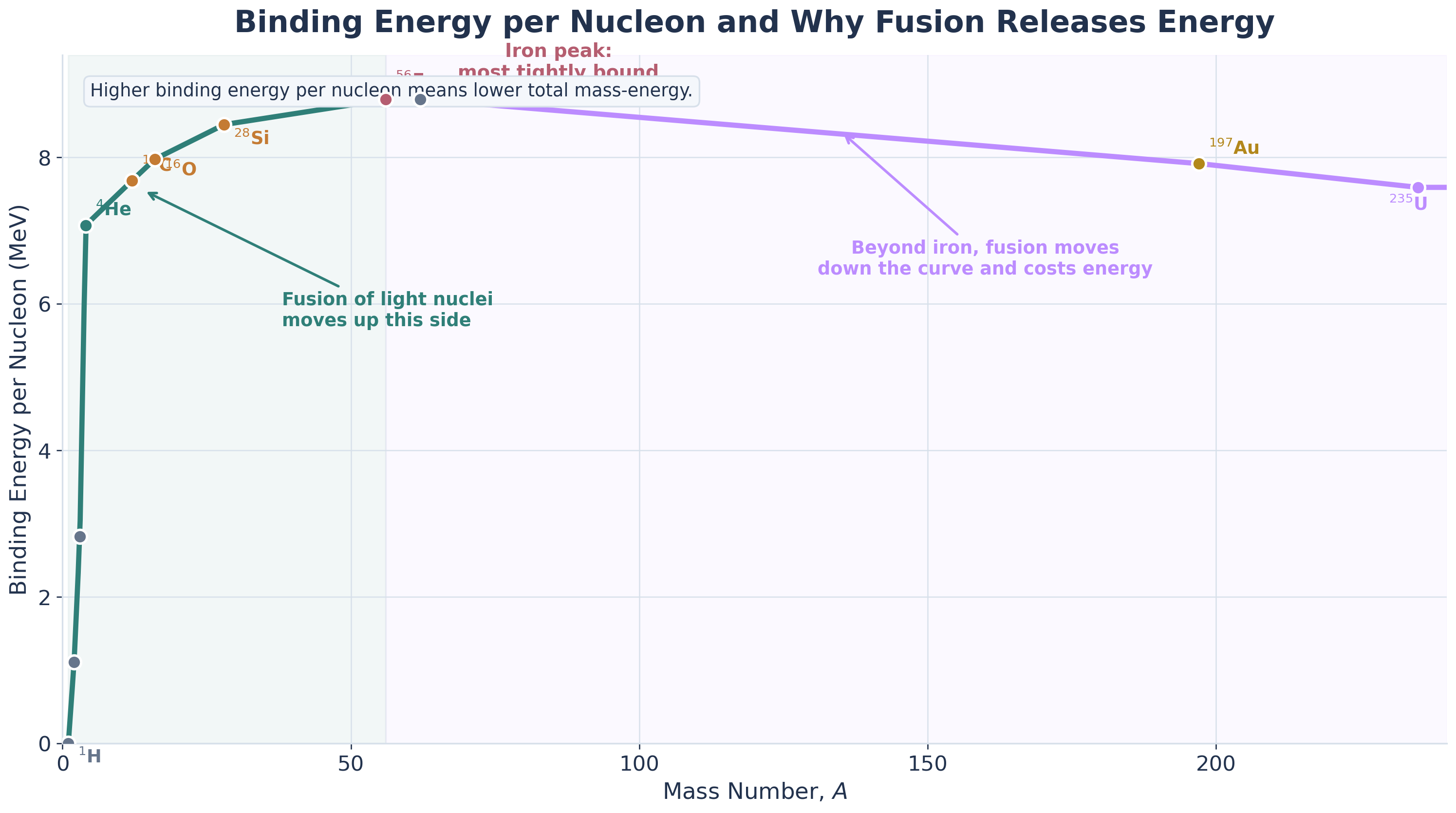
What to notice: moving upward on the binding-energy curve means moving to a lower total mass-energy. That is why fusion releases energy up to the broad iron/nickel peak, while fusion beyond that region costs energy. (Credit: ASTR 201 (generated))
This gives the rule immediately:
- For nuclei lighter than the iron-group peak, fusion tends to move matter toward larger \(B/A\), so energy is released.
- For nuclei heavier than the iron-group peak, fusion tends to move matter toward smaller \(B/A\), so energy must be supplied.
So when we say “iron is the endpoint of fusion,” the precise statement is: the broad maximum of \(B/A\) lies in the iron/nickel group, so fusion no longer provides a net energy source once the core is dominated by iron-group nuclei.
Fusion supports a star only when it can turn nuclear mass-energy into thermal pressure quickly enough to oppose gravity. Iron-group nuclei are not special because fusion becomes impossible; they are special because further fusion is endothermic. At that point, fusion stops being a support mechanism.
“Iron is the heaviest element a star can make” is false. The correct statement is that ordinary hydrostatic fusion cannot extract net energy by fusing beyond the iron-group peak. Elements heavier than iron can still be built by neutron-capture processes.
The Iron Core Grows
During silicon burning, the center of the star fills with iron-group nuclei (mainly isotopes in the Fe/Ni group). The iron core:
- grows in mass as silicon burning continues in shells around it,
- becomes hotter and denser as the overlying layers compress it,
- is supported mainly by electron degeneracy pressure, not ordinary thermal gas pressure.
So the inner core is physically similar to a white-dwarf-like degenerate core embedded inside a massive star. That means its stability is controlled by the Chandrasekhar mass.
For an ideal cold relativistic electron gas, the maximum supported mass has the scaling and composition dependence shown below:
\[ M_\text{Ch} \sim \left(\frac{\hbar c}{G}\right)^{3/2} \frac{1}{m_p^2} \]
\[ M_\text{Ch} \approx 5.83\,Y_e^2\,M_\odot \approx 1.46\,M_\odot \quad (Y_e \approx 0.50) \tag{1}\]
What it predicts
The maximum mass of a white dwarf supported by electron degeneracy pressure.
What it depends on
Built from four fundamental constants: \(\hbar\), \(c\), \(G\), \(m_p\). Independent of temperature and radius; the exact value also depends on composition through the electron fraction \(Y_e\).
What it’s saying
Once a degenerate core reaches a mass of order \(1.4\,M_\odot\), relativistic electrons cannot generate enough pressure to balance gravity in the idealized model. Stable white-dwarf solutions disappear, and further collapse requires a different support mechanism.
Assumptions
- Relativistic electron degeneracy pressure
- Cold equation of state (temperature-independent)
- Exact value depends on \(Y_e\): \(M_\text{Ch} = 5.83\,Y_e^2\,M_\odot \approx 1.46\,M_\odot\) for \(Y_e = 0.5\) (C/O)
See: the equation
For a carbon-oxygen white dwarf, \(Y_e\approx 0.50\), so
\[ \begin{aligned} M_\text{Ch} &\approx \left(5.83\right)\left(0.50\right)^2\,M_\odot \\ &\approx 1.46\,M_\odot \end{aligned} \]
where \(Y_e\) is dimensionless, so the result keeps the units of \(M_\odot\).
In an iron core, electron capture reduces \(Y_e\), so the effective Chandrasekhar mass can be somewhat smaller. For ASTR 201, the important statement is that collapse begins once the degenerate iron core reaches a mass of order
\[ M_\text{core}\sim 1.4\,M_\odot. \]
At that point, no stable electron-degeneracy-supported solution remains, and the core collapses.
This mass limit assumes:
- a cold degenerate electron gas,
- relativistic electrons,
- no rotation,
- no magnetic support,
- composition entering through \(Y_e\).
So \(1.4\,M_\odot\) is an astrophysically useful benchmark, not a universal magic number that applies unchanged in every situation.
Suppose two degenerate cores have the same mass, but one has \(Y_e=0.50\) and the other has \(Y_e=0.46\). Which one reaches instability first, and why?
Because
\[ M_\text{Ch}\propto Y_e^2, \]
lowering \(Y_e\) lowers the maximum mass that electron degeneracy pressure can support. The core with \(Y_e=0.46\) therefore reaches instability first. Electron capture is dangerous not only because it produces neutrinos, but also because it lowers the pressure-support ceiling.
Prediction first: once silicon burning begins, could the star remain stable for a long time by “choosing” not to burn the silicon to iron? Explain in terms of contraction, temperature, and pressure support.
No. A star is not choosing among options. If the core contracts, the virial theorem implies that the central temperature rises. Once silicon-rich material reaches temperatures high enough for silicon burning, reactions proceed at the rate set by nuclear physics. The overlying layers continue to compress the core, so the temperature does not remain below ignition. Silicon burning therefore continues, building an iron-group core. The real issue is whether any stable pressure source remains once the core becomes iron-rich. It does not.
Part 3: Core Collapse
When the degenerate iron core reaches an effective Chandrasekhar mass, collapse begins on a dynamical timescale. The inner core reaches nuclear density, bounces, and launches a shock wave, but core bounce alone does not eject the envelope. In the modern picture the shock stalls and must be revived, with neutrino heating playing the central role.
The Collapse Sequence
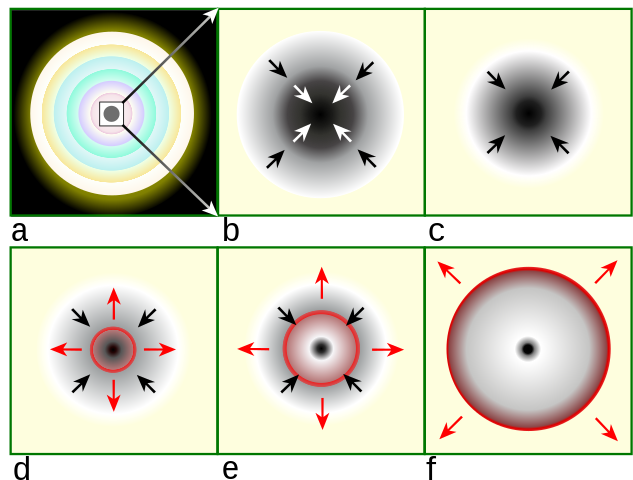
The six stages of core-collapse supernova — from iron core to explosion. (a) Onion-shell structure with iron core. (b) Core collapses as iron photodisintegrates. (c) Inner core reaches nuclear density and bounces. (d) Bounce launches a shock wave (red circle), but the shock stalls. (e) Neutrino heating revives the shock. (f) Shock breaks through — supernova explosion ejects the envelope. The entire sequence from (b) to (f) takes less than one second.
The collapse happens on a dynamical timescale, so before following the sequence of events, estimate the timescale directly.
Using the dynamical-timescale estimate from Reading 1:
\[ \tau_\text{dyn} \sim \frac{1}{\sqrt{G\bar{\rho}}} \tag{2}\]
What it predicts
Given mean density \(\bar{\rho}\), it predicts the timescale for gravitational rearrangement.
What it depends on
Scales as \(\tau_\text{dyn} \propto \bar{\rho}^{-1/2}\). Denser objects respond faster.
What it’s saying
If pressure support were removed, gravity would rearrange or collapse a self-gravitating object in roughly this time. The Sun’s dynamical time is ~50 minutes.
Assumptions
- Uniform density approximation (order-of-magnitude estimate)
- Free-fall timescale — actual collapse is modified by pressure response
See: the equation
Take \(G=6.67\times10^{-8}\ \mathrm{cm^3\,g^{-1}\,s^{-2}}\) and a collapsing iron-core mean density \(\bar{\rho}\sim10^{10}\ \mathrm{g\,cm^{-3}}\). A unit check matters here:
\[ [G\bar{\rho}] = \left(\mathrm{cm^3\,g^{-1}\,s^{-2}}\right) \left(\mathrm{g\,cm^{-3}}\right) = \mathrm{s^{-2}}, \]
so
\[ \frac{1}{\sqrt{G\bar{\rho}}} \]
has units of seconds, as it should.
Now evaluate the scale:
\[ \begin{aligned} \tau_\text{dyn} &\sim \frac{1}{\sqrt{(6.67\times10^{-8}\ \mathrm{cm^3\,g^{-1}\,s^{-2}})(10^{10}\ \mathrm{g\,cm^{-3}})}} \\ &= \frac{1}{\sqrt{6.67\times10^2\ \mathrm{s^{-2}}}} \\ &\approx 3.9\times10^{-2}\ \mathrm{s} \end{aligned} \]
\[ \boxed{\tau_\text{dyn} \approx 0.04\ \mathrm{s}} \]
So once pressure support fails, collapse on a timescale of \(\sim 0.04\ \mathrm{s}\) is completely reasonable.
The causal sequence is then:
Electron capture (\(\sim10\ \text{ms}\)). At densities above about \(10^{10}\ \mathrm{g\,cm^{-3}}\), electrons are captured by protons:
\[ p + e^- \rightarrow n + \nu_e. \]
This process does two things at once: it removes electrons that were helping provide degeneracy pressure, and it emits electron neutrinos. Both effects push the core toward faster collapse.
Photodisintegration of iron (\(\sim100\ \text{ms}\)). At temperatures above about \(5\times10^9\ \mathrm{K}\), energetic photons can break iron-group nuclei apart:
\[ {}^{56}\mathrm{Fe} + \gamma \rightarrow 13\,{}^{4}\mathrm{He} + 4n. \]
This reaction is endothermic: it absorbs energy instead of releasing it. Thermal pressure drops further.
Free-fall collapse (\(\sim100\ \text{ms}\)). With both degeneracy support and thermal support reduced, the inner core collapses rapidly. Typical infall speeds reach a substantial fraction of the speed of light, of order
\[ v\sim 0.25\,c \approx 0.25\left(3.0\times10^5\ \mathrm{km\,s^{-1}}\right) \approx 7.5\times10^4\ \mathrm{km\,s^{-1}}. \]
Core bounce (\(t=0\)). When the inner core reaches nuclear density,
\[ \rho_\text{nuc}\sim 2.8\times10^{14}\ \mathrm{g\,cm^{-3}}, \]
the equation of state stiffens sharply and neutron degeneracy pressure becomes important. The inner core halts and rebounds, launching a shock into the still-infalling outer core.
Shock stall and neutrino heating (\(\sim100\)–\(500\ \text{ms}\)). The outgoing shock loses energy by dissociating infalling nuclei and stalls. Neutrinos streaming out of the hot proto-neutron star deposit a small fraction of their energy behind the shock; that deposited energy can help revive the shock.
Explosion (\(\sim1\ \text{s}\)). The revived shock propagates outward through the envelope, ejecting much of the star’s outer layers at speeds of order
\[ 10^4\text{--}3\times10^4\ \mathrm{km\,s^{-1}}. \]
The core bounce does not by itself blow the star apart. In the modern picture, the shock initially stalls and must be revived. That is why neutrinos matter dynamically, not just as an observational detail.
The Energy Budget
The gravitational energy released by core collapse is of order
\[ \Delta E_\text{grav}\sim \frac{G M_\text{core}^2}{R_\text{NS}}, \]
where we have used the fact that the final radius dominates the difference
\[ \Delta E_\text{grav}\sim G M^2\left(\frac{1}{R_f}-\frac{1}{R_i}\right) \]
because \(R_f \ll R_i\).
Now evaluate the scale carefully. Take
\[ \begin{aligned} M_\text{core} &= 1.4\,M_\odot \\ &\approx 1.4(1.99\times10^{33}\ \mathrm{g}) \\ &\approx 2.8\times10^{33}\ \mathrm{g} \end{aligned} \]
and
\[ \begin{aligned} R_\text{NS} &\sim 10\ \mathrm{km} \left(\frac{10^5\ \mathrm{cm}}{1\ \mathrm{km}}\right) \\ &= 10^6\ \mathrm{cm} \end{aligned} \]
Then
\[ \begin{aligned} \Delta E_\text{grav} &\sim \frac{(6.67\times10^{-8}\ \mathrm{cm^3\,g^{-1}\,s^{-2}})(2.8\times10^{33}\ \mathrm{g})^2}{10^6\ \mathrm{cm}} \\ &\approx 5\times10^{53}\ \mathrm{erg} \end{aligned} \]
\[ \boxed{\Delta E_\text{grav} \sim 5\times10^{53}\ \mathrm{erg}} \]
Because this is an order-of-magnitude estimate and real neutron stars are not uniform spheres, it is standard to summarize the result as a few \(\times10^{53}\ \mathrm{erg}\).
The unit check is worth doing explicitly:
\[ \frac{\mathrm{cm^3\,g^{-1}\,s^{-2}}\cdot \mathrm{g^2}}{\mathrm{cm}} = \mathrm{g\,cm^2\,s^{-2}} = \mathrm{erg}. \]
So the dimensions are correct.
A representative energy budget is:
| Channel | Typical energy | Approximate fraction | Timescale |
|---|---|---|---|
| Neutrinos | \(\sim 3\times10^{53}\ \mathrm{erg}\) | \(\sim 99\%\) | \(\sim 10\ \mathrm{s}\) |
| Kinetic energy of ejecta | \(\sim 10^{51}\ \mathrm{erg}\) | \(\sim 0.3\%\) | days–months |
| Photons (light) | \(\sim 10^{49}\ \mathrm{erg}\) | \(\sim 0.003\%\) | weeks–months |
So the most luminous optical event in the universe is not where most of the energy goes. The optical display is spectacular because photons are easy for us to detect, not because they carry the dominant share of the energy. The visible light curve is powered largely by radioactive decay, especially the chain
\[ {}^{56}\mathrm{Ni}\rightarrow{}^{56}\mathrm{Co}\rightarrow{}^{56}\mathrm{Fe}. \]
A supernova can briefly outshine its host galaxy in visible light. Does that imply visible light carries most of the explosion energy? Use the table above to justify your answer quantitatively.
No. The light output is observationally dramatic but energetically tiny. Comparing channels,
\[ \begin{aligned} \frac{10^{49}\ \mathrm{erg}}{3\times10^{53}\ \mathrm{erg}} &\sim 3\times10^{-5} \end{aligned} \]
So only a few hundred-thousandths of the total energy comes out as light. Neutrinos dominate the energy budget by about four orders of magnitude.
“Bright” does not mean “energetically dominant.” Brightness tells you what is easy to observe; it does not automatically tell you where most of the energy went.
On February 23, 1987, a supernova was detected in the Large Magellanic Cloud (\(d \approx 50~\text{kpc}\)) — the nearest supernova visible to the naked eye since Kepler’s supernova of 1604. About three hours before the optical brightening was noticed, Kamiokande II in Japan and IMB in Ohio detected a burst of about 20 neutrinos arriving within a \(\sim 13~\text{s}\) window. Including the Baksan detector brings the total to about 24 neutrinos.
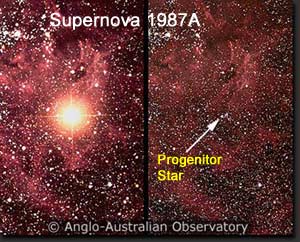
Supernova 1987A — before and after. Left: the bright supernova in the Large Magellanic Cloud, visible to the naked eye in February 1987. Right: the same field before the explosion, with the blue supergiant progenitor star (Sanduleak −69° 202) marked by the arrow. SN 1987A was the closest supernova observed since Kepler’s supernova in 1604, and the first from which neutrinos were detected — confirming the core-collapse mechanism. (Credit: Anglo-Australian Observatory)
Twenty neutrinos might not sound impressive, but the calculation is stunning. The total neutrino energy was \(\sim 3 \times 10^{53}~\text{erg}\), emitted as \(\sim 10^{58}\) neutrinos, passing through the Earth at a flux of \(\sim 10^{10}~\text{neutrinos}/\text{cm}^2\). Neutrinos interact so weakly that the massive water detectors (\(\sim 3{,}000\) tonnes) captured only a tiny fraction of the particles that passed through them.
Those detections confirmed the core-collapse theory: the energy scale, the timing, and the burst duration all matched the prediction that most of the collapse energy escapes in neutrinos before the optical light curve peaks.
The collapse of the iron core from \(R \sim 1{,}000~\text{km}\) to \(R \sim 10~\text{km}\) releases gravitational energy \(\Delta E_\text{grav} \sim GM^2(1/R_f - 1/R_i)\). Show that the final term dominates and estimate the energy released for a \(1.4\,M_\odot\) core.
Since
\[ \begin{aligned} R_f &= 10~\text{km} \left(\frac{10^5~\text{cm}}{1~\text{km}}\right) \\ &= 10^6~\text{cm} \end{aligned} \]
and
\[ \begin{aligned} R_i &= 1{,}000~\text{km} \left(\frac{10^5~\text{cm}}{1~\text{km}}\right) \\ &= 10^8~\text{cm} \end{aligned} \]
\[ \begin{aligned} \frac{1}{R_f} - \frac{1}{R_i} &= \frac{1}{10^6~\text{cm}} - \frac{1}{10^8~\text{cm}} \\ &= 10^{-6}~\text{cm}^{-1}(1 - 0.01) \\ &\approx 10^{-6}~\text{cm}^{-1} \end{aligned} \]
The \(1/R_i\) term contributes only \(1\%\) — the final radius dominates. The energy released:
\[ \begin{aligned} \Delta E &\sim \frac{GM^2}{R_f} \\ &\sim \frac{(6.67 \times 10^{-8}~\text{cm}^3\,\text{g}^{-1}\,\text{s}^{-2})\,(2.8 \times 10^{33}~\text{g})^2}{10^6~\text{cm}} \\ &= \frac{(6.67 \times 10^{-8})(7.84 \times 10^{66})~\text{cm}^3\,\text{g}\,\text{s}^{-2}}{10^6~\text{cm}} \\ &\approx 5.2 \times 10^{53}~\text{g\,cm}^2\,\text{s}^{-2} \\ &= 5.2 \times 10^{53}~\text{erg} \end{aligned} \]
\[ \boxed{\Delta E \approx 5\times10^{53}~\text{erg}} \]
This is \(\sim 5 \times 10^{53}~\text{erg}\) — about \(0.07\,M_\odot c^2\) — released in less than a second. For comparison, the Sun’s total energy output over its entire \(10~\text{Gyr}\) lifetime is \(\sim 10^{51}~\text{erg}\). A supernova releases \(\sim 500\) solar lifetimes’ worth of energy in under a second.
Part 4: Building the Periodic Table
Nucleosynthesis Capstone
This is the payoff of the nucleosynthesis story. We can now connect broad classes of elements to the physical environments that make them:
| Elements | Main process | Main astrophysical site(s) | Comment |
|---|---|---|---|
| H, He (most) | Big Bang nucleosynthesis | Early universe | Covered in Module 4 |
| He (additional) | pp-chain, CNO cycle | Main-sequence stars | Hydrogen-burning products |
| C, O | Triple-alpha, alpha capture | Helium-burning stars | Red giants and massive stars |
| Ne, Na, Mg | Carbon burning | Massive-star cores | Advanced burning products |
| O, Mg (additional) | Neon burning | Massive-star cores | Advanced burning products |
| Si, S, Ca | Oxygen and silicon burning | Massive stars and their explosions | Late-stage burning plus explosive burning |
| Fe-group (Fe, Co, Ni) | Silicon burning and explosive burning | Core-collapse supernovae and Type Ia supernovae | This reading focuses on the massive-star channel |
| Elements beyond Fe | s-process | AGB stars | Slow neutron capture |
| Elements beyond Fe | r-process | Neutron-star mergers, and possibly some rare explosive events | Rapid neutron capture |
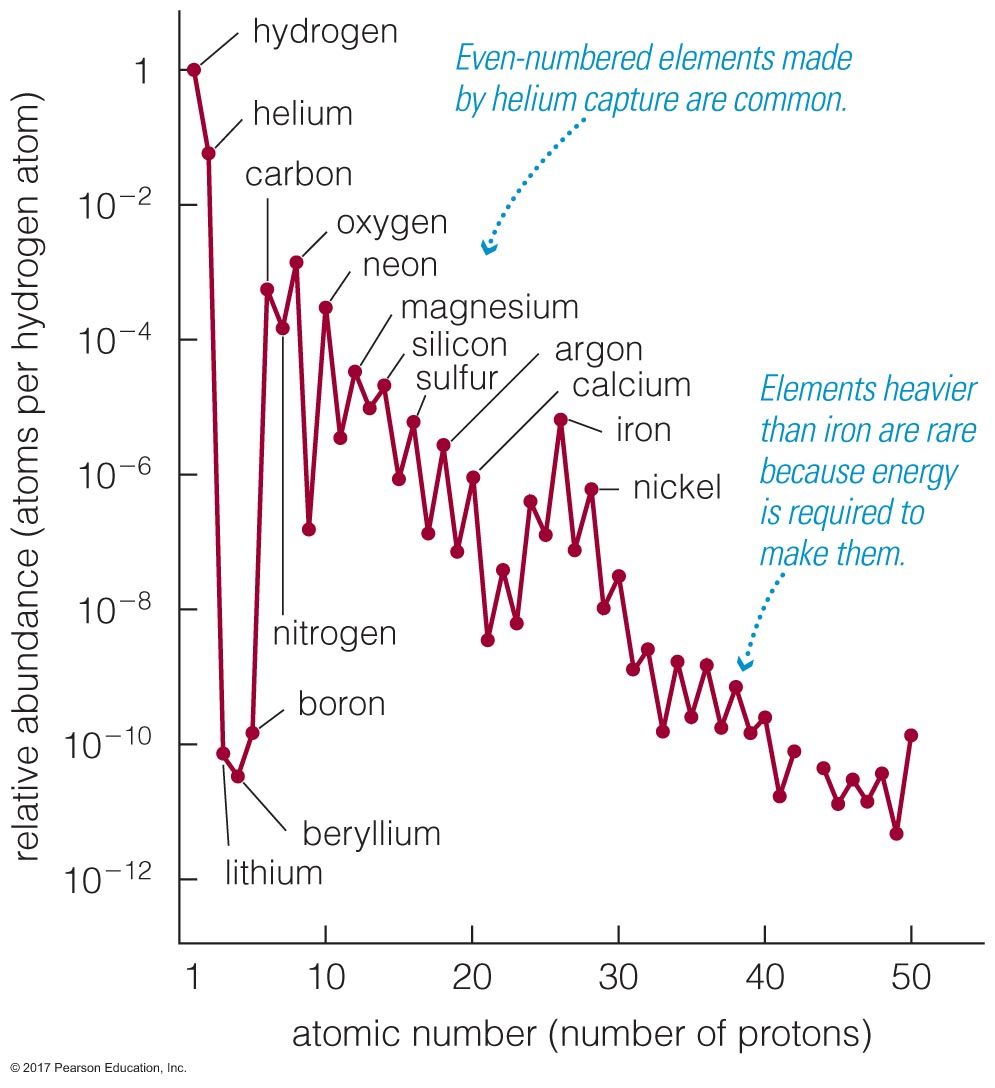
Cosmic abundances — the fingerprint of nucleosynthesis. The sawtooth pattern is not random: even-numbered elements (C, O, Ne, Mg, Si, Fe) are far more abundant than their odd-numbered neighbors because they are built by alpha capture (adding ⁴He nuclei). The iron peak near atomic number 26 marks the most stable nuclei. Elements heavier than iron are rare because making them costs energy rather than releasing it — they require neutron capture processes (s-process and r-process). (Credit: Pearson Education (2017))
The r-Process: Beyond Iron
Fusion is not the only way to build nuclei. In a neutron-rich environment, a nucleus can capture neutrons without paying a Coulomb-barrier penalty:
\[ {}^{A}_{Z}X + n \rightarrow {}^{A+1}_{Z}X + \gamma. \]
If neutron captures happen faster than beta decays, the nucleus is driven to very neutron-rich isotopes. After the neutron flood ends, those unstable isotopes beta-decay back toward stability, producing heavy elements such as Au, Pt, and U.
Historically, ordinary core-collapse supernovae were often treated as the leading candidate r-process site. The cleaner modern statement is this:
- neutron-star mergers are strongly favored as the dominant source of the heavy r-process elements;
- some supernova-like channels may still contribute, especially for lighter r-process nuclei.
On 17 August 2017, LIGO/Virgo detected GW170817, a binary neutron-star merger. Its electromagnetic counterpart included a kilonova powered by radioactive decay of freshly synthesized heavy nuclei. This event did not prove that all r-process elements come from mergers, but it provided direct evidence that neutron-star mergers are a major r-process site.
Your Body Is Stellar Ash
Be careful about what is being measured. Abundances can be quoted by mass or by number of atoms. Those are not the same thing.
The table below gives approximate mass fractions for the human body:
| Element | Mass fraction in body | Stellar origin |
|---|---|---|
| Hydrogen | 10% | Big Bang |
| Oxygen | 65% | Helium burning, especially in massive stars, then dispersed by stellar winds and supernovae |
| Carbon | 18% | Triple-alpha in helium-burning stars, then dispersed by winds and ejecta |
| Nitrogen | 3% | CNO cycle processing in massive stars |
| Calcium | 1.5% | Advanced burning in massive stars |
| Phosphorus | 1% | Advanced burning in massive stars |
| Iron | 0.006% | Iron-group nucleosynthesis in supernovae |
| Iodine | trace | Neutron-capture nucleosynthesis |
| Gold | trace | Heavy r-process, likely dominated by neutron-star mergers |
The nearby periodic-table graphic, however, is best interpreted as showing approximate composition by number of atoms, not by mass. That is why hydrogen appears overwhelmingly dominant there. Hydrogen atoms are very light, so a modest mass fraction can still correspond to a very large fraction of the total number of atoms.
Aside from hydrogen (and most helium), the atoms in your body were manufactured in earlier generations of stars and stellar explosions before the Sun formed. In that precise sense, you are made of stellar ash.
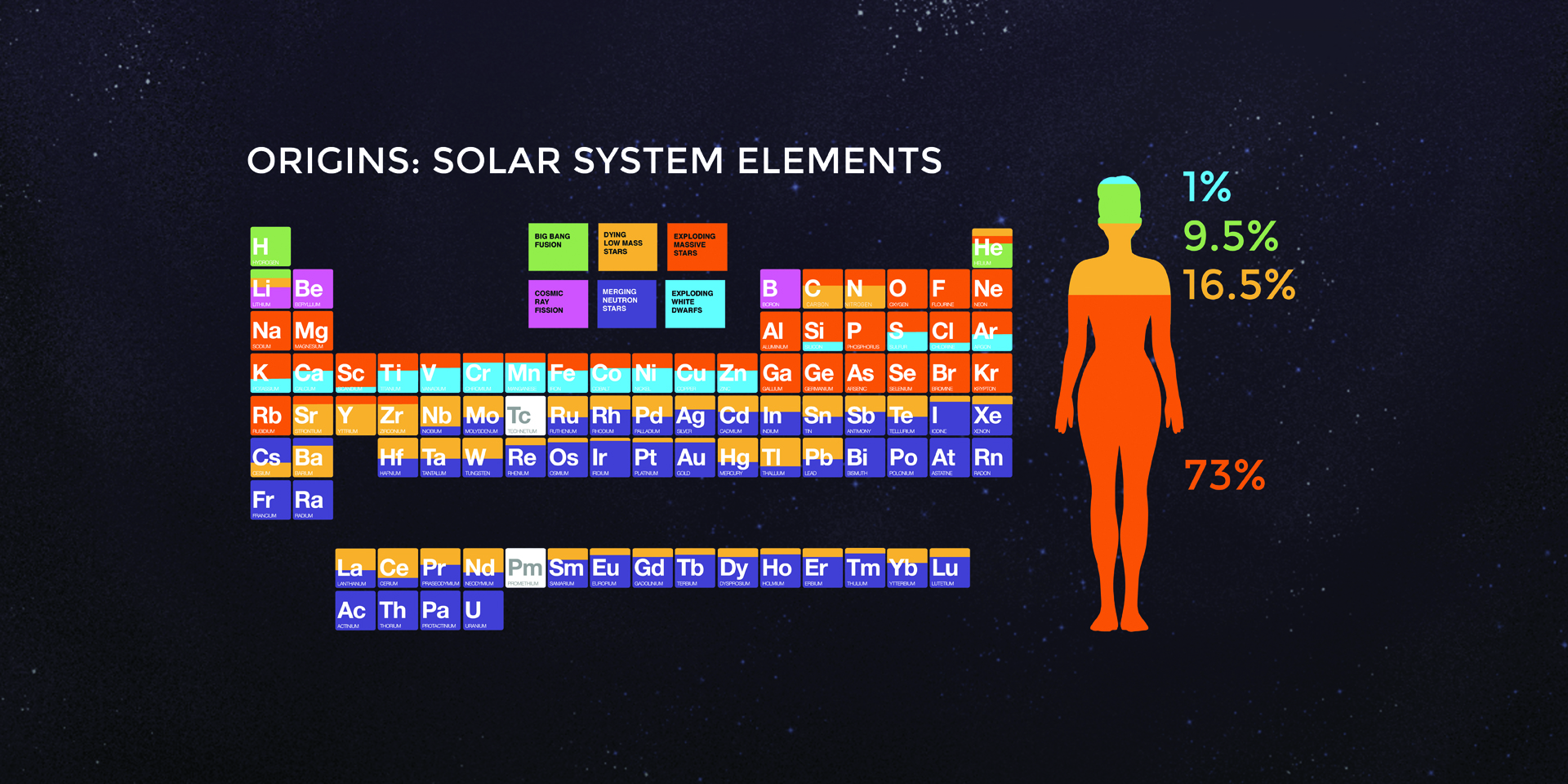
Your body is stellar ash. This periodic table is color-coded by nucleosynthesis origin: Big Bang (H, He), dying low-mass stars (C, N), exploding massive stars (O, Si, Fe), merging neutron stars (Au, Pt), and cosmic-ray spallation (Li, Be, B). The human silhouette at right should be read as an approximate composition by number of atoms, not by mass. That is why hydrogen appears so dominant even though oxygen contributes most of the body’s mass. (Credit: NASA/CXC/SAO)
“Your body is mostly hydrogen, so most of your mass came from the Big Bang” is false. By number of atoms, hydrogen dominates. By mass, oxygen dominates. Always ask: abundance by mass or by number?
Observable: The solar photosphere contains 67 elements heavier than helium, in specific relative abundances (e.g., the “solar abundance pattern”).
Model: Nucleosynthesis theory — Big Bang + stellar fusion (pp, CNO, triple-alpha, successive burning) + neutron capture (s-process, r-process) — predicts relative abundances.
Inference: The predicted abundance pattern matches observations to remarkable precision across nearly the entire periodic table. The few discrepancies (e.g., lithium, beryllium, boron) are explained by additional processes (cosmic ray spallation). The periodic table is a record of stellar nucleosynthesis.
Why are lithium, beryllium, and boron much rarer in the universe than carbon and oxygen? Make a prediction first: are these elements hard to make, easy to destroy, or both?
They are both hard to make in stars and easy to destroy. These nuclei have relatively low binding energies and are broken apart efficiently at stellar-interior temperatures. They are also bypassed by the main stellar fusion chains because of the mass-5 and mass-8 bottlenecks. Most of the Li, Be, and B in the universe is therefore attributed to non-stellar processes such as cosmic-ray spallation rather than ordinary stellar fusion.
Part 5: Supernova Remnants and the Next Generation
What’s Left Behind
After the explosion, two things remain:
A compact remnant — either a neutron star (\(M_\text{core} \lesssim 2\text{–}3\,M_\odot\)) or a black hole (\(M_\text{core} \gtrsim 3\,M_\odot\)). We’ll study these in Reading 10.
A supernova remnant (SNR) — the expanding shell of ejected material, rich in heavy elements, which sweeps up interstellar gas and glows in X-rays, optical, and radio for thousands of years. Famous examples: the Crab Nebula (SN 1054), Cassiopeia A (SN ~1680), and the Vela SNR.
Seeding the Next Generation
Supernova remnants disperse into the interstellar medium over \(\sim 10^5~\text{yr}\), enriching it with metals (astronomer’s term for everything heavier than helium). This enriched gas eventually collapses into new molecular clouds, forming new stars and planetary systems.
The Sun formed from gas that had been enriched by multiple generations of stellar nucleosynthesis. Its metallicity (\(Z_\odot \approx 0.014\) — meaning about \(1.4\%\) of its mass is elements heavier than helium) records the cumulative nucleosynthesis of \(\sim 10~\text{Gyr}\) of Galactic chemical evolution. The Earth, which is overwhelmingly made of elements heavier than helium, condensed from gas and dust enriched by many earlier stellar winds and supernova ejecta.
Stars are born from the ashes of dead stars. This is cosmic recycling on the grandest scale — and it means that the first generation of stars (formed from pure hydrogen and helium in the early universe) was fundamentally different from later generations. Those first stars — called Population III stars — had no metals, no planets, and likely no life. Everything that makes the universe interesting today was built inside stars that came after.
Reference Tables
Burning Stages of a \(25\,M_\odot\) Star
| Stage | Fuel to ash | \(T\) (K) | \(\rho\) (g/cm³) | Duration | Energy (MeV/nucleon) |
|---|---|---|---|---|---|
| H | \(\text{H} \rightarrow \text{He}\) | \(4 \times 10^7\) | \(5\) | \(7 \times 10^6~\text{yr}\) | 6.7 |
| He | \(\text{He} \rightarrow \text{C,O}\) | \(2 \times 10^8\) | \(700\) | \(5 \times 10^5~\text{yr}\) | 0.6 |
| C | \(\text{C} \rightarrow \text{Ne,Mg}\) | \(6 \times 10^8\) | \(2 \times 10^5\) | \(600~\text{yr}\) | 0.5 |
| Ne | \(\text{Ne} \rightarrow \text{O,Mg}\) | \(1.2 \times 10^9\) | \(4 \times 10^6\) | \(1~\text{yr}\) | 0.3 |
| O | \(\text{O} \rightarrow \text{Si,S}\) | \(1.5 \times 10^9\) | \(10^7\) | \(6~\text{mo}\) | 0.5 |
| Si | \(\text{Si} \rightarrow \text{Fe,Ni}\) | \(2.7 \times 10^9\) | \(3 \times 10^7\) | \(1~\text{day}\) | 0.2 |
Core-Collapse Supernova Energy Budget
| Channel | Energy (erg) | Fraction | Timescale |
|---|---|---|---|
| Neutrinos | \(\sim 3 \times 10^{53}\) | \(\sim 99.7\%\) | \(\sim 10~\text{s}\) |
| Kinetic (ejecta) | \(\sim 10^{51}\) | \(\sim 0.3\%\) | \(\sim \text{days–months}\) |
| Photons (light) | \(\sim 10^{49}\) | \(\sim 0.003\%\) | \(\sim \text{weeks–months}\) |
Symbol Legend
| Symbol | Meaning | Units |
|---|---|---|
| \(^{56}\text{Fe}\) | Iron-56 (most common iron isotope) | — |
| \(^{56}\text{Ni}\) | Nickel-56 (radioactive; decays to \(^{56}\text{Fe}\)) | \(t_{1/2} = 6.1~\text{days}\) |
| \(\nu_e\) | Electron neutrino | — |
| r-process | Rapid neutron capture process | — |
| s-process | Slow neutron capture process | — |
| SNR | Supernova remnant | — |
Summary: Gravity’s Most Violent Victory
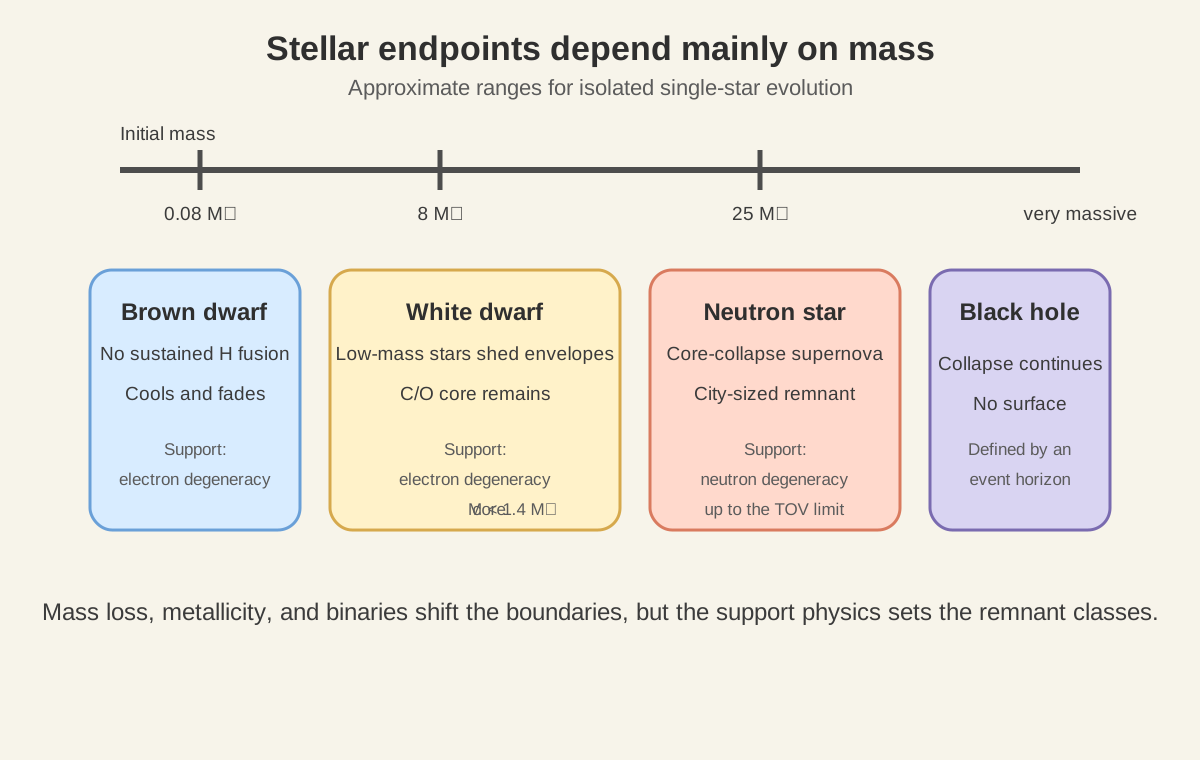
Stellar remnants depend on initial mass
The most important ideas from this reading:
Massive stars burn through fuel on an accelerating timescale. Each successive stage requires a higher temperature, releases less energy per unit mass, and is shortened further by increasing neutrino losses.
Iron-group nuclei mark the end of exothermic fusion in stellar cores. Once the core is dominated by iron-group material, fusion no longer provides a net pressure source against gravity.
When the degenerate iron core reaches an effective Chandrasekhar mass of order \(1.4\,M_\odot\), collapse begins on a dynamical timescale. Electron capture and photodisintegration accelerate that collapse.
Core collapse releases a few \(\times10^{53}\ \mathrm{erg}\), mostly in neutrinos. The visible supernova is spectacular but energetically subdominant.
The periodic table records multiple nucleosynthesis channels. Stellar fusion builds elements up to the iron group; neutron-capture processes build many elements beyond it; later generations of stars and planets inherit that enriched material.
┌──────────────────────────────────────────────────────┐
│  Gravity Scoreboard — Reading 9                      │
├──────────────────────────────────────────────────────┤
│  Attacker:    Gravity                                │
│  Defenders (fallen):                                 │
│    - Thermal pressure (fuel exhausted)               │
│    - Electron degeneracy (Chandrasekhar exceeded)    │
│  Status:      GRAVITY WINS — CATASTROPHICALLY.       │
│               Iron core collapses in < 1 second.     │
│               Energy: about 3 x 10^53 erg, mostly   │
│               in neutrinos.                         │
│                                                      │
│  But: the collapse is not the end.                   │
│    - The core bounces at nuclear density             │
│    - NEUTRON DEGENERACY halts the collapse           │
│    - If the core is too massive even for that...     │
│      gravity wins completely, and a black hole forms.│
│                                                      │
│  The explosion ejects much of the star's             │
│  previously synthesized material.                    │
│  The periodic table is a record of gravity's battles.│
│  Next: Neutron stars and black holes, Reading 10     │
└──────────────────────────────────────────────────────┘
The throughline is simple: massive stars spend millions of years building the conditions for a collapse that lasts less than a second. Gravity wins violently, but the aftermath seeds the next generation of cosmic structure. In Reading 10, we meet the neutron star (held up by neutron degeneracy pressure) and the black hole (where nothing stops the collapse), and take our first step into general relativity.
Inference takeaway: when we observe a supernova remnant rich in heavy elements and a compact remnant at its center, the model points to a core that crossed the Chandrasekhar limit, collapsed on a dynamical timescale, and expelled previously synthesized material into the interstellar medium.
The neutron star at the center of a supernova remnant is the densest object in the universe that still has a surface. In Reading 10, we’ll explore its extreme properties — densities of \(10^{14}~\text{g}/\text{cm}^3\) (a teaspoon weighs a billion tonnes), magnetic fields \(10^{12}\) times Earth’s, rotation periods of milliseconds — and discover that even neutron degeneracy has a limit. Above \(\sim 2\text{–}3\,M_\odot\), no known force can resist gravity. The result is a black hole — an object where spacetime itself collapses. We’ll introduce the Schwarzschild radius, the event horizon, and take our first step into Einstein’s general relativity.