Lecture 4: The Long Way Out — Radiation Transport
How does fusion energy escape from the core to the surface?
Guiding question: If photons move at the speed of light, why does energy released in the solar core take roughly \(10^5\) years to leak out?
Observable → Model → Inference
Observable: The Sun’s luminosity is steady on human timescales, yet the energy powering it is produced deep in the core.
Model: The solar interior is optically thick. Photons interact repeatedly with matter through absorption and scattering, so energy transport becomes a random walk that can be described macroscopically by radiative diffusion.
Inference: Energy does not stream outward at speed \(c\) across the star. Instead, it diffuses slowly through an enormous number of interactions, leading to a transport time of order \(\sim 10^5\) years.
Learning Objectives
After completing this reading, you should be able to:
- Define opacity \(\kappa\) and optical depth \(\tau\) and explain what each measures.
- Derive the mean free path \(\ell = 1/(\kappa \rho)\) from the microscopic relation \(\ell = 1/(n\sigma)\).
- Use a one-zone solar model to estimate the mean free path, optical depth, and diffusion time.
- Explain why a random walk gives \(d \sim \sqrt{N}\,\ell\) rather than \(d \sim N\ell\).
- Write the radiative-diffusion flux and luminosity equations and explain what controls the energy flow.
- Explain conceptually why convection can take over when radiative transport becomes inefficient.
- Compare radiation pressure with gas pressure in the Sun using an explicit mean molecular weight.
- Derive the Eddington luminosity from force balance between radiation and gravity.
Concept Throughline
Reading 3 answered the energy-generation question: fusion releases energy in the core. This reading answers a different question: how does that energy get out?
The logic chain is the spine of the whole topic:
- Matter blocks radiation, so stars are opaque.
- Opacity and density set the photon mean free path.
- A tiny mean free path turns transport into a random walk.
- Random walks are inefficient, so energy diffuses outward slowly.
- If radiative diffusion becomes too inefficient, convection can carry energy by bulk fluid motion.
- The same radiation field also carries momentum, producing radiation pressure.
- In very luminous stars, radiation pressure can compete directly with gravity.
Track A (Core, ~25 min): Read Parts 1–5 in order. This gives you the full opacity \(\rightarrow\) mean-free-path \(\rightarrow\) random-walk \(\rightarrow\) diffusion \(\rightarrow\) convection story.
Track B (Full, ~35 min): Read everything, including the extra scaling checkpoints and the force-balance derivation of the Eddington luminosity.
Both tracks cover the core learning objectives. Track B adds more practice and more explicit derivation steps.
If the Sun were transparent, energy would cross one solar radius in only a few seconds. In the real Sun, the same energy takes of order \(10^5\) years to leak out.
The delay is not caused by photons moving slowly. Photons always move locally at the speed of light, \(c\).
The transport is slow because the solar interior is extremely opaque. In a one-zone solar-core estimate,
\[ \ell \approx 0.02~\text{cm}, \]
so the outward transport becomes a random walk with a tiny step size. What diffuses slowly is the energy content of the radiation field, not the identity of one immortal photon.
Part 1: Why Stars Are Opaque
The travel-time paradox
Start with the wrong model on purpose. If the Sun were transparent, energy released in the core could stream directly to the surface. The straight-line travel time would be
\[ t_\text{stream} = \frac{R_\odot}{c} = \frac{7.0 \times 10^{10}~\text{cm}}{3.0 \times 10^{10}~\text{cm s}^{-1}} \approx 2.3~\text{s}. \]
That is obviously not how a real star works. The missing physics is opacity.
Opacity: how effectively matter blocks radiation
The opacity \(\kappa\) measures how strongly matter absorbs or scatters radiation per unit mass. Its units are
\[ [\kappa] = \text{cm}^2\,\text{g}^{-1}. \]
A larger \(\kappa\) means matter is better at intercepting radiation. In stellar structure, \(\kappa\) is usually a mean opacity that packages many microscopic interaction processes into one macroscopic quantity.
| Opacity Source | Physical Process | Dominates When |
|---|---|---|
| Electron scattering (Thomson) | Free electrons deflect photons | Hot, fully ionized gas |
| Bound-free absorption | Photon ionizes an atom | Moderate \(T\); partially ionized gas |
| Free-free absorption (bremsstrahlung) | Photon interacts during an electron-ion encounter | Ionized gas over a wide range of conditions |
| Bound-bound absorption | Photon excites atomic transition | Lower \(T\); partially ionized gas |
For a fully ionized hydrogen-rich plasma, the cleanest baseline estimate is electron scattering:
\[ \kappa_\text{es} \approx 0.2(1 + X)~\text{cm}^2\,\text{g}^{-1} \approx 0.34~\text{cm}^2\,\text{g}^{-1} \]
where \(X \approx 0.70\) is the hydrogen mass fraction. That is the standard one-zone baseline for the solar interior in an introductory course. A more detailed stellar model uses a Rosseland mean opacity and can include free-free and other contributions as well.
Do not read \(\kappa_\text{es} \approx 0.34~\text{cm}^2\,\text{g}^{-1}\) as “the one exact solar-core opacity.”
It is the right pedagogical baseline for a fully ionized H-rich plasma and a very useful first estimate. Real stellar-opacity calculations are more detailed.
Optical depth: how many mean free paths thick is the star?
Opacity becomes especially useful when combined with density. Define the optical-depth increment by
\[ d\tau = \kappa \rho\,dr. \]
Integrating across a region of size \(R\) gives
\[ \tau \sim \kappa \rho R. \]
Using the mean free path \(\ell = 1/(\kappa \rho)\), we can rewrite this as
\[ \tau \sim \frac{R}{\ell}, \]
- \(\tau \ll 1\) means optically thin, so photons stream freely.
- \(\tau \gg 1\) means optically thick, so photons undergo many interactions.
So \(\tau\) literally counts how many mean free paths fit across the star.
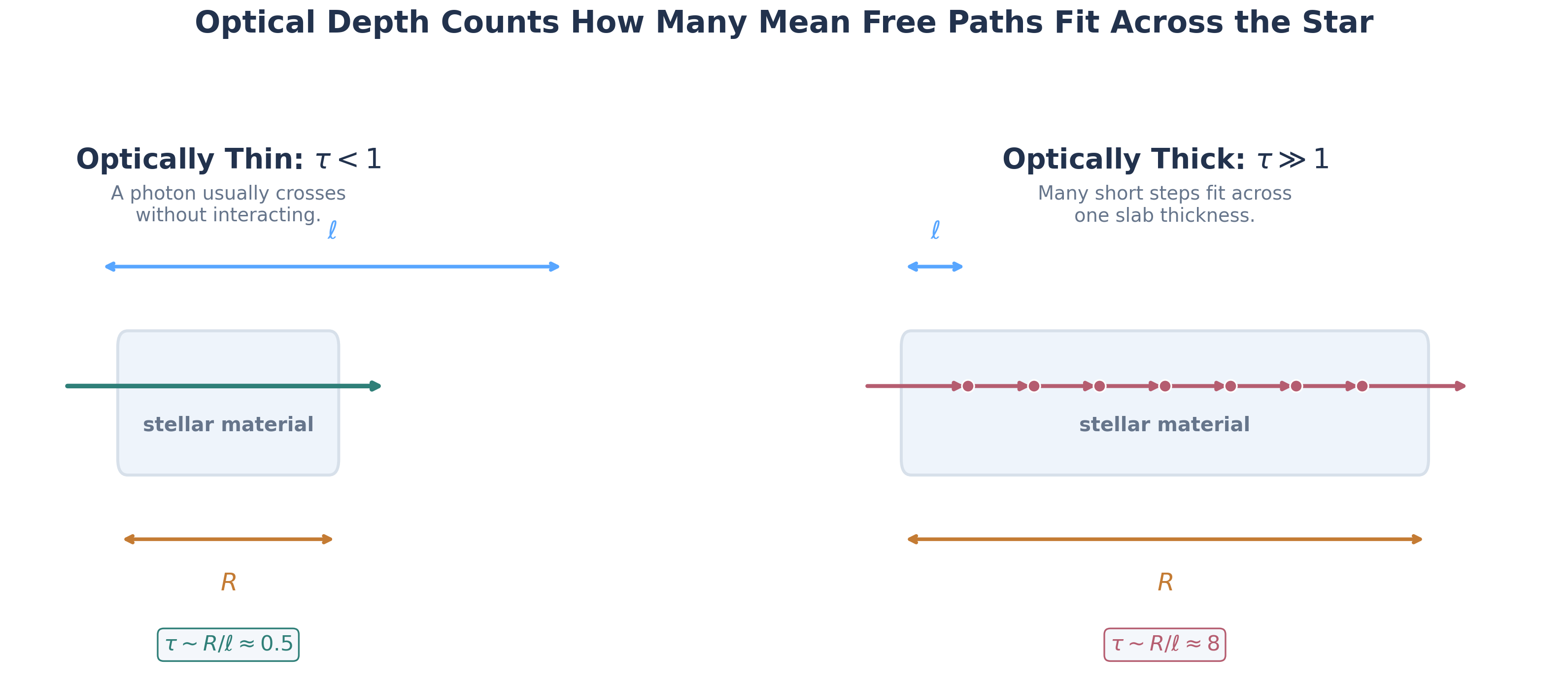
What to notice: optical depth is a count of how many mean free paths fit across a region. In the optically thin case, \(\ell > R\) and a photon usually crosses without interacting. In the optically thick case, \(\ell \ll R\), so many short steps fit across the same slab thickness and transport becomes interaction-dominated. (Credit: ASTR 201 (generated))
Suppose a star becomes denser while its opacity stays the same.
- Does the mean free path get longer or shorter?
- Does the optical depth get larger or smaller?
- Should energy escape more easily or less easily?
Part 2: The Mean Free Path — How Far a Photon Travels
From microscopic cross sections to macroscopic opacity
The mean free path formula should not appear by magic. Start microscopically.
If a photon moves through a medium with number density \(n\) of interaction targets, and each target has cross section \(\sigma\), then the mean free path is
\[ \ell = \frac{1}{n\sigma}. \]
Here
- \(n\) is the number density of targets in \(\text{cm}^{-3}\),
- \(\sigma\) is the interaction cross section in \(\text{cm}^2\).
Now connect that to opacity. Since \(\kappa\) is cross section per unit mass,
\[ \kappa = \frac{n\sigma}{\rho}. \]
So
\[ n\sigma = \kappa \rho. \]
Substitute this into the microscopic expression:
\[ \ell = \frac{1}{n\sigma} = \frac{1}{\kappa \rho}. \]
This is the macroscopic mean-free-path equation used in stellar structure:
\[ \ell = \frac{1}{\kappa\,\rho} \tag{1}\]
What it predicts
Given opacity \(\kappa\) and density \(\rho\), it predicts the average distance a photon travels between interactions.
What it depends on
Scales as \(\ell \propto 1/(\kappa\rho)\). Higher density or opacity means shorter steps.
What it’s saying
The photon’s ‘step size’ in its random walk through the star. In the solar core, \(\ell \approx 0.02~\text{cm}\) — a photon barely moves before scattering again.
Assumptions
- Homogeneous medium (locally uniform \(\kappa\) and \(\rho\))
- Opacity \(\kappa\) includes all interaction processes (scattering + absorption)
See: the equation
The physics is simple: higher density means more targets per volume, and higher opacity means more effective targets per gram. Both shorten the distance a photon can travel before interacting.
\[ \ell \propto \frac{1}{\kappa \rho} \]
- Higher density means more targets, so \(\ell\) gets shorter.
- Higher opacity means stronger interactions, so \(\ell\) gets shorter.
If density increases while \(\kappa\) stays fixed, then
\[ \ell = \frac{1}{\kappa \rho} \]
gets smaller, while
\[ \tau \sim \kappa \rho R \]
gets larger. The medium becomes more optically thick, so radiation escapes less easily.
Worked example: mean free path in the solar core
Use the one-zone solar-core values
\[ \rho_c \approx 150~\text{g cm}^{-3}, \qquad \kappa_\text{es} \approx 0.34~\text{cm}^2\,\text{g}^{-1}. \]
\[ \ell = \frac{1}{\kappa \rho_c} = \frac{1}{(0.34~\text{cm}^2\,\text{g}^{-1})(150~\text{g cm}^{-3})}. \]
\[ \kappa \rho_c = 51~\text{cm}^{-1}, \]
so
\[ \boxed{\ell \approx 1.96 \times 10^{-2}~\text{cm} \approx 0.20~\text{mm}}. \]
That is a tiny step size. In this one-zone estimate, a photon in the solar core travels only about two-tenths of a millimeter between interactions.
Unit check
\[ [\kappa \rho] = \left(\text{cm}^2\,\text{g}^{-1}\right)\left(\text{g cm}^{-3}\right) = \text{cm}^{-1} \]
\[ [\ell] = \frac{1}{[\kappa \rho]} = \text{cm} \]
Compare with the solar radius
Compare this with the solar radius,
\[ R_\odot = 7.0 \times 10^{10}~\text{cm}. \]
Then the number of mean free paths across the Sun is roughly
\[ \frac{R_\odot}{\ell} \approx \frac{7.0 \times 10^{10}~\text{cm}}{2.0 \times 10^{-2}~\text{cm}} \approx 3.5 \times 10^{12}. \]
So the optical depth across the Sun is of order
\[ \tau \sim \frac{R_\odot}{\ell} \sim 3.5 \times 10^{12}. \]
The Sun is not just opaque. It is enormously optically thick.
The crucial result is not merely that \(\ell\) is “small.” It is that
\[ \ell \ll R_\odot. \]
That is the diffusion regime. Radiation cannot stream out in straight lines; it can only leak outward by an immense number of tiny, repeatedly redirected steps.
A small mean free path does not mean photons move at less than \(c\).
It means photons move at \(c\) only for a very short distance before interaction with the plasma redirects and reshapes the radiation field.
Suppose \(\kappa\) doubles while \(\rho\) stays fixed.
- What happens to \(\ell\)?
- What happens to \(\tau\) across the same star?
- Should diffusion become faster or slower?
If \(\kappa \rightarrow 2\kappa\), then
\[ \ell = \frac{1}{\kappa \rho} \rightarrow \frac{1}{2}\ell. \]
So the step size halves. The optical depth
\[ \tau \sim \kappa \rho R \]
doubles. Radiation transport becomes slower because the random walk must use smaller steps through a more optically thick medium.
Part 3: The Random Walk — Why It Takes Hundreds of Thousands of Years
What is a random walk?
A photon in the solar interior does not travel radially outward in one uninterrupted path. After each interaction, the next step is taken in a new direction. The result is a random walk.
If the step size is \(\ell\) and the number of steps is \(N\), the net displacement is
\[ d \sim \sqrt{N}\,\ell \tag{2}\]
What it predicts
Given step size \(\ell\) and number of steps \(N\), it predicts the net displacement \(d\).
What it depends on
Scales as \(d \propto \sqrt{N}\). To double the distance, you need four times as many steps.
What it’s saying
Random walks are devastatingly inefficient. Energy released in the solar core is carried outward through roughly \(10^{25}\) photon interactions, so the diffusion time is of order \(10^5\) years, not seconds.
Assumptions
- Each step is independent and random in direction
- Constant step size (uniform medium)
- Three-dimensional random walk (the \(\sqrt{N}\) result holds in any dimension)
See: the equation
Random walks are inefficient because the net displacement grows as \(\sqrt{N}\), not as \(N\).
The square root matters. After many steps, the total path length is
\[ d_\text{total} \sim N\ell, \]
but the net outward displacement is only
\[ d \sim \sqrt{N}\,\ell. \]
So random walks are extremely inefficient. To cross a distance \(R\), the required number of steps is therefore
\[ N \sim \left(\frac{R}{\ell}\right)^2. \]
A photon needs to get across a star of radius \(R\).
Which grows faster with the number of interactions:
- the total path length,
- or the net outward displacement?
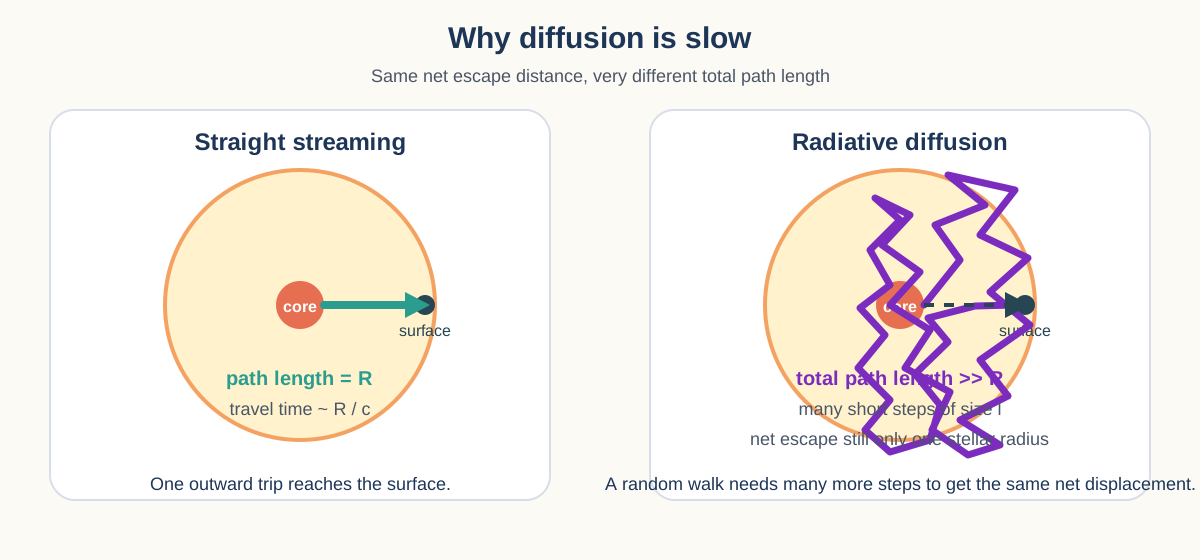
What to notice: a straight-line beam crosses the star in one stellar radius, but radiative diffusion follows a tangled path whose total length is vastly larger. The step size stays tiny, so the transport time explodes even though each individual step is taken at the speed of light. (Credit: Course illustration (A. Rosen))
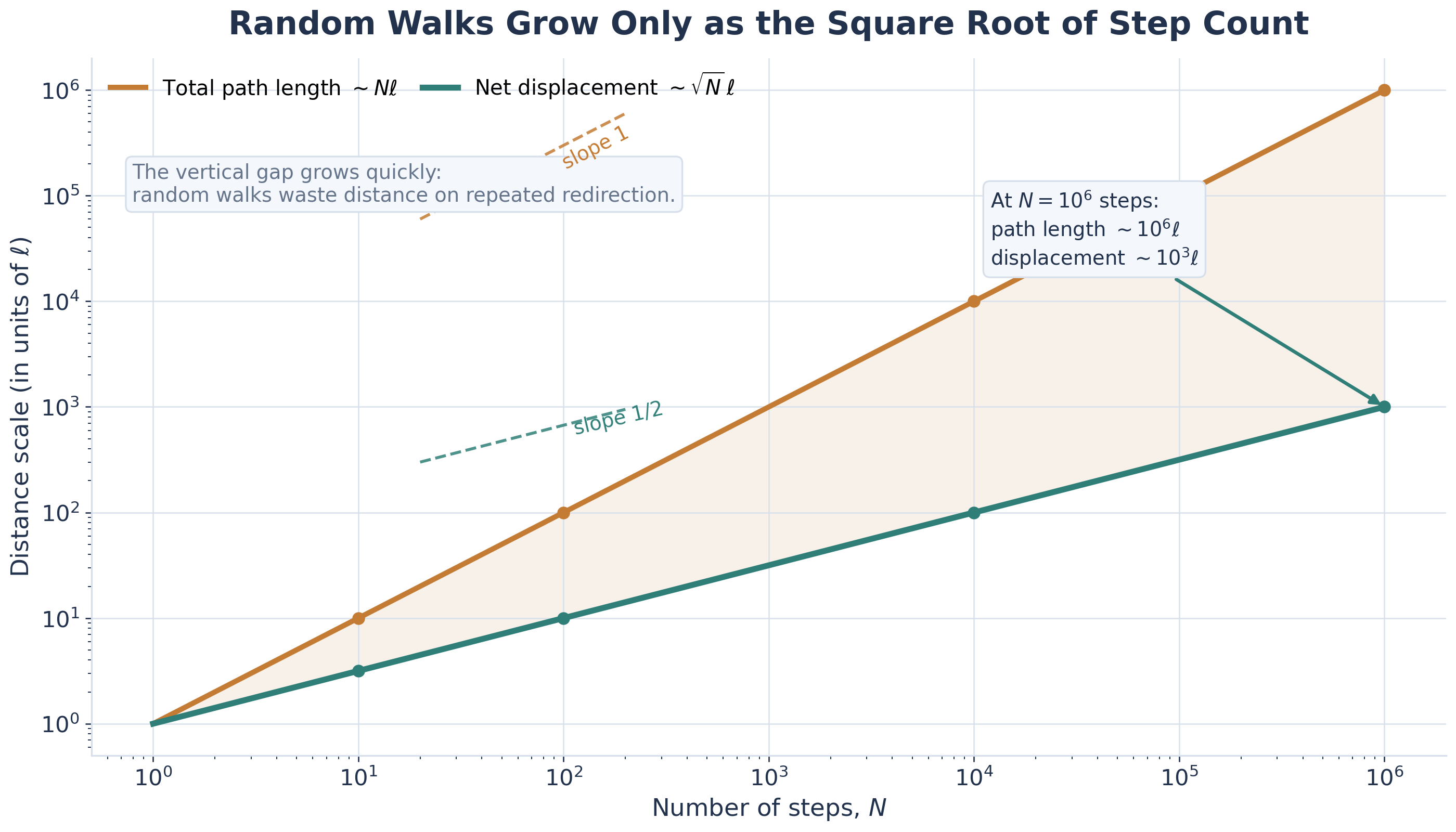
What to notice: the total path length grows as \(N\\ell\), but the net displacement grows only as \(\sqrt{N}\\,\\ell\). The widening gap is why random walks are so inefficient: after many steps, most of the travel has been spent getting redirected rather than making net outward progress. (Credit: ASTR 201 (generated))
Worked example: photon diffusion time in the Sun
Use the one-zone estimate from Part 2:
\[ \displaystyle R_\odot = 7.0 \times 10^{10}~\text{cm}, \qquad \ell \approx 2.0 \times 10^{-2}~\text{cm}. \]
\[ N \sim \left(\frac{R_\odot}{\ell}\right)^2 \sim \left(\frac{7.0 \times 10^{10}~\text{cm}}{2.0 \times 10^{-2}~\text{cm}}\right)^2. \]
\[ N \sim (3.5 \times 10^{12})^2 \approx 1.2 \times 10^{25} \]
About \(10^{25}\) scatterings — ten trillion trillion bounces.
The time per step is
\[ t_\text{step} \sim \frac{\ell}{c}. \]
Therefore the diffusion time is
\[ t_\text{diff} \sim N\frac{\ell}{c} \sim \frac{R_\odot^2}{\ell c}. \]
\[ t_\text{diff} \sim \frac{(7.0 \times 10^{10}~\text{cm})^2}{(2.0 \times 10^{-2}~\text{cm})(3.0 \times 10^{10}~\text{cm s}^{-1})}. \]
\[ \boxed{t_\text{diff} \sim 2.6 \times 10^5~\text{yr}}. \]
That is the right order of magnitude. More realistic solar models, which account for the strong radial variation of density and opacity, remain in the same broad \(10^5\)-year range.
A useful alternate form
Since
\[ \tau \sim \frac{R}{\ell}, \]
the diffusion time can also be written as
\[ t_\text{diff} \sim \tau \frac{R}{c}. \]
This form is worth remembering:
- \(R/c\) is the straight-line crossing time.
- \(\tau\) tells you how many mean-free-path layers thick the star is.
An optically thick star multiplies the straight-line crossing time by an enormous factor.
\[ \left[\frac{R^2}{\ell c}\right] = \frac{\text{cm}^2}{\text{cm}\,(\text{cm}\,\text{s}^{-1})} = \text{s} \]
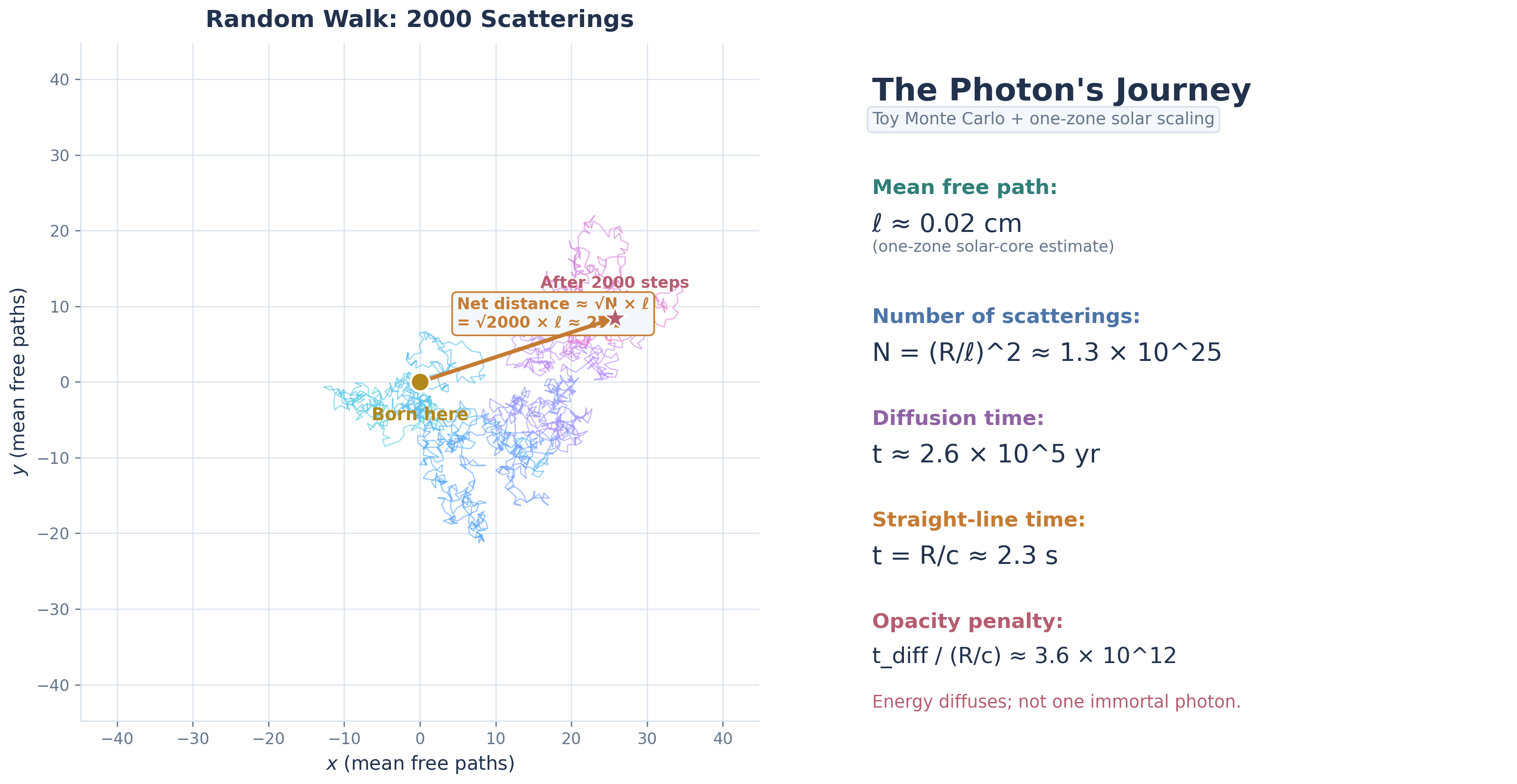
Toy walk plus one-zone solar scaling. The left panel is a simulated 2,000-step random walk that makes the \(\sqrt{N}\) scaling visible. The right panel is a separate one-zone solar estimate using a mean free path of about 0.02 cm, about \(10^{25}\) interactions, and a diffusion time of about 260,000 years. Students should not read the left-panel geometry as a literal solar trajectory. (Credit: ASTR 201 (generated))
The sunlight you see from the Sun left its surface about \(8\) minutes ago. But the energy in that light was released in the core roughly \(10^5\) years earlier.
In the stellar interior, photons are absorbed, scattered, and re-emitted many times. What diffuses outward slowly is the energy content of the radiation field, not the identity of one particular photon.
A real star is stratified. The opacity, density, and mean free path all vary strongly with radius, so there is no single exact “photon escape time.”
That is fine. The one-zone estimate above gives the correct physical scaling and the correct order of magnitude.
Use
\[ t_\text{diff} \sim \frac{R^2}{\ell c}. \]
- If \(\ell\) decreases by a factor of \(10\), what happens to \(t_\text{diff}\)?
- If \(R\) doubles while \(\ell\) stays the same, what happens to \(t_\text{diff}\)?
Because
\[ t_\text{diff} \propto \frac{1}{\ell}, \]
decreasing \(\ell\) by a factor of \(10\) makes the diffusion time ten times longer.
Because
\[ t_\text{diff} \propto R^2, \]
doubling \(R\) makes the diffusion time four times longer.
Part 4: Radiative Diffusion — Energy Flow as a Leaking Fog
Why move beyond the random walk?
The random-walk argument tells us why transport is slow. Stellar structure needs one more thing: a law for how much luminosity a given temperature gradient can carry.
That is the job of radiative diffusion.
Radiation energy density
A thermal radiation field has energy density
\[ u_\text{rad} = aT^4, \]
where
\[ a = 7.56 \times 10^{-15}~\text{erg cm}^{-3}\,\text{K}^{-4} \]
is the radiation constant. If the interior is hotter than the exterior, then \(u_\text{rad}\) decreases outward. That gradient drives a net outward flux.
Radiative flux
In the diffusion approximation, the radiative flux is
\[ F_\text{rad} = -\frac{c}{3\kappa\rho}\frac{d(aT^4)}{dr} = -\frac{4acT^3}{3\kappa\rho}\frac{dT}{dr} \tag{3}\]
What it predicts
Given the opacity \(\kappa\), density \(\rho\), and temperature profile \(T(r)\), it predicts the radiative energy flux \(F_\text{rad}\).
What it depends on
Scales as \(F \propto -c\,d(aT^4)/dr /(\kappa\rho)\). Steeper temperature gradients increase the flux; higher opacity or density suppress it.
What it’s saying
This is the macroscopic version of the random walk. Energy diffuses from hot regions to cool regions, and opacity throttles how efficiently that happens.
Assumptions
- Diffusion approximation (photon mean free path \(\ll r\))
- Local thermodynamic equilibrium
- Radiation is the dominant transport mechanism in the region of interest
See: the equation
This is the diffusion-law version of the random-walk story. It says:
- a steeper temperature gradient drives a larger flux,
- higher opacity suppresses the flux,
- higher density suppresses the flux,
- the minus sign means energy flows from hot to cool.
Opacity acts like a resistance to energy flow: the more opaque the medium, the harder it is for luminosity to leak outward.
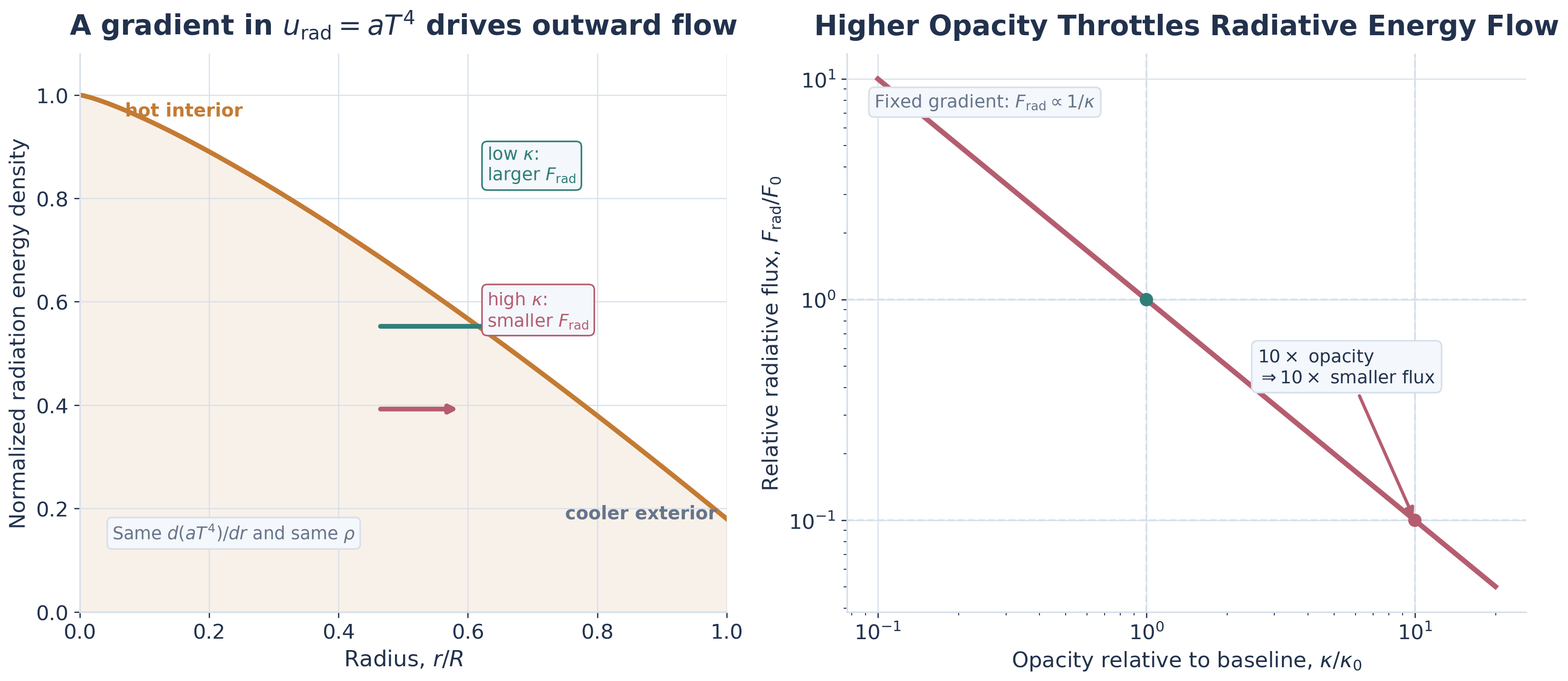
What to notice: a temperature gradient creates an outward radiative flux, but opacity throttles how much energy that gradient can carry. For the same density and the same \(d(aT^4)/dr\), increasing \(\kappa\) by a factor of 10 reduces \(F_\\text{rad}\) by the same factor. (Credit: ASTR 201 (generated))
From flux to luminosity
Luminosity is flux times area:
\[ L(r) = 4\pi r^2 F_\text{rad}. \]
Substitute the diffusion flux:
\[ L(r) = -\frac{4\pi r^2 c}{3\kappa\rho}\frac{d(aT^4)}{dr} \tag{4}\]
What it predicts
Given the opacity \(\kappa\), density \(\rho\), temperature profile \(T(r)\), and radius \(r\), it predicts the luminosity carried outward by radiative diffusion.
What it depends on
Scales as \(L \propto r^2 c\,|d(aT^4)/dr|/(\kappa\rho)\). Steeper temperature gradients or lower opacity allow faster energy flow.
What it’s saying
This is the energy-flow version of the random walk. Photons still move at \(c\) between interactions, but the net outward luminosity is throttled by opacity and the temperature gradient.
Assumptions
- Radiation is the dominant transport mechanism (not convection)
- Diffusion approximation (photon mean free path \(\ll r\))
- Local thermodynamic equilibrium
See: the equation
Assumptions behind radiative diffusion
This treatment assumes:
- the medium is optically thick,
- local thermodynamic equilibrium is a good approximation,
- radiation is the dominant transport mechanism in the region being modeled,
- the radiation field is close enough to isotropic that a diffusion treatment is valid.
Unit check
Start from
\[ u_\text{rad} = aT^4. \]
Its units are
\[ [u_\text{rad}] = \text{erg cm}^{-3}, \]
so
\[ \left[\frac{du_\text{rad}}{dr}\right] = \text{erg cm}^{-4}. \]
Now evaluate the prefactor:
\[ \left[\frac{c}{\kappa \rho}\right] = \frac{\text{cm s}^{-1}}{\left(\text{cm}^2\,\text{g}^{-1}\right)\left(\text{g cm}^{-3}\right)} = \text{cm}^2\,\text{s}^{-1}. \]
Therefore
\[ [F_\text{rad}] = \left[\frac{c}{\kappa \rho}\frac{du_\text{rad}}{dr}\right] = \text{erg cm}^{-2}\,\text{s}^{-1}, \]
which is exactly a flux, and
\[ [L] = [4\pi r^2 F] = \text{erg s}^{-1}. \]
Why opacity matters for stellar structure
At fixed luminosity, high opacity makes radiative transport less efficient. The star then needs a steeper temperature gradient to carry the same outward energy flow. If the required gradient becomes too steep, radiation is no longer the preferred transport mechanism and convection can take over.
At some radius inside a star, suppose the luminosity \(L(r)\) stays fixed but the opacity \(\kappa\) increases by a factor of \(10\).
- Does radiative transport become easier or harder?
- Must the magnitude of \(dT/dr\) increase or decrease to carry the same luminosity?
A larger \(\kappa\) suppresses the radiative flux, so radiative transport becomes harder.
To carry the same luminosity, the star must compensate by making the temperature gradient steeper, so that
\[ \left|\frac{dT}{dr}\right| \]
increases.
Observable: The Sun’s luminosity \(L_\odot = 3.8 \times 10^{33}~\text{erg}/\text{s}\) and its surface temperature \(T_\text{eff} = 5{,}800~\text{K}\).
Model: Radiative diffusion carries energy through an optically thick interior, with the flux set by the temperature gradient and opacity.
Inference: The Sun’s luminosity and fusion rate are coupled by self-regulation. Opacity controls how hard it is for energy to escape, while the fusion rate adjusts through the stellar thermostat until energy production and energy loss match.
Part 5: When Radiation Isn’t Enough — Convection
So far, we have assumed that radiation carries energy outward.
But radiative diffusion has a built-in limitation:
- photons move energy by many tiny, random steps,
- high opacity makes those steps even smaller,
- energy flow becomes inefficient.
To carry a fixed luminosity through a very opaque region, the star must increase the temperature gradient.
The key physical question
What happens if the required temperature gradient becomes too steep?
Physical picture: a fluid can move
Unlike photons, the stellar plasma is a fluid.
If a blob of hot gas is slightly hotter than its surroundings,
- it is less dense,
- buoyancy pushes it upward.
As it rises,
- it carries energy with it.
Meanwhile,
- cooler, denser gas sinks.
This creates a circulating flow.
Convection is energy transport by bulk motion of fluid, driven by buoyancy.
- hot material rises,
- cool material sinks,
- energy is carried by moving matter, not diffusing radiation.
Why convection is efficient
Compare the mechanisms:
- Radiation: many tiny steps (random walk).
- Convection: large-scale motion across significant distances.
So convection can transport energy much more efficiently than radiation in regions where diffusion struggles.
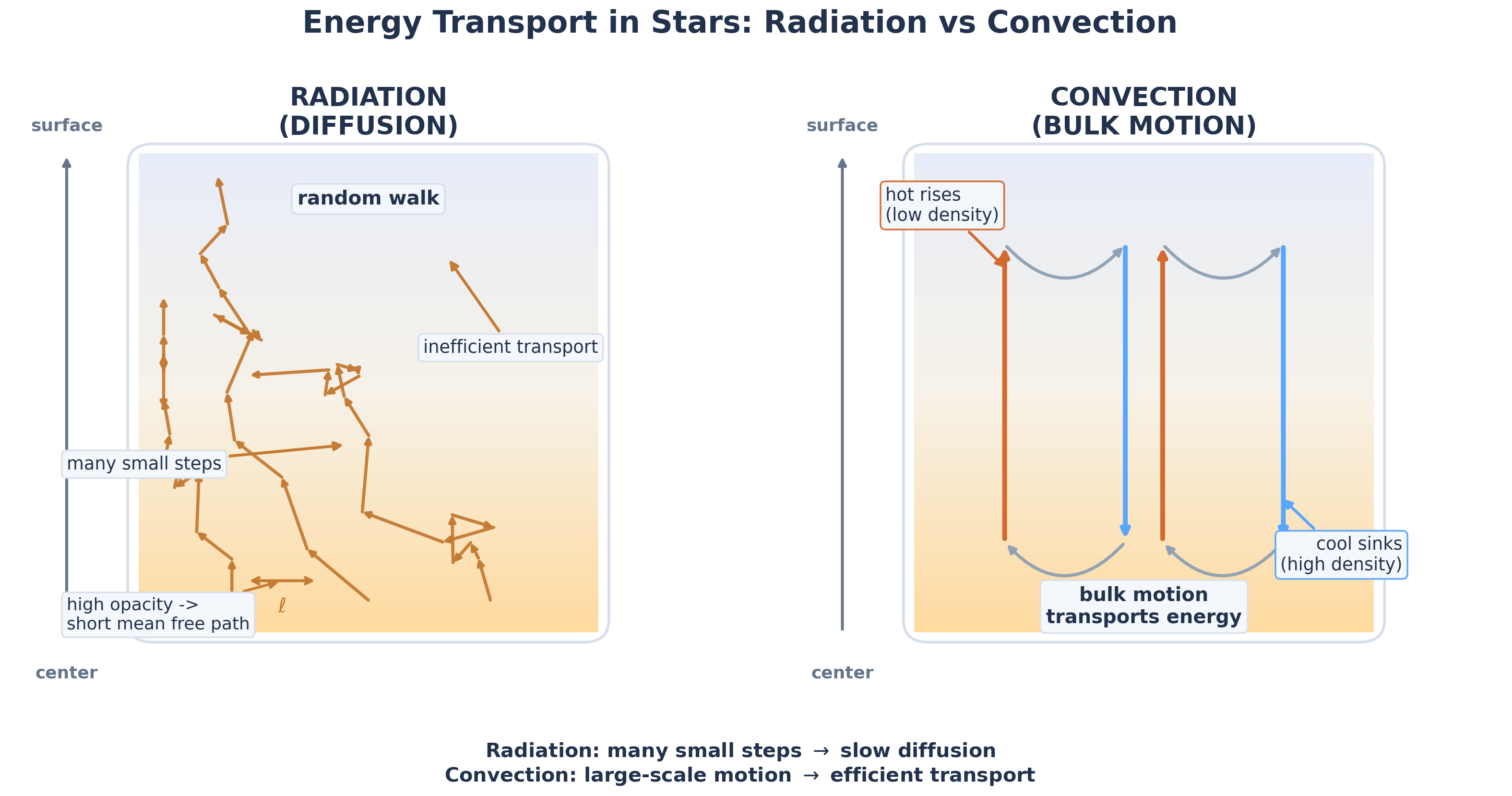
What to notice: both panels show the same center-to-surface slice, but the transport mechanism is completely different. On the left, radiation diffuses by a random walk of many tiny steps because high opacity keeps the mean free path short. On the right, convection moves energy by large-scale circulation: hot, low-density plasma rises and cool, high-density plasma sinks. (Credit: ASTR 201 (generated))
When does convection occur?
Conceptually,
- if radiation can carry the luminosity, the star stays radiative,
- if radiation struggles, the temperature gradient steepens,
- if the gradient becomes too steep, the fluid becomes unstable,
- convection turns on.
If opacity increases in some region of a star,
- does radiative transport become easier or harder?
- what must happen to the temperature gradient?
- would this make convection more or less likely?
Explain your reasoning in words.
Two transport regimes
We now have two fundamentally different ways energy moves in stars:
| Mechanism | How Energy Moves | When It Dominates |
|---|---|---|
| Radiation | Diffusion of photons | Low opacity / gentle gradients |
| Convection | Bulk fluid motion | High opacity / steep gradients |
Stars are not “radiative” or “convective” everywhere.
Different regions of the same star can use different transport mechanisms.
Part 6: Radiation Pressure
Photons carry momentum
Photons do not only carry energy. They also carry momentum. For a photon,
\[ p = \frac{E}{c}. \]
So when radiation is absorbed or scattered, it exerts a force on matter. In an isotropic thermal radiation field, the radiation pressure is
\[ P_\text{rad} = \frac{aT^4}{3} \tag{5}\]
What it predicts
Given temperature \(T\), it predicts the pressure exerted by a radiation field in thermal equilibrium.
What it depends on
Scales as \(P_\text{rad} \propto T^4\). Doubling the temperature increases radiation pressure by \(16\times\).
What it’s saying
Radiation exerts pressure because photons carry momentum. At low \(T\), this is negligible compared to gas pressure. At high \(T\) (massive star cores), radiation pressure dominates and sets the maximum stellar mass.
Assumptions
- Thermal equilibrium (blackbody radiation)
- Isotropic radiation field
See: the equation
This is why radiation transport is also a force problem.
Compare radiation pressure with gas pressure in the Sun
For the gas pressure, use the ideal-gas estimate
\[ P_\text{gas} \approx \frac{\rho k_B T}{\mu m_H}, \]
\[ \mu \approx 0.61 \]
for a fully ionized solar mixture.
Now use solar-core values
\[ T_c \approx 1.5 \times 10^7~\text{K}, \qquad \rho_c \approx 150~\text{g cm}^{-3}. \]
\[ P_\text{rad} = \frac{aT_c^4}{3} \approx 1.3 \times 10^{14}~\text{dyn cm}^{-2}. \]
\[ P_\text{gas} \approx \frac{(150~\text{g cm}^{-3})(1.38 \times 10^{-16}~\text{erg K}^{-1})(1.5 \times 10^7~\text{K})}{(0.61)(1.67 \times 10^{-24}~\text{g})} \approx 3.0 \times 10^{17}~\text{dyn cm}^{-2}. \]
So
\[ \frac{P_\text{rad}}{P_\text{gas}} \approx \frac{1.3 \times 10^{14}}{3.0 \times 10^{17}} \approx 4 \times 10^{-4}. \]
In the Sun, radiation pressure is tiny compared with gas pressure. But the crucial scaling is
\[ P_\text{rad} \propto T^4, \qquad P_\text{gas} \propto T \quad (\text{at fixed } \rho). \]
Radiation pressure grows much faster with temperature. That is why it becomes important in very massive stars.
Radiation pressure is not the same thing as ordinary thermal gas pressure.
Gas pressure comes from particle motions in matter. Radiation pressure comes from photon momentum. Both are pressures, but they arise from different physics.
Deriving the Eddington luminosity
Now ask a sharper question: how luminous can a star become before radiation pushes outward as strongly as gravity pulls inward?
Assume:
- spherical symmetry,
- steady state,
- opacity dominated by electron scattering.
Take a shell of gas at radius \(r\). The outward radiative acceleration is
\[ g_\text{rad} = \frac{\kappa F}{c}. \]
Since
\[ F = \frac{L}{4\pi r^2}, \]
this becomes
\[ g_\text{rad} = \frac{\kappa L}{4\pi r^2 c}. \]
The inward gravitational acceleration is
\[ g = \frac{GM}{r^2}. \]
At the Eddington limit, the two balance:
\[ g_\text{rad} = g. \]
So
\[ \frac{\kappa L_\text{Edd}}{4\pi r^2 c} = \frac{GM}{r^2}, \]
which gives
\[ L_\text{Edd} = \frac{4\pi G M c}{\kappa} \tag{6}\]
What it predicts
Given stellar mass \(M\) and opacity \(\kappa\), it predicts the maximum luminosity a star can sustain in hydrostatic equilibrium.
What it depends on
Scales as \(L_\text{Edd} \propto M/\kappa\). More massive stars tolerate higher luminosities.
What it’s saying
When radiation force on the gas rivals gravity, stars approach a luminosity ceiling. Near that regime, radiation pressure and mass loss strongly reshape the structure and help set the upper stellar-mass scale.
Assumptions
- Spherically symmetric
- Electron-scattering opacity dominates (\(\kappa \approx 0.34~\text{cm}^2/\text{g}\))
- Steady state (no time-dependent effects)
See: the equation
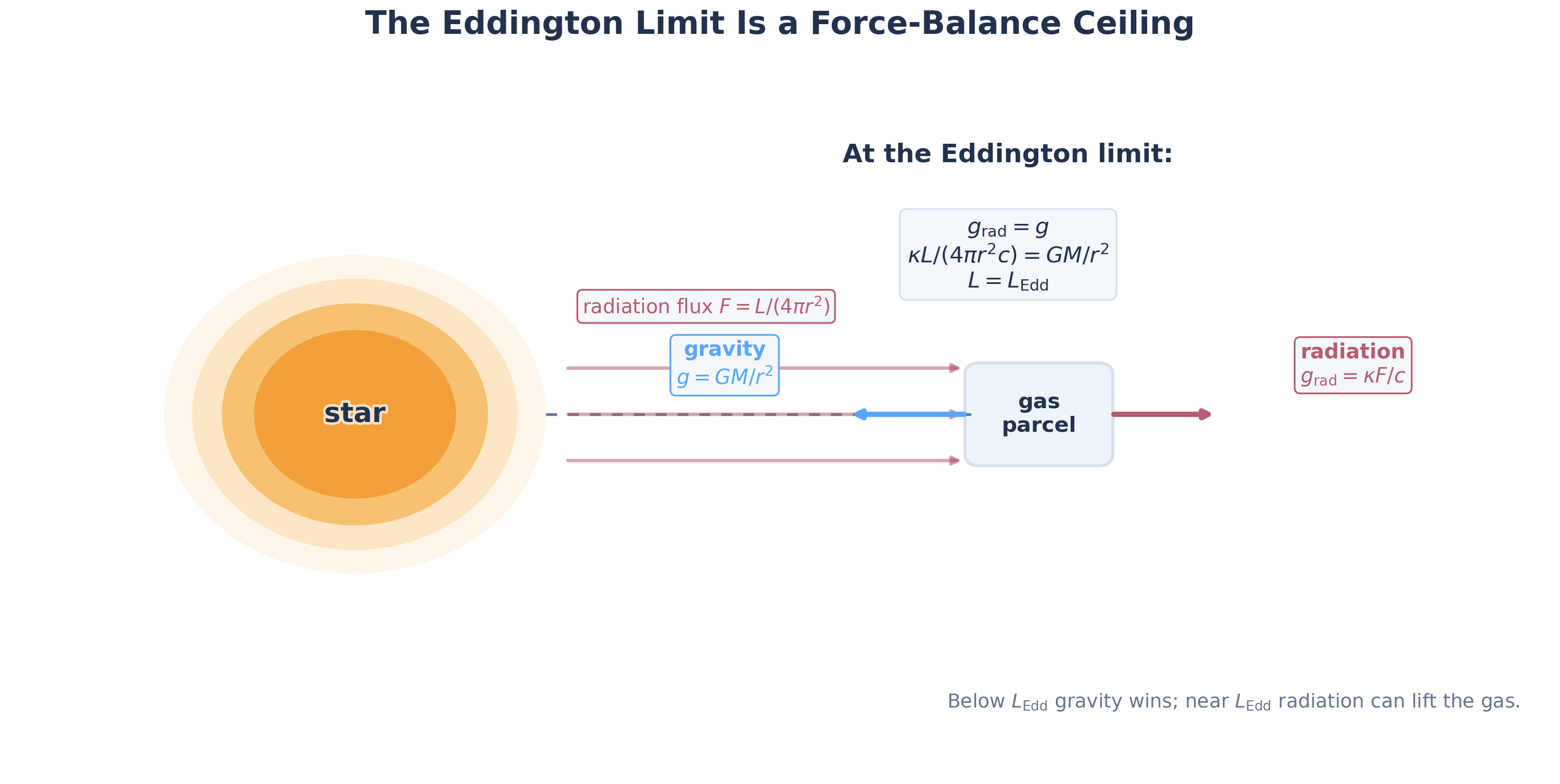
What to notice: the Eddington luminosity comes from a force balance on the same gas parcel. Gravity pulls inward with \(g = GM/r^2\), while radiation pushes outward with \(g_\text{rad} = \kappa L/(4\pi r^2 c)\). Setting those equal gives the luminosity at which radiation pressure can compete directly with gravity. (Credit: ASTR 201 (generated))
Physical meaning
The Eddington luminosity is a force-balance ceiling:
- Below \(L_\text{Edd}\), gravity wins.
- Near \(L_\text{Edd}\), radiation can reshape the stellar envelope and drive strong winds.
- Above \(L_\text{Edd}\), hydrostatic balance becomes very difficult to maintain.
Worked example: the Sun’s Eddington luminosity
Use
\[ G = 6.674 \times 10^{-8}~\text{cm}^3\,\text{g}^{-1}\,\text{s}^{-2}, \]
\[ M_\odot = 2.0 \times 10^{33}~\text{g}, \]
\[ c = 3.0 \times 10^{10}~\text{cm s}^{-1}, \]
\[ \kappa \approx 0.34~\text{cm}^2\,\text{g}^{-1}. \]
\[ L_\text{Edd} = \frac{4\pi G M_\odot c}{\kappa} \]
\[ L_\text{Edd} = \frac{4\pi (6.674 \times 10^{-8})(2.0 \times 10^{33})(3.0 \times 10^{10})}{0.34}~\text{erg s}^{-1} \]
\[ \boxed{L_\text{Edd} \approx 1.5 \times 10^{38}~\text{erg s}^{-1} \approx 3.8 \times 10^4\,L_\odot}. \]
The Sun is far below this limit, so radiation pressure is dynamically negligible for solar structure. But massive stars come much closer because their actual luminosities rise faster than linearly with mass.
Unit check
\[ \left[\frac{GMc}{\kappa}\right] = \frac{\left(\text{cm}^3\,\text{g}^{-1}\,\text{s}^{-2}\right)\left(\text{g}\right)\left(\text{cm s}^{-1}\right)}{\text{cm}^2\,\text{g}^{-1}} = \text{g cm}^2\,\text{s}^{-3} = \text{erg s}^{-1}. \]
The Eddington luminosity scales as
\[ L_\text{Edd} \propto \frac{M}{\kappa}. \]
At fixed opacity:
- If stellar mass doubles, what happens to \(L_\text{Edd}\)?
- Why do the most massive stars come closest to this limit even though \(L_\text{Edd}\) rises with mass?
At fixed \(\kappa\),
\[ L_\text{Edd} \propto M, \]
so doubling the mass doubles the Eddington luminosity.
Massive main-sequence stars still come closest to the limit because their actual luminosities rise much faster than linearly with mass. So \(L\) catches up to \(L_\text{Edd}\) as stellar mass increases.
Reference Tables
Radiation Transport at a Glance
| Quantity | Formula | Sun Value |
|---|---|---|
| Opacity (electron scattering) | \(\kappa_\text{es} \approx 0.34~\text{cm}^2/\text{g}\) | \(0.34~\text{cm}^2/\text{g}\) |
| Mean free path (core) | \(\ell = \frac{1}{\kappa\rho}\) | \(\sim 0.02~\text{cm}\) |
| Number of scatterings | \(N \sim \left(\frac{R}{\ell}\right)^2\) | \(\sim 10^{25}\) |
| Optical depth | \(\tau \sim \kappa \rho R \sim R/\ell\) | \(\sim 3.5 \times 10^{12}\) |
| Photon diffusion time | \(t_\text{diff} \sim \frac{R^2}{\ell c}\) | \(\sim 2.6 \times 10^5~\text{yr}\) |
| Radiation pressure (core) | \(P_\text{rad} = aT^4/3\) | \(\sim 1.3 \times 10^{14}~\text{dyn cm}^{-2}\) |
| Pressure ratio | \(P_\text{rad}/P_\text{gas}\) | \(\sim 4 \times 10^{-4}\) |
| Eddington luminosity | \(L_\text{Edd} = 4\pi GMc/\kappa\) | \(\sim 1.5 \times 10^{38}~\text{erg s}^{-1}\) |
Symbol Legend
| Symbol | Meaning | CGS Units |
|---|---|---|
| \(\kappa\) | Opacity (cross-section per unit mass) | \(\text{cm}^2/\text{g}\) |
| \(\rho\) | Mass density | \(\text{g}/\text{cm}^3\) |
| \(\ell\) | Mean free path | cm |
| \(\tau\) | Optical depth | dimensionless |
| \(N\) | Number of scatterings | Dimensionless |
| \(F_\text{rad}\) | Radiative flux | \(\text{erg}\,\text{cm}^{-2}\,\text{s}^{-1}\) |
| \(L\) | Luminosity | \(\text{erg}\,\text{s}^{-1}\) |
| \(a\) | Radiation constant (\(4\sigma/c\)) | \(7.56 \times 10^{-15}~\text{erg}\,\text{cm}^{-3}\,\text{K}^{-4}\) |
| \(u_\text{rad}\) | Radiation energy density | \(\text{erg}/\text{cm}^3\) |
| \(P_\text{rad}\) | Radiation pressure | \(\text{dyn}/\text{cm}^2\) |
| \(\mu\) | Mean molecular weight | dimensionless |
| \(m_H\) | Hydrogen mass | g |
Summary: Energy’s Tortuous Journey
The most important ideas from this reading:
Stars are opaque — the mean free path of a photon in the solar core is \(\sim 0.2~\text{mm}\), about a hundred billion times smaller than the solar radius.
The random walk explains the diffusion time: a simple solar-core estimate gives \(t_\text{diff} \sim 2.6 \times 10^5~\text{yr}\), and more realistic solar models remain in the same broad \(10^5\)-year range.
Radiative diffusion transports energy outward, driven by the temperature gradient. The random walk explains why the transport is slow; the diffusion equation explains how much luminosity a given gradient can carry.
Convection takes over when radiative diffusion becomes too inefficient. In that regime, energy is carried by rising and sinking fluid rather than by photon diffusion alone.
Radiation pressure (\(P_\text{rad} = aT^4/3\)) is negligible in the Sun but grows rapidly with temperature. In very luminous stars it competes with gravity and leads to the Eddington luminosity.
┌──────────────────────────────────────────────────────┐
│  Gravity Scoreboard — Reading 4                      │
├──────────────────────────────────────────────────────┤
│  Attacker:    Gravity (always)                       │
│  Defender:    Pressure support from hot stellar gas  │
│  New player:  Radiation pressure (rises as T^4)      │
│  Status:      BALANCED — the star remains hydrostatic│
│               while energy moves outward by radiation │
│               or convection, depending on conditions. │
│  New insight: Transport can switch mechanisms when    │
│               diffusion struggles, and radiation also │
│               pushes on matter through momentum.      │
│  Takeaway:    Photons move at c, but net outward      │
│               transport is slow because random walks  │
│               only gain distance as the square root   │
│               of the number of steps.                 │
│  Next:        Why luminosity rises so steeply with    │
│               mass — Reading 5                        │
└──────────────────────────────────────────────────────┘
We now understand how energy moves through a star: by radiative diffusion when photons can carry the luminosity, and by convection when diffusion becomes inefficient. But we still have not explained the scaling relations — why luminosity rises so steeply with mass, and why the required radiative gradient can eventually fail.
You now have three essential pieces of stellar structure: hydrostatic balance, energy generation, and energy transport. In Reading 5, we combine those ideas with mass conservation to derive the leading-order stellar scaling relations and explain why luminosity rises so steeply with mass. We will also see more clearly when radiative transport fails and convection takes over.