Lecture 2: The Balancing Act — Hydrostatic Equilibrium

What holds a star up against its own gravity?

hydrostatic-equilibrium
virial-theorem
stellar-structure
pressure
core-temperature
The Sun has maintained a nearly stable equilibrium for 4.6 billion years. What balances gravity? The answer is pressure — specifically, a pressure gradient that increases toward the center, pushing outward against the inward pull of gravity. This balance is called hydrostatic equilibrium, and it is the single most important equation in stellar physics. Combined with the virial theorem, it lets us estimate the Sun’s core temperature from nothing more than its mass and radius.
Author

Dr. Anna Rosen

Published

March 10, 2026

Learning Objectives

After completing this reading, you should be able to:

  1. Explain why a star needs a pressure gradient (not just pressure) to resist gravitational collapse
  2. Distinguish thermal gas pressure, radiation pressure, and degeneracy pressure as different sources of support inside stars
  3. Derive and interpret the equation of hydrostatic equilibrium: \(\frac{dP}{dr} = -\rho g = -\frac{G M(r)\rho(r)}{r^2}\)
  4. Apply the virial theorem (\(2K_{\text{th}} + U_{\text{grav}} = 0\)) to relate thermal and gravitational energy
  5. Estimate a star’s central temperature: \(T_c \sim \frac{\mu G M m_p}{k_B R}\) using hydrostatic scaling and the ideal-gas law
  6. Explain why gravity alone predicts a stellar core temperature of order \(10^7\,\mathrm{K}\) for the Sun
  7. Explain why a self-gravitating system has negative heat capacity — it gets hotter as it loses energy
  8. Connect hydrostatic equilibrium to the dynamical timescale: departures are corrected on a timescale of order minutes for the Sun
NoteMath Grammar Convention

In this reading, we will be careful about what each mathematical symbol means.

  • \(=\) means an equality within a stated model or definition
  • \(\approx\) means numerically approximately equal
  • \(\sim\) means “is of order” or “has the scaling”
  • \(\propto\) means “is proportional to”

We will also carry units explicitly in all worked examples. In astrophysics, unit tracking is part of the reasoning, not optional bookkeeping.

Concept Throughline

Gravity never stops pulling inward. For a star to survive, a force must balance gravity at every radius — not uniformly, but with a strength that increases toward the center, where the weight of the overlying material is greatest. That force comes from a pressure gradient, and the condition that pressure exactly balances gravity at every point inside the star is called hydrostatic equilibrium.

This force balance is the foundation of stellar structure theory. Combined with the virial theorem and the ideal-gas picture, it lets us estimate a solar core temperature of order \(10^7\,\mathrm{K}\), or about \(15\,\mathrm{MK}\). No nuclear reaction physics is needed to estimate this temperature scale — only gravity, force balance, energy balance, and the thermal behavior of gas.

ImportantThe Reasoning Ladder (Preview)

In this lecture, we will build a chain of reasoning:

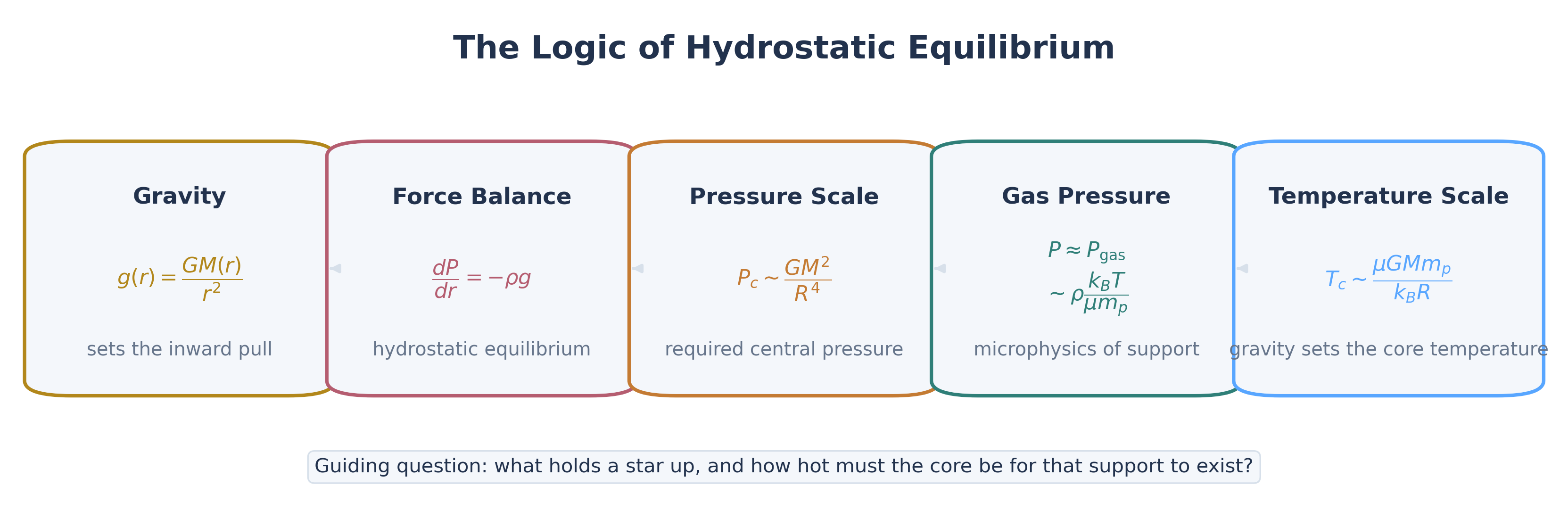
  • Gravity sets the inward pull: \[ g(r) = \frac{G M(r)}{r^2} \]

  • Force balance gives hydrostatic equilibrium: \[ \frac{dP}{dr} = -\rho g \]

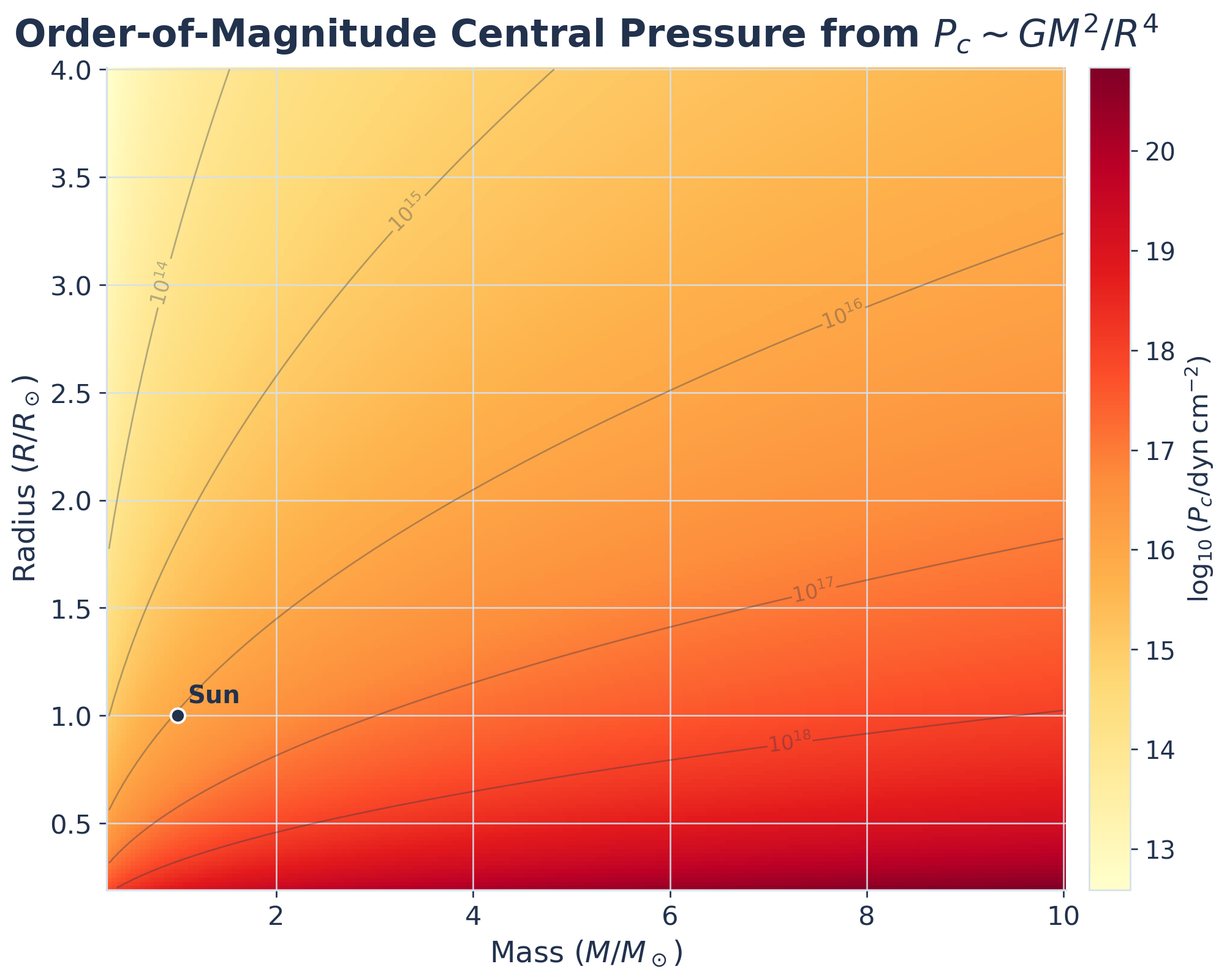
  • This implies a required central pressure: \[ P_c \sim \frac{G M^2}{R^4} \]

  • The ideal-gas law connects pressure to temperature: \[ P \approx P_{\text{gas}} \sim \rho \frac{k_B T}{\mu m_p} \]

  • Therefore, gravity sets a temperature scale: \[ T_c \sim \frac{\mu G M m_p}{k_B R} \]

This chain is the logic of stellar structure.

Horizontal five-step flowchart for hydrostatic equilibrium with rounded boxes labeled Gravity, Force Balance, Pressure Scale, Gas Pressure, and Temperature Scale, each containing the key equation and connected by arrows.

What to notice: stellar structure is a reasoning chain. Gravity sets the inward pull, hydrostatic equilibrium sets the required pressure gradient, the pressure scale implies a central pressure, and the ideal-gas picture turns that into a core temperature scale. (Credit: ASTR 201 (generated))

NoteReading Map — Choose Your Track

Track A (Core, ~30 min): Read Parts 1–5 in order. Skip any box marked Enrichment. This covers hydrostatic equilibrium, the main sources of pressure in stars, the virial theorem, core temperature estimation, and negative heat capacity.

Track B (Full, ~40 min): Read everything, including the warning, OMI, and reference sections. There are no separate enrichment boxes in this draft, so the full track mainly asks you to linger on the pressure-source discussion, the worked estimates, and the counterintuitive energy argument.

Both tracks cover all core learning objectives.


ImportantThe Big Idea

A star is held up by a pressure gradient, not just by pressure. The pressure must increase toward the center — rising from essentially zero at the surface to enormous values in the core — so that each layer can support the weight of the material above it. This balance, called hydrostatic equilibrium, is the foundational force-balance equation of stellar structure.


Part 1: Why Doesn’t the Sun Collapse?

A Deceptively Simple Question

In Reading 1, you calculated the Sun’s dynamical timescale: \(\tau_{\text{dyn}} \sim 50\,\mathrm{min}\). If gravity were the only force acting, the Sun would collapse in less than an hour. Yet the Sun has been shining for \(4.6\,\mathrm{Gyr}\) — about \(4 \times 10^{13}\) dynamical times. Somehow it maintains an almost perfect balance between inward pull and outward support.

What force opposes gravity? The answer is pressure — specifically, the pressure of the hot gas inside the star. But saying “pressure holds the star up” is not quite right, and understanding why requires some care. If the balance fails, even briefly, the gas cannot remain static: some layer must accelerate inward or outward on roughly the dynamical timescale.

Pressure vs. Pressure Gradient

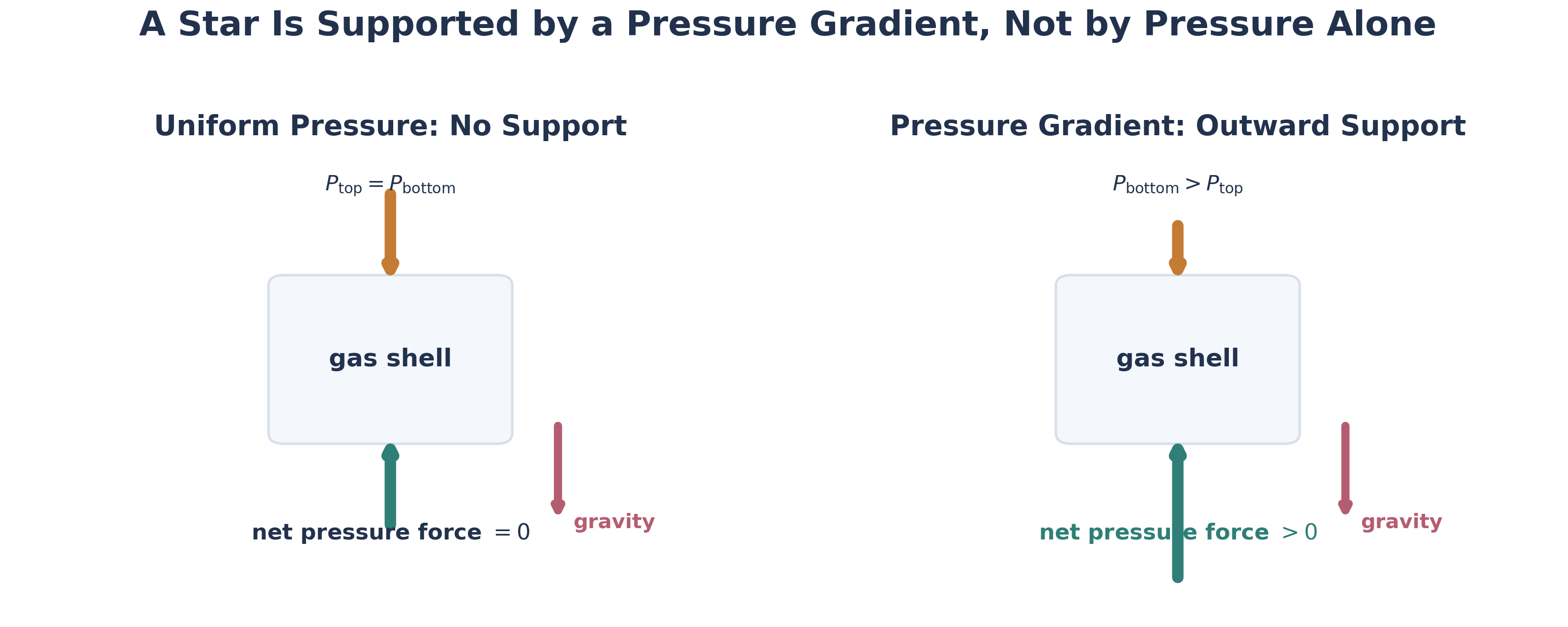
Two-panel didactic diagram comparing a gas shell with equal pressure on top and bottom to a gas shell with larger pressure below than above, alongside downward gravity arrows and net-force labels.

What to notice: uniform pressure produces no net support. Only when the lower side pushes harder than the upper side does a shell feel a net outward pressure force. (Credit: ASTR 201 (generated))

Imagine a thin shell of gas at some radius \(r\) inside a star. This shell feels gravity pulling it inward (toward the center) and pressure pushing it from both sides — inward from the gas above and outward from the gas below.

If the pressure were the same everywhere inside the star, the inward and outward pressure forces on the shell would exactly cancel, and gravity would win unopposed. For pressure to resist gravity, the pressure below the shell must exceed the pressure above it. In other words, it’s not pressure itself that matters — it’s the pressure gradient, the rate at which pressure changes with position.

What matters physically is the difference in pressure across the shell: \[ F_{P,\text{net}} = \left[P(r) - P(r+dr)\right]A. \] If \(P(r+dr) = P(r)\), then \(F_{P,\text{net}} = 0\) no matter how large the common pressure is. A star is supported only when the lower side pushes harder than the upper side.

The physical point is that it is the pressure gradient, \[ \frac{dP}{dr}, \] not the pressure \(P\) by itself, that provides the outward force.

NotePrinciple — Pressure vs. Force

Uniform pressure cannot move anything. If the pressure is the same on both sides of a surface, the forces cancel. Pressure produces a net force only when it varies with position, which is why pressure gradients, not pressure alone, support stars against gravity.

TipThink First

You’ve experienced a pressure gradient before: at the bottom of a swimming pool, the water pressure is higher than at the surface. Why? What’s the analogy to a star?

The water pressure increases with depth because each layer must support the weight of all the water above it. A star works the same way: the gas pressure increases toward the center because each layer must support the weight of all the stellar material above it. The deeper you go, the more weight there is to support, so the higher the pressure must be.

TipMicro-checkpoint

Predict the motion of a gas shell if the pressure were extremely large but exactly uniform everywhere inside the star. Be explicit about the pressure forces and gravity.

Answer: The shell would move inward. Uniform pressure produces equal forces in opposite directions, so the net pressure force on the shell is zero. Gravity would be unopposed, and only a pressure gradient could provide outward support.

Types of Pressure in Stars

To say that “pressure supports a star” raises a deeper question: what physical process creates that pressure in the first place? In ordinary stars like the Sun, the answer begins with the random thermal motions of particles. In hotter and more massive stars, trapped radiation also contributes. Much later in the course, when we discuss white dwarfs and stellar remnants, we will meet a third kind of support that comes from quantum mechanics rather than temperature.

Thermal Gas Pressure: Momentum from Particle Collisions

Start from first principles. A gas is made of particles moving in many directions. When those particles strike a surface, they bounce and transfer momentum. Pressure is the rate of momentum transfer per unit area. Faster particles hit harder; more particles per cubic centimeter hit more often. That is why heating a gas or compressing it both raise its pressure.

For a thermal gas, this idea is summarized by the ideal-gas pressure law: \[ P_{\text{gas}} = n k_B T = \frac{\rho k_B T}{\mu m_p}. \]

NoteDeep Dive — What Gas Pressure Really Is

Gas pressure is a macroscopic description of an enormous number of microscopic collisions. A gas contains a vast ensemble of particles moving in many directions. Every time those particles strike a surface, they transfer momentum. Pressure is the cumulative rate of that momentum transfer per unit area.

Temperature is not “how much heat a single particle contains.” It is a macroscopic description of the typical kinetic-energy distribution of the whole ensemble. A hotter gas has particles that typically move faster, so collisions transfer more momentum. A denser gas has more particles in each cubic centimeter, so collisions happen more often. Both effects raise the pressure.

The ideal-gas law collects those ideas into one compact statement: \[ P_{\text{gas}} = n k_B T = \frac{\rho k_B T}{\mu m_p}. \]

Read term by term:

  • \(n\) is the number density, so it counts how many particles can collide in each unit volume.
  • \(T\) is the temperature, so it sets the typical kinetic-energy scale of the particle distribution.
  • \(\rho\) is the mass density, so it tracks how much matter is packed into the gas.
  • \(\mu m_p\) is the mean mass per particle, so it converts from mass density to number density.

What this equation is really saying: gas pressure increases when there are more particles per unit volume or when those particles have larger typical speeds.

Symbol Meaning
\(P_{\text{gas}}\) thermal gas pressure, in \(\mathrm{dyn\,cm^{-2}}\)
\(n\) number density, in particles per \(\mathrm{cm^3}\)
\(k_B\) Boltzmann’s constant
\(T\) temperature, in \(\mathrm{K}\)
\(\rho\) mass density, in \(\mathrm{g\,cm^{-3}}\)
\(m_p\) proton mass
\(\mu\) mean molecular weight
\(\mu m_p\) mean mass per particle

This equation says something physically simple but powerful: at fixed density, a hotter gas pushes harder; at fixed temperature, a denser gas pushes harder. In ordinary stars like the Sun, this thermal gas pressure is the main source of support against gravity.

ImportantWhat \(\mu\) Means and Why It Matters

\(\mu\) is the mean molecular weight. It is dimensionless, and it tells you the average mass per particle in units of the proton mass. The actual mean mass per particle is therefore \[ \mu m_p. \]

In a fully ionized gas, “particle” means more than just nuclei. Electrons also count, because electrons and nuclei both contribute to the particle population that shares thermal energy and produces pressure. That is why ionization state and chemical composition both affect \(\mu\).

For a fully ionized mixture with hydrogen mass fraction \(X\), helium mass fraction \(Y\), and metal mass fraction \(Z\), the mean molecular weight is approximately \[ \frac{1}{\mu} \approx 2X + \frac{3}{4}Y + \frac{1}{2}Z. \]

Here:

  • \(X\) is the mass fraction of hydrogen
  • \(Y\) is the mass fraction of helium
  • \(Z\) is the mass fraction of all elements heavier than helium

These mass fractions satisfy \[ X + Y + Z = 1. \]

The factors in the \(\mu\) equation come from counting how many pressure-producing particles you get per unit mass:

  • hydrogen contributes one proton and one electron when fully ionized, so it gives many particles per gram
  • helium contributes one nucleus and two electrons, but that mass is packed into four nucleons, so it gives fewer particles per gram than hydrogen
  • heavier elements contribute still fewer particles per gram, which is why they enter with a smaller coefficient

For ionized solar-composition gas, a typical choice is \[ X \approx 0.70, \qquad Y \approx 0.28, \qquad Z \approx 0.02. \]

Substituting gives \[ \frac{1}{\mu} \approx 2(0.70) + \frac{3}{4}(0.28) + \frac{1}{2}(0.02) = 1.40 + 0.21 + 0.01 = 1.62, \] so \[ \mu \approx \frac{1}{1.62} \approx 0.62 \approx 0.6. \]

That is why throughout this reading we use \[ \mu \approx 0.6. \]

Physically, \(\mu\) matters because it connects mass density to number density: \[ n = \frac{\rho}{\mu m_p}. \] At fixed \(\rho\) and \(T\), a smaller \(\mu\) means each particle is lighter on average, so there are more particles per unit volume. More particles means more collisions, and more collisions mean a larger gas pressure. Composition therefore affects both pressure support and the temperature required for hydrostatic support.

TipCheck Yourself — Why \(\mu\) Matters

Suppose \(\mu\) decreases while \(\rho\) and \(T\) stay fixed. Does the gas pressure increase or decrease? Explain physically before you quote the equation.

The gas pressure increases.

From \[ P_{\text{gas}} = \frac{\rho k_B T}{\mu m_p}, \] a smaller \(\mu\) gives a larger pressure at fixed \(\rho\) and \(T\).

The physical reason is more important than the algebra: if \(\mu\) decreases, the average mass per particle decreases, so the same mass density contains more particles. More particles per unit volume means more collisions, so the momentum-transfer rate and therefore the pressure increase.

Temperature Describes a Distribution, Not a Single Speed

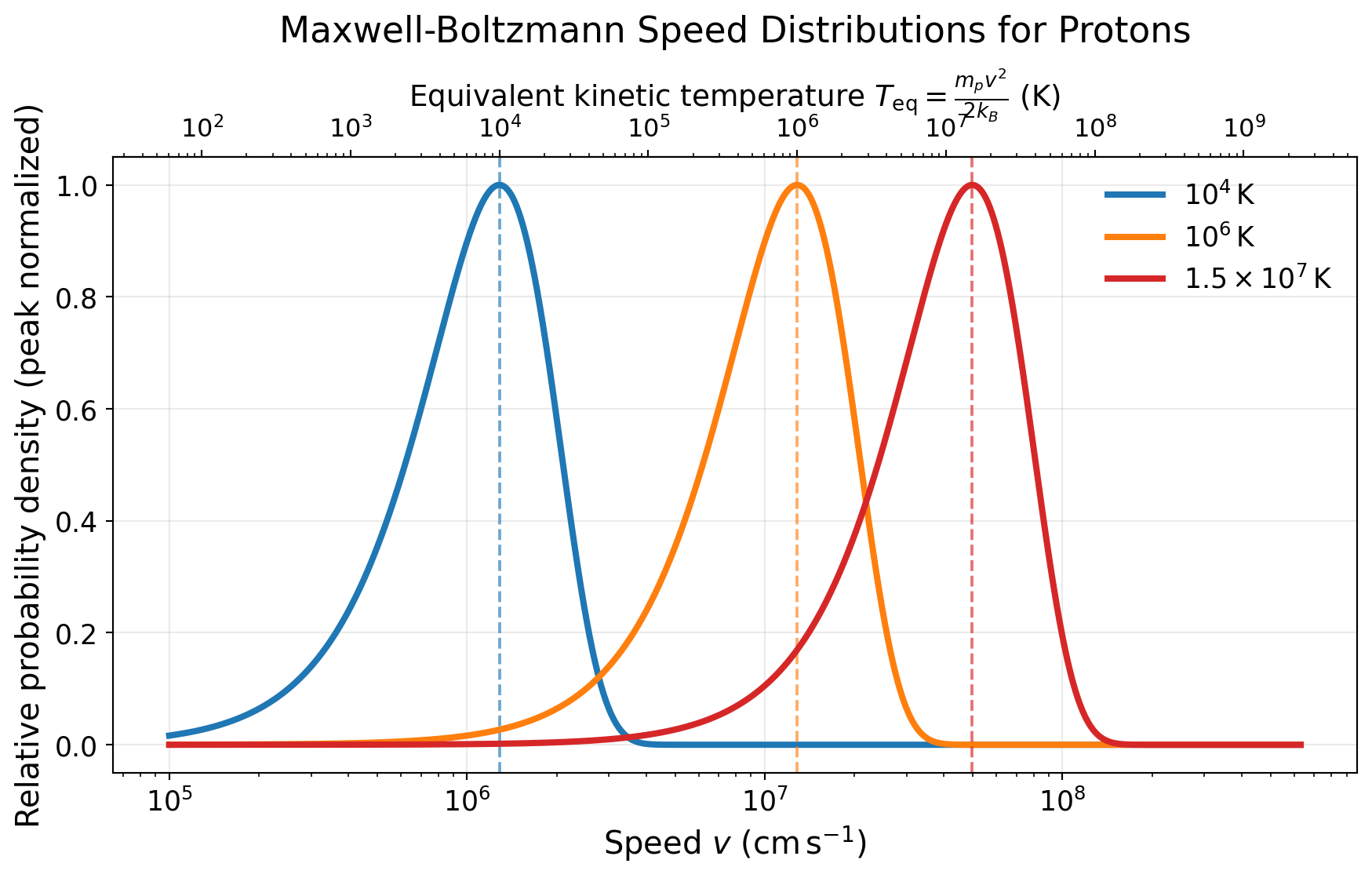
One more subtle point matters here. Temperature does not assign one “correct speed” to every particle. It describes a distribution of particle speeds and kinetic energies. Some particles move slower than the average, some faster, and the whole distribution shifts as the gas heats up.

The plot below uses a Maxwell-Boltzmann speed distribution for protons as a pedagogical illustration. The exact formula matters less than the pattern: as temperature rises, the distribution broadens and shifts toward higher speeds.

Code
import numpy as np
import matplotlib.pyplot as plt
from matplotlib.ticker import LogFormatterMathtext

k_b = 1.380649e-16      # erg K^-1
m_p = 1.6726219e-24     # g

temperatures = [1.0e4, 1.0e6, 1.5e7]
labels = [r"$10^4\,\mathrm{K}$", r"$10^6\,\mathrm{K}$", r"$1.5\times10^7\,\mathrm{K}$"]
colors = ["tab:blue", "tab:orange", "tab:red"]

v = np.logspace(5.0, 8.8, 1600)  # cm s^-1

def maxwell_boltzmann_speed(v_cgs, temperature):
    prefactor = 4.0 * np.pi * (m_p / (2.0 * np.pi * k_b * temperature)) ** 1.5
    return prefactor * v_cgs**2 * np.exp(-m_p * v_cgs**2 / (2.0 * k_b * temperature))

def speed_to_temperature(v_cgs):
    return m_p * v_cgs**2 / (2.0 * k_b)

def temperature_to_speed(temperature):
    return np.sqrt(2.0 * k_b * temperature / m_p)

fig, ax = plt.subplots(figsize=(9.2, 6.0))

for temperature, label, color in zip(temperatures, labels, colors):
    distribution = maxwell_boltzmann_speed(v, temperature)
    distribution = distribution / distribution.max()
    most_probable_speed = np.sqrt(2.0 * k_b * temperature / m_p)
    ax.plot(v, distribution, label=label, color=color, linewidth=3.0)
    ax.axvline(most_probable_speed, color=color, linewidth=1.4, linestyle="--", alpha=0.65)

ax.set_xscale("log")
ax.set_xlabel(r"Speed $v$ ($\mathrm{cm\,s^{-1}}$)", fontsize=15)
ax.set_ylabel("Relative probability density (peak normalized)", fontsize=15)
ax.set_title("Maxwell-Boltzmann Speed Distributions for Protons", fontsize=17, pad=12)
ax.tick_params(labelsize=13)
ax.grid(True, alpha=0.25)
ax.legend(frameon=False, fontsize=13)
ax.xaxis.set_major_formatter(LogFormatterMathtext())

secax = ax.secondary_xaxis("top", functions=(speed_to_temperature, temperature_to_speed))
secax.set_xscale("log")
secax.set_xlabel(
    r"Equivalent kinetic temperature $T_{\mathrm{eq}} = \frac{m_p v^2}{2k_B}$ ($\mathrm{K}$)",
    fontsize=14,
)
secax.tick_params(labelsize=12)
secax.xaxis.set_major_formatter(LogFormatterMathtext())

plt.tight_layout()
plt.show()
Log-scale plot of normalized Maxwell-Boltzmann speed distributions for protons at 10^4 K, 10^6 K, and 1.5 times 10^7 K. The bottom axis shows speed in centimeters per second, and the top axis shows the equivalent kinetic temperature scale. Hotter curves are broader and shifted toward higher speeds.
Figure 1: What to notice: temperature describes a distribution of particle speeds, not a single particle speed. The bottom axis uses CGS speed units (\(\mathrm{cm\,s^{-1}}\)), and the top axis shows the equivalent single-particle kinetic temperature scale \(T_{\mathrm{eq}} = \frac{m_p v^2}{2k_B}\). Higher temperatures broaden the Maxwell-Boltzmann distribution and shift it toward faster particles.

The upper axis is a translation from speed to the single-particle kinetic temperature scale \[ T_{\mathrm{eq}} = \frac{m_p v^2}{2k_B}. \] It is a way to compare speeds and thermal-energy scales, not a claim that all protons at temperature \(T\) move at one speed.

WarningMisconception Check — “Temperature Is the Speed of a Single Particle”

A student says, “At \(1.5\times10^7\,\mathrm{K}\) every proton in the solar core must move at the same speed.”

Why is this wrong?

It is wrong because temperature describes an ensemble, not a single particle. Even in thermal equilibrium, particles occupy a distribution of speeds and energies. The temperature sets the overall scale of that distribution, but different particles still move at different speeds at the same instant.

Radiation Pressure: Momentum from Light

Photons carry momentum even though they have no rest mass. If photons are trapped inside a star and scatter repeatedly from matter, they exert a pressure on the gas. That contribution is called radiation pressure.

For a radiation field in local thermal equilibrium, the radiation energy density is \[ u_{\text{rad}} = a T^4, \] where \(a\) is the radiation constant. For an isotropic radiation field, the associated pressure is \[ P_{\text{rad}} = \frac{1}{3} u_{\text{rad}} = \frac{1}{3} a T^4. \]

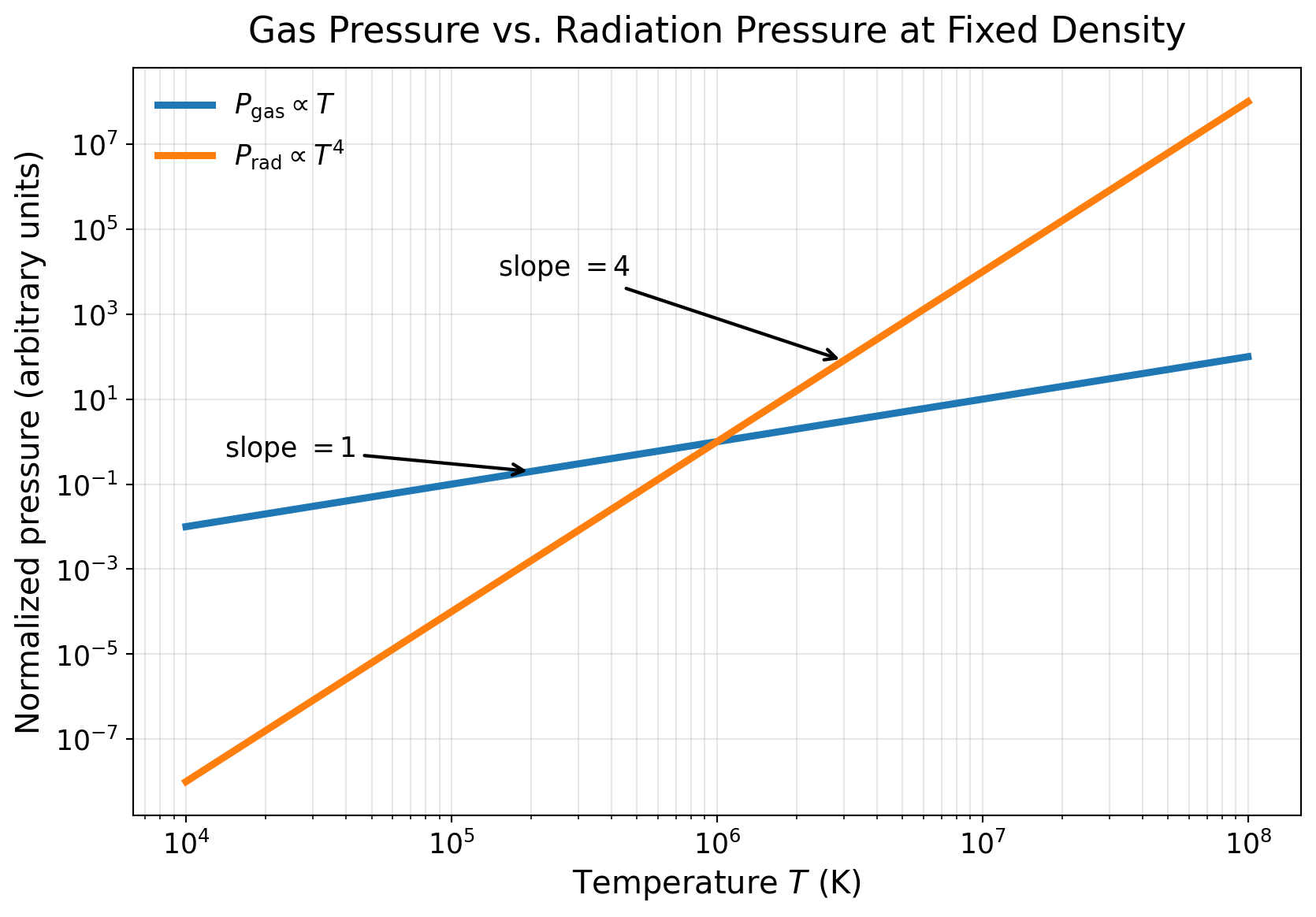
The important physics is the temperature dependence: \[ P_{\text{gas}} \propto T, \qquad P_{\text{rad}} \propto T^4 \] at fixed density. Radiation pressure therefore grows much more rapidly with temperature than thermal gas pressure does.

For a star like the Sun, thermal gas pressure dominates. In very hot, very massive stars, radiation pressure becomes much more important.

We can make that trend more explicit with a scaling argument. Using \[ P_{\text{gas}} \sim \frac{\rho k_B T}{\mu m_p}, \] the ratio of radiation pressure to gas pressure scales as \[ \frac{P_{\text{rad}}}{P_{\text{gas}}} \propto \frac{T^4}{\rho T} = \frac{T^3}{\rho}. \]

Later in this reading we will estimate that \[ T_c \sim \frac{M}{R}, \qquad \rho \sim \frac{M}{R^3}. \]

Substituting those hydrostatic scaling estimates gives \[ \frac{P_{\text{rad}}}{P_{\text{gas}}} \propto \frac{(M/R)^3}{M/R^3} \propto M^2. \]

This scaling uses simplified hydrostatic estimates and ignores detailed structure and composition. It is meant to show a trend, not predict exact stellar interiors.

WarningMisconception Check — Radiation Pressure

True or false:

Because radiation pressure scales as \(T^4\), it must dominate the support in all stars.

Think before reading.

Answer: False.

The fact that radiation pressure grows very rapidly with temperature does not mean it dominates in every star. In Sun-like stars, thermal gas pressure is still the main source of support. Radiation pressure becomes much more important only in hotter, more massive stars.

Deep Dive — Radiation Pressure, Thermal Equilibrium, and Why Stars Look Like Blackbodies
NoteDeep Dive — Photons as a Fluid: Pressure, Diffusion, and Blackbody Radiation

So far, we have treated radiation pressure as a formula:

\[ P_{\rm rad} = \frac{1}{3} a T^4. \]

But where does this actually come from physically?

To understand radiation pressure inside a star, we need to connect three ideas:

  • photons carry momentum
  • photons interact repeatedly with matter inside stars
  • these interactions drive the radiation field toward thermal equilibrium

1. Photons Carry Momentum → Radiation Can Push

Even though photons have no rest mass, they carry energy and momentum:

\[ p = \frac{E}{c}. \]

When photons are absorbed or scattered, they transfer momentum to matter.

Pressure is momentum transfer per unit area per unit time.

So if photons are constantly hitting matter from all directions, they exert a real pressure.


2. Inside a Star: Photons Don’t Free-Stream — They Diffuse

A key difference between the interior of a star and empty space:

  • In space: photons travel freely.
  • Inside a star: photons are constantly absorbed and re-emitted or scattered.

The mean free path of a photon is extremely short compared to the stellar radius.

So instead of moving in straight lines across the star, photons execute a random walk.

This process is called radiative diffusion.

ImportantKey Idea — Radiation as a Diffusing Fluid

Inside a star, radiation behaves like a diffusing fluid of energy and momentum, not like a beam of light.

This has two crucial consequences:

  1. The radiation field becomes nearly isotropic (same in all directions).
  2. Energy transport is slow and governed by gradients, not free streaming.

3. Why the Factor of 1/3?

The radiation energy density is:

\[ u_{\rm rad} = a T^4. \]

But pressure is not equal to energy density — it is the momentum flux along one direction.

In an isotropic radiation field:

  • photons move in all directions equally
  • only a fraction of their momentum contributes along any given axis

A geometric average gives:

\[ P_{\rm rad} = \frac{1}{3} u_{\rm rad}. \]

This factor of \(1/3\) comes from averaging over all directions in 3D.


4. Thermal Equilibrium → Blackbody Radiation

Because photons are constantly interacting with matter:

  • absorption and emission happen repeatedly
  • scattering redistributes photon directions

the radiation field is driven toward local thermal equilibrium (LTE).

In LTE:

  • the radiation spectrum becomes a blackbody spectrum
  • the energy density depends only on temperature: \[ u_{\rm rad} = a T^4 \]
TipConnection to Modules 1 & 2

This is why stars behave approximately like blackbodies:

  • deep inside the star, radiation and matter are tightly coupled
  • photons are repeatedly absorbed and re-emitted
  • the radiation field forgets its origin and relaxes to a thermal spectrum

The surface layers then emit something close to that blackbody radiation.


5. Pressure + Energy Transport Are Linked

Radiation plays two roles simultaneously:

  1. Pressure support (via momentum transfer)
  2. Energy transport (via diffusion)

The same photons that:

  • push outward (pressure)
  • also carry energy outward (luminosity)

This is why stellar structure and stellar luminosity are deeply connected.


6. Big Physical Picture

Put it all together:

  • Gravity compresses the star
  • Compression heats the gas
  • Hot gas emits radiation
  • Radiation becomes trapped and diffuses outward
  • That radiation:
    • transports energy
    • exerts pressure
ImportantSynthesis — Why Radiation Pressure Matters

Radiation pressure is not a separate “extra” effect.

It is the natural consequence of:

  • hot matter emitting photons
  • photons interacting with matter
  • and the system reaching thermal equilibrium

In massive stars, where temperatures are high, this radiation field becomes strong enough to help support the star against gravity.


Check Yourself — Diffusion vs Free Streaming

Explain the difference between:

  • photons escaping freely from a hot object
  • photons diffusing through a stellar interior

Why does only one of these situations produce a blackbody spectrum?


Check Yourself — Why \(T^4\) Matters

Radiation pressure scales as:

\[ P_{\rm rad} \propto T^4. \]

Explain physically why this rises much faster with temperature than gas pressure.

(Hint: think about both the number of photons and their typical energy.)

WarningMisconception Check — “Massless Photons Cannot Exert Pressure”

A student says, “Photons have no mass, so they cannot push on matter.”

Why is this incorrect?

Photons have no rest mass, but they do carry momentum. When photons are absorbed or scattered, they transfer momentum to matter. Pressure is momentum transfer per unit area, so trapped radiation can exert a real pressure even though the photons themselves are massless.

NoteSpoiler for Later: Degeneracy Pressure

There is a third major pressure source in stellar astrophysics: degeneracy pressure. Unlike thermal gas pressure, it does not come from particles being hot. It comes from quantum mechanics, specifically the Pauli exclusion principle, which prevents identical fermions from all occupying the same low-energy state. That is the pressure support that matters in white dwarfs and neutron stars. For now, the key point is that not all stellar pressure is thermal.

TipCheck Yourself

Suppose the density stays the same but the temperature doubles. How does the thermal gas pressure change? How does the radiation pressure change? Which pressure source becomes relatively more important in a hotter star?

For thermal gas pressure, \(P_{\text{gas}} \propto T\) at fixed density, so \[ P_{\text{gas,new}} = 2\,P_{\text{gas,old}}. \]

For radiation pressure, \(P_{\text{rad}} \propto T^4\), so doubling \(T\) gives \[ P_{\text{rad,new}} = 2^4 P_{\text{rad,old}} = 16\,P_{\text{rad,old}}. \]

So radiation pressure increases much more rapidly with temperature than gas pressure does. That is why radiation pressure becomes relatively more important in hotter stars, even though thermal gas pressure dominates in the Sun.


Part 2: The Equation of Hydrostatic Equilibrium

Setting Up the Force Balance

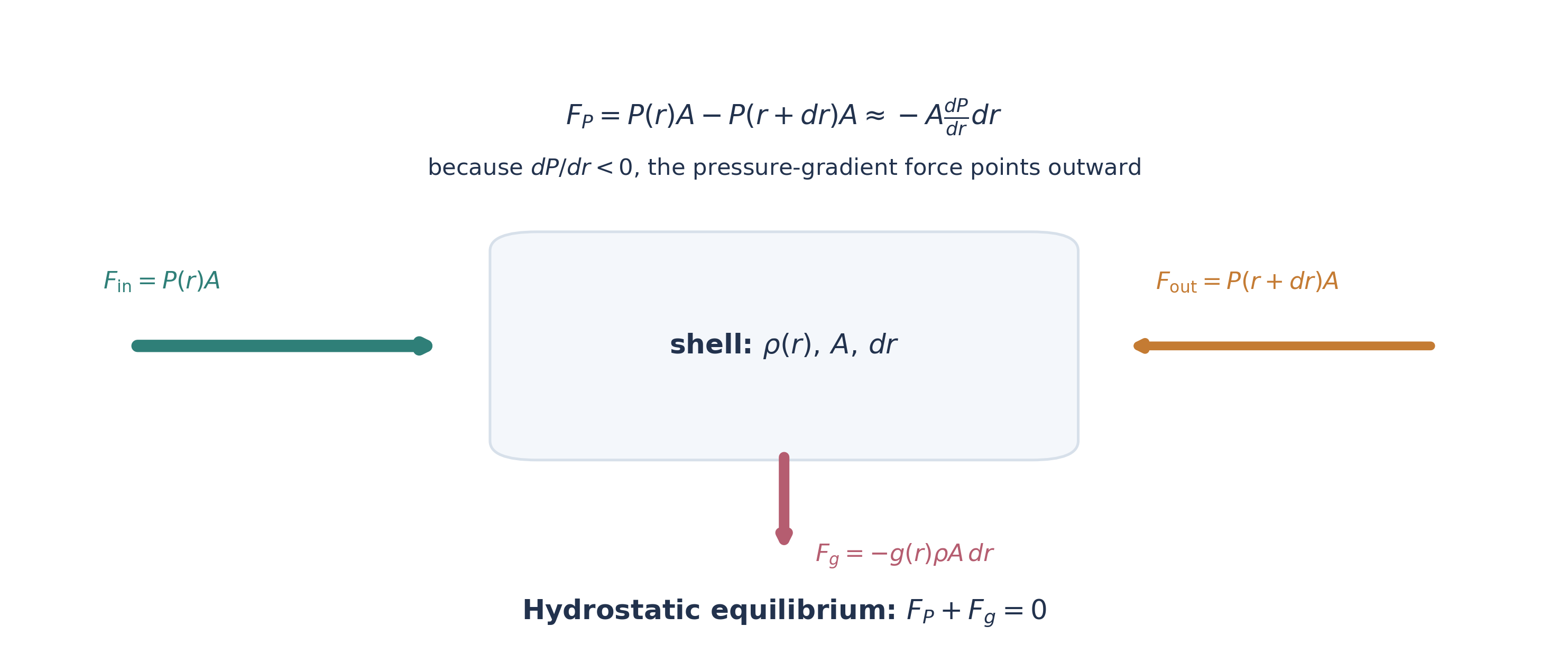
Generated shell-force diagram with a rectangular gas shell labeled by density rho, area A, and thickness dr, plus arrows and equations for the inner pressure force, outer pressure force, and inward gravitational force.

What to notice: the hydrostatic equation comes directly from shell bookkeeping. Pressure on the inner face pushes outward, pressure on the outer face pushes inward, and gravity pulls the shell inward. (Credit: ASTR 201 (generated))

Consider a thin shell of gas at radius \(r\) inside a star. Give the shell thickness \(dr\), cross-sectional area \(A\), and density \(\rho(r)\). The shell mass is \[ dm = \rho(r)A\,dr. \]

If the inward and outward forces do not cancel, the shell accelerates. That is what makes this equation so important: hydrostatic equilibrium is the condition for a star to remain nearly static instead of beginning a rapid global readjustment.

Two forces act on this shell in the radial direction:

The pressure on the inner face pushes outward: \[ F_{\text{in}} = P(r)A. \]

The pressure on the outer face pushes inward: \[ F_{\text{out}} = P(r+dr)A. \]

The net pressure force is therefore \[ F_P = F_{\text{in}} - F_{\text{out}} = P(r)A - P(r+dr)A. \] If the two face pressures were equal, this force would vanish. The shell would then feel gravity alone.

Now use the first-order Taylor expansion: \[ P(r+dr) \approx P(r) + \frac{dP}{dr}\,dr, \] Then \[ F_P \approx -A\frac{dP}{dr}\,dr. \]

Because pressure decreases outward, \(\frac{dP}{dr} < 0\), so the pressure-gradient force points outward. The minus sign ensures the direction of the force is physically correct.

Gravity pulls the shell inward. If \(g(r)\) is the local gravitational acceleration, then \[ F_g = -g(r)\,dm = -g(r)\rho(r)A\,dr. \]

Using \[ g(r) = \frac{G M(r)}{r^2}, \] this becomes \[ F_g = -\frac{G M(r)\rho(r)}{r^2}A\,dr. \]

For hydrostatic equilibrium, the shell has no radial acceleration, so the net force must vanish: \[ F_P + F_g = 0. \]

Substituting the two forces gives \[ -A\frac{dP}{dr}\,dr - g(r)\rho(r)A\,dr = 0. \]

Now divide through by \(A\,dr\): \[ \frac{dP}{dr} = -\rho(r)g(r). \]

Finally, substitute \(g(r) = G M(r)/r^2\): \[ \frac{dP}{dr} = -\rho g = -\frac{G M(r)\rho(r)}{r^2}. \]

Reading the Equation

The left-hand side, \[ \frac{dP}{dr}, \] tells you how quickly pressure changes as you move outward. Inside a normal star, it must be negative: \[ \frac{dP}{dr} < 0, \] which means pressure is highest near the center and decreases toward the surface.

The right-hand side, \[ -\frac{G M(r)\rho(r)}{r^2}, \] is the local weight per unit volume. The factor \[ g(r) = \frac{G M(r)}{r^2} \] is the gravitational acceleration at radius \(r\), and multiplying by \(\rho(r)\) gives the weight density \(\rho g\).

Read as a sentence, the equation says: at every radius inside the star, the pressure must decrease outward at exactly the rate needed to support the weight of the overlying gas.

That sign is the physics. Since \(\rho > 0\) and \(g > 0\), the right-hand side is negative, so \(\frac{dP}{dr}\) must also be negative. Pressure must decrease outward if the pressure-gradient force is going to point outward.

This is a local force-balance law. If the pressure fell too slowly with radius, gravity would win and the gas would move inward. If it fell too quickly, the gas would be pushed outward. At the surface, \(P\) drops to nearly zero; at the center, it reaches its maximum value \(P_c\).

This is a differential equation, meaning it relates how pressure changes with radius to the local conditions inside the star. To solve for the full structure \(P(r)\), \(\rho(r)\), and \(M(r)\), we need additional equations. That fuller system is the subject of Reading 5.

TipCheck Yourself — Local or Global?

Classify each statement as either a local law or a global scaling estimate:

  1. \[ \frac{dP}{dr} = -\rho g \]
  2. \[ P_c \sim \frac{G M^2}{R^4} \]

Then explain what physical question each one answers.

NoteSolution

The equation

\[ \frac{dP}{dr} = -\rho g \]

is a local law. It tells us how pressure must change with radius at a specific location inside the star in order to balance the local weight of the gas.

The relation

\[ P_c \sim \frac{G M^2}{R^4} \]

is a global scaling estimate. It tells us the approximate pressure scale a whole star must build in order to support itself, using only its overall mass and radius.

So the first equation describes the detailed force balance inside the star, while the second gives an order-of-magnitude inference about the star’s central conditions.

WarningMisconception Check — “High Pressure = Support”

A student says:

“If the pressure is extremely high everywhere inside a star, that should prevent collapse.”

Is this correct?

Think before reading.

Answer:

No.

Uniform pressure produces no net force, because the forces on opposite sides of a shell cancel.

Only a pressure gradient produces support: \[ \frac{dP}{dr} < 0. \]

Support depends on how pressure changes with radius, not on pressure being “large” in some absolute sense.

NoteObservable → Model → Inference

Observable: The Sun keeps nearly the same size for many billions of years, far longer than its \(\sim 50\) minute dynamical timescale.

Model: Force balance on a thin shell inside the star.

Inference: Each shell must satisfy \[ \frac{dP}{dr} = -\rho g. \] If that balance is violated, the shell accelerates inward or outward instead of staying in place.

TipCheck Yourself

The equation of hydrostatic equilibrium says \(\frac{dP}{dr} < 0\) everywhere inside a star. What would happen if \(\frac{dP}{dr} > 0\) at some radius (pressure increasing outward)? What would happen if \(\frac{dP}{dr} = 0\) (uniform pressure)?

If \[ \frac{dP}{dr} > 0, \] then pressure would increase outward. In that case, the pressure gradient force would point inward, in the same direction as gravity. The gas would be driven inward even more strongly.

If \[ \frac{dP}{dr} = 0, \] then the pressure would be uniform, so the pressure forces on a shell would cancel exactly. Gravity would be unopposed, and the star would collapse on the dynamical timescale.

For hydrostatic equilibrium, we require \[ \frac{dP}{dr} < 0 \] everywhere inside the star: pressure must decrease outward so that the net pressure force points outward and balances gravity.


Part 3: Estimating the Central Pressure

Hydrostatic equilibrium tells us the slope of the pressure profile, but not yet the pressure scale itself. In astronomy, we often know a star’s mass and radius before we know its internal structure. A scaling argument lets us infer interior conditions directly from those observable quantities.

To answer our guiding question more quantitatively, we now estimate the central pressure a star must build in order to support its own weight.

A Scaling Argument

We cannot solve the hydrostatic equilibrium equation exactly without knowing the full internal profiles \(M(r)\) and \(\rho(r)\). But a scaling argument lets us connect those unknown interior quantities to the global properties we can often measure first.

Step 1: Approximate the pressure gradient

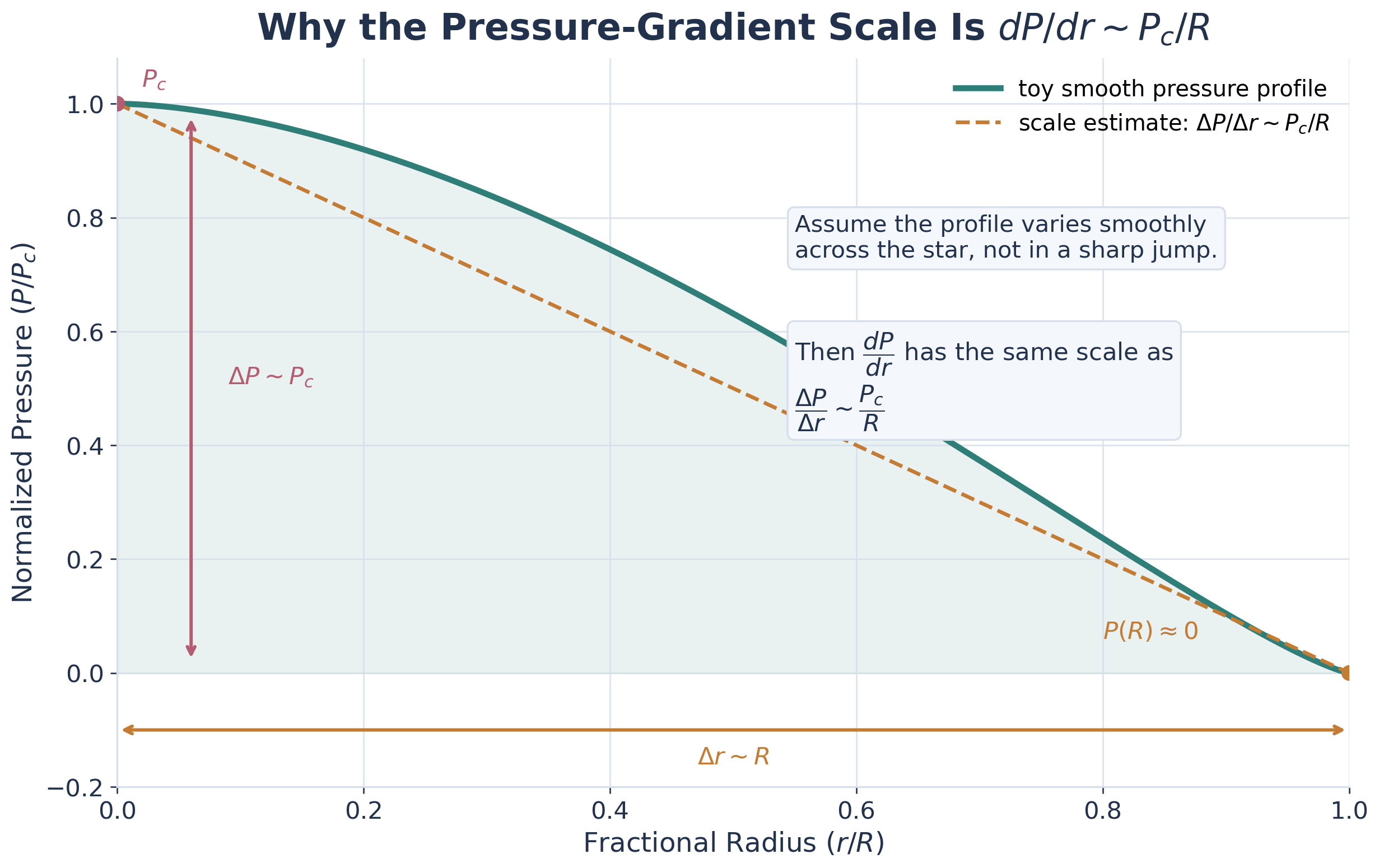
Across the star, pressure decreases from roughly \(P_c\) at the center to nearly zero at the surface. That means \[ \Delta P \sim P_c, \] because the surface pressure is tiny compared with the central pressure. The change happens across a distance of order the stellar radius, \[ \Delta r \sim R. \] This assumes the pressure profile varies smoothly over a scale of order \(R\), rather than changing abruptly in a very narrow layer.

Therefore, \[ \frac{dP}{dr} \sim \frac{\Delta P}{\Delta r} \sim \frac{P_c}{R}. \]

Single-panel plot of normalized pressure versus fractional radius for a smooth toy stellar profile, with labels marking central pressure, near-zero surface pressure, a vertical delta-P arrow, a horizontal delta-r arrow, and a dashed secant representing the scale estimate P_c over R.

What to notice: the pressure profile is smooth across a scale of order the stellar radius, so the pressure-gradient scale is set by a total drop of order \(P_c\) across a distance of order \(R\). That is why \(dP/dr \sim P_c/R\) is a sensible scaling estimate. (Credit: ASTR 201 (generated))

Step 2: Replace local quantities with global scales

For an order-of-magnitude estimate, replace the local density by a global scaling based on the mean density: \[ \rho \sim \frac{M}{R^3}. \]

Important: this is a global scaling approximation, not the true local density profile. Real stars are centrally concentrated, so this step captures the scaling but not the detailed structure.

WarningMisconception Check — “\(\rho \sim M/R^3\) Is the Density Everywhere”

Does the relation \[ \rho \sim \frac{M}{R^3} \] tell you the true density at every radius inside a star?

No. It is a mean-density scaling, not the local density profile \(\rho(r)\). Real stars are denser in their interiors than in their outer layers. We use this approximation only to estimate the overall pressure scale, not to claim that the star has uniform density.

Step 3: Apply hydrostatic equilibrium

Using \[ \frac{dP}{dr} \sim -\rho g, \] and replacing the local gravitational acceleration by the global scale \[ g \sim \frac{G M}{R^2}, \] we get \[ \frac{P_c}{R} \sim \frac{G M \rho}{R^2}. \]

Here we replace the local gravitational acceleration \(g(r)=\frac{GM(r)}{r^2}\) with a global scale \(g \sim \frac{GM}{R^2}\). This is a scaling approximation, not a statement about the exact local value of gravity inside the star.

Now insert the mean-density approximation: \[ \frac{P_c}{R} \sim \frac{G M}{R^2} \cdot \frac{M}{R^3}. \]

Step 4: Solve the scaling

So \[ \frac{P_c}{R} \sim \frac{G M^2}{R^5}. \]

Multiply both sides by \(R\): \[ P_c \sim \frac{G M^2}{R^4}. \]

Final result

\[ P_c \sim \frac{G M^2}{R^4}. \]

Physical interpretation

This is a scaling estimate, not an exact solution. It tells us that stronger gravity demands higher internal pressure, and smaller radii make that demand rise sharply: \[ P_c \propto R^{-4}. \]

That is why compact stars require enormous internal pressure even when their total mass is not especially large.

Worked Example: The Sun’s Central Pressure

For the Sun, use the constants \[ G = 6.674\times10^{-8}\,\mathrm{cm^3\,g^{-1}\,s^{-2}}, \quad M_\odot = 2.0\times10^{33}\,\mathrm{g}, \quad R_\odot = 7.0\times10^{10}\,\mathrm{cm}. \]

The scaling estimate is \[ P_c \sim \frac{G M_\odot^2}{R_\odot^4}. \]

Substitute each value explicitly: \[ P_c \sim \frac{(6.674\times10^{-8}\,\mathrm{cm^3\,g^{-1}\,s^{-2}}) (2.0\times10^{33}\,\mathrm{g})^2} {(7.0\times10^{10}\,\mathrm{cm})^4}. \]

Evaluate the powers: \[ (2.0\times10^{33}\,\mathrm{g})^2 = 4.0\times10^{66}\,\mathrm{g^2}, \] \[ (7.0\times10^{10}\,\mathrm{cm})^4 \approx 2.4\times10^{43}\,\mathrm{cm^4}. \]

Evaluate the coefficients: \[ P_c \sim \frac{(6.674\times10^{-8})(4.0\times10^{66})}{2.4\times10^{43}} \,\mathrm{cm^3\,g^{-1}\,s^{-2}\,g^2\,cm^{-4}}. \]

Numerically, \[ P_c \sim 1.1\times10^{16}\,\mathrm{g\,cm^{-1}\,s^{-2}}. \]

Convert units: \[ 1\,\mathrm{dyn} = 1\,\mathrm{g\,cm\,s^{-2}}. \] Therefore, \[ 1\,\mathrm{g\,cm^{-1}\,s^{-2}} = 1\,\mathrm{dyn\,cm^{-2}}, \] so \[ P_c \sim 1.1\times10^{16}\,\mathrm{dyn\,cm^{-2}}. \]

Now convert to atmospheres: \[ 1\,\mathrm{atm} = 1.013\times10^6\,\mathrm{dyn\,cm^{-2}}. \]

Then \[ P_c \sim \frac{1.1\times10^{16}\,\mathrm{dyn\,cm^{-2}}} {1.013\times10^6\,\mathrm{dyn\,cm^{-2}\,atm^{-1}}} \approx 1.1\times10^{10}\,\mathrm{atm}. \]

Final answer with interpretation: \[ P_c \sim 1.1\times10^{16}\,\mathrm{dyn\,cm^{-2}} \approx 1.1\times10^{10}\,\mathrm{atm}. \]

So the Sun’s central pressure is about 10 billion atmospheres. This is the pressure scale gravity demands in order to support the weight of the overlying solar interior.

Detailed solar models give \[ P_{c,\odot} \approx 2.5\times10^{17}\,\mathrm{dyn\,cm^{-2}}, \] so this simple estimate is low by about a factor of \(20\). That is expected, because the Sun is centrally concentrated rather than uniform in density.

TipCheck Yourself — Units as Physics

Verify that \[ \frac{G M^2}{R^4} \] has units of pressure in CGS. Do this by tracking the units of each factor.

Use the CGS units of each quantity: \[ [G] = \mathrm{cm^3\,g^{-1}\,s^{-2}}, \qquad [M^2] = \mathrm{g^2}, \qquad [R^4] = \mathrm{cm^4}. \]

Therefore, \[ \frac{G M^2}{R^4} = \mathrm{cm^3\,g^{-1}\,s^{-2}} \cdot \mathrm{g^2} \cdot \mathrm{cm^{-4}} = \mathrm{g\,cm^{-1}\,s^{-2}}. \]

But \[ 1\,\mathrm{dyn} = 1\,\mathrm{g\,cm\,s^{-2}}, \] so \[ \mathrm{g\,cm^{-1}\,s^{-2}} = \mathrm{dyn\,cm^{-2}}. \]

That is exactly the CGS unit of pressure.


Part 4: The Virial Theorem for Stars

Force balance tells us what support a star needs at each radius. But it does not yet tell us how gravity and thermal energy are linked as the star contracts, radiates, and evolves.

To answer that question, we need an energy argument.

The virial theorem is the key tool: it connects the star’s thermal energy to its gravitational binding energy and explains why contraction heats a self-gravitating object instead of cooling it.

Energy Balance in Self-Gravitating Systems

Hydrostatic equilibrium is a force-balance statement: it tells us how pressure gradients balance gravity at each radius inside the star.

The virial theorem is an energy-balance statement: it relates the star’s total thermal energy to its gravitational potential energy.

For a bound star, the gravitational potential energy has the characteristic scale \[ U_{\text{grav}} \sim -\frac{G M^2}{R}. \]

The minus sign matters. A bound self-gravitating object has less energy than the same mass dispersed to infinite separation.

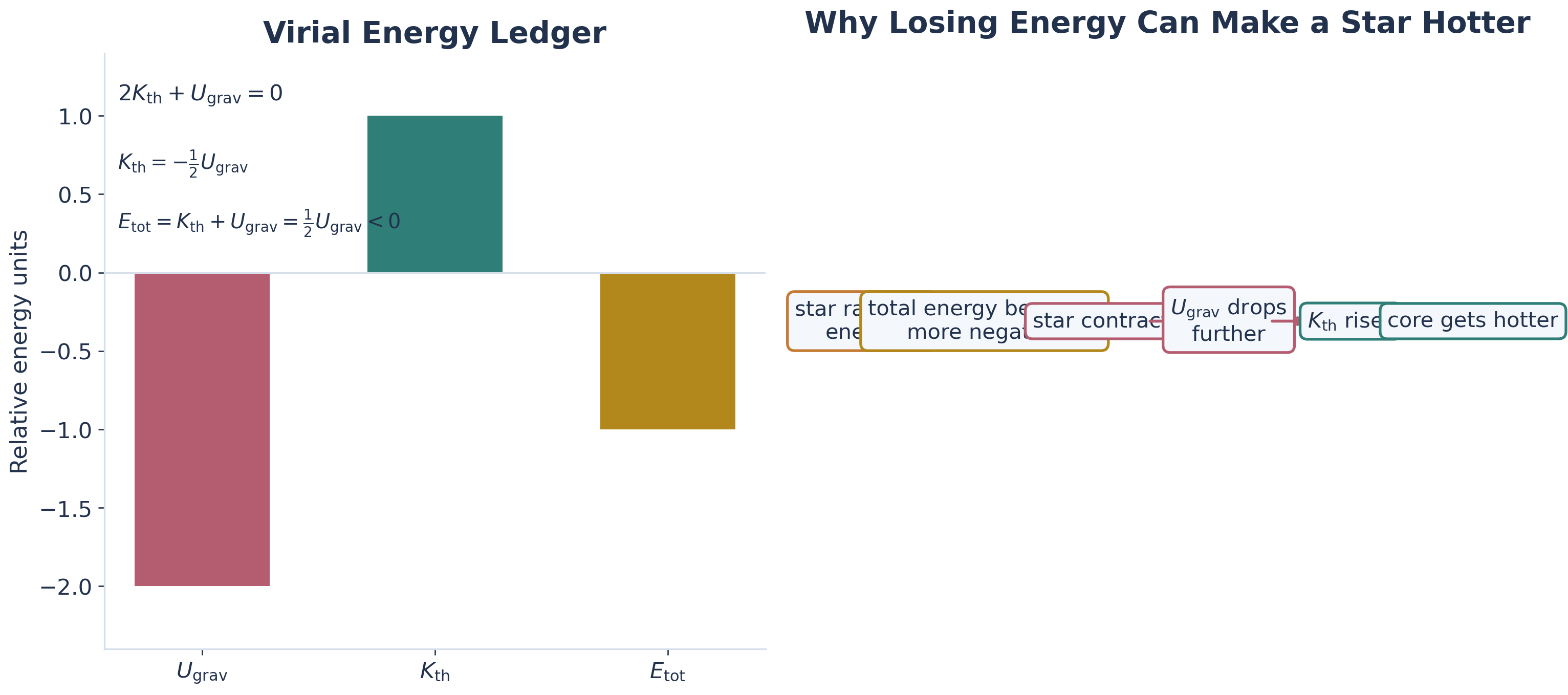
For a star in hydrostatic equilibrium, the virial theorem gives \[ 2K_{\text{th}} + U_{\text{grav}} = 0. \]

Here:

  • \(K_{\text{th}}\) is the total thermal energy of the gas
  • \(U_{\text{grav}}\) is the total gravitational potential energy
  • the factor of \(2\) is the characteristic coefficient for a non-relativistic, self-gravitating gas in equilibrium

Rearranging, \[ K_{\text{th}} = -\frac{1}{2} U_{\text{grav}}. \]

Since \(U_{\text{grav}} < 0\), the thermal energy is positive, as it must be.

Now define the total energy: \[ E_{\text{tot}} = K_{\text{th}} + U_{\text{grav}}. \]

Substitute the virial-theorem relation: \[ E_{\text{tot}} = -\frac{1}{2}U_{\text{grav}} + U_{\text{grav}} = \frac{1}{2}U_{\text{grav}} = - K_{\text{th}} < 0. \]

So a star in hydrostatic equilibrium is gravitationally bound: its total energy is negative.

NoteWhy the Factor of 2?

The full derivation is beyond the scope of this reading, but the coefficient is not arbitrary. The thermal term enters through pressure support and kinetic motion, while the gravitational term depends on how the binding energy changes when the star is rescaled. In equilibrium, those contributions combine to give

\[ 2K_{\text{th}} + U_{\text{grav}} = 0. \]

For this course, the key takeaway is the consequence:

\[ K_{\text{th}} = -\frac{1}{2}U_{\text{grav}}. \]

Thermal energy and gravitational binding are tightly linked in a self-gravitating star.

In quasi-static contraction, the virial theorem implies that roughly half of the released gravitational energy increases the thermal energy of the gas, while roughly half must be lost from the star. That bookkeeping is what leads to the counterintuitive thermal behavior of stars.

TipCheck Yourself — Energy Scaling

Use the scaling

\[ U_{\text{grav}} \sim -\frac{G M^2}{R}. \]

If a star contracts to one-third its radius at fixed mass:

  1. By what factor does \(|U_{\text{grav}}|\) change?
  2. Is this a small or large effect?
  3. What does this imply about heating?
NoteSolution

At fixed mass,

\[ |U_{\text{grav}}| \propto \frac{1}{R}. \]

So shrinking the radius from \(R\) to \(R/3\) gives \[ \frac{|U_{\text{grav,new}}|}{|U_{\text{grav,old}}|} = \frac{R}{R/3} = 3. \]

That is a large change in binding energy, not a tiny correction. The star becomes much more tightly bound. In quasi-static contraction, the virial theorem implies that part of that released gravitational energy goes into thermal energy, so the gas heats substantially.

The Negative Heat Capacity Paradox

Here is the surprising part.

A star radiates energy from its surface, so its total energy decreases:

\[ E_{\text{tot}} \rightarrow \text{more negative}. \]

Because

\[ E_{\text{tot}} = \frac{1}{2} U_{\text{grav}}, \]

this means that \(U_{\text{grav}}\) must also become more negative. Physically, the star contracts into a more tightly bound state.

But the virial theorem also says

\[ K_{\text{th}} = -\frac{1}{2} U_{\text{grav}}. \]

So if \(U_{\text{grav}}\) becomes more negative, then \(K_{\text{th}}\) becomes larger. More thermal energy means larger typical particle speeds and therefore a higher temperature.

So the star gets hotter as it loses energy.

This is called negative heat capacity, and it is a defining feature of self-gravitating systems.

The logic chain is:

  1. The star radiates energy away.
  2. Its total energy becomes more negative.
  3. The star contracts.
  4. Its gravitational potential energy becomes more negative.
  5. Its thermal energy increases because \[ K_{\text{th}} = -\frac{1}{2}U_{\text{grav}}. \]
  6. The core temperature rises.

In an ordinary laboratory system, losing energy usually lowers the temperature. In a self-gravitating system, energy loss drives contraction, and contraction raises the typical particle speeds. That is why gravitational contraction heats a protostar.

Two-panel generated figure with a virial energy ledger bar chart for gravitational, thermal, and total energy on the left and a causal chain from radiating energy to core heating on the right.

What to notice: the virial theorem fixes the bookkeeping: \(K_{\text{th}} = -\tfrac{1}{2}U_{\text{grav}}\) and \(E_{\text{tot}} < 0\). That is why a star can lose energy, contract, and still get hotter. (Credit: ASTR 201 (generated))

NoteObservable → Model → Inference

Observable: Protostars radiate energy while gradually shrinking instead of collapsing in free fall.

Model: A bound self-gravitating gas obeys the virial theorem, so \[ 2K_{\text{th}} + U_{\text{grav}} = 0. \]

Inference: As radiation removes total energy, the star contracts, \(U_{\text{grav}}\) becomes more negative, and the thermal energy increases. The core gets hotter as the star loses energy.

WarningThis Is Counterintuitive — But It’s Real

In everyday life, losing energy makes things cooler. In self-gravitating systems, losing energy makes things hotter. This is not a mathematical trick — it is the physical mechanism by which protostars heat up as they contract, eventually reaching core temperatures high enough to ignite nuclear fusion. The negative heat capacity of gravity is how stars are born.

TipThink First — Energy Logic

A protostar loses energy by radiation.

Before using equations:

  • Does it expand or contract?
  • Does the temperature rise or fall?

Explain using physical reasoning, not formulas.

As the protostar radiates energy away, its total energy becomes more negative. A self-gravitating object responds by contracting into a tighter, more strongly bound state.

That contraction deepens the gravitational well and increases the typical particle speeds, so the core temperature rises rather than falls.

That means the core temperature rises with time.

This is exactly why gravitational contraction is good news for fusion: hydrogen fusion requires core temperatures of order \[ 10^7\,\mathrm{K} \approx 10\,\mathrm{MK}. \] A protostar begins too cool for fusion, but contraction steadily heats the core until fusion can ignite.

WarningMisconception Check — “If a Star Loses Energy, It Must Cool”

True or false: If a star loses energy, it must cool.

False. For a self-gravitating star, \[ E_{\text{tot}} = \frac{1}{2} U_{\text{grav}} \qquad \text{and} \qquad K_{\text{th}} = -\frac{1}{2} U_{\text{grav}}. \]

If radiation makes \(E_{\text{tot}}\) more negative, then \(U_{\text{grav}}\) must also become more negative. That contraction increases \(K_{\text{th}}\), so the core temperature rises rather than falls.


Part 5: Estimating the Core Temperature

Pressure is the macroscopic requirement. To answer our guiding question more fully, we now connect that required pressure to microscopic particle motion and therefore to temperature.

Connecting Pressure to Temperature

NoteAssumption: Gas Pressure Dominance

In this derivation, we assume that thermal gas pressure dominates: \[ P \approx P_{\text{gas}}. \]

This is a good approximation for Sun-like stars. In very massive stars, radiation pressure becomes important and modifies this result.

For an ideal gas, \[ P_{\text{gas}} = \frac{\rho k_B T}{\mu m_p}, \] where \(P_{\text{gas}}\) is the thermal gas pressure, \(\rho\) is the mass density, \(T\) is the temperature, \(k_B = 1.38\times10^{-16}\,\mathrm{erg\,K^{-1}}\) is Boltzmann’s constant, \(m_p = 1.67\times10^{-24}\,\mathrm{g}\) is the proton mass, and \(\mu\) is the mean molecular weight. For ionized solar-composition gas, \(\mu \approx 0.6\), so \(\mu m_p\) is the mean mass per particle.

To estimate the core temperature, we now connect the hydrostatic pressure scale to the ideal-gas pressure scale.

Step 1: Write both pressure scales

From Part 3, hydrostatic support requires \[ P_c \sim \frac{G M^2}{R^4}. \]

For the gas pressure in the core, \[ P_c \sim \frac{\rho k_B T_c}{\mu m_p}. \]

Step 2: Substitute the mean density

Using the same mean-density approximation as before, \[ \rho \sim \frac{M}{R^3}, \] so the gas-pressure scale becomes \[ P_c \sim \frac{M}{R^3} \cdot \frac{k_B T_c}{\mu m_p}. \]

Step 3: Set the two pressure estimates equal

Hydrostatic support demands \[ \frac{M}{R^3} \cdot \frac{k_B T_c}{\mu m_p} \sim \frac{G M^2}{R^4}. \]

Step 4: Cancel terms carefully

Cancel one factor of \(M\): \[ \frac{1}{R^3} \cdot \frac{k_B T_c}{\mu m_p} \sim \frac{G M}{R^4}. \]

Now multiply both sides by \(R^3\): \[ \frac{k_B T_c}{\mu m_p} \sim \frac{G M}{R}. \]

Final result

\[ T_c \sim \frac{\mu G M m_p}{k_B R}. \]

What this means physically

The left-hand side is the thermal-energy scale per particle, while the right-hand side is the gravitational-energy scale per particle. Hydrostatic support requires these scales to be comparable.

This result is powerful: gravity alone sets the temperature scale required for fusion.

This is still an order-of-magnitude estimate, not a full stellar-structure solution. But it captures the key point: gravity alone predicts a stellar core temperature of order \(10^7\,\mathrm{K}\).

At this point, we can sharpen our answer to the guiding question. A Sun-like star is held up by a pressure gradient supplied mainly by hot gas, and gravity demands that this gas reach a core temperature of roughly \(10^7\,\mathrm{K}\).

WarningMisconception Check — “The Core Temperature Is Chosen by Fusion Physics First”

A student says, “The Sun’s core is hot because fusion needs about \(10^7\,\mathrm{K}\), so the star somehow adjusts itself to that number.”

What is backward about that statement?

The direction of reasoning is reversed. Before we talk about nuclear reaction details, hydrostatic support and the ideal-gas picture already imply \[ T_c \sim \frac{\mu G M m_p}{k_B R}. \] Gravity sets the thermal scale required for support. Fusion becomes possible because gravity drives the star to that temperature scale, not because the star first “knows” a fusion target temperature.

NoteWhat This Equation Is Saying

The combination \(GM/R\) is the gravitational potential scale per unit mass. The combination \(k_B T_c/(\mu m_p)\) is the thermal-energy scale per unit mass of the gas. Hydrostatic support requires these two scales to be comparable. That is why gravity fixes the core temperature scale.

Generated log-log plot of core temperature scale in megakelvin versus stellar mass, showing a hydrostatic scaling curve based on T proportional to M over R, a Sun point, and a dashed comparison for the unrealistic fixed-radius case.

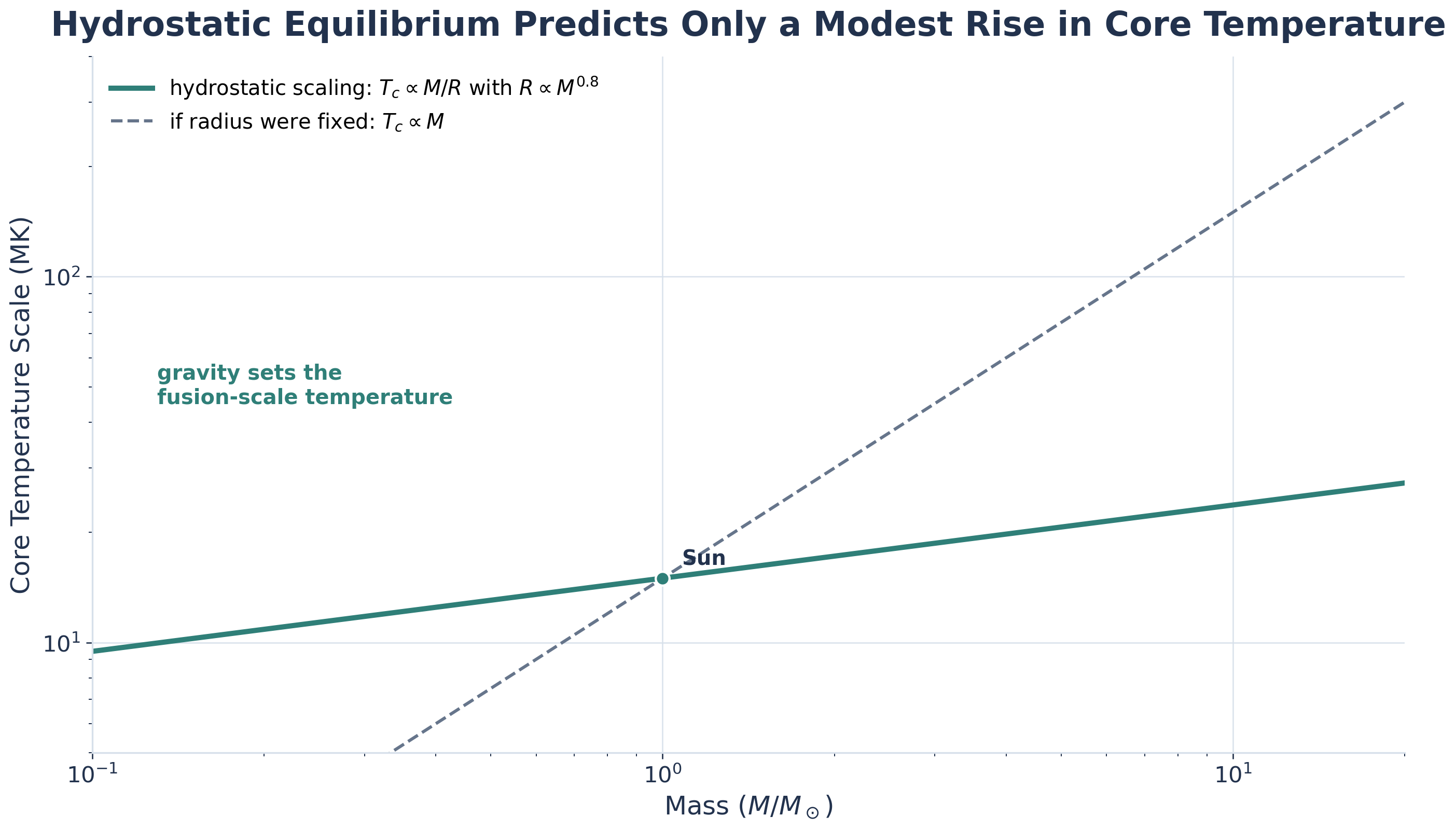
What to notice: hydrostatic equilibrium sets a fusion-scale temperature for every main-sequence star, but the core temperature rises only modestly with mass because more massive stars are also larger. (Credit: ASTR 201 (generated))

Worked Example: The Sun’s Core Temperature

For the Sun, use \[ \mu = 0.6, \quad G = 6.674\times10^{-8}\,\mathrm{cm^3\,g^{-1}\,s^{-2}}, \quad M_\odot = 2.0\times10^{33}\,\mathrm{g}, \] \[ m_p = 1.67\times10^{-24}\,\mathrm{g}, \quad k_B = 1.38\times10^{-16}\,\mathrm{erg\,K^{-1}}, \quad R_\odot = 7.0\times10^{10}\,\mathrm{cm}. \]

The scaling estimate is \[ T_c \sim \frac{\mu G M_\odot m_p}{k_B R_\odot}. \]

Substitute each quantity explicitly: \[ T_c \sim \frac{(0.6)(6.674\times10^{-8}\,\mathrm{cm^3\,g^{-1}\,s^{-2}}) (2.0\times10^{33}\,\mathrm{g}) (1.67\times10^{-24}\,\mathrm{g})} {(1.38\times10^{-16}\,\mathrm{erg\,K^{-1}}) (7.0\times10^{10}\,\mathrm{cm})}. \]

Evaluate the powers and grouped factors: \[ (0.6)(6.674\times10^{-8})(2.0\times10^{33})(1.67\times10^{-24}) \approx 1.34\times10^2\,\mathrm{cm^3\,s^{-2}}. \]

Now evaluate the denominator: \[ (1.38\times10^{-16})(7.0\times10^{10}) \approx 9.66\times10^{-6}\,\mathrm{erg\,K^{-1}\,cm}. \]

Check the units: \[ \frac{\mathrm{cm^3\,g^{-1}\,s^{-2}\,g\,g}} {\mathrm{erg\,K^{-1}\,cm}} = \frac{\mathrm{g\,cm^2\,s^{-2}}}{\mathrm{erg}}\,\mathrm{K} = \mathrm{K}, \] because \(1\,\mathrm{erg} = 1\,\mathrm{g\,cm^2\,s^{-2}}\).

So numerically, \[ T_c \sim \frac{1.34\times10^2}{9.66\times10^{-6}}\,\mathrm{K} \approx 1.4\times10^7\,\mathrm{K}. \]

Convert kelvin to megakelvin: \[ 1\,\mathrm{MK} = 10^6\,\mathrm{K}. \]

Then \[ T_c \sim \frac{1.4\times10^7\,\mathrm{K}}{10^6\,\mathrm{K\,MK^{-1}}} = 14\,\mathrm{MK}. \]

Final answer with interpretation: \[ T_c \sim 1.4\times10^7\,\mathrm{K} \approx 14\,\mathrm{MK}. \]

Detailed solar models give \[ T_{c,\odot} \approx 1.5\times10^7\,\mathrm{K} \approx 15\,\mathrm{MK}, \] so this stripped-down estimate is already in the correct solar ballpark.

The physical lesson matters more than the exact coefficient: gravity and the ideal-gas picture alone already demand a core temperature of order \(10^7\,\mathrm{K}\). This is a scaling success, not an exact stellar-structure solution, and that is exactly the level of agreement we should expect from such a stripped-down argument.

NoteObservable → Model → Inference

Observable: The Sun’s mass (\(M_\odot = 2.0 \times 10^{33}\,\mathrm{g}\)) and radius (\(R_\odot = 7.0 \times 10^{10}\,\mathrm{cm}\)) — both measured from binary orbits and angular size + distance.

Model: Hydrostatic equilibrium + gas-pressure dominance + ideal gas law + the mean-density scaling \(\rho \sim M/R^3\).

Inference: \(T_c \sim 10^7\,\mathrm{K}\). The Sun’s core is about 15 million kelvin — hot enough for nuclear fusion. This follows directly from force balance, the ideal-gas picture, and measured solar mass and radius: the temperature needed for fusion is set by gravity.

What This Temperature Means

A core temperature of \[ T_c \approx 1.5\times10^7\,\mathrm{K} \] corresponds to an average thermal energy per particle of \[ \frac{3}{2}k_B T_c. \]

Substitute values: \[ \frac{3}{2}k_B T_c = \frac{3}{2}(1.38\times10^{-16}\,\mathrm{erg\,K^{-1}}) (1.5\times10^7\,\mathrm{K}). \]

Numerically, \[ \frac{3}{2}k_B T_c \approx 3.1\times10^{-9}\,\mathrm{erg}. \]

To convert to kilo-electron-volts, use \[ 1\,\mathrm{keV} = 1.602\times10^{-9}\,\mathrm{erg}. \]

Then \[ \frac{3}{2}k_B T_c \approx \frac{3.1\times10^{-9}\,\mathrm{erg}} {1.602\times10^{-9}\,\mathrm{erg\,keV^{-1}}} \approx 1.9\,\mathrm{keV}. \]

So the typical thermal energy per particle in the solar core is about \[ 2\,\mathrm{keV}. \]

If you instead look at \(k_B T\) by itself, you get about \(1.3\,\mathrm{keV}\). We will keep using \(\frac{3}{2}k_B T\) here because that is the thermal-energy-per-particle scale listed in the reference table.

At these temperatures, atoms are fully ionized, so the solar core is a plasma of free electrons, protons, and helium nuclei.

But this still is not enough thermal energy to overcome the proton-proton Coulomb barrier classically. That barrier is of order \[ 1\,\mathrm{MeV} = 10^3\,\mathrm{keV}, \] hundreds of times larger than the typical thermal energy in the solar core. So classical thermal motion alone should not allow fusion. The missing ingredient is quantum tunneling, which is the subject of Reading 3.

TipCheck Yourself

Using the scaling \(T_c \propto M/R\) and the main-sequence mass-radius relation \(R \propto M^{0.8}\), how does the core temperature scale with mass for main-sequence stars? Is a \(10\,M_\odot\) star’s core hotter or cooler than the Sun’s?

Using \[ T_c \propto \frac{M}{R} \] and the main-sequence mass-radius relation \[ R \propto M^{0.8}, \] we get \[ T_c \propto \frac{M}{M^{0.8}} = M^{0.2}. \]

So core temperature increases only weakly with stellar mass.

For a \(10\,M_\odot\) star, \[ \frac{T_{c,10}}{T_{c,\odot}} \approx 10^{0.2} \approx 1.6. \]

So a \(10\,M_\odot\) star has a core temperature only about \(60\%\) higher than the Sun’s: \[ T_{c,10} \approx 1.6 \times 15\,\mathrm{MK} \approx 24\,\mathrm{MK}. \]

This is an important result. Core temperature varies surprisingly little across the main sequence, because more massive stars are also larger. The enormous luminosity differences across the main sequence come not from core temperatures differing by orders of magnitude, but from stellar structure and from the strong temperature sensitivity of nuclear reaction rates.

ImportantCommon Misconceptions
  1. “Pressure holds the star up.”
    Not quite. A pressure gradient holds the star up.

  2. “If the pressure is huge, the star must expand.”
    Not necessarily. Large pressure on both sides of a layer can still cancel. What matters is the pressure difference across the layer.

  3. “More massive stars must have enormously hotter cores.”
    Not by much. On the main sequence, the core temperature scales only weakly with mass: \[ T_c \propto M^{0.2}. \]


Step Physics What it determines
Gravity \(g(r)\) inward pull
Hydrostatic equilibrium \(\frac{dP}{dr}\) pressure gradient
Pressure scaling \(P_c\) central pressure
Ideal gas \(P \leftrightarrow T\) temperature
Virial theorem \(K, U\) energy balance

Synthesis: The Stellar Reasoning Ladder

Before reading the summary, step back and look at the logic chain we have built. Each rung uses one physical idea to infer the next:

  1. Gravity sets the local inward pull: \[ g(r) = \frac{G M(r)}{r^2}. \]
  2. Force balance on each shell gives hydrostatic equilibrium: \[ \frac{dP}{dr} = -\rho g. \]
  3. That force balance implies a central pressure scale: \[ P_c \sim \frac{G M^2}{R^4}. \]
  4. The ideal-gas relation then turns a pressure requirement into a temperature requirement: \[ T_c \sim \frac{\mu G M m_p}{k_B R}. \]
  5. The virial theorem explains why contraction heats the core: \[ 2K_{\text{th}} + U_{\text{grav}} = 0. \]
  6. Gravity therefore drives stars naturally toward fusion temperatures of order \[ 10^7\,\mathrm{K}. \]

This is the payoff of stellar structure. Starting from gravity alone, and adding only force balance, energy balance, and a thermal-gas model, we find that stars naturally develop hot cores. Fusion is not an arbitrary extra ingredient pasted onto stars later. Gravity itself drives the star to the temperature scale where fusion becomes possible.

Practice Problems

Use these values unless a problem states otherwise:

  • \(G = 6.674 \times 10^{-8}~\text{cm}^3~\text{g}^{-1}~\text{s}^{-2}\)
  • \(M_\odot = 2.0 \times 10^{33}~\text{g}\)
  • \(R_\odot = 7.0 \times 10^{10}~\text{cm}\)
  • \(m_p = 1.67 \times 10^{-24}~\text{g}\)
  • \(k_B = 1.38 \times 10^{-16}~\text{erg}~\text{K}^{-1}\)
  • \(\mu = 0.6\)
  • \(1~\text{atm} = 1.013 \times 10^6~\text{dyn/cm}^2\)

Conceptual

  1. Pressure is not enough. A student says, “The Sun survives because the pressure inside it is huge.”
      1. Explain why that statement is incomplete.
      1. What does a pressure gradient do that uniform pressure cannot do?
      1. In one sentence, connect this idea to hydrostatic equilibrium.
  1. ⭐⭐ What if the gradient were wrong?
      1. What would happen if \(\frac{dP}{dr} = 0\) everywhere inside a star?
      1. What would happen if \(\frac{dP}{dr} > 0\) at some radius?
      1. Why must hydrostatic equilibrium require \(\frac{dP}{dr} < 0\)?
  1. Why smaller \(\mu\) matters. Suppose the mean molecular weight \(\mu\) decreases while \(\rho\) and \(T\) stay fixed.
      1. Does the gas pressure increase or decrease?
      1. Explain the physical reason in terms of particle number density.
      1. Why does composition therefore matter for pressure support?

Calculation

  1. How compactness changes the pressure requirement. At fixed mass, the central-pressure scaling is \[ P_c \sim \frac{G M^2}{R^4}. \]
      1. If a star’s radius shrinks from \(R\) to \(R/2\), by what factor does the required central pressure change?
      1. Repeat for a shrink from \(R\) to \(R/3\).
      1. Explain why the result is so sensitive to radius.
  1. ⭐⭐ The Sun’s central pressure.
      1. Use \[ P_c \sim \frac{G M_\odot^2}{R_\odot^4} \] to estimate the Sun’s central pressure in \(\text{dyn/cm}^2\).
      1. Convert your answer to atmospheres.
      1. Explain why this is a scaling success even though detailed solar models give a larger value.
  1. ⭐⭐ Core temperature from gravity.
      1. Use \[ T_c \sim \frac{\mu G M_\odot m_p}{k_B R_\odot} \] to estimate the Sun’s core temperature in kelvin and in MK.
      1. Use the scaling \(T_c \propto M/R\) together with the main-sequence mass-radius relation \(R \propto M^{0.8}\) to estimate the core temperature of a \(10\,M_\odot\) star relative to the Sun.
      1. Explain why the result in part (b) is physically surprising at first glance.

Synthesis

  1. ⭐⭐ Losing energy, getting hotter. A protostar radiates energy from its surface while remaining gravitationally bound.
      1. Use the virial theorem to explain why the protostar contracts as it loses energy.
      1. Explain why the core temperature rises instead of falls.
      1. In 2–4 sentences, describe why this behavior is called negative heat capacity.
  1. ⭐⭐ From mass and radius to fusion conditions.
      1. Write the reasoning ladder that links measured stellar mass and radius to an inferred core temperature of order \(10^7~\text{K}\).
      1. Identify one assumption in the pressure-scaling step and one assumption in the temperature-scaling step.
      1. Explain why this argument is enough to show that gravity naturally drives stars toward fusion temperatures, even before we discuss nuclear reaction rates.

Reference Tables

Key Results from Hydrostatic Equilibrium

Quantity Scaling / Formula Sun Value
Central pressure \(P_c \sim \frac{G M^2}{R^4}\) \(\sim 10^{16}\,\mathrm{dyn\,cm^{-2}}\)
Core temperature \(T_c \sim \frac{\mu G M m_p}{k_B R}\) \(\sim 1.5 \times 10^{7}\,\mathrm{K}\)
Core thermal energy/particle \(\frac{3}{2}k_B T_c\) \(\sim 2\,\mathrm{keV}\)
Virial relation \(2K_{\text{th}} + U_{\text{grav}} = 0\)

Symbol Legend

Symbol Meaning CGS Units
\(P\) Gas pressure \(\mathrm{dyn\,cm^{-2}}\) (\(= \mathrm{g\,cm^{-1}\,s^{-2}}\))
\(n\) Number density \(\mathrm{cm^{-3}}\)
\(\rho\) Mass density \(\mathrm{g\,cm^{-3}}\)
\(M(r)\) Mass enclosed within radius \(r\) g
\(g(r)\) Local gravitational acceleration \(\mathrm{cm\,s^{-2}}\)
\(u_{\text{rad}}\) Radiation energy density \(\mathrm{erg\,cm^{-3}}\)
\(a\) Radiation constant \(\mathrm{erg\,cm^{-3}\,K^{-4}}\)
\(k_B\) Boltzmann constant \(1.38 \times 10^{-16}\,\mathrm{erg\,K^{-1}}\)
\(m_p\) Proton mass \(1.67 \times 10^{-24}\,\mathrm{g}\)
\(\mu\) Mean molecular weight Dimensionless (\(\approx 0.6\) for ionized solar gas)
\(\mu m_p\) Mean mass per particle g
\(K_{\text{th}}\) Total thermal energy of the star erg
\(U_{\text{grav}}\) Gravitational potential energy of the star erg (negative)

Conservation Laws at Work

Conservation Law Where It Appears What It Constrains
Momentum conservation Hydrostatic equilibrium (\(\frac{dP}{dr} = -\rho g\)) Force balance at every radius — net force on each shell is zero
Energy conservation Virial theorem (\(2K_{\text{th}} + U_{\text{grav}} = 0\)) Relationship between thermal and gravitational energy in equilibrium

Summary: Gravity vs. Pressure — Round 1

The most important ideas from this reading are:

  • Hydrostatic equilibrium \[ \frac{dP}{dr} = -\rho g \] is the foundational force-balance equation of stellar structure. It says that the pressure gradient at each radius exactly balances the local weight of the overlying gas.

  • The virial theorem \[ 2K_{\text{th}} + U_{\text{grav}} = 0 \] connects thermal energy to gravitational energy and explains why self-gravitating systems have negative heat capacity: as they lose energy, they contract and get hotter.

  • The core temperature of a star can be estimated from its mass and radius: \[ T_c \sim \frac{\mu G M m_p}{k_B R}. \] For the Sun, this gives \[ T_c \sim 10^7\,\mathrm{K} \approx 15\,\mathrm{MK}. \]

  • Stars are dynamically stable: departures from hydrostatic equilibrium are corrected on the dynamical timescale, which is only minutes for the Sun.

NoteGravity Scoreboard — Reading 2
┌──────────────────────────────────────────────────────┐
│  Gravity Scoreboard — Reading 2                      │
├──────────────────────────────────────────────────────┤
│  Attacker:    Gravity (inward pull, always)           │
│  Defender:    Thermal pressure gradient (outward push)│
│  Status:      BALANCED — for now. The pressure        │
│               gradient exactly cancels gravity at     │
│               every radius. But maintaining this      │
│               pressure requires a hot core of about   │
│               15 MK, and maintaining that             │
│               temperature requires an energy source.  │
│               Without one, the star cools on the      │
│               Kelvin-Helmholtz timescale of about     │
│               30 Myr.                                 │
│  Retrieval:   Pressure alone is not enough; the      │
│               pressure must decrease outward.         │
│  The problem: What keeps the core hot?                │
│  Next battle: Nuclear Fusion → Reading 3              │
└──────────────────────────────────────────────────────┘

We’ve identified gravity’s opponent: the thermal pressure gradient. But this defense has a cost — the hot core radiates energy, and without a power source, the star would cool and contract in \(\sim 30\,\mathrm{Myr}\). Something must replenish the thermal energy. That something is nuclear fusion — and understanding how protons fuse at “only” \(15\,\mathrm{MK}\) (when the Coulomb barrier demands \(\sim 10\,\mathrm{GK}\)) requires all four fundamental forces of nature. That’s the subject of Reading 3.

TipRetrieval Practice — 60 Seconds

Without looking back, try to answer these from memory:

  • Why does a star require a pressure gradient rather than just pressure?
  • What does \(\frac{dP}{dr} < 0\) mean physically?
  • What force balance does hydrostatic equilibrium describe?
  • What energy balance does the virial theorem describe?
  • Why does a contracting protostar get hotter?
  • Why does gravity alone predict a stellar core temperature of order \(10^7\,\mathrm{K}\)?
TipLooking Ahead

Hydrostatic equilibrium tells us what holds a star up (pressure gradient) and how hot the core must be (\(\sim 15\,\mathrm{MK}\)). But it doesn’t tell us what keeps the core hot. The answer — nuclear fusion — requires physics beyond gravity and thermodynamics. In Reading 3, we’ll introduce all four fundamental forces, encounter quantum tunneling for the first time, and discover how stars convert mass to energy via \(E = mc^2\). The nuclear energy source is what transforms a slowly contracting ball of gas into a stable, long-lived star.