Lecture 10: The Final States — Neutron Stars and Black Holes
When even neutron-star matter cannot resist gravity, spacetime itself becomes the story
What observations force astronomers to conclude that neutron stars and black holes are real?
By the end of this reading, you should be able to explain the reasoning chain:
Observable \(\rightarrow\) Model \(\rightarrow\) Inference
- Observable: millisecond pulses, X-ray binaries, compact stellar orbits, gravitational waves, and horizon-scale images
- Model: compact remnants supported by dense matter, or by no stable pressure support at all
- Inference: neutron stars and black holes are not speculative endpoints; they are required by the data
Learning Objectives
After completing this reading, you should be able to:
- Describe the basic properties of neutron stars: mass, radius, density, magnetic field, and rotation rate.
- Explain pulsars as rotating, magnetized neutron stars using the lighthouse model.
- Explain what the Tolman-Oppenheimer-Volkoff limit means physically, and why it is less precisely known than the Chandrasekhar limit.
- Calculate the Schwarzschild radius,
\[ R_s = \frac{2GM}{c^2}, \]
for a compact object of mass \(M\).
- Use the compactness ratio \(R_s/R\) to decide when general relativity becomes important.
- Distinguish an event horizon from a material surface.
- Explain how observations support the existence of neutron stars and black holes.
Concept Throughline
We have followed gravity through every stage of stellar evolution.
First, gravity was opposed by thermal pressure. Then nuclear fusion replaced lost thermal energy and kept stars stable for millions to billions of years. In massive stars, radiation pressure became important. After fusion ended, electron degeneracy pressure supported white dwarfs, but only below the Chandrasekhar limit.
Now we reach the final two possibilities.
If collapse reaches nuclear density and the remnant mass is not too large, neutron-rich matter can form a neutron star: roughly a solar mass compressed into a city-sized object. If even that support fails, the collapse forms a black hole: not a solid object, not a surface, but a region of spacetime bounded by an event horizon.
The main skill in this lecture is not memorizing object names. The skill is learning how astronomers reason from observations to physical models:
\[ \text{observable behavior} \rightarrow \text{compact-object model} \rightarrow \text{physical inference}. \]
Track A: Core path, about 30 minutes
Read Parts 1–5. Focus on neutron-star properties, pulsars, the TOV limit, Schwarzschild radius, and observational evidence.
Track B: Full path, about 40 minutes
Read everything, including the gravitational-redshift enrichment box. This track builds a stronger bridge from Newtonian gravity to general relativity.
Both tracks cover the core learning objectives.
Use this ScienceClic video as a visual preview before the reading turns quantitative. As you watch, track the reasoning chain that will organize this lecture: a compact remnant explains rapid rotation, strong magnetic fields, and lighthouse-like pulses.
If the embedded player does not appear, open the video directly: ScienceClic — Neutron Stars and Pulsars.
Credit: ScienceClic
Part 1: Neutron Stars — Nuclear-Density Objects
A neutron star is what remains when a stellar core collapses to roughly nuclear density but does not form a black hole.
A typical neutron star has
- mass \(M \sim 1.4\,M_\odot\),
- radius \(R \sim 10\,\mathrm{km}\),
- density \(\rho \sim 10^{14}\)–\(10^{15}\,\mathrm{g\,cm^{-3}}\).
It is not simply “a giant atom.” It is a self-gravitating object whose pressure support comes from dense nuclear matter, including neutron degeneracy pressure and short-range nuclear interactions.
Observable \(\rightarrow\) Model \(\rightarrow\) Inference
Observable: Pulsars produce pulses with periods from milliseconds to seconds. Some X-ray binaries contain compact accretors with masses near or above a solar mass. Gravitational-wave events show mergers of extremely dense objects.
Model: A normal star cannot rotate hundreds of times per second without tearing itself apart. A compact remnant with radius of order \(10\,\mathrm{km}\) can.
Inference: These observations require stellar remnants far denser than white dwarfs. Neutron stars are the model that explains compactness, rapid rotation, strong magnetic fields, and nuclear-density matter.
Formation
During core collapse in a massive star:
- The iron core grows until it exceeds the effective Chandrasekhar mass.
- Electron degeneracy pressure can no longer support the core.
- Electrons are captured by protons:
\[ p + e^- \rightarrow n + \nu_e. \]
- The core becomes neutron-rich and collapses toward nuclear density:
\[ \rho_{\rm nuc} \approx 2.8 \times 10^{14}\,\mathrm{g\,cm^{-3}}. \]
- The collapse halts only if dense nuclear matter can supply enough pressure before an event horizon forms.
This produces a proto-neutron star: hot, compact, neutrino-bright, and only tens of kilometers across.
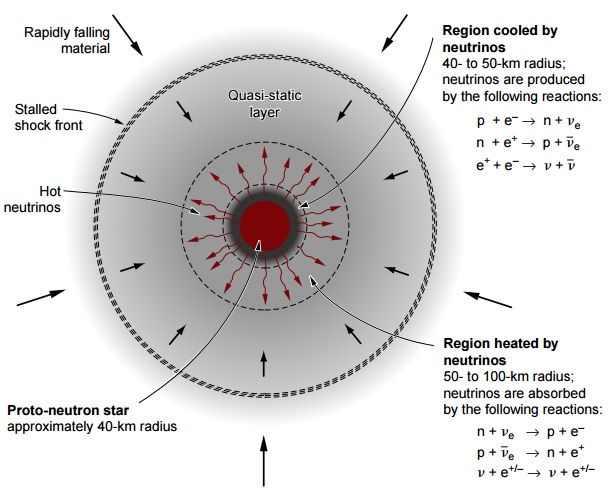
Anatomy of a core-collapse supernova at ~0.5 seconds after bounce. The proto-neutron star (~40 km radius) radiates neutrinos in all directions. Within 50 km, neutrinos cool the material (neutrino emission dominates). Between 50–100 km, neutrinos heat the material (neutrino absorption dominates) — this is the ‘gain region’ where the stalled shock is revived. High-entropy convective plumes carry heated material outward, helping push the shock to larger radii.
The key physical point is that neutron-star formation is not a quiet compression process. It is tied to neutrino transport, nuclear-density matter, and the explosion mechanism.
Extreme Properties
| Property | Typical neutron star | Physical meaning |
|---|---|---|
| Mass | \(1.4\)–\(2.0\,M_\odot\) | Comparable to the Sun |
| Radius | \(\sim 10\,\mathrm{km}\) | Comparable to a city |
| Density | \(\sim 5 \times 10^{14}\,\mathrm{g\,cm^{-3}}\) | Comparable to nuclear density |
| Surface gravity | \(\sim 2 \times 10^{14}\,\mathrm{cm\,s^{-2}}\) | \(\sim 2 \times 10^{11}\) times Earth gravity |
| Newtonian escape speed | \(\sim 0.6c\) | A substantial fraction of light speed |
| Magnetic field | \(10^{12}\)–\(10^{15}\,\mathrm{G}\) | Trillions to quadrillions of gauss |
| Rotation period | \(\sim 10^{-3}\)–\(10\,\mathrm{s}\) | Milliseconds to seconds |
Not quite.
A neutron star has nuclear-density matter, but it is not a single enormous nucleus. It is a gravitationally bound star with layers: a crust, neutron-rich material, superfluid components, and possibly exotic phases in the core. The physics is controlled by gravity, degeneracy pressure, nuclear forces, and general relativity.
The Density Calculation
A good compact-object calculation should always carry units. Suppose neutron-star matter has density
\[ \rho = 5 \times 10^{14}\,\mathrm{g\,cm^{-3}}. \]
A teaspoon has volume about
\[ V \approx 5\,\mathrm{cm^3}. \]
The mass is
\[ m = \rho V. \]
Substitute the numbers with units:
\[ m = \left(5 \times 10^{14}\,\mathrm{g\,cm^{-3}}\right) \left(5\,\mathrm{cm^3}\right). \]
The \(\mathrm{cm^3}\) cancels:
\[ m = 2.5 \times 10^{15}\,\mathrm{g}. \]
Convert grams to kilograms:
\[ m = 2.5 \times 10^{15}\,\mathrm{g} \left(\frac{1\,\mathrm{kg}}{10^3\,\mathrm{g}}\right) = 2.5 \times 10^{12}\,\mathrm{kg}. \]
Convert kilograms to metric tonnes:
\[ m = 2.5 \times 10^{12}\,\mathrm{kg} \left(\frac{1\,\mathrm{tonne}}{10^3\,\mathrm{kg}}\right) = 2.5 \times 10^9\,\mathrm{tonnes}. \]
So a teaspoon-sized volume at neutron-star density would contain
\[ \boxed{m \approx 2.5 \times 10^9\,\mathrm{tonnes}}. \]
That is about 2.5 billion tonnes in a teaspoon-sized volume.
This is a scale analogy, not a laboratory scenario. Neutron-star matter exists because it is compressed by the gravity of an entire star. If removed from that pressure, it would not remain a stable spoonful of neutron-star material.
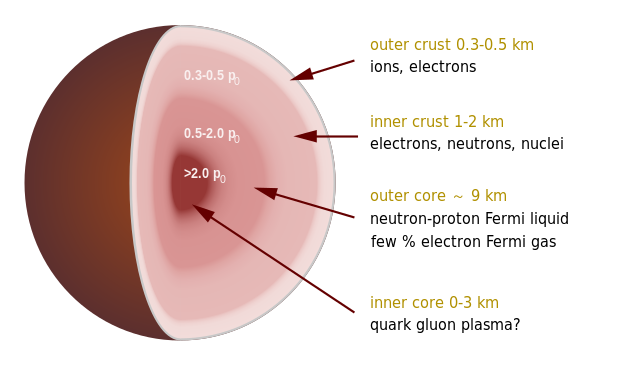
Internal structure of a neutron star. The outer crust (0.3–0.5 km) contains ions and electrons at densities of 0.3–0.5 ρ₀ (where ρ₀ ≈ 2.8 × 10¹⁴ g/cm³ is nuclear density). The inner crust (1–2 km) has neutron-rich nuclei immersed in a sea of free neutrons. The outer core (~9 km) is a neutron-proton Fermi liquid. The inner core (0–3 km) is so dense that the equation of state is unknown — it may contain exotic matter such as a quark-gluon plasma.
Before doing the calculation, predict the answer qualitatively.
If the density is \(5 \times 10^{14}\,\mathrm{g\,cm^{-3}}\), should a \(5\,\mathrm{cm^3}\) sample have a mass closer to:
- \(10^6\,\mathrm{g}\),
- \(10^{12}\,\mathrm{g}\),
- \(10^{15}\,\mathrm{g}\)?
Explain your choice before multiplying.
The answer should be closest to \(10^{15}\,\mathrm{g}\) because multiplying \(5 \times 10^{14}\,\mathrm{g\,cm^{-3}}\) by \(5\,\mathrm{cm^3}\) only changes the coefficient, not the power of ten by many orders of magnitude.
Why So Fast? Conservation of Angular Momentum
Neutron stars often rotate rapidly because collapse makes the radius enormously smaller.
The angular momentum of a rotating object is
\[ L = I\omega, \]
where
- \(L\) is angular momentum,
- \(I\) is moment of inertia,
- \(\omega\) is angular velocity.
If angular momentum is approximately conserved during collapse,
\[ L_1 = L_2, \]
so
\[ I_1\omega_1 = I_2\omega_2. \]
For a simple uniform sphere,
\[ I = \frac{2}{5}MR^2. \]
This model is not exact for a real star, but it captures the scaling:
\[ I \propto MR^2. \]
If the mass is approximately unchanged during collapse, then
\[ I \propto R^2. \]
Conservation of angular momentum gives
\[ R_1^2\omega_1 \approx R_2^2\omega_2. \]
Therefore,
\[ \frac{\omega_2}{\omega_1} \approx \left(\frac{R_1}{R_2}\right)^2. \]
Because period and angular velocity are related by
\[ \omega = \frac{2\pi}{P}, \]
a larger angular velocity means a shorter rotation period. Thus,
\[ \frac{P_2}{P_1} \approx \left(\frac{R_2}{R_1}\right)^2. \]
Now compare a Sun-sized object to a neutron star:
\[ R_1 = 7 \times 10^{10}\,\mathrm{cm}, \]
\[ R_2 = 10^6\,\mathrm{cm}. \]
The radius ratio is
\[ \frac{R_1}{R_2} = \frac{7 \times 10^{10}\,\mathrm{cm}}{10^6\,\mathrm{cm}} = 7 \times 10^4. \]
The spin-up factor is
\[ \left(\frac{R_1}{R_2}\right)^2 = \left(7 \times 10^4\right)^2 = 4.9 \times 10^9. \]
If the initial rotation period were roughly the Sun’s rotation period,
\[ P_1 \approx 25\,\mathrm{days}, \]
then
\[ P_1 = 25\,\mathrm{days} \left(\frac{86400\,\mathrm{s}}{1\,\mathrm{day}}\right) = 2.16 \times 10^6\,\mathrm{s}. \]
The final period would be
\[ P_2 \approx \frac{P_1}{4.9 \times 10^9} = \frac{2.16 \times 10^6\,\mathrm{s}}{4.9 \times 10^9} = 4.4 \times 10^{-4}\,\mathrm{s}. \]
So the simple estimate gives
\[ \boxed{P_2 \approx 0.4\,\mathrm{ms}}. \]
Real neutron stars lose angular momentum during collapse, and their internal structure is not a uniform sphere. The point of the calculation is the scaling: shrinking the radius by a factor of about \(10^5\) can increase the rotation rate by about \(10^{10}\).
A star collapses from radius \(R_1\) to radius \(R_2 = R_1/1000\).
- Before calculating, should its rotation period become larger or smaller?
- By what factor does the period change if angular momentum is conserved?
- What assumption did you make about the mass?
The period becomes smaller because the star spins faster. If \(P \propto R^2\), then \(P_2/P_1 = (1/1000)^2 = 10^{-6}\). The period is one million times shorter, assuming the mass is approximately unchanged and angular momentum is conserved.
A similar scaling helps explain why neutron stars have strong magnetic fields.
If magnetic flux is approximately conserved,
\[ \Phi = B\pi R^2 \approx \text{constant}. \]
Then
\[ B_1R_1^2 \approx B_2R_2^2, \]
so
\[ B_2 \approx B_1\left(\frac{R_1}{R_2}\right)^2. \]
For \(B_1 \sim 1\,\mathrm{G}\), \(R_1 = 7 \times 10^{10}\,\mathrm{cm}\), and \(R_2 = 10^6\,\mathrm{cm}\),
\[ B_2 \approx 1\,\mathrm{G} \left(\frac{7 \times 10^{10}\,\mathrm{cm}}{10^6\,\mathrm{cm}}\right)^2 = 4.9 \times 10^9\,\mathrm{G}. \]
This is already enormous. Observed neutron-star magnetic fields are often \(10^{12}\)–\(10^{15}\,\mathrm{G}\), so collapse alone is not always enough; additional amplification can occur in the turbulent proto-neutron star.
Part 2: Pulsars — Cosmic Lighthouses
The observational puzzle
Some radio sources produce pulses so regular that they act like cosmic clocks. The first known pulsar, discovered by Jocelyn Bell Burnell and Antony Hewish in 1967, had a period of about
\[ P = 1.337\,\mathrm{s}. \]
Many pulsars have periods from milliseconds to seconds.
That immediately creates a physical constraint: whatever produces the pulses must be compact enough to rotate that quickly.
A pulsar is not a star turning on and off.
A pulsar is a rotating neutron star whose magnetic axis is misaligned with its rotation axis. Radiation beams sweep across space. If the beam crosses Earth, we see a pulse once per rotation.
The Lighthouse Model
A neutron star can have a strong magnetic field, rapid rotation, charged particles accelerated near its magnetic poles, and radiation beams that do not necessarily align with the rotation axis. As the star rotates, the beams sweep through space.
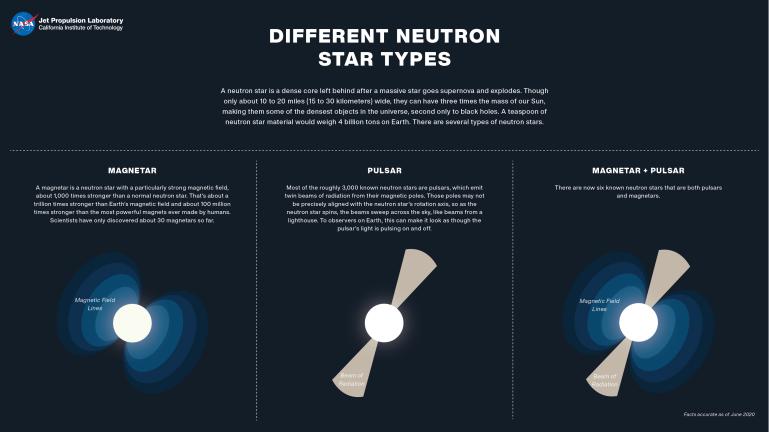
What to notice: pulsars emit beams from magnetic-pole regions, and we see pulses only when the rotating beam crosses Earth. Magnetars are neutron stars with especially strong magnetic fields; the categories describe observed behavior, not separate kinds of matter. (Credit: NASA/JPL-Caltech)
The pulse period is the rotation period of the neutron star, not a blinking time.
Compactness from pulse periods
A rotating object cannot have its surface moving faster than light. This gives a simple size estimate.
The equatorial speed of a rotating object is approximately
\[ v = \frac{2\pi R}{P}, \]
where \(R\) is the radius and \(P\) is the rotation period. Requiring \(v < c\) gives
\[ \frac{2\pi R}{P} < c. \]
Solving for \(R\),
\[ R < \frac{cP}{2\pi}. \]
For a millisecond pulsar with
\[ P = 1.0\,\mathrm{ms} = 1.0 \times 10^{-3}\,\mathrm{s}, \]
the maximum radius is
\[ R < \frac{\left(3.0 \times 10^{10}\,\mathrm{cm\,s^{-1}}\right) \left(1.0 \times 10^{-3}\,\mathrm{s}\right)}{2\pi}. \]
The seconds cancel:
\[ R < 4.8 \times 10^6\,\mathrm{cm}. \]
Convert to kilometers:
\[ R < 4.8 \times 10^6\,\mathrm{cm} \left(\frac{1\,\mathrm{km}}{10^5\,\mathrm{cm}}\right) = 48\,\mathrm{km}. \]
A millisecond pulsar must therefore be only tens of kilometers across. That is neutron-star scale, not normal-star scale.
A pulsar has \(P = 5\,\mathrm{ms}\).
- Before calculating, should the maximum possible radius be larger or smaller than the \(P=1\,\mathrm{ms}\) case?
- Use \(R < cP/(2\pi)\) to estimate the maximum radius.
- Explain why this rules out a normal star.
The maximum radius is larger because the object has more time to rotate once. Since the period is five times larger than \(1\,\mathrm{ms}\), the radius limit is also five times larger:
\[ R < 5(48\,\mathrm{km}) \approx 240\,\mathrm{km}. \]
Even this is far smaller than a normal star, so the source must be a compact remnant.
The neutron star is not repeatedly switching on and off. The radiation beam is always present, but Earth only sees it when the beam points toward us. The pulse is a viewing effect caused by rotation.
Pulsar spin-down
Most isolated pulsars gradually slow down. They lose rotational energy through magnetic fields, particle winds, and radiation. This means their periods increase over time.
The detailed spin-down physics is beyond this course, but the qualitative inference is important: young pulsars tend to spin rapidly, old isolated pulsars tend to spin more slowly, and old neutron stars in binary systems can be spun back up by accreting matter from a companion. These spun-up old neutron stars are called millisecond pulsars.
Part 3: The TOV Limit — The End of Neutron-Star Support
Another maximum mass
White dwarfs have a maximum mass: the Chandrasekhar limit,
\[ M_{\rm Ch} \approx 1.4\,M_\odot. \]
Neutron stars also have a maximum mass. It is called the Tolman-Oppenheimer-Volkoff limit, or TOV limit.
The TOV limit is the maximum mass of a stable neutron star.
Below this limit, dense nuclear matter can support the star. Above this limit, no known pressure support can prevent collapse to a black hole.
Why the TOV limit is not a single clean number
The Chandrasekhar limit is relatively clean because it depends on electron degeneracy pressure in white-dwarf matter.
The TOV limit is harder because neutron-star interiors involve:
- general relativity, because gravity is strong;
- nuclear-density matter, whose equation of state is uncertain;
- strong-force physics, which becomes important at very small distances;
- possible exotic phases such as hyperons or deconfined quarks.
For this course, use the order-of-magnitude statement:
\[ M_\text{TOV} \sim 2\text{--}3\,M_\odot \tag{1}\]
What it predicts
The maximum mass of a stable neutron star.
What it depends on
Depends on the equation of state of nuclear matter at supra-nuclear density and on general relativity.
What it’s saying
Above roughly \(2\text{--}3\,M_\odot\), pressure support from dense neutron-star matter cannot keep up with gravity. For course-level reasoning, \(2.5\,M_\odot\) is a useful dividing value, not an exact universal constant.
Assumptions
- General relativistic hydrostatic equilibrium (TOV equation)
- Cold nuclear matter equation of state (uncertain above nuclear density)
- One of the most massive securely measured neutron stars is \(2.08 \pm 0.07\,M_\odot\) (PSR J0740+6620)
See: the equation
When we need a simple dividing value, we will use
\[ M_{\rm TOV} \approx 2.5\,M_\odot. \]
Do not treat \(2.5\,M_\odot\) as an exact universal constant. It is a useful course-level boundary.
| Object | Main support mechanism | Approximate maximum mass | What happens above the limit? |
|---|---|---|---|
| White dwarf | electron degeneracy pressure | \(1.4\,M_\odot\) | collapse toward neutron-star densities |
| Neutron star | dense nuclear matter and neutron degeneracy pressure | \(\sim 2\)–\(3\,M_\odot\) | collapse to a black hole |
The physical meaning
The TOV limit does not mean “neutrons suddenly disappear.”
It means that for a sufficiently massive neutron star, adding more mass increases gravity faster than pressure support can respond. In general relativity, pressure itself also contributes to gravity, making the stability problem even more severe.
The inference is:
\[ M_{\rm remnant} < M_{\rm TOV} \quad \Rightarrow \quad \text{stable neutron star possible}, \]
but
\[ M_{\rm remnant} > M_{\rm TOV} \quad \Rightarrow \quad \text{black-hole formation expected}. \]
One of the most important observational facts is that neutron stars with masses near or above \(2\,M_\odot\) exist. That means the true maximum mass must be at least about \(2\,M_\odot\).
For example, PSR J0740+6620 has a securely measured mass of about
\[ M \approx 2.08\,M_\odot. \]
This strongly constrains the equation of state of dense nuclear matter.
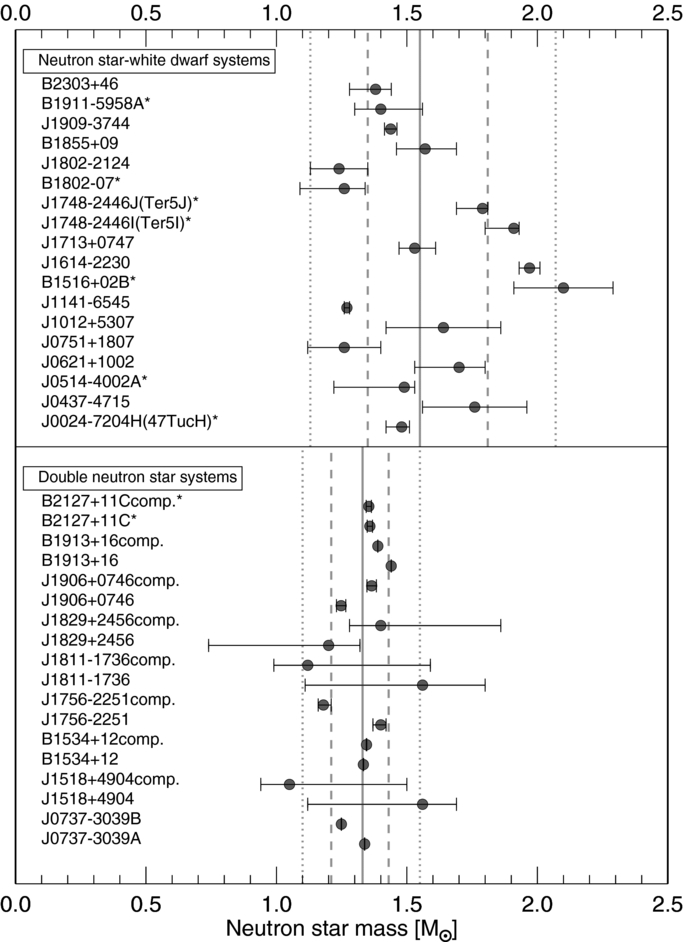
Measured neutron star masses from binary pulsar systems. Most cluster tightly around 1.3–1.5 M☉ — strikingly close to the Chandrasekhar limit of 1.4 M☉. The vertical lines mark the mean and standard deviation. The tight clustering is not a coincidence: it reflects the physics of core collapse, where the iron core mass at the moment of collapse is set by electron degeneracy and the Chandrasekhar limit. A few neutron stars have been found with masses ~2 M☉, pushing the upper limit of neutron degeneracy pressure.
That analogy is useful but incomplete.
Both limits are maximum masses for compact objects supported by quantum pressure. But the TOV limit depends much more strongly on uncertain nuclear physics and on general relativity. It is not known as precisely as the Chandrasekhar limit.
Suppose an unseen compact object in a binary system has a securely measured mass of \(4\,M_\odot\).
- Why is it unlikely to be a white dwarf?
- Why is it unlikely to be a neutron star?
- What compact-object model is left?
- What assumption are you making about the TOV limit?
A \(4\,M_\odot\) compact object is above the Chandrasekhar limit, so it is too massive to be a white dwarf. It is also above the course-level TOV range of roughly \(2\)–\(3\,M_\odot\), so it is unlikely to be a stable neutron star. The remaining compact-object model is a black hole, assuming the true TOV limit is below \(4\,M_\odot\).
Above the TOV limit
If the remnant mass exceeds the maximum stable neutron-star mass, then the known sources of pressure support have failed:
- thermal pressure cannot help permanently, because the remnant cools;
- electron degeneracy pressure already failed at the Chandrasekhar limit;
- neutron-star matter cannot support the remnant above the TOV limit.
The collapse forms an event horizon. In classical general relativity, continued collapse inside the horizon leads toward a singularity. A complete quantum theory of gravity would be needed to describe the innermost endpoint.
Part 4: Black Holes — Where Gravity Wins
A black hole is not a material surface.
A black hole is a region of spacetime bounded by an event horizon. The event horizon is the boundary beyond which no future-directed signal can escape to distant observers.
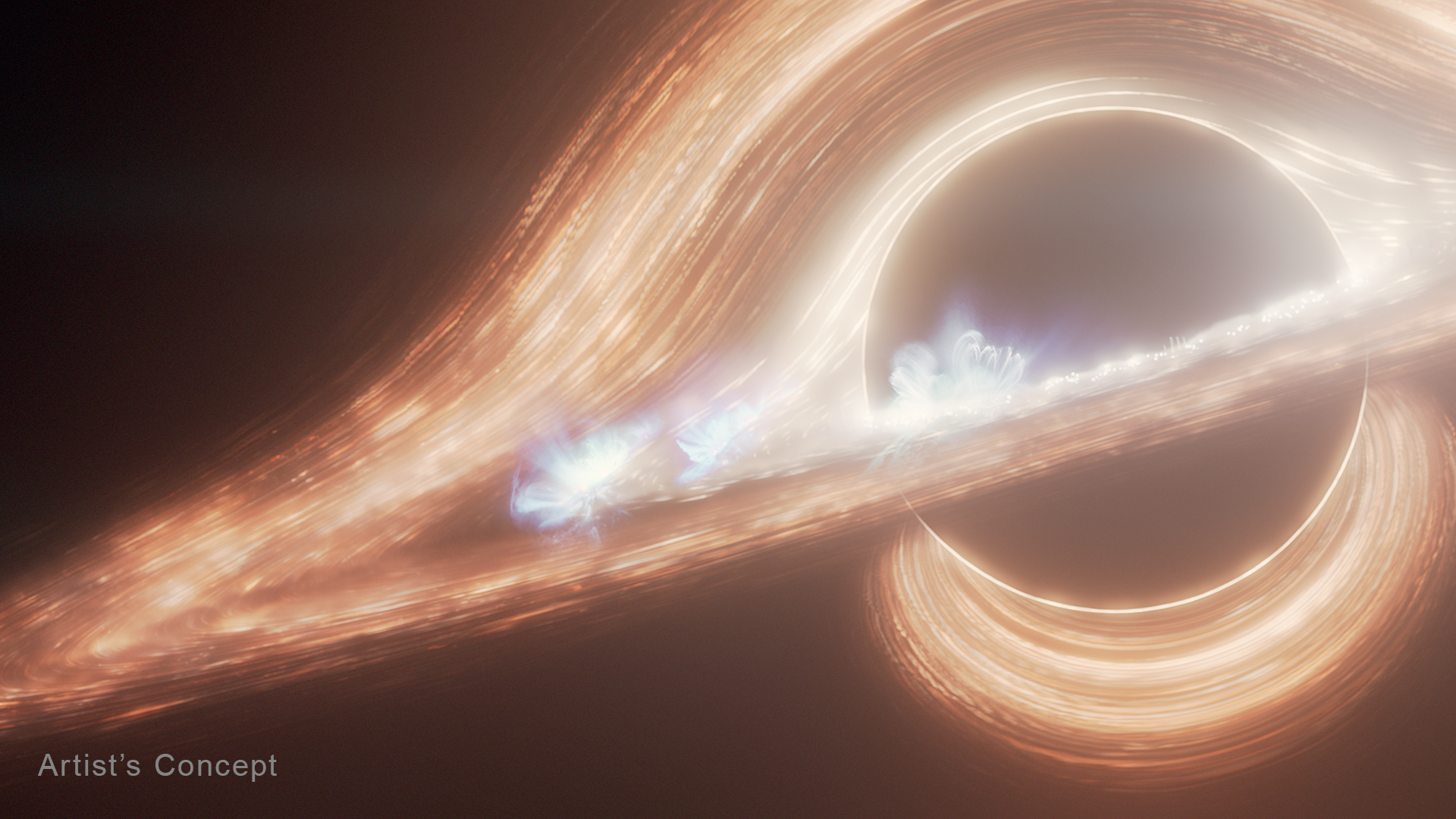
What to notice: the black hole itself is not glowing. The light comes from hot gas in the accretion flow, while the dark central region and bent light paths reveal strongly curved spacetime near the event horizon. (Credit: NASA/STScI)
This ScienceClic video is a visual bridge from the event-horizon idea to the curved-spacetime effects behind black-hole images. Watch for the same physical themes we use below: escape, horizons, light bending, and gravitational time dilation.
If the embedded player does not appear, open the video directly: ScienceClic — The Math Behind Interstellar’s Black Hole.
Credit: ScienceClic
The Schwarzschild Radius: A Newtonian Preview
We can motivate the correct event-horizon scale using a Newtonian escape-speed argument.
The escape speed from radius \(R\) around mass \(M\) is
\[ v_{\rm esc} = \sqrt{\frac{2GM}{R}}, \]
where \(G\) is the gravitational constant, \(M\) is the mass, and \(R\) is the radius from the center.
Set the escape speed equal to the speed of light:
\[ v_{\rm esc} = c. \]
Then
\[ c = \sqrt{\frac{2GM}{R}}. \]
Square both sides:
\[ c^2 = \frac{2GM}{R}. \]
Solve for \(R\):
\[ R = \frac{2GM}{c^2}. \]
This radius is called the Schwarzschild radius:
\[ R_s = \frac{2GM}{c^2} \tag{2}\]
What it predicts
Given \(M\), it predicts the event horizon radius \(R_{\mathrm{sch}}\).
What it depends on
Scales as \(R_{\mathrm{sch}} \propto M\).
What it’s saying
More massive objects have larger event horizons—linearly.
Assumptions
- Non-rotating (Schwarzschild, not Kerr)
- Uncharged
- Spherically symmetric
See: the equation
For a non-rotating, uncharged black hole, \(R_s\) is the event-horizon radius.
The Schwarzschild radius formula assumes the black hole is non-rotating, electrically uncharged, spherically symmetric, and isolated enough that a single mass \(M\) describes the spacetime well.
Real astrophysical black holes usually rotate, so they are better described by the Kerr solution. But \(R_s\) remains the right first scale to learn.
Worked Example: The Sun’s Schwarzschild Radius
Use cgs units:
\[ G = 6.67 \times 10^{-8}\,\mathrm{cm^3\,g^{-1}\,s^{-2}}, \]
\[ M_\odot = 2.0 \times 10^{33}\,\mathrm{g}, \]
\[ c = 3.0 \times 10^{10}\,\mathrm{cm\,s^{-1}}. \]
The Schwarzschild radius is
\[ R_{s,\odot} = \frac{2GM_\odot}{c^2}. \]
Substitute values:
\[ R_{s,\odot} = \frac{ 2 \left(6.67 \times 10^{-8}\,\mathrm{cm^3\,g^{-1}\,s^{-2}}\right) \left(2.0 \times 10^{33}\,\mathrm{g}\right) }{ \left(3.0 \times 10^{10}\,\mathrm{cm\,s^{-1}}\right)^2 }. \]
First compute the numerator:
\[ 2GM_\odot = 2.67 \times 10^{26}\,\mathrm{cm^3\,s^{-2}}. \]
Compute the denominator:
\[ c^2 = 9.0 \times 10^{20}\,\mathrm{cm^2\,s^{-2}}. \]
Now divide:
\[ R_{s,\odot} = \frac{ 2.67 \times 10^{26}\,\mathrm{cm^3\,s^{-2}} }{ 9.0 \times 10^{20}\,\mathrm{cm^2\,s^{-2}} } = 2.97 \times 10^5\,\mathrm{cm}. \]
The units reduce to centimeters:
\[ \frac{\mathrm{cm^3\,s^{-2}}}{\mathrm{cm^2\,s^{-2}}} = \mathrm{cm}. \]
Convert to kilometers:
\[ R_{s,\odot} = 2.97 \times 10^5\,\mathrm{cm} \left(\frac{1\,\mathrm{km}}{10^5\,\mathrm{cm}}\right) = 2.97\,\mathrm{km}. \]
So
\[ \boxed{R_{s,\odot} \approx 3.0\,\mathrm{km}}. \]
To make the Sun into a black hole, you would need to compress one solar mass inside a radius of about \(3\,\mathrm{km}\).
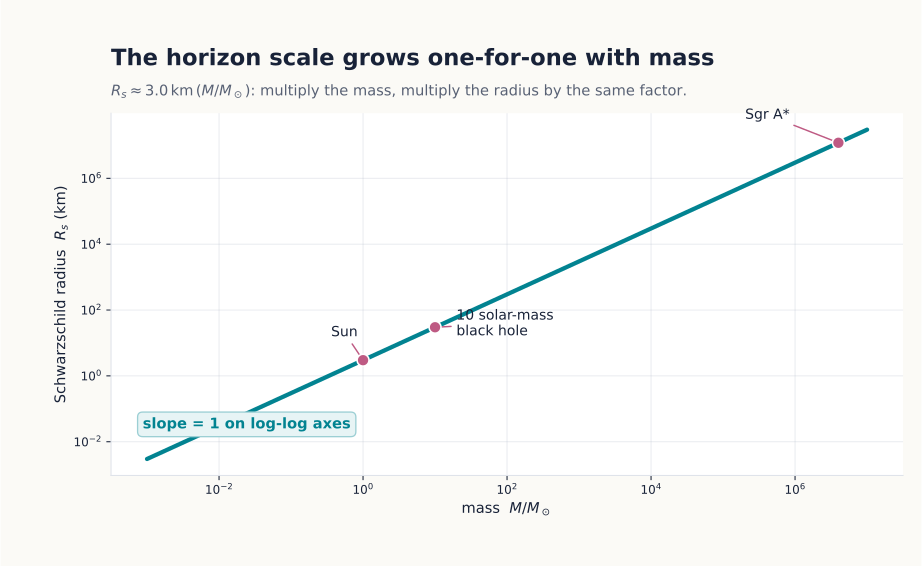
What to notice: Schwarzschild radius scales linearly with mass. Doubling the mass doubles the event-horizon radius, which is why the scaling \(R_s \approx 3.0\,\mathrm{km}(M/M_\odot)\) is so powerful. (Credit: ASTR 201 (generated))
Useful scaling relation
Because \(R_s\) is proportional to mass,
\[ R_s \propto M. \]
Using the Sun as the reference case,
\[ R_s \approx 3.0\,\mathrm{km} \left(\frac{M}{M_\odot}\right). \]
Examples:
| Object | Mass | Schwarzschild radius |
|---|---|---|
| Sun | \(1\,M_\odot\) | \(3.0\,\mathrm{km}\) |
| \(10\,M_\odot\) black hole | \(10\,M_\odot\) | \(30\,\mathrm{km}\) |
| Sgr A* | \(4 \times 10^6\,M_\odot\) | \(1.2 \times 10^7\,\mathrm{km}\) |
Use
\[ R_s \approx 3.0\,\mathrm{km} \left(\frac{M}{M_\odot}\right). \]
- What is \(R_s\) for a \(5\,M_\odot\) black hole?
- What is \(R_s\) for a \(30\,M_\odot\) black hole?
- Why did you not need to plug in \(G\) and \(c\) again?
For \(5\,M_\odot\), \(R_s \approx 15\,\mathrm{km}\). For \(30\,M_\odot\), \(R_s \approx 90\,\mathrm{km}\). You do not need to plug in \(G\) and \(c\) again because the proportionality constant was already evaluated for one solar mass.
Compactness: When does gravity become relativistic?
The Schwarzschild radius is useful even for objects that are not black holes. Compare \(R_s\) to the object’s actual radius \(R\):
\[ \text{compactness} = \frac{R_s}{R}. \]
This ratio tells us how relativistic the object’s gravity is.
For Earth,
\[ \frac{R_s}{R_\oplus} \sim 10^{-9}. \]
For the Sun,
\[ \frac{R_s}{R_\odot} = \frac{3\,\mathrm{km}}{7 \times 10^5\,\mathrm{km}} \approx 4 \times 10^{-6}. \]
For a neutron star with \(M=1.4\,M_\odot\) and \(R=10\,\mathrm{km}\),
\[ R_s = 3.0\,\mathrm{km} \left(\frac{1.4\,M_\odot}{M_\odot}\right) = 4.2\,\mathrm{km}. \]
Therefore,
\[ \frac{R_s}{R} = \frac{4.2\,\mathrm{km}}{10\,\mathrm{km}} = 0.42. \]
A compactness of \(0.42\) is enormous. General relativity is not a tiny correction for neutron stars; it is essential.
The Newtonian escape-speed estimate gives
\[ \frac{v_{\rm esc}}{c} = \sqrt{\frac{R_s}{R}}. \]
For this neutron star,
\[ \frac{v_{\rm esc}}{c} = \sqrt{0.42} \approx 0.65. \]
So the escape speed is roughly
\[ \boxed{v_{\rm esc} \approx 0.65c}. \]
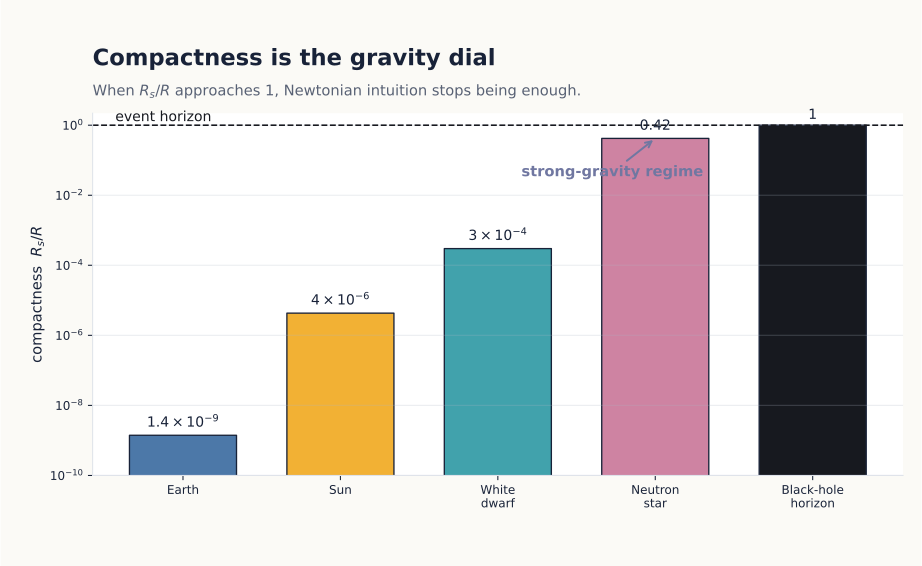
What to notice: compactness \(R_s/R\) is tiny for Earth and the Sun, larger for white dwarfs, a large fraction of unity for neutron stars, and exactly \(1\) at a black-hole event horizon. Compactness, not mass alone, tells us when general relativity matters. (Credit: ASTR 201 (generated))
Rank these objects by compactness \(R_s/R\), from smallest to largest:
- Earth
- Sun
- white dwarf
- neutron star
- black hole event horizon
Then explain which objects require general relativity for accurate modeling.
The order is Earth, Sun, white dwarf, neutron star, black hole event horizon. General relativity is essential for neutron stars and black holes because their compactness is a large fraction of unity. It is a tiny correction for Earth and the Sun in most ordinary contexts.
A black hole is not a star with a hard surface. It has no material surface at \(R_s\). The event horizon is a causal boundary: once inside, no signal can reach distant observers.
Why General Relativity?
The Newtonian escape-speed argument gives the correct Schwarzschild radius, but it does not explain what an event horizon really is.
Newtonian gravity has no universal speed limit. General relativity does.
General relativity changes the picture in three key ways:
- Nothing can travel faster than light.
- Mass and energy curve spacetime.
- Inside an event horizon, all future-directed paths lead inward.
That last statement is the key. The event horizon is not a wall. It is the place where the geometry of spacetime prevents outward escape.
A photon climbing out of a gravitational well loses energy. Its wavelength increases.
For a non-rotating compact object, the gravitational redshift factor for light emitted from radius \(R\) is
\[ \frac{\lambda_{\rm obs}}{\lambda_{\rm emit}} = \frac{1}{\sqrt{1 - R_s/R}}. \]
For a neutron star with
\[ \frac{R_s}{R} = 0.42, \]
we get
\[ \frac{\lambda_{\rm obs}}{\lambda_{\rm emit}} = \frac{1}{\sqrt{1 - 0.42}} = \frac{1}{\sqrt{0.58}} \approx 1.31. \]
A photon emitted at
\[ \lambda_{\rm emit} = 500\,\mathrm{nm} \]
would be observed at
\[ \lambda_{\rm obs} = 1.31 \left(500\,\mathrm{nm}\right) = 655\,\mathrm{nm}. \]
That is a shift from green light toward red light.
This is not a Doppler shift caused by motion. It is gravitational redshift caused by spacetime curvature. As emission comes from surfaces closer and closer to \(R_s\), the redshift grows without bound.
The formula does not mean that a normal flashlight can hover exactly at the event horizon and send light outward. A static emitter at the horizon is not physically possible. The useful lesson is the limiting behavior: as the emitting surface approaches \(R_s\), light escaping to distant observers is increasingly redshifted.
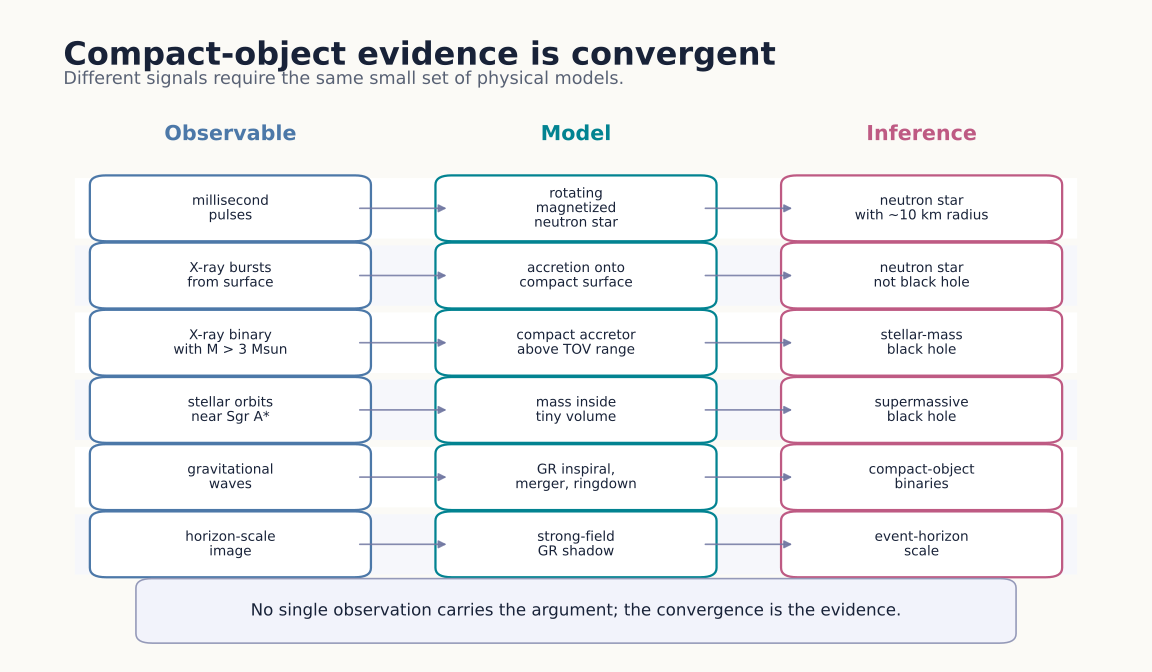
What to notice: no single observation carries the whole argument. Pulses, X-ray binaries, stellar orbits, gravitational waves, and horizon-scale images converge on neutron-star and black-hole models. (Credit: ASTR 201 (generated))
Part 5: Observational Evidence
How do we know neutron stars and black holes are real?
Neither object is easy to observe directly in isolation.
- Neutron stars are tiny and often faint.
- Black holes emit no light from inside the event horizon.
So the evidence is mostly indirect. But indirect does not mean weak. The evidence is strong because many independent observations point to the same physical models.
Evidence for neutron stars
| Observable | Model | Inference |
|---|---|---|
| Regular radio or X-ray pulses | rotating magnetized neutron star | pulsars are compact, rapidly rotating remnants |
| Millisecond periods | radius must be tens of km or less | normal stars are ruled out |
| Pulsar glitches | solid crust coupled to fluid/superfluid interior | neutron stars have internal structure |
| X-ray bursts in binaries | accretion onto a compact surface | some compact objects have surfaces |
| Neutron-star mergers | gravitational waves from dense-object inspiral | neutron stars merge and constrain dense matter |
Observable: A radio source pulses every few milliseconds.
Model: A rotating lighthouse beam sweeps across Earth once per rotation.
Inference: The source must be compact enough to rotate that fast. A neutron star explains the period, compactness, magnetic field, and stability.
Evidence for black holes
| Observable | Model | Inference |
|---|---|---|
| X-ray binaries with compact objects above \(\sim 3\,M_\odot\) | accretion onto a compact object too massive to be a neutron star | stellar-mass black hole |
| No surface emission from the compact object | event horizon rather than material surface | black-hole model favored |
| Stellar orbits around Sgr A* | Keplerian orbits around an unseen compact mass | \(\sim 4 \times 10^6\,M_\odot\) inside a tiny region |
| Gravitational waves from mergers | inspiral, merger, and ringdown predicted by GR | black-hole binaries exist |
| Event Horizon Telescope images | horizon-scale emission and shadow | strong-field GR near supermassive black holes |
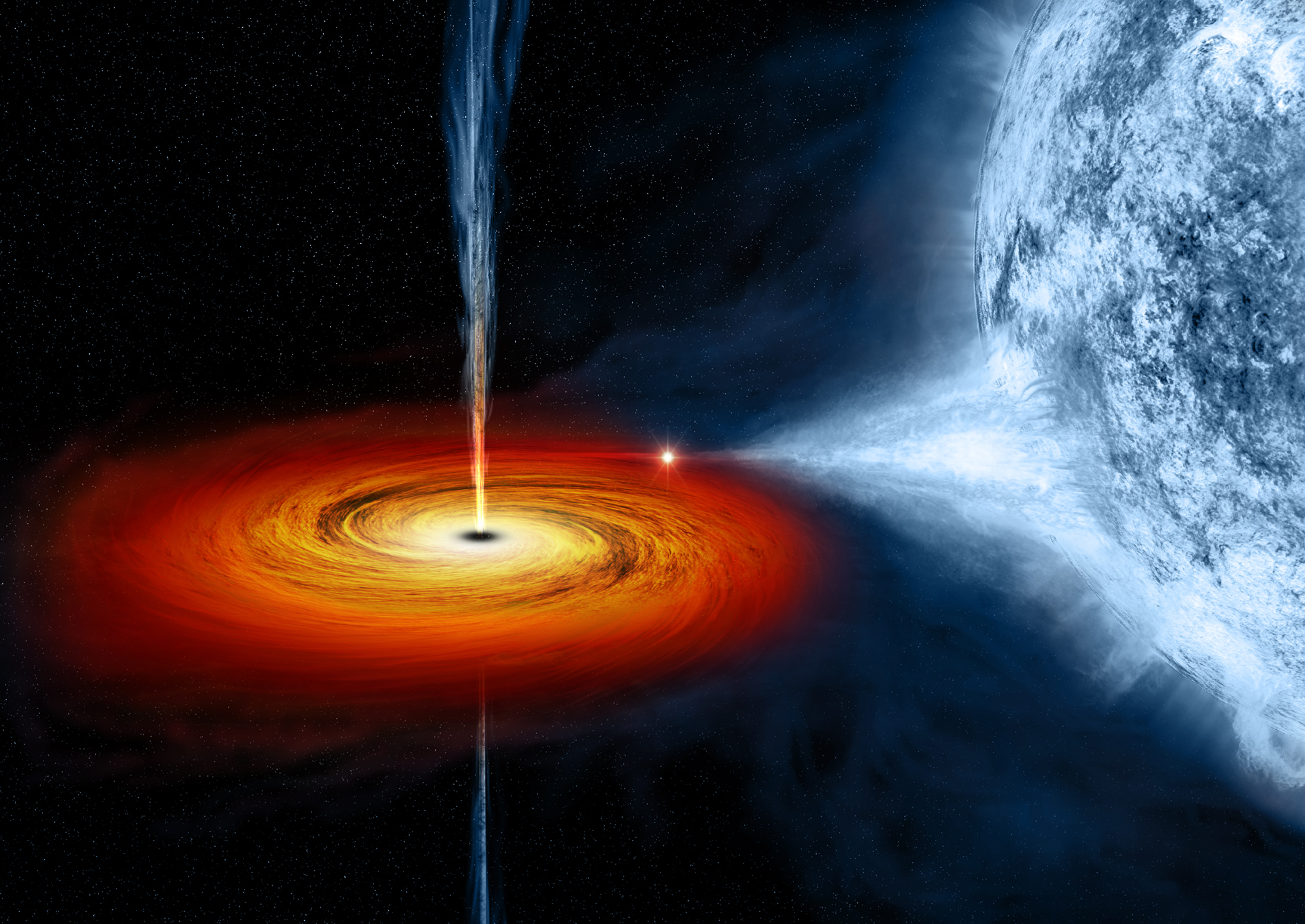
Cygnus X-1 — the first strong black hole candidate. A stellar-mass black hole (~21 M☉) accretes gas from its blue supergiant companion star (HDE 226868). The infalling matter forms a swirling accretion disk heated to millions of kelvin, producing intense X-ray emission. Relativistic jets emerge perpendicular to the disk. The black hole itself is invisible — we infer its existence from the X-ray luminosity and the orbital dynamics of the companion. (Credit: NASA/CXC)
Cygnus X-1 is a classic black-hole candidate. We do not see the black hole directly. We infer it from the companion star’s orbit, the mass of the compact object, and the intense X-ray emission from accreting gas.
Observable: LIGO detected a gravitational-wave signal whose frequency and amplitude changed rapidly with time.
Model: General relativity predicts the waveform from two black holes spiraling together, merging, and ringing down.
Inference: The source was a binary black-hole merger. The initial black holes had masses of tens of solar masses, and several solar masses of energy were radiated as gravitational waves.
Not necessarily.
Many of the strongest inferences in astronomy are indirect because we cannot touch, sample, or spatially resolve most objects. The question is not whether the evidence is direct. The question is whether multiple independent measurements require the same model.
For black holes, the evidence comes from orbits, accretion, gravitational waves, and horizon-scale imaging. These independent lines of evidence point to the same conclusion.
Worked Example: Sgr A*
The supermassive black hole at the center of the Milky Way has mass approximately
\[ M \approx 4 \times 10^6\,M_\odot. \]
Use the scaling relation
\[ R_s \approx 3.0\,\mathrm{km} \left(\frac{M}{M_\odot}\right). \]
Then
\[ R_s \approx 3.0\,\mathrm{km} \left(4 \times 10^6\right) = 1.2 \times 10^7\,\mathrm{km}. \]
Compare this with the Sun’s radius:
\[ R_\odot \approx 7 \times 10^5\,\mathrm{km}. \]
Then
\[ \frac{R_s}{R_\odot} = \frac{1.2 \times 10^7\,\mathrm{km}}{7 \times 10^5\,\mathrm{km}} \approx 17. \]
So the event-horizon radius of Sgr A* is about \(17\) solar radii.
Now compare with Earth’s orbital radius:
\[ 1\,\mathrm{AU} \approx 1.5 \times 10^8\,\mathrm{km}. \]
Then
\[ \frac{R_s}{1\,\mathrm{AU}} = \frac{1.2 \times 10^7\,\mathrm{km}}{1.5 \times 10^8\,\mathrm{km}} = 0.08. \]
So Sgr A* has an event-horizon radius of about
\[ \boxed{R_s \approx 0.08\,\mathrm{AU}}. \]
Even a four-million-solar-mass black hole has an event horizon smaller than Mercury’s orbit.
Suppose observations show an unseen object with:
- mass \(M = 8\,M_\odot\),
- strong X-ray emission from accretion,
- no evidence for a surface,
- rapid orbital motion of a companion star.
Explain why the black-hole model is favored over a neutron-star model.
An \(8\,M_\odot\) compact object is above the expected maximum mass of a stable neutron star. The X-rays show accretion onto a compact object, while the absence of surface evidence favors an event horizon rather than a neutron-star surface. The companion orbit provides the mass constraint, so the black-hole model is the best fit.
Part 6: The Gravity Scoreboard — Final Entry
The complete compact-remnant picture
The outcome of stellar evolution depends most directly on the final core mass, not just the star’s initial mass. Initial mass still matters, but mass loss, metallicity, rotation, and binary interaction can shift the boundaries.
| Approximate initial mass | Typical final remnant | Physical support |
|---|---|---|
| \(M \lesssim 0.08\,M_\odot\) | brown dwarf | electron degeneracy, no sustained hydrogen fusion |
| \(0.08 \lesssim M/M_\odot \lesssim 8\) | white dwarf | electron degeneracy pressure |
| \(8 \lesssim M/M_\odot \lesssim 25\) | neutron star | dense nuclear matter and neutron degeneracy pressure |
| \(M \gtrsim 25\,M_\odot\) | black hole | no stable pressure support outside an event horizon |
The boundary is not exact.
A star’s final fate depends on how much mass it loses, whether it has a binary companion, its metallicity, rotation, and explosion physics. The table gives a useful first map, not a deterministic rule.
Gravity’s opponents
| Opponent | What it does | When it fails |
|---|---|---|
| Thermal pressure | gas pressure pushes outward | fuel is exhausted and the star cools |
| Nuclear fusion | replaces lost thermal energy | fusion reaches iron-group nuclei |
| Radiation pressure | supports massive stars | contributes to instability and mass loss |
| Electron degeneracy pressure | supports white dwarfs | fails near \(1.4\,M_\odot\) |
| Dense nuclear matter | supports neutron stars | fails above roughly \(2\)–\(3\,M_\odot\) |
| Nothing known | no stable support | black hole forms |
Compact Objects at a Glance
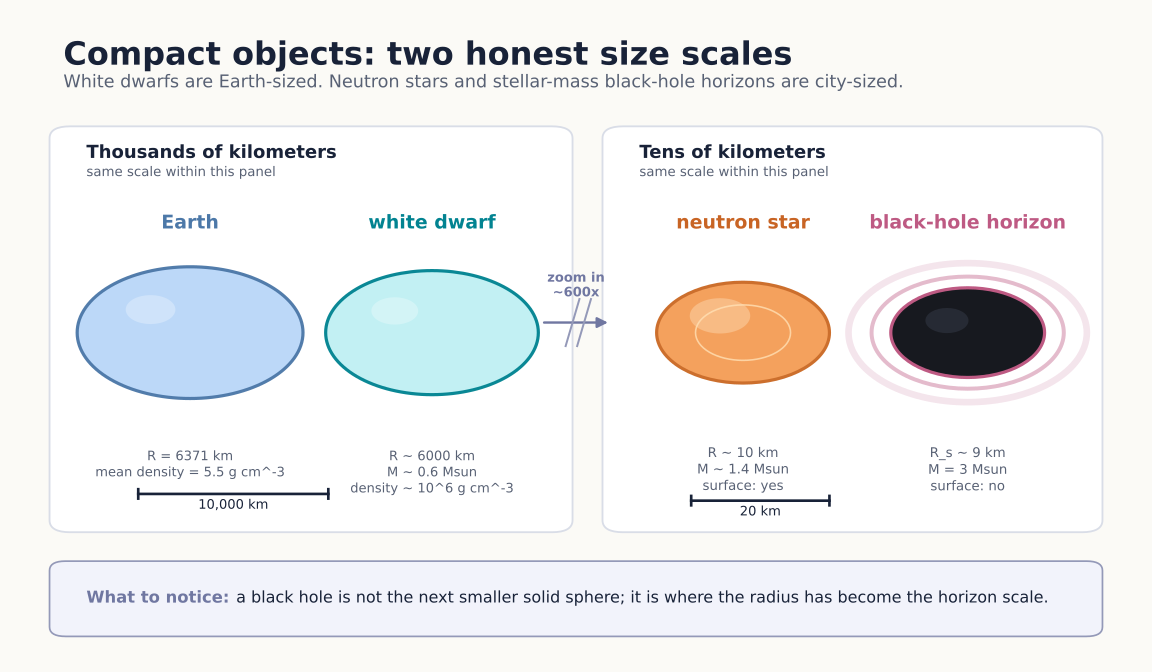
What to notice: this figure uses two honest scales. Earth and a white dwarf are comparable in radius, but a neutron star and a stellar-mass black-hole horizon are hundreds of times smaller. The black hole is not the next smaller solid sphere; it has no material surface. (Credit: ASTR 201 (generated))
| Property | White dwarf | Neutron star | Black hole |
|---|---|---|---|
| Mass | \(\lesssim 1.4\,M_\odot\) | \(1.4\)–\(\sim 2.5\,M_\odot\) | \(\gtrsim 3\,M_\odot\) for stellar remnants |
| Radius | \(\sim 6000\,\mathrm{km}\) | \(\sim 10\,\mathrm{km}\) | \(R_s = 3.0\,\mathrm{km}(M/M_\odot)\) |
| Density | \(\sim 10^6\,\mathrm{g\,cm^{-3}}\) | \(\sim 10^{14}\)–\(10^{15}\,\mathrm{g\,cm^{-3}}\) | no material density at a surface |
| Compactness \(R_s/R\) | \(\sim 10^{-4}\) | \(\sim 0.4\) | \(1\) at the event horizon |
| Support | electron degeneracy | dense nuclear matter | no stable material surface |
| Surface? | yes | yes | no; event horizon |
Symbol Legend
| Symbol | Meaning | Typical units |
|---|---|---|
| \(R_s\) | Schwarzschild radius | \(\mathrm{cm}\) or \(\mathrm{km}\) |
| \(M_{\rm TOV}\) | maximum stable neutron-star mass | \(M_\odot\) |
| \(P\) | pulsar period | \(\mathrm{s}\) |
| \(\Phi\) | magnetic flux | \(\mathrm{G\,cm^2}\) |
| \(\omega\) | angular velocity | \(\mathrm{rad\,s^{-1}}\) |
| \(R_s/R\) | compactness | dimensionless |
Practice Problems
Use these values unless a problem states otherwise:
- \(G = 6.674 \times 10^{-8}\,\mathrm{cm^3\,g^{-1}\,s^{-2}}\)
- \(c = 3.0 \times 10^{10}\,\mathrm{cm\,s^{-1}}\)
- \(M_\odot = 2.0 \times 10^{33}\,\mathrm{g}\)
- \(1\,\mathrm{km} = 10^5\,\mathrm{cm}\)
- \(R_s \approx 3.0\,\mathrm{km}\left(\frac{M}{M_\odot}\right)\)
- For this course, use \(M_{\rm TOV} \approx 2.5\,M_\odot\) as an order-of-magnitude dividing value.
Conceptual
- ⭐ Pulsars as evidence.
- What is the observable in the pulsar argument?
- What compact-object model explains that observable?
- What physical inference does the model force us to make about the size and density of the source?
- ⭐⭐ The TOV limit is not a second Chandrasekhar constant.
- Why is the Chandrasekhar limit more precisely known than the TOV limit?
- Name two pieces of physics that make the neutron-star maximum mass harder to calculate.
- Explain why a securely measured \(2.1\,M_\odot\) neutron star is scientifically important.
- ⭐ Surface or horizon? A student says, “A black hole is just a neutron star with a darker surface.”
- What part of this statement is misleading?
- What is an event horizon?
- Name one observation that can help distinguish a compact object with a surface from one with an event horizon.
Calculation
- ⭐ Schwarzschild radius by scaling. A stellar-mass black hole has mass \(8\,M_\odot\).
- Use \[ R_s \approx 3.0\,\mathrm{km}\left(\frac{M}{M_\odot}\right) \] to estimate its Schwarzschild radius.
- Convert your answer to centimeters.
- Compare your result to a neutron-star radius of \(10\,\mathrm{km}\).
- ⭐⭐ Compactness and escape speed. Consider a neutron star with mass \(1.4\,M_\odot\) and radius \(12\,\mathrm{km}\).
- Estimate \(R_s\) using the solar-mass scaling.
- Compute the compactness \[ \frac{R_s}{R}. \]
- Use \[ \frac{v_{\rm esc}}{c} = \sqrt{\frac{R_s}{R}} \] to estimate the escape speed as a fraction of \(c\).
- Explain why this object requires general relativity for accurate modeling.
- ⭐⭐ Pulse period as a size limit. A millisecond pulsar has period \[
P = 2.0\,\mathrm{ms}.
\]
- Convert the period to seconds.
- Use \[ R < \frac{cP}{2\pi} \] to estimate the largest possible radius if the surface speed must remain below \(c\).
- Convert your answer from centimeters to kilometers.
- Explain why this rules out a normal star.
Synthesis
- ⭐⭐ Classifying an unseen compact object. Observations of a binary system imply an unseen companion with mass \(5\,M_\odot\). The system emits strong X-rays from accreting gas, and there is no evidence for thermonuclear bursts from a surface.
- Why is a white dwarf model unlikely?
- Why is a neutron-star model unlikely?
- What compact-object model is favored?
- State the assumption about the TOV limit that enters your inference.
- ⭐⭐ Converging evidence. Choose two of the following observations: pulsar pulses, X-ray binaries, stellar orbits around Sgr A*, gravitational waves, or Event Horizon Telescope images.
- For each observation, identify the observable.
- For each observation, identify the physical model.
- Explain how the two observations together make the case for compact remnants stronger than either observation alone.
- ⭐⭐⭐ Initial mass is not destiny. Two massive stars both begin with initial masses near \(25\,M_\odot\). One leaves a neutron star; the other leaves a black hole.
- Explain why this is possible even if the lecture table gives \(25\,M_\odot\) as an approximate boundary.
- Name three physical effects that can shift the final outcome.
- In one paragraph, explain why final core mass is a better predictor of remnant type than initial mass alone.
Glossary
Accretion: The process in which gas falls onto a compact object. As the gas loses gravitational potential energy, it can heat up and emit X-rays.
Black hole: A region of spacetime bounded by an event horizon. It is not a material surface or a solid object.
Compactness (\(R_s/R\)): A dimensionless measure of how close an object’s radius is to its Schwarzschild radius. Large compactness means relativistic gravity is important.
Dense nuclear matter: Matter compressed to densities comparable to or above atomic nuclei, where neutron degeneracy pressure, nuclear interactions, and general relativity all matter.
Equation of state: A relationship between pressure, density, temperature, and composition. For neutron stars, the high-density equation of state is uncertain.
Event horizon: The causal boundary of a black hole. Inside the horizon, no future-directed signal can escape to distant observers.
Gravitational redshift: The stretching of light to longer wavelengths as it climbs out of a gravitational field.
Lighthouse model: The model in which a pulsar’s radiation beam sweeps across Earth because the neutron star’s magnetic axis is misaligned with its rotation axis.
Millisecond pulsar: A rapidly rotating neutron star with a period of a few milliseconds, often spun up by accretion from a binary companion.
Neutron degeneracy pressure: Quantum pressure associated with densely packed neutrons. In real neutron stars, this is only part of the pressure support.
Neutron star: A compact remnant with roughly a solar mass compressed into a radius of order \(10\,\mathrm{km}\), supported by dense nuclear matter.
Pulsar: A rotating, magnetized neutron star observed through regular pulses of radiation as its beam crosses our line of sight.
Schwarzschild radius (\(R_s\)): The event-horizon radius of a non-rotating, uncharged black hole:
\[ R_s = \frac{2GM}{c^2}. \]
TOV limit: The maximum mass of a stable neutron star, set by general relativity and the equation of state of dense nuclear matter. In this course, treat it as roughly \(2\)–\(3\,M_\odot\).
Summary: Gravity Wins
The most important ideas from this reading are:
Neutron stars are nuclear-density remnants.
They contain roughly a solar mass in a radius of about \(10\,\mathrm{km}\) and are supported by dense nuclear matter.Pulsars are rotating neutron stars.
Their short periods require compact objects. The lighthouse model explains why we see pulses without requiring the star to turn on and off.The TOV limit is the neutron-star maximum mass.
It is roughly \(2\)–\(3\,M_\odot\), but its exact value depends on the uncertain equation of state of dense nuclear matter and on general relativity.The Schwarzschild radius sets the black-hole scale.
\[ R_s = \frac{2GM}{c^2} \approx 3.0\,\mathrm{km} \left(\frac{M}{M_\odot}\right). \]
Compactness tells us when gravity becomes relativistic.
The ratio \(R_s/R\) is tiny for Earth and the Sun, but large for neutron stars and equal to \(1\) at a black-hole event horizon.Black holes are causal boundaries, not material surfaces.
The event horizon is the boundary beyond which no signal can escape to distant observers.The evidence is convergent.
Pulsars, X-ray binaries, gravitational waves, stellar orbits, and horizon-scale imaging all point to compact remnants governed by dense matter and general relativity.
Gravity has now defeated every long-term source of pressure support.
Below the hydrogen-burning limit, objects become brown dwarfs.
Below the Chandrasekhar limit, dead stellar cores become white dwarfs.
Below the TOV limit, collapsed massive-star cores become neutron stars.
Above the TOV limit, no known pressure support remains.
The result is a black hole.
But the story is not only destruction. The same stellar evolution that produces white dwarfs, neutron stars, and black holes also builds the periodic table. Stars make the elements, supernovae and mergers distribute them, and later generations of stars and planets form from that enriched material.
The final lesson is therefore larger than compact objects:
The periodic table is a record of gravity’s battles.
Module 3 followed stars from hydrostatic equilibrium to black holes. Module 4 zooms out. We will use stars as tracers of galaxies, galaxies as tracers of cosmic structure, and cosmic expansion as evidence for the history of the universe itself.