Lecture 14: Our Star: The Sun
A Physics Lab 8 Light-Minutes Away
The Big Idea
The Sun is a physics laboratory 8 light-minutes away. Every mechanism we discover in the Sun — fusion, magnetic fields, energy transport — is at work in billions of other stars. Understanding the Sun is the gateway to understanding the universe.
This reading treats the Sun as a physical problem to solve, not just a set of facts to memorize.
Default expectation (best): Read the whole page before lecture and pause at each Check Yourself prompt.
If you’re short on time (~20 min):
- Focus on the opening paradoxes, hydrostatic equilibrium, the proton-proton chain, and the energy transport section.
- Skim the deeper history and come back to the practice problems after class.
Reference mode: Return to the summary, glossary, and practice problems when later lectures compare other stars to the Sun and ask what changes with stellar mass.
The Sun as a Physical Problem
The Sun should be easier to understand than any other star. It is close, bright, and constantly observable. And yet it presents a set of astonishing puzzles. Gravity should crush it inward. Its fuel source should have run out long ago if it were powered like an ordinary fire. Light made in the core should not take an absurdly long time to reach the surface. And strangest of all, the Sun’s outer atmosphere is far hotter than the visible surface below it.
This reading treats the Sun not as a list of parts to memorize, but as a physical problem to solve. What keeps a star alive? How does energy move through it? Why does its surface erupt? And how do we know any of this when the core is hidden from view?
By the end of the reading, the answer should feel earned: the Sun is our nearest working example of a star balancing two competing tendencies. Gravity pulls inward, while pressure pushes outward. Everything else in this lecture — fusion, transport, magnetism, neutrinos, and later stellar evolution — grows out of that balance.
The Sun in Context
The Sun is not special because it is extreme. It is not the hottest star, the biggest star, or the most luminous star. The Sun is special because it is measurable. We can resolve its surface, monitor its activity in real time, detect particles from its core, and test our stellar models against an actual nearby example. That is why the Sun becomes the calibration object for the rest of Module 2.
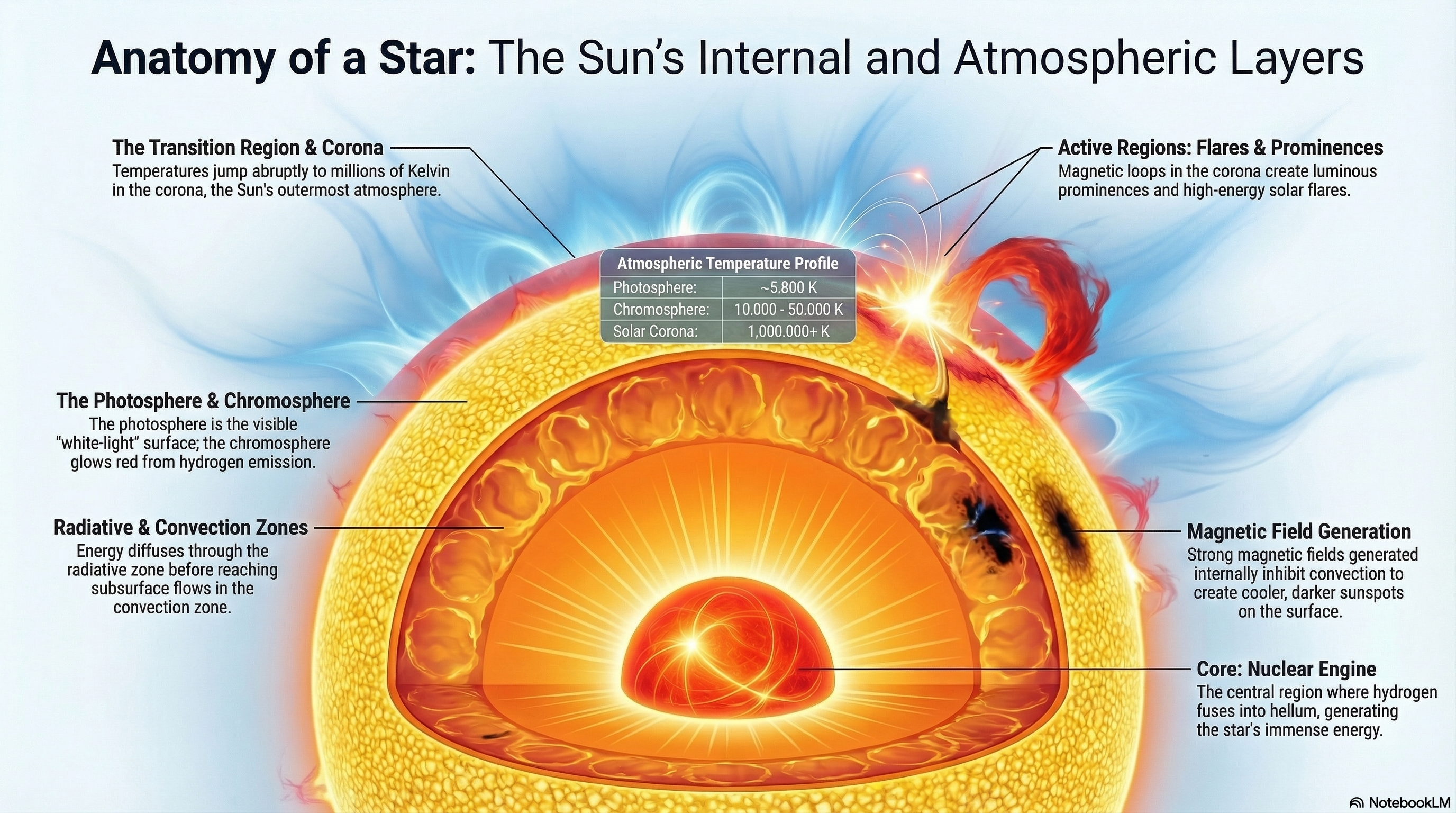
What to notice: the Sun is layered because different physical jobs happen in different regions. Fusion is confined to the core, energy moves outward through radiative and convective zones, and the photosphere, chromosphere, and corona are the observable outer layers.
The Sun will appear in nearly every lecture from here forward. Its mass becomes the yardstick we use to measure other stars, its luminosity becomes a reference scale for stellar power, and its eventual fate previews what happens to billions of Sun-like stars.
If gravity is always pulling inward, what must a stable star provide in return?
A stable star must provide an outward pressure force that balances gravity. In the Sun, that pressure ultimately comes from the hot gas and radiation produced by energy released in the core.
What Keeps the Sun From Collapsing?
The first problem any star must solve is simple to state and hard to solve: gravity is trying to crush it. Every layer of the Sun feels the weight of the material above it. If nothing pushed back, the Sun would contract.
What pushes back is pressure. In a stable star, inward gravity and outward pressure balance at every depth. This condition is called hydrostatic equilibrium. It is the reason the Sun can keep nearly the same size for billions of years rather than collapsing in a cosmic instant or blowing itself apart.
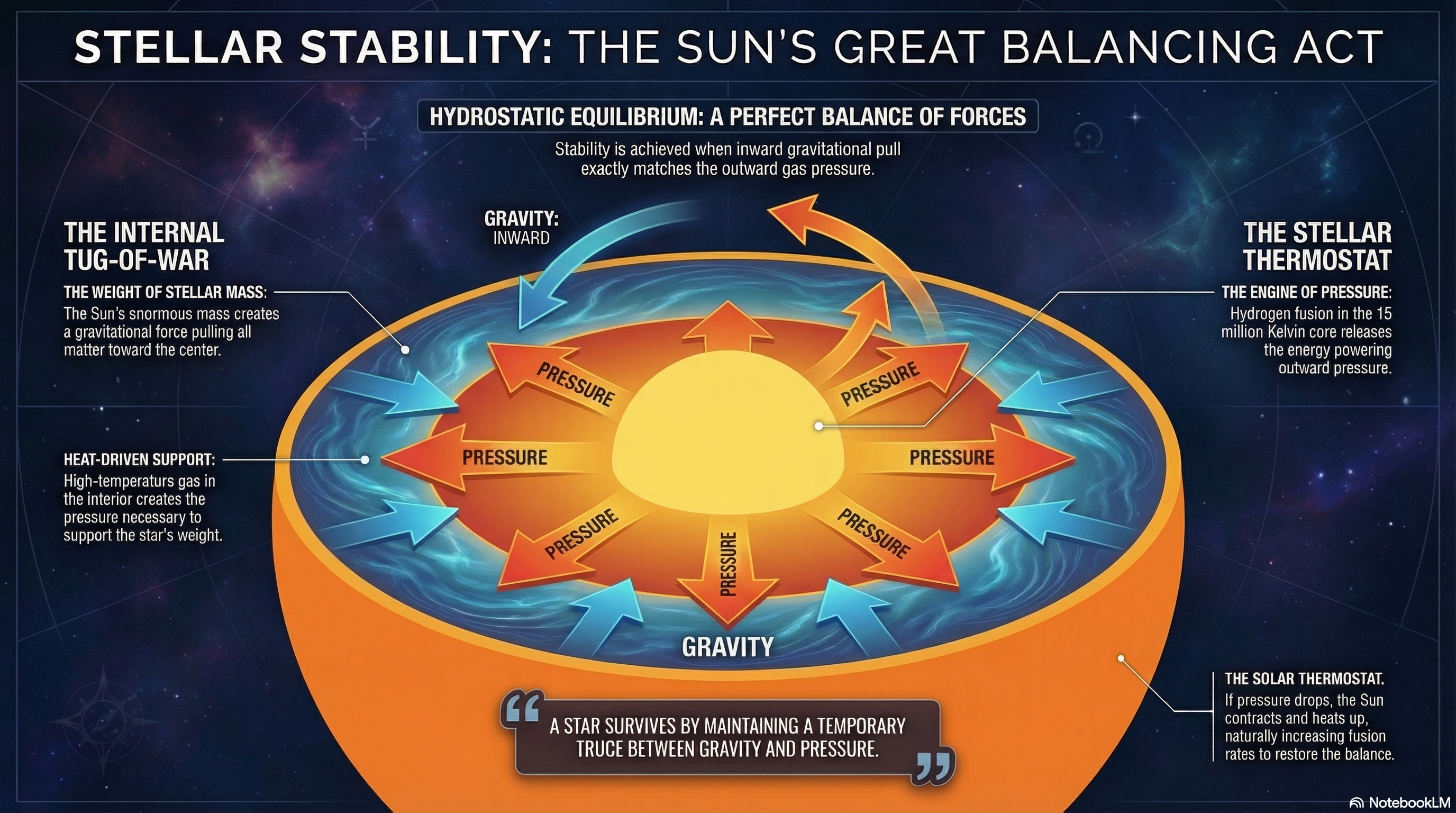
What to notice: the Sun remains stable only because inward gravity is balanced by outward pressure. Fusion keeps renewing that pressure, so the star behaves like a self-regulating thermostat rather than collapsing all at once.
The place where this balance is maintained most intensely is the core. The core occupies only the inner quarter of the Sun’s radius, yet it contains about half of the Sun’s mass. Temperatures reach about 15 million K, the density is enormous, and matter exists as plasma, a sea of electrons and nuclei rather than ordinary neutral atoms. The core is not just the hottest place in the Sun. It is the place where the Sun generates the energy that makes pressure support possible in the first place.
The Sun is a temporary truce between gravity and pressure. Gravity never stops pulling inward. Pressure never gets to relax. A star remains stable only as long as it can keep renewing the outward push.
If the pressure in the Sun’s core suddenly dropped, would the Sun expand, contract, or stay the same?
It would contract. With less outward pressure, gravity would win temporarily and squeeze the core inward. That contraction would heat the core, increasing the fusion rate and helping restore the balance. This is the stellar thermostat.
Because the core must support the star, it must stay hot.
What Powers the Pressure? Fusion in the Core
For centuries, the Sun’s energy source was a mystery. If the Sun were powered like an ordinary fire, it would have burned out long ago. If it were powered only by slow gravitational contraction, it could have stayed bright for only tens of millions of years, far shorter than Earth’s age. The real answer is deeper and stranger: the Sun shines because atomic nuclei can fuse.
From Hydrogen to Helium: The Proton-Proton Chain
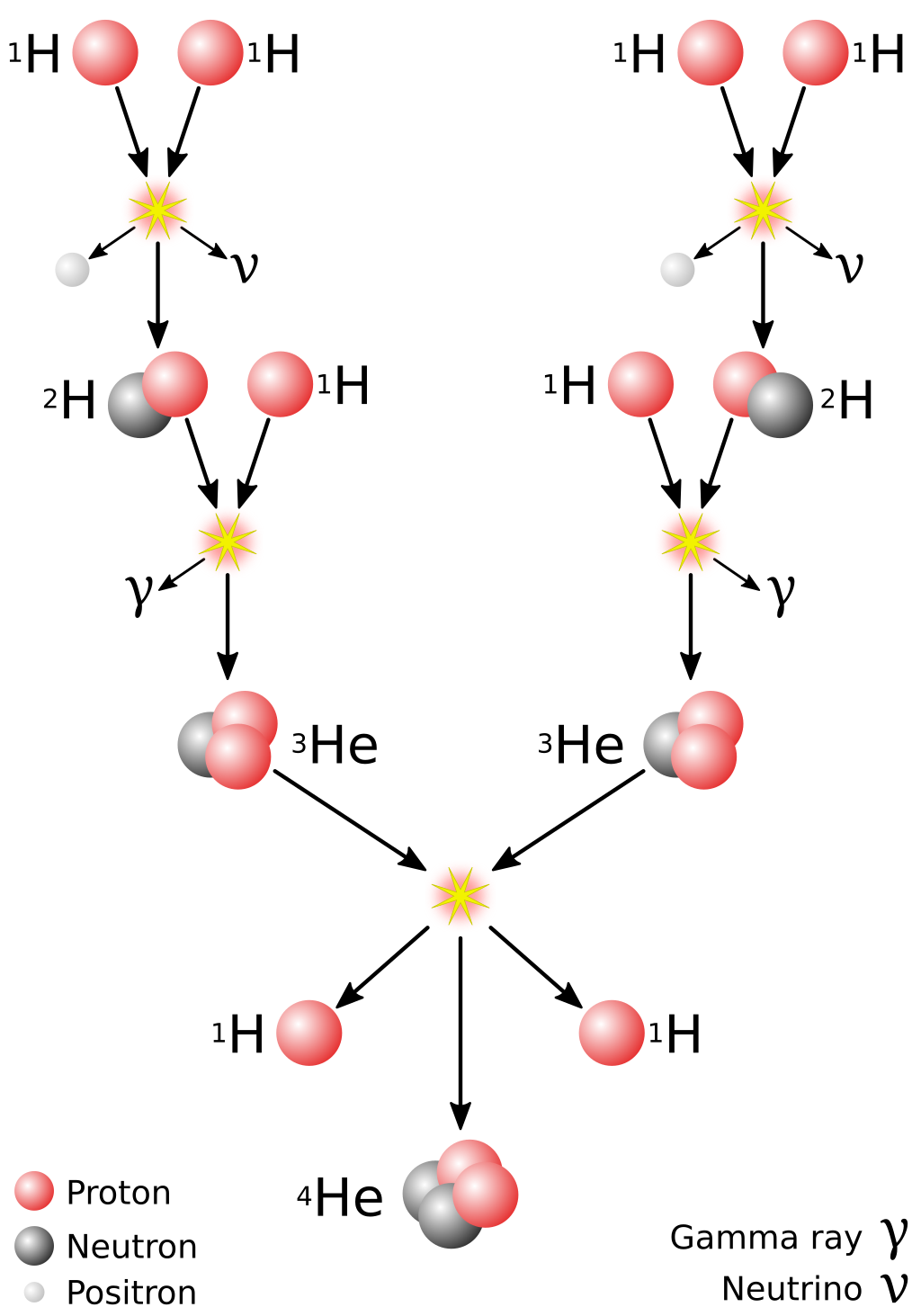
What to notice: the proton-proton chain gradually turns four protons into one helium nucleus, releasing photons, neutrinos, and energy that helps support the Sun against gravity.
In the Sun’s core, hydrogen nuclei fuse into helium through a sequence of reactions called the proton-proton chain. In words, the chain takes four protons and gradually turns them into one helium-4 nucleus, along with photons, neutrinos, and kinetic energy. A neutrino is an electrically neutral, extremely low-mass particle that interacts only very weakly with matter, which is why it can escape almost directly from the core.
Step 1: Two protons collide and form deuterium, releasing a positron and a neutrino:
\[ p + p \rightarrow d + e^+ + \nu \]
Step 2: The deuterium nucleus captures another proton and produces helium-3 plus a photon:
\[ d + p \rightarrow ^3\text{He} + \gamma \]
Step 3: Two helium-3 nuclei fuse to form helium-4 and return two protons:
\[ ^3\text{He} + ^3\text{He} \rightarrow ^4\text{He} + p + p \]
The net reaction is often summarized as:
\[ 4p \rightarrow ^4\text{He} + 2e^+ + 2\nu + \gamma \]
Proton-Proton Chain (PP Chain): The dominant fusion pathway in a Sun-like star, converting hydrogen into helium and releasing energy.
This is the Sun’s engine. The core does not support the Sun because it is merely hot. It supports the Sun because fusion continuously replenishes the pressure that gravity is trying to destroy.
Before doing any arithmetic, should a helium nucleus produced by fusion have more mass or less mass than the four original protons if the reaction releases energy?
It must have less mass. If the reaction releases energy, that energy has to come from somewhere. In fusion, a tiny amount of the initial mass is converted into energy, so the final helium nucleus has slightly less mass than the starting protons.
Mass Deficit and Energy Release
Fusion matters because the helium nucleus produced at the end has slightly less mass than the four original protons. That missing mass is not lost. It is converted into energy.
Four protons have a combined mass of about 4.0290 amu. A helium-4 nucleus has a mass of about 4.0026 amu. The difference is:
\[ \Delta m = 4.0290 - 4.0026 = 0.0264 \text{ amu} \]
Einstein’s relation tells us how to read that difference:
\[ E = \Delta m c^2 \]
What this equation is really saying is simple: if a reaction leaves behind less mass than it started with, the missing mass appears as energy. In the Sun, that energy emerges as:
- Kinetic energy of particles in the core
- Photons that will eventually work their way outward
- Neutrinos that escape almost immediately
Einstein’s famous equation is usually written as
\[ E = mc^2 \]
In full generality, this means that mass is a form of energy. More precisely, an object’s rest mass contributes to its total energy. The factor \(c^2\) is enormous because the speed of light is enormous, so even a tiny amount of mass corresponds to a very large amount of energy.
That is why fusion can power a star. The Sun is not “creating energy from nothing.” It is converting a small amount of rest mass into other forms of energy: particle motion, radiation, and neutrinos. This is one of the clearest everyday consequences of special relativity in astronomy. Without Einstein’s insight that mass and energy are interchangeable, we would not understand why stars can shine for billions of years.
This is also why fusion is so attractive to humans as an energy source. In principle, fusion promises:
- Enormous energy density: a small amount of fuel can release a tremendous amount of energy.
- Abundant fuel: hydrogen isotopes can be obtained from water or bred from lithium.
- No carbon dioxide from the reaction itself: fusion does not work by burning fossil fuel.
- Less long-lived radioactive waste than ordinary fission reactors: not zero engineering challenges, but a very different waste profile.
So why don’t we just build a miniature Sun on Earth? Because the Sun cheats in one very important way: it has gravity. The Sun’s huge mass crushes its core to immense pressure and keeps fusion going for billions of years. On Earth we do not have a star’s gravity, so we must try to compensate with other strategies:
- heat fuel to extreme temperatures so nuclei move fast enough to fuse,
- confine the plasma so it does not fly apart,
- and keep the system stable long enough that the fusion releases more energy than we had to put in.
That is why controlled fusion on Earth is so hard. A fusion reactor has to hold an ultra-hot plasma together without letting it touch the walls, all while dealing with instabilities, turbulence, and brutal engineering constraints.
You may hear the phrase cold fusion used as the dream version of this problem: fusion that would happen without the extreme temperatures and confinement of today’s reactor concepts. If that were possible in a reliable, reproducible way, it would be revolutionary. But that is exactly why physicists are cautious. Claims of room-temperature or “cold” fusion have not become accepted, reproducible mainstream physics. So the real holy grail is better stated this way: practical, controlled fusion that produces more usable energy than it consumes.
The Sun reminds us that fusion is real. The challenge for humans is not whether fusion works. The challenge is whether we can make it work under Earthly conditions, on demand, and safely enough to power civilization.
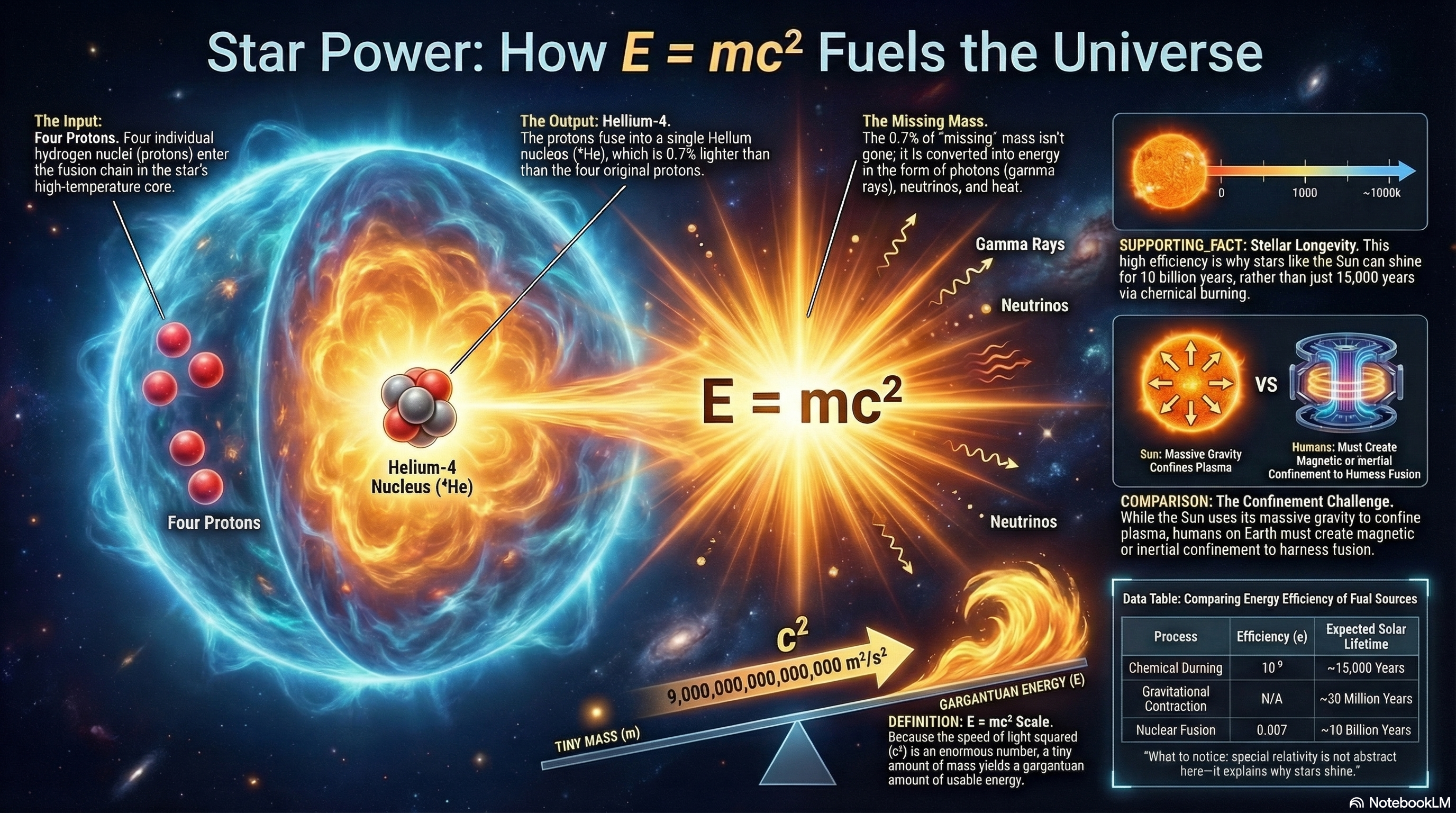
What to notice: when four protons become one helium nucleus, the tiny missing mass does not vanish. It becomes energy, which is why a star can shine for billions of years.
The energy released per completed PP chain is about 26.7 MeV. That is vastly larger than the energy released in an ordinary chemical reaction. The Sun converts about 600 million tons of hydrogen into helium every second, and about 4 million tons of mass per second become pure energy. That energy is what ultimately keeps the Sun from collapsing.
Why Fusion Needs Extreme Conditions
If fusion is so powerful, why does it not happen everywhere? The obstacle is the Coulomb barrier. Protons are positively charged, so they repel one another. To fuse, they must get close enough for the strong nuclear force to take over.
The core’s temperature of about 15 million K gives protons huge thermal energies by everyday standards, but not enough to make fusion easy in a classical sense. Two things rescue the Sun. First, not all particles have the same energy; a high-energy tail in the distribution means some collisions are especially violent. Second, quantum tunneling allows protons to penetrate the barrier even when they do not classically have enough energy to go over it.
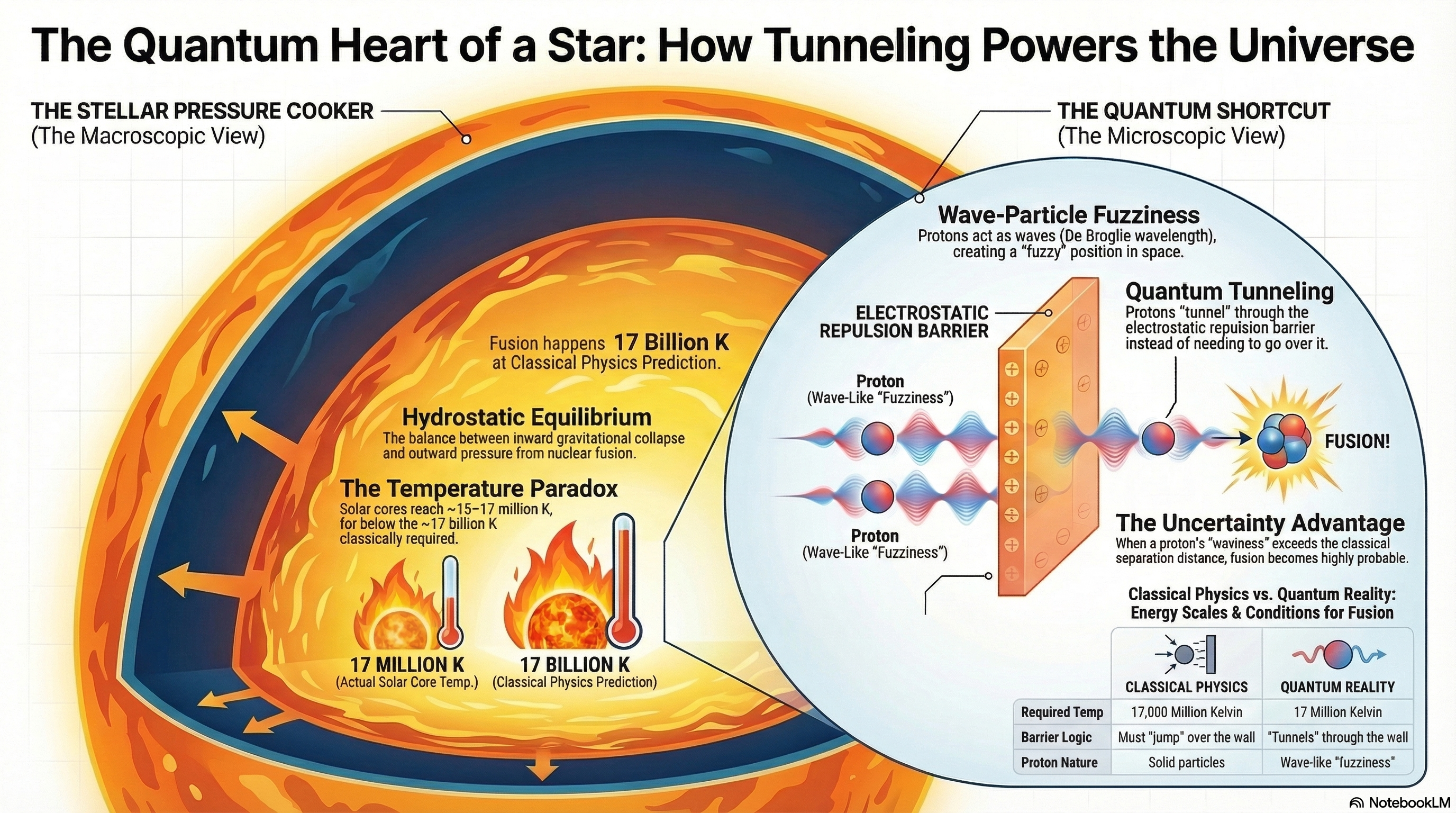
What to notice: classically, the Sun’s core is too cool for protons to fuse easily. Quantum tunneling lets some proton pairs penetrate the Coulomb barrier anyway, making stellar fusion possible.
This makes fusion extremely temperature-sensitive. If the core gets hotter, fusion speeds up and pressure increases. If the core cools, fusion slows and gravity squeezes the core until it heats again. That feedback is what makes the Sun a self-regulating star rather than an explosive one.
Fusion -> energy release -> pressure support -> temporary stability. That is the causal chain at the heart of the Sun.
The fusion rate depends on the reaction cross-section, which measures how likely a collision is to produce fusion. At solar core temperatures the cross-section is tiny, so any one proton pair is very unlikely to fuse. But the Sun contains such an enormous number of particles that even very rare events add up to a tremendous luminosity.
Quantum tunneling is essential here. Without it, the Sun would need a much hotter core to shine at all.
Why Doesn’t the Energy Escape Immediately?
Solving the first problem creates the second one. Once fusion releases energy in the core, that energy has to get out. It does not simply shoot to the surface. The Sun is far too dense for that.
Radiative Transport: The Photon’s Long Walk
In the inner Sun, energy moves outward mainly by radiative transport. A photon travels a short distance, gets absorbed, gets re-emitted in a new direction, and repeats the process again and again. The path is not a straight escape. It is a random walk.
Radiative Transport: Energy moves outward when photons are repeatedly absorbed and re-emitted, with no large-scale bulk motion of the gas.
The typical mean free path of a photon in the deep interior is only a few centimeters. That means a photon created in the core may take about 170,000 years to reach the surface. The sunlight hitting Earth today was generated in the core long before human civilization existed.
The key idea is not the exact number. It is the physical lesson: the Sun is not transparent to its own interior radiation. Because energy cannot leave quickly, transport structure matters.
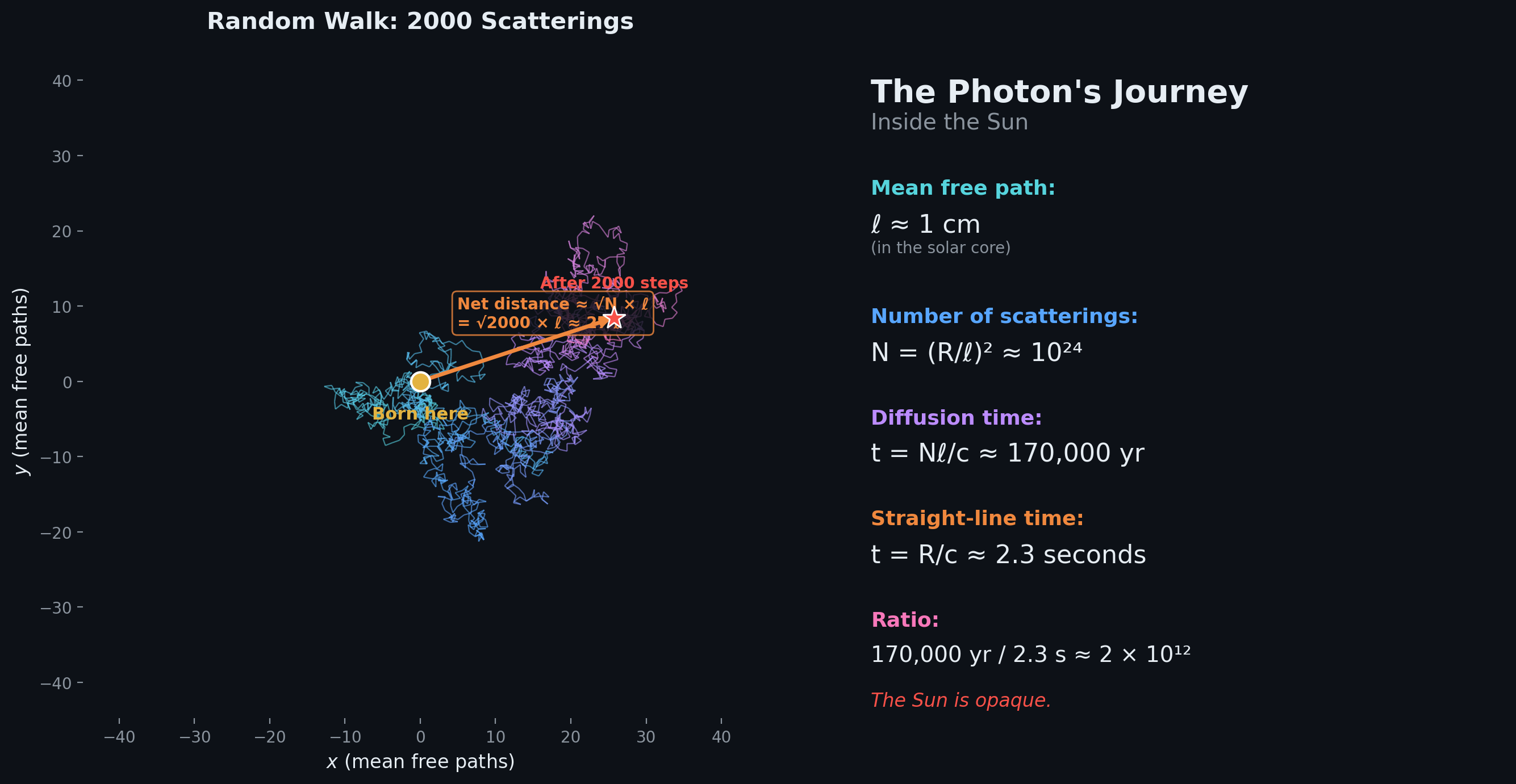
What to notice: a photon born in the solar core does not travel straight outward. Repeated absorption and re-emission turn escape into a random walk, so radiative transport is a diffusion problem, not a direct beam.
If photons stop carrying energy outward efficiently in the outer Sun, what else could the Sun do?
The Sun can switch to bulk motion of gas. Hot material can rise, cool material can sink, and the moving plasma can carry thermal energy outward. That is convection.
Convection: When the Gas Itself Has to Move
Farther out, the temperature drops enough that the opacity rises. Radiation becomes less effective at carrying the required energy flux. When that happens, hot gas rises and cool gas sinks. Energy is now transported by convection rather than by photons alone.
Convective Transport: Energy moves outward when hot gas rises and cool gas sinks, carrying heat through bulk motion.
At the visible surface we can actually see the tops of those convective cells as granulation. The bright centers are hotter upwellings; the darker boundaries are cooler sinking lanes. The pattern shifts on timescales of minutes, which gives us a direct observable signature of the otherwise invisible transport process below.
Granulation: The mottled photospheric pattern produced by the tops of convection cells in the Sun’s outer layers.
Observable: We see granulation on the photosphere, a bright-dark pattern that churns on timescales of minutes.
Model: Granulation is the surface expression of convection in the Sun’s outer layers.
Inference: From the size, contrast, and timescale of granulation, we infer that the outer Sun transports energy through bulk motion rather than radiation alone.
Because energy cannot leave quickly, the Sun must organize itself into transport zones.
Why Does the Sun Have Layers at All?
Now that we know the jobs a star must perform, we can read the Sun as a functional map rather than as a list of anatomical terms.
| Layer | Main job | What to notice |
|---|---|---|
| Core | Generate energy through fusion | The balance against gravity is renewed here |
| Radiative zone | Move energy outward slowly by photon diffusion | The Sun is opaque to its own interior light |
| Convective zone | Move energy outward by bulk motion | Convection also helps build magnetic activity |
| Photosphere | Let radiation escape to space | This is the visible surface we actually observe |
| Chromosphere + corona | Reveal magnetic heating and outflow | The outer atmosphere is dynamic, hot, and magnetically structured |
Photosphere: The visible surface of the Sun, where most of the sunlight we see escapes to space.
Chromosphere: A thin atmospheric layer above the photosphere, visible during eclipses as a reddish rim.
Corona: The Sun’s extended outer atmosphere, reaching temperatures of millions of kelvin and feeding the solar wind.
The Sun has layers because different physical conditions demand different solutions. The figure is useful now because you already know what each layer is trying to accomplish.
Why Is the Surface So Active? Magnetism, Sunspots, and Solar Storms
The outer Sun is not calm. It rotates, convects, twists magnetic fields, and occasionally erupts. Once we reach the convective envelope and photosphere, the Sun stops looking like a steady glowing ball and starts looking like a magnetized, moving fluid.
If magnetic fields suppress convection locally, should that region of the photosphere look brighter or darker?
The region should look darker. If less hot material reaches the surface, that patch cools relative to its surroundings and emits less visible light.
Sunspots: Magnetic Fields Made Visible
Sunspots are dark patches on the photosphere, typically 1,000 to 100,000 km across. They are cooler than the surrounding surface, about 3,700 K instead of about 5,800 K, because strong magnetic fields suppress convection there. Less hot gas reaches the surface, so the region cools and darkens.
Sunspot: A dark, magnetically intense region on the solar photosphere, cooler than the surrounding photosphere, produced by intense magnetic field opposing convection.
Sunspots are therefore not just blemishes. They are evidence that the outer Sun behaves like a rotating, conducting fluid with a dynamic magnetic field. Because the outer layers convect and rotate differentially, magnetic activity emerges.
The Solar Cycle: Magnetism on an 11-Year Rhythm
The number of sunspots rises and falls on a roughly 11-year cycle. At solar minimum, only a few sunspots may be present. At solar maximum, the Sun may be covered with many active regions. New sunspots appear first at higher latitudes and then gradually emerge closer to the equator as the cycle progresses.
During a solar cycle:
Rising phase (0–5.5 years): Sunspots appear first at high latitudes (about 30–40 degrees from the equator) and increase in number. The sunspot area grows.
Maximum (around year 5.5): The number of sunspots and total sunspot area peak.
Declining phase (5.5–11 years): Sunspots become less frequent. New sunspots appear at lower and lower latitudes, approaching the equator.
Minimum (around year 11): Sunspots nearly disappear. The cycle repeats.
This is called the Spörer butterfly diagram when plotted as sunspot latitude versus time — it looks like a butterfly’s wings spreading open during the rising phase, then closing during the declining phase.
The solar cycle is the visible signature of the solar dynamo. Convection stirs the plasma, differential rotation stretches magnetic field lines, and the magnetic field is repeatedly amplified, tangled, and reversed. The full magnetic polarity cycle is about 22 years, with the familiar sunspot cycle marking half of that pattern.
Solar Cycle: A roughly 11-year periodic variation in the number and intensity of sunspots and other solar activity features, reflecting the behavior of the Sun’s magnetic dynamo.
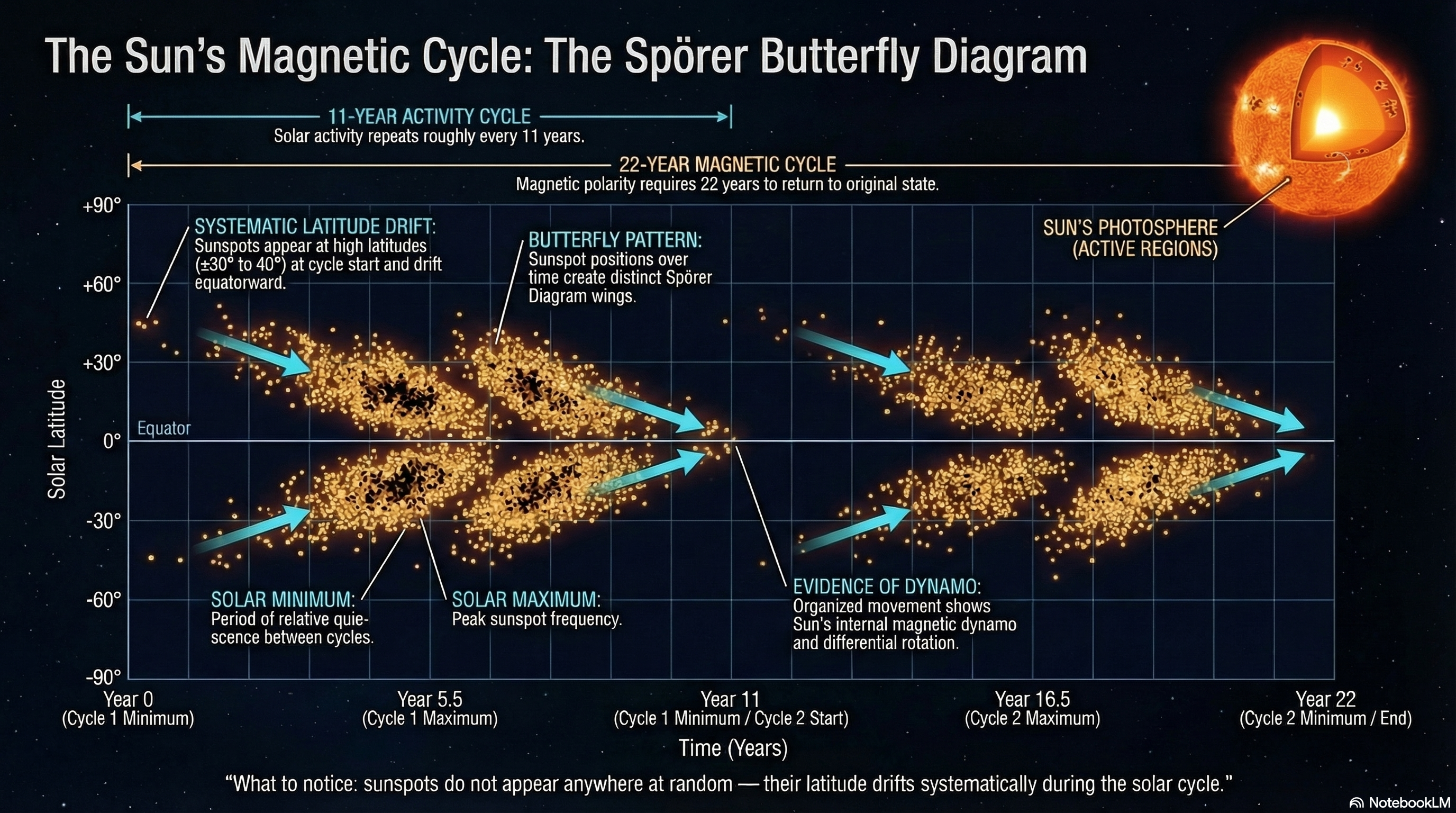
What to notice: sunspots do not appear at random. Early in each cycle they emerge at mid-latitudes, then drift toward the equator, revealing the organized rhythm of the Sun’s magnetic field.
Solar Flares and Coronal Mass Ejections
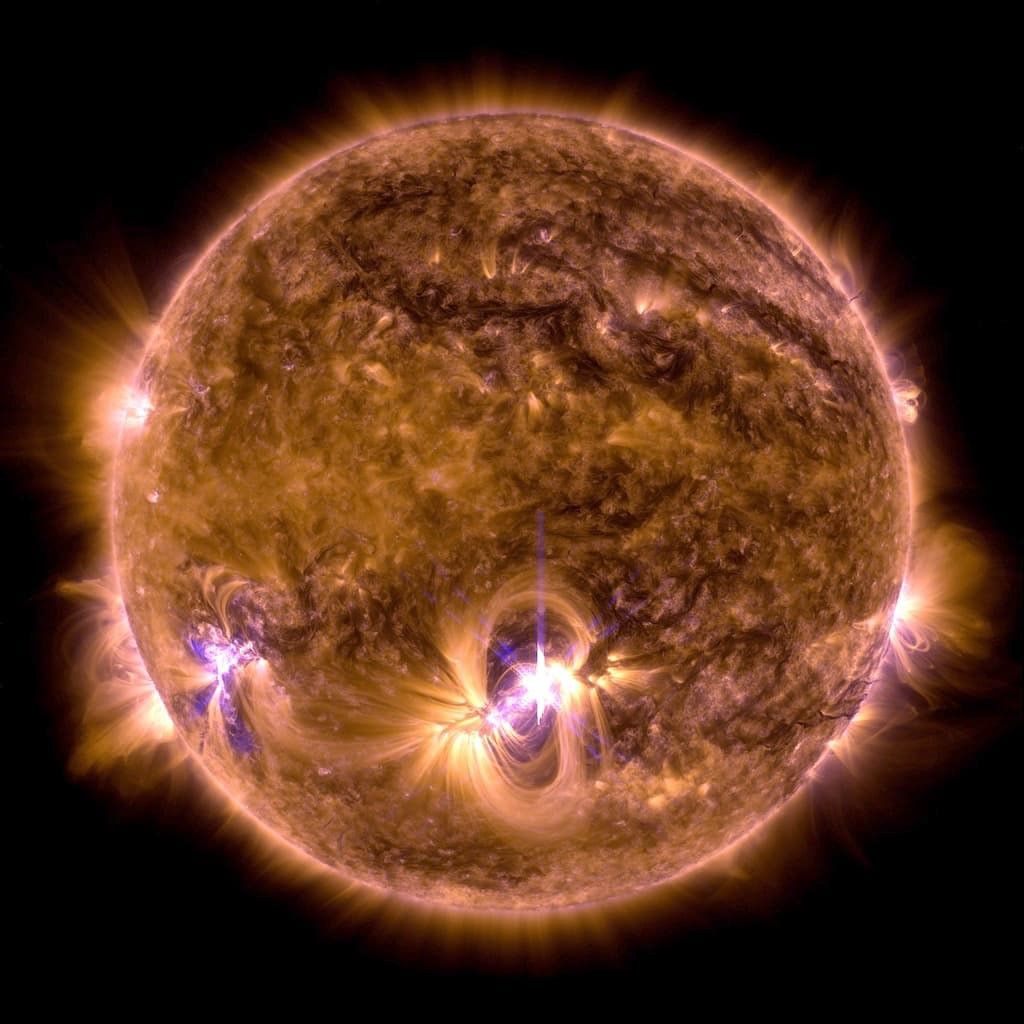
What to notice: the Sun’s surface (photosphere) glows because of its ~5800 K temperature — this is thermal radiation. The bright flares show localized regions of extreme heating, with magnetic loops visible at the limb. (Credit: NASA/SDO)
Sunspots are only the visible beginning. When magnetic field lines in the outer Sun become twisted and stressed, they can reconnect and release huge amounts of energy.
A solar flare is a sudden bright eruption that heats plasma to tens of millions of kelvin. A coronal mass ejection (CME) launches billions of tons of plasma into space at enormous speeds. These events are linked to magnetic energy stored in the outer Sun.
When a CME reaches Earth’s magnetosphere, it can:
- Disrupt radio and satellite communications
- Cause power grid blackouts
- Increase radiation doses for astronauts and airline crews
- Create brilliant auroras in the night sky
The most famous example is the Carrington Event of 1859, a massive solar storm that caused auroras visible near the equator and shut down telegraph systems worldwide. If such a storm hit today, it could cause trillions of dollars in economic damage. This is why space weather — the study of the Sun’s effects on Earth and near-Earth space — has become an urgent concern for modern society.
The solar wind carries the Sun’s magnetic field far into space, inflating a heliosphere that extends well beyond Pluto. Solar variability is therefore real and important for space weather. But the 11-year solar cycle changes Earth’s received energy by only about 0.1%, far too little to explain current global warming. That is a different climate problem with a different cause.
Why Is the Corona Hotter Than the Surface?
If you knew nothing about the corona and only knew that heat usually flows outward, would you expect gas higher above the photosphere to be cooler or hotter?
You would expect it to be cooler. That is exactly why the chromosphere and corona are so surprising. Their rising temperatures tell us that some extra heating process must be operating in the outer atmosphere.
The chromosphere and corona preserve one of the Sun’s strangest paradoxes. The visible surface is about 5,800 K, but the atmosphere above it gets hotter rather than cooler. The chromosphere rises to about 10,000 to 20,000 K, and the corona reaches about 1 to 3 million K.
This is not fully solved at the introductory level, and that matters pedagogically: students should see that good science includes active frontiers. The leading explanation is magnetic heating. As magnetic field lines twist, braid, and reconnect in the outer atmosphere, they release energy into the plasma. That energy appears to be what heats the corona and drives much of the outer Sun’s violent behavior.
The key takeaway is not that every detail is settled. It is that the Sun’s outer atmosphere is heated by magnetic processes, not by simple outward cooling from the surface.
How Do We Know the Core Model Is Right?
The interior of the Sun is hidden. We cannot lower a thermometer into the core. So why should we trust the story we have just told? Because the Sun gives us ways to test the model.
The Solar Neutrino Problem: A Crisis That Revealed Truth
In the 1960s, something strange happened in solar physics. Theory predicted how many neutrinos the Sun should produce through the proton-proton chain. Experiment measured how many neutrinos actually arrive at Earth. The numbers didn’t match. Theory predicted about three times as many neutrinos as experiment detected.
This was the solar neutrino problem, and it created a crisis. Either the theory of solar fusion was wrong — which seemed unthinkable given how well everything else in the solar model fit the data — or there was something strange about neutrinos that nobody understood.
Why Neutrinos Matter
Neutrinos are ghostly particles produced in the proton-proton chain. They have no electric charge, extremely tiny mass, and they interact with matter only through the weak nuclear force. That means most neutrinos simply pass through ordinary matter almost unaffected. A neutrino can pass through a billion kilometers of lead without hitting a single atom. This makes them extremely difficult to detect, but also extremely valuable: they carry direct information from the Sun’s core, undisturbed by any of the intervening layers. While photons from the core take 170,000 years to reach us, neutrinos produced in the core arrive at Earth after only about 8 minutes. In some sense, neutrinos let us see the Sun’s present state, while photons show us its ancient past.
Detecting solar neutrinos requires enormous, sensitive detectors buried deep underground (to shield from cosmic rays) and filled with specially prepared material that occasionally produces a detectable signal when a solar neutrino interacts with it.
The Resolution: Neutrino Oscillations
The resolution of the solar neutrino problem came in the early 2000s, when experiments definitively detected that neutrinos change flavor as they travel from the Sun to Earth. Specifically, electron neutrinos (produced in the proton-proton chain) are converted into muon and tau neutrinos on their way here.
The original detectors were sensitive only to electron neutrinos, so they missed the muon and tau neutrinos. When the total rate of all neutrino flavors was measured, it matched the theoretical prediction perfectly.
This discovery was profound in two ways:
It confirmed that the solar model — our understanding of how the Sun works — is correct. The Sun really does shine by fusing hydrogen into helium in its core.
It revealed a fundamental property of neutrinos themselves: they have mass (even if very small) and can oscillate between different flavors. This was a major discovery in particle physics and contributed to the 2015 Nobel Prize in Physics.
The resolution of the solar neutrino problem is a beautiful example of how a mismatch between theory and observation can strengthen a model rather than destroy it. The Sun’s fusion model survived the test.
The solar neutrino problem seemed like a crisis but turned out to be a blessing. It led to experimental techniques sensitive enough to detect neutrinos at all, which revealed a fundamental property of the universe: neutrino oscillations. Sometimes the most important discoveries come from resolving apparent contradictions.
Helioseismology: A Seismic Map of the Sun
Neutrinos are not our only test. The solar photosphere vibrates with millions of oscillation modes. These waves behave like sound waves trapped inside the Sun. By measuring their frequencies, astronomers infer how temperature, density, and sound speed vary with depth. Helioseismology is essentially a CAT scan of the Sun.
So the hidden Sun is still testable. We cannot see the core directly, but we can check whether the observed vibrations and neutrino flux match the model of a fusion-powered, pressure-supported star.
Observables:
- Solar spectrum (photosphere temperature, composition)
- Sunspot count and latitude (solar cycle)
- Solar luminosity (total power output)
- Solar wind properties (velocity, density, temperature)
- Solar neutrino flux (rate of neutrinos arriving at Earth)
- Helioseismology (vibrations in the solar photosphere, revealing interior sound waves)
Model:
- Hydrostatic equilibrium (gravity balanced by pressure)
- Nuclear fusion (proton-proton chain in the core)
- Radiative and convective energy transport
- Magnetic dynamo (explaining the solar cycle)
Inferences:
- Core temperature and density (to support observed fusion rate)
- Interior structure (core, radiative zone, convective zone, photosphere, chromosphere, corona)
- Age of the Sun (by matching models to observed properties)
- Future evolution (the Sun will eventually exhaust its hydrogen and become a red giant)
This is the payoff of the whole reading: the Sun’s core is hidden, but it is not beyond evidence.
Common Misconceptions and Clarifications
Misconception 1: “The Sun Burns Like a Fire”
Reality: The Sun doesn’t burn through chemical combustion. It shines through nuclear fusion. A wood fire converts chemical potential energy into heat and light. It’s a surface phenomenon and produces ash. The Sun converts mass directly into energy through nuclear fusion deep in its core. It is vastly more powerful and operates on an incomprehensibly longer timescale.
Misconception 2: “The Sun is a Ball of Gas”
Reality: The Sun’s interior is plasma — a state of matter where atoms are ionized (electrons stripped away). The core and radiative zone are so hot and dense that the material behaves more like a fluid of electrons and nuclei than like an ordinary gas. The photosphere, which we see, is indeed mostly atomic hydrogen gas, but it’s still too hot to be completely unionized.
Misconception 3: “Sunspots Are Cooler Because They Radiate More Energy”
Reality: Sunspots are cooler despite being regions of intense magnetic activity. The magnetic field suppresses convection, blocking the upward transport of heat from below. Sunspots radiate less energy, not more, because they are cooler.
Misconception 4: “The Sun Will Soon Explode as a Supernova”
Reality: The Sun is far too low in mass to ever explode as a supernova. In about 5 billion years, it will exhaust the hydrogen in its core and begin fusing hydrogen in a shell around an inert helium core. It will expand to become a red giant, engulfing Mercury and Venus. Eventually, it will shed its outer layers, forming a planetary nebula, and leave behind a white dwarf — a dense stellar corpse about the size of Earth.
Summary: A Stable Star Is a Temporary Truce
We can now read the Sun as a system held together by a temporary truce between gravity and pressure, and the remarkable thing is that this hidden balance is testable. That truce is not static. It has to be renewed constantly.
Gravity is always trying to compress the Sun. A stable star exists only because outward pressure balances that inward pull.
Fusion keeps renewing the pressure support. The proton-proton chain converts hydrogen into helium, and the mass difference appears as energy.
Energy transport shapes the Sun’s interior. Radiation dominates in the inner Sun, while convection takes over in the outer layers and reveals itself through granulation.
Magnetic activity makes the outer Sun dynamic. Sunspots, flares, CMEs, and coronal heating all emerge from a convecting, magnetized plasma.
The model is testable. Neutrinos and helioseismology let us test the hidden balance directly, so the Sun is not just a story about stellar structure. It is evidence.
For the Sun, we can inspect the lab. For other stars, we usually get only light. Next lecture we learn how brightness and distance let us recover stellar properties from a point source, so the methods we test on the Sun can be extended across the galaxy.
Solutions are available in the Lecture 14 Solutions.
Practice Problems
Core Concepts (Solve At Least 3)
1. Solar Neutrino Travel Time
The proton-proton chain in the Sun’s core produces electron neutrinos. A photon produced in the core takes about 170,000 years to reach Earth’s surface, but a neutrino escapes in about 8 minutes. Explain why the time difference is so enormous, even though both particles travel at (or very close to) the speed of light.
2. Mass-Energy Conversion in the PP Chain
The proton-proton chain converts four hydrogen nuclei (mass 1.0073 amu each) into one helium-4 nucleus (mass 4.0026 amu). Calculate the mass defect (in amu) and the energy released (in MeV). Use the conversion factor: 1 amu = 931.5 \(MeV/c^{2}.\)
3. The Coulomb Barrier
Two protons repel each other with electrostatic force. Explain why protons in the Sun’s core can fuse despite having average kinetic energies below the Coulomb barrier height. What quantum mechanical process allows fusion to occur?
4. Radiative vs. Convective Energy Transport
Why does the Sun switch from radiative transport (in the core and radiative zone) to convective transport (in the convective zone)? What property of the gas changes to make this transition?
5. The Solar Cycle and Sunspots
Solar flares and coronal mass ejections are often associated with active regions on the Sun containing many sunspots. Explain the relationship between sunspots and magnetic field strength, and why sunspots appear darker than the surrounding photosphere.
Challenge Problems (Optional)
C1. Hydrostatic Equilibrium
Consider a thin shell at the Sun’s core-radiative zone boundary. The outward pressure force must equal the inward gravitational force for the Sun to be in hydrostatic equilibrium. If the Sun’s core temperature were 10 million Kelvin instead of 15 million, explain qualitatively how the pressure balance would shift, and what would happen to the Sun as a result.
C2. Helioseismology and the Interior
Solar oscillations at the photosphere have different frequencies depending on the wavelength and the sound speed of the material through which they propagate. In the Sun’s core, the sound speed is much higher than in the convective zone. How would you expect the frequencies of p-modes (pressure oscillations) that penetrate deep into the core to compare with those that remain in the outer layers?
C3. Solar Wind and Earth’s Magnetosphere
The solar wind has a density of about 5 \(particles/cm^{3}\) and a velocity of about 400 km/s. Calculate the dynamic pressure (ram pressure) of the solar wind at Earth’s orbit: \(P = \frac{1}{2} \rho v^2\), where \(\rho\) is the mass density and \(v\) is the velocity. Compare this to Earth’s magnetic pressure (about 7 nPa) and discuss why the magnetosphere has a definite boundary.
C4. The Sun’s Lifetime
The Sun converts about 600 million metric tons of hydrogen into helium per second. The Sun’s total mass is about \(2 \times 10^{30}\) kg, but only a fraction of that mass is available for long-term core hydrogen fusion. Use this information to estimate why the Sun’s main-sequence lifetime is of order billions of years rather than millions or trillions. (Hint: compare the consumption rate to an available fusion mass of order 10% of the Sun’s total mass.)
Glossary
- ★ Alpha particle
- A helium-4 nucleus; consists of two protons and two neutrons bound together. The final product of the proton-proton chain.
- ★ Chromosphere
- The thin layer of the Sun's atmosphere above the photosphere, with a temperature of about 10,000 Kelvin. Visible as a red rim during total solar eclipses.
- ★ Convection
- The transport of energy through the bulk motion of gas or liquid. Hot material rises; cool material sinks. Dominates energy transport in the Sun's outer layers.
- ★ Corona
- The Sun's outer atmosphere, extending millions of kilometers into space. Temperature is 1–3 million Kelvin, much hotter than the photosphere.
- ★ Coronal Mass Ejection (CME)
- A sudden eruption of plasma from the Sun's corona into interplanetary space, often associated with solar flares. Can reach speeds exceeding 1,000 km/s.
- ★ Coulomb barrier
- The electrostatic repulsion between two positively charged nuclei. Must be overcome (through heat, pressure, or quantum tunneling) for nuclear fusion to occur.
- ★ Dynamo
- A mechanism by which moving conductive fluid (plasma) generates a magnetic field. The solar dynamo in the convective zone generates the Sun's magnetic field.
- ★ Fusion
- A nuclear reaction in which two light nuclei combine to form a heavier nucleus, releasing energy. Occurs in the Sun's core via the proton-proton chain.
- ★ Granulation
- The patchwork of bright and dark features visible on the solar photosphere, representing the tops of convection cells in the convective zone.
- ★ Helioseismology
- The study of vibrations and sound waves in the Sun, used to probe the Sun's interior structure and properties.
- ★ Hydrostatic equilibrium
- A balance between outward pressure and inward gravitational force, maintaining a stable structure. The Sun is in hydrostatic equilibrium.
- ★ Neutrino
- An electrically neutral particle with extremely small mass, produced in nuclear reactions such as fusion in the Sun's core. Because it interacts only through the weak nuclear force, it can pass through matter almost unhindered and escape directly from the Sun.
- ★ Photosphere
- The visible surface of the Sun, about 500 km thick, where photons escape and reach Earth. Temperature about 5,800 Kelvin.
- ★ Plasma
- A state of matter consisting of ionized gas — electrons and nuclei separated and moving freely. Most of the Sun's interior is plasma.
- ★ Proton-proton chain (PP chain)
- A sequence of nuclear fusion reactions that converts four hydrogen nuclei (protons) into one helium-4 nucleus, releasing energy and neutrinos. The dominant fusion process in the Sun.
- ★ Radiative transport
- Energy transport via the absorption and re-emission of photons. Dominates the Sun's core and radiative zone.
- ★ Solar cycle
- A roughly 11-year periodic variation in the number and intensity of sunspots and other solar magnetic activity.
- ★ Solar flare
- A sudden, bright eruption on the solar surface, releasing as much energy as a million nuclear bombs. Powered by magnetic reconnection.
- ★ Solar neutrino problem
- The discrepancy between the predicted and observed rates of solar neutrinos arriving at Earth, resolved by the discovery of neutrino oscillations.
- ★ Solar wind
- A continuous stream of charged particles flowing from the Sun's corona at about 400 km/s, carrying the Sun's magnetic field.
- ★ Sunspot
- A dark, magnetically intense region on the solar photosphere, typically 1,000–100,000 km across, cooler than surrounding areas.