Lecture 21: Neutron Stars and Black Holes
When Gravity Wins: The Universe’s Most Extreme Objects
The Big Idea
Neutron stars and black holes matter because they force astronomers to do what astronomy always does best: reason from evidence. We detect pulses of radio waves, X-rays from hot accretion disks, the motion of stars, and ripples in spacetime. From those observables, we infer the existence of some of the most extreme objects in the universe.
This reading is the capstone for Module 2: the compact remnants left behind when stellar evolution reaches its limit.
Default expectation (best): Read the whole page before lecture and stop at each Check Yourself prompt.
If you’re short on time (~20 min):
- Focus on neutron stars and pulsars, the Schwarzschild-radius section, and the evidence for black holes.
- Return to gravitational waves and the practice problems after class.
Reference mode: Use this page later when Module 3 revisits supermassive black holes in galaxies.
Learning Outcomes
By the end of this reading, you should be able to say:
What Happens When Stars Run Out of Tricks?
In Lecture 20, we saw that once nuclear fusion can no longer provide enough pressure, gravity takes over and the core collapses. For lower-mass stars, that collapse stops at a white dwarf, supported by electron degeneracy pressure. For more massive stellar cores, the compression goes further.
This lecture asks the next question:
When gravity keeps winning, what kinds of objects does nature produce, and how do we know they are really there?
That question matters because neutron stars and black holes are not just strange leftovers. They are places where matter reaches extraordinary density, gravity becomes extremely strong, and new kinds of evidence become available, including gravitational waves.
Keep asking the same three questions:
- What do astronomers actually observe?
- What physical model explains that observation?
- What can we infer from that model?
Neutron Stars: Matter Pushed to the Limit
When Degeneracy Meets Its Match
A white dwarf is supported by electron degeneracy pressure, the quantum-mechanical resistance of electrons to being squeezed into the same state. But that support has a limit. Subrahmanyan Chandrasekhar showed that a white dwarf cannot remain stable above about \(1.4\,M_\odot\).
If a collapsing core is more massive than this, electron degeneracy pressure is no longer enough. Compression continues, electrons are forced into protons, matter becomes neutron-rich, and the remnant is no longer supported as a white dwarf.
Now a different support mechanism matters: neutron degeneracy pressure. Neutrons, like electrons, obey the Pauli exclusion principle, so they also resist being squeezed into the same quantum state.
The Neutron Star: A City Compressed to Nuclear Density
A typical neutron star has a radius of about \(10\) to \(12\) km and a mass of roughly \(1.4\) to about \(2\,M_\odot\) in most observed systems. That means an object only about \(20\) to \(25\) km across can contain more mass than the Sun.
Its average density is comparable to the density inside an atomic nucleus. That is why neutron stars are not just “small stars.” They are stellar cores compressed so much that ordinary atomic structure no longer survives.
If a neutron star and a white dwarf can have somewhat similar mass, what must be different if the neutron star is so much smaller?
What to notice: compact remnants differ most dramatically in radius, not just in mass. Earth and a white dwarf are similar in size, while neutron stars and stellar-mass black holes are hundreds of times smaller. The right-hand pair is magnified so you can actually see them, and the black-hole marker shows the event horizon radius rather than a solid surface. (Credit: Illustration: A. Rosen (SVG))
The main difference among white dwarfs, neutron stars, and black holes is not simply mass. The key difference is how much mass is compressed into how little space.
A neutron star is not just a smaller star. It is a stellar core compressed into nuclear-density matter, where the support mechanism and the structure of matter have both changed.
If a neutron star and a white dwarf can have somewhat similar masses, why is the neutron star so much smaller?
Compare the support mechanisms. Ask which one allows matter to be compressed more tightly.
Because the support mechanism is different. A neutron star is held up by neutron degeneracy pressure, which allows matter to be packed much more tightly than in a white dwarf, where electron degeneracy pressure sets the structure.
Pulsars: Timing as Evidence
In 1967, Jocelyn Bell Burnell discovered a source of radio emission that produced pulses at extremely regular intervals. At first, the signal was so regular that it seemed almost artificial. It was not an alien beacon. It was the first clear observational evidence of a neutron star.
If a source produces extremely regular pulses, what kinds of physical explanations become plausible, and what kinds become less plausible?
A pulsar is a rapidly rotating neutron star whose magnetic axis is tilted relative to its rotation axis. Radiation is emitted in beams near the magnetic poles. As the star rotates, those beams sweep through space like lighthouse beams. If one beam crosses Earth, we detect a pulse.
This ScienceClic video works best here as a conceptual bridge. Watch for the same ideas we care about in this section: extreme compression, rapid rotation, magnetic fields, and how regular pulses become evidence for a rotating neutron star rather than for a source that simply turns on and off.
Caption: Use this as a visual model, not as something to memorize scene by scene. The point is to connect rotation, beams, and pulse timing into one physical story.
That kind of clock-like regularity rules out many ordinary stellar explanations and makes a rotating compact object a much better model.
Observable: regular pulses of radio emission
Model: a rotating neutron star with a tilted magnetic field and beamed emission
Inference: the source is a compact, rapidly rotating stellar remnant with a strong magnetic field
The logic matters here. We do not see a neutron star “blinking” on and off. We infer rotation from the pulse timing and the lighthouse geometry.
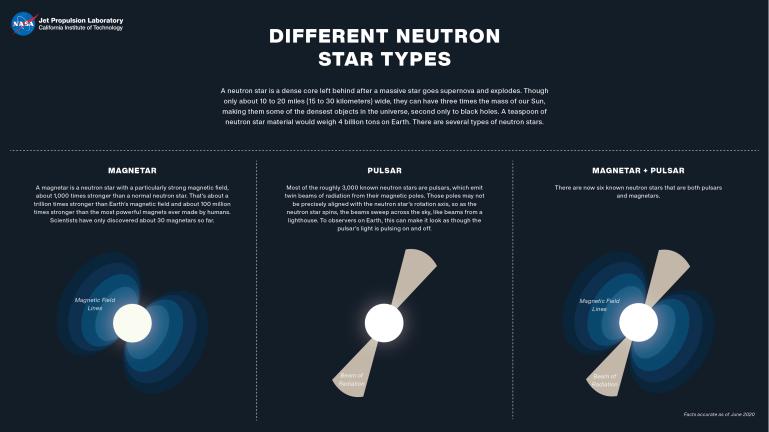
What to notice: ‘neutron star’ is a family name, not a single appearance. The same compact remnant can show up as a pulsar, a magnetar, or both, depending on its magnetic field, rotation, and how its beams are oriented relative to Earth. (Credit: NASA/JPL-Caltech)
“Neutron star” names the physical object. “Pulsar” and “magnetar” describe how some neutron stars behave observationally.
A pulsar is not a star that turns on and off. The pulse happens because a rotating beam sweeps across our line of sight.
If a pulsar has a period of \(0.5\) seconds, how many times per second does it rotate?
The rotation frequency is the inverse of the period: \(f = 1/P\).
The period is the time for one rotation, so the rotation frequency is
\[ f = \frac{1}{P} = \frac{1}{0.5\ \mathrm{s}} = 2\ \text{rotations per second}. \]
So the neutron star rotates \(2\) times each second.
Pulsars are valuable because their timing is extraordinarily regular. Astronomers use that regularity to test gravity, measure binary orbits, detect companion objects, and probe the gas between stars through pulse dispersion.
Pulsars matter because timing can reveal the properties of an object we cannot directly touch or resolve.
Young pulsars gradually slow down as they lose rotational energy, but the slowdown is very gradual. Older neutron stars in binary systems can be spun up again if they accrete matter from a companion. These are called recycled pulsars.
Recycled Pulsars and Binary Companions
This matters because neutron stars are not only isolated remnants. Binary interaction changes what we observe, and accretion can explain both strong X-rays and rapid spin.
Some neutron stars live in binary systems with ordinary stars. If gas from the companion flows toward the neutron star, it usually forms an accretion disk. As the gas spirals inward, gravitational energy is converted into heat, and the system often becomes a strong source of X-rays. A system like this is called an X-ray binary.
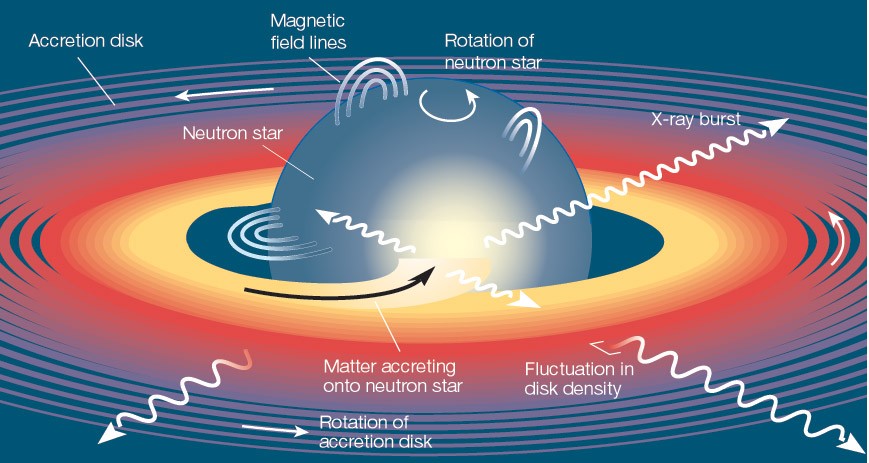
What to notice: the accretion disk is not just glowing scenery. Infalling gas releases X-rays and delivers angular momentum, which can spin an old neutron star back up into a recycled pulsar.
This infalling gas does two important things at once. It releases energy, making the system bright in X-rays, and it brings angular momentum, which can spin the neutron star up. That is why some old neutron stars rotate hundreds of times per second: they were gradually recycled by accretion from a companion star.
Why does accretion both heat the gas and change the neutron star’s spin?
Ask what the gas carries inward: energy and angular momentum.
As gas falls inward, it loses gravitational potential energy, which is converted into heat. Because the gas is orbiting, it also carries angular momentum; when that material lands on or interacts with the neutron star, it can transfer angular momentum and spin the star up.
The Tolman–Oppenheimer–Volkoff Limit
A neutron star also has a maximum possible mass. This is the neutron-star analog of the Chandrasekhar limit: just as electron degeneracy pressure cannot support an arbitrarily massive white dwarf, neutron degeneracy pressure cannot support an arbitrarily massive neutron star.
The maximum stable neutron-star mass is called the Tolman–Oppenheimer–Volkoff limit, or TOV limit. Its exact value depends on the physics of ultra-dense matter, but for ASTR 101 the key idea is the logic:
- below the white-dwarf limit, a collapsed core can become a white dwarf
- above that, a more massive collapsed core may become a neutron star
- if even neutron pressure cannot hold the core up, collapse continues to a black hole
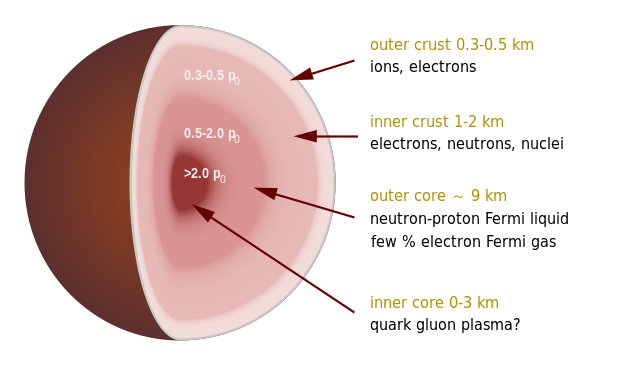
What to notice: even a neutron star is layered. The crust, outer core, and possible exotic inner core remind us that neutron stars are laboratories for matter under conditions we cannot reproduce on Earth.
Even neutron stars are not simple solid balls. Their interiors are layered, and the deepest regions probe matter under conditions we still do not fully understand.
At the greatest depths, matter may enter forms we still do not fully understand, which is one reason neutron stars are important laboratories for modern physics.
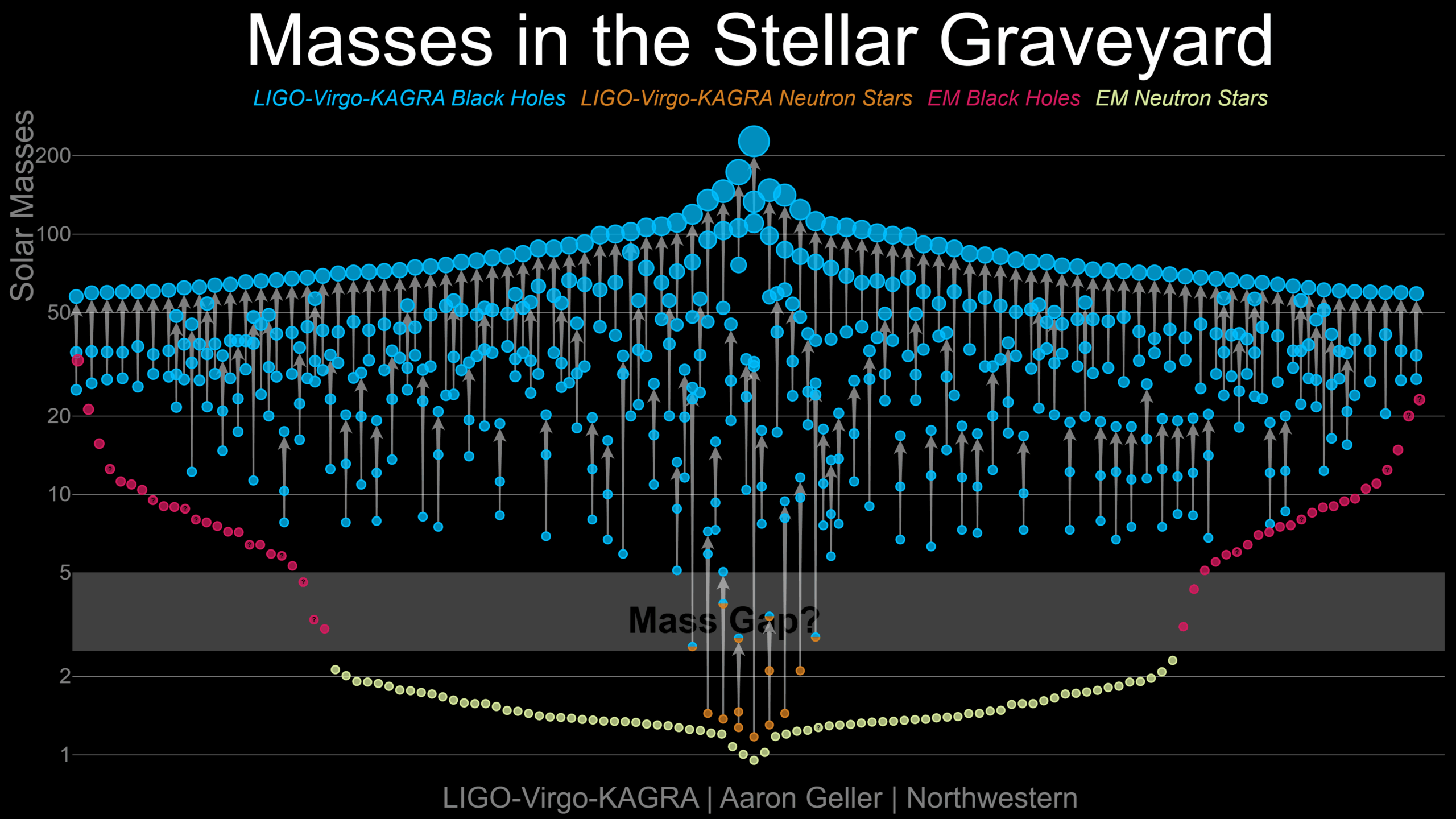
What to notice: stellar remnants do not all land at one mass. White dwarfs, neutron stars, and stellar-mass black holes occupy different parts of the compact-object graveyard, and the transitions between them are tied to which pressure support fails.
This graveyard view is useful here because it turns the endpoint story into an observational map. White dwarfs, neutron stars, and black holes do not occupy the same mass range, and the boundaries between them reflect where one form of pressure support fails and another takes over — or fails completely.
Black Holes: When Gravity Wins Completely
If collapse goes so far that no known pressure can stop it, the remnant becomes a black hole. In general relativity, the key idea is not a hard surface but a region of spacetime bounded by the event horizon, the boundary beyond which signals cannot reach distant observers.
This ScienceClic video works well here because it gives a visual bridge from stellar collapse to general relativity. Watch for the big ideas we need in this section: how collapse can continue past the neutron-star stage, what an event horizon means, and why black holes are about spacetime geometry, not just about “very strong gravity.”
Caption: Use this as a conceptual preview, not as something to memorize frame-by-frame. The goal is to build intuition for how continued collapse leads from a massive stellar remnant to an event horizon, and why black holes are best understood through general relativity rather than through ordinary Newtonian pictures alone.
The Schwarzschild Radius and the Event Horizon
What would it mean physically if even light could not escape from an object?
If black holes are defined by a boundary, we need a way to estimate where that boundary lies.
For a non-rotating black hole, the size of the event horizon is described by the Schwarzschild radius:
\[ R_s = \frac{2GM}{c^2} \]
Here \(R_s\) is the Schwarzschild radius, \(G\) is the gravitational constant, \(M\) is the mass of the object, and \(c\) is the speed of light. For ASTR 101, the equation gives a size scale for the event horizon.
The event horizon is not a solid surface or a glowing shell. It is a boundary in spacetime, and the black hole is inferred from what happens to light and matter outside that boundary.
For a \(10\,M_\odot\) black hole, the Schwarzschild radius is about \(30\) km. So a stellar-mass black hole can contain several Suns’ worth of mass inside a region only a few tens of kilometers across.
Calculate the Schwarzschild radius for the Sun if it were somehow compressed into a black hole. Use \(M_{\odot} = 2 \times 10^{30}\,\mathrm{kg}\).
Use
\[ R_s = \frac{2GM}{c^2} \]
with \(G = 6.67 \times 10^{-11}\,\mathrm{N\,m^2/kg^2}\) and \(c = 3.0 \times 10^8\,\mathrm{m/s}\).
\[ R_s = \frac{2 \times (6.67 \times 10^{-11}) \times (2 \times 10^{30})}{(3 \times 10^8)^2} \approx 3\ \mathrm{km} \]
So the Sun, if it could become a black hole, would have an event-horizon radius of only about \(3\) km. That is smaller than a typical neutron-star radius. Of course, the real Sun does not have enough mass to collapse into a black hole.
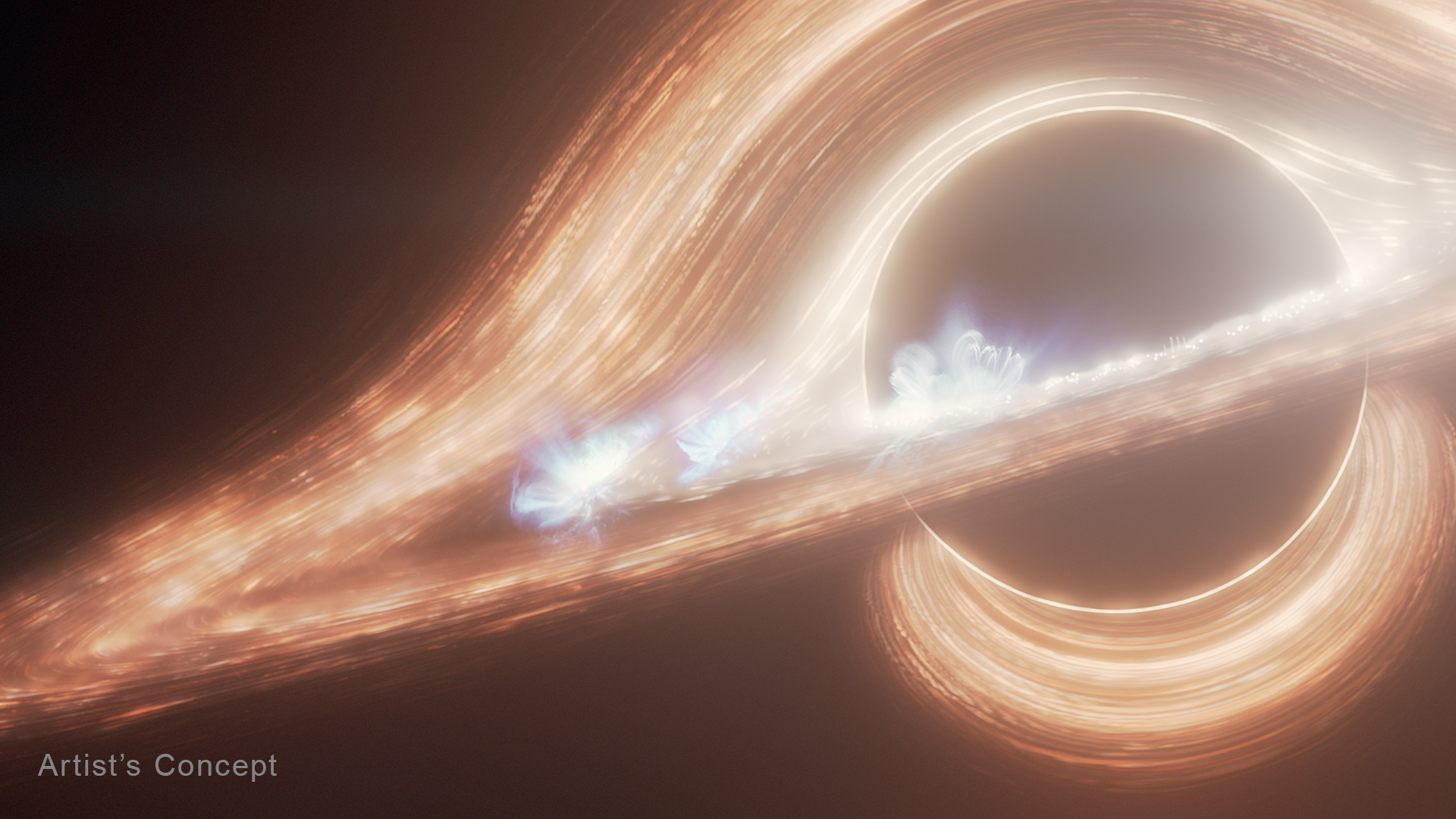
What to notice: the black hole itself stays dark. The light comes from hot gas outside the event horizon, and strong gravity bends light from the far side of the disk into the bright ring we can see.
A Common Misconception: “Black Holes Are Cosmic Vacuums”
Far from a black hole, gravity behaves just as it would for any other object with the same mass. If the Sun were magically replaced by a black hole of exactly the same mass, Earth would still orbit at roughly the same distance. The difference would be that sunlight and heat were gone, not that gravity at Earth’s orbit suddenly became stronger.
Black holes are not cosmic vacuum cleaners. Far away, gravity depends on mass and distance just as usual. What makes black holes dangerous is getting very close, where spacetime curvature and tidal forces become extreme.
Falling Into a Black Hole: Tidal Forces and Spaghettification
A tidal force happens because gravity is stronger at one part of an object than another. Near a compact object, the difference in gravity between your feet and your head can become enormous.
Near a stellar-mass black hole, these tidal forces can become lethal before or around the time you reach the event horizon. Near a supermassive black hole, the event horizon is much larger, so the tidal-force difference at the horizon can be much smaller.
This ScienceClic 360-degree video works best as intuition-building for the tidal-force discussion. Watch for the contrast between the event horizon as a boundary and the very real stretching caused by tidal gravity.
Caption: Use this as a mental model for tidal stretching, not as a literal travel guide. The important distinction is between the event horizon, which is a spacetime boundary, and the tidal forces, which depend strongly on black-hole mass and distance from the center.
Whether the event horizon is violently destructive at the moment you cross it depends on the mass of the black hole. Small black holes have stronger tidal gradients near the horizon than supermassive black holes do.
We often say that a black hole contains a singularity, meaning that general relativity predicts a breakdown of the theory in the deepest interior. For this course, the important point is not to imagine a literal tiny object we fully understand, but to recognize that our current physics is incomplete there.
How Astronomers Know
Black holes are a perfect test of astronomical reasoning because we usually do not detect the black hole itself directly. Instead, we detect what happens around it.
Keep the chain in mind:
observation \(\to\) physical model \(\to\) inference
Observable Evidence for Black Holes
Black holes do not emit light from inside the event horizon, so astronomers infer them from their effects on nearby matter, light, and orbits. No single line of evidence does all the work; the case becomes strong because multiple independent clues point to the same physical model.
Evidence 1: X-ray Binaries and Accretion Disks
In some binary systems, a compact object pulls gas from a companion star. That gas forms an accretion disk, heats up enormously, and emits X-rays.
If measurements of the companion star’s orbit show that the unseen compact object has too much mass to be a neutron star, the best explanation is a black hole.
Observable: X-rays from hot gas plus orbital motion of the visible companion star
Model: gas accretes onto a compact object in a binary system
Inference: the unseen object is extremely compact, and if its mass is too large for a neutron star, it is a black hole
Evidence 2: The Galactic Center and Stellar Orbits
At the center of the Milky Way, astronomers have tracked stars orbiting an invisible object called Sagittarius A*, or Sgr A*.
The star S0-2 is especially important because astronomers have watched it complete a full orbit. Its path shows that about \(4\) million solar masses are concentrated into a very small region.
That much mass in such a small volume cannot be explained by a normal star cluster or any ordinary stellar object. The best explanation is a supermassive black hole.
S0-2 has an orbital period of about 16 years and a semi-major axis of about 1000 AU. If you use Kepler’s third law to estimate the central mass, what general conclusion do you reach?
You do not need a precise answer here. The important question is whether the inferred mass is ordinary, stellar, or millions of solar masses.
The estimate comes out to roughly a few million solar masses concentrated into a very small region. Once so much mass is packed into such a tiny volume, ordinary stars and star clusters stop being plausible explanations. A supermassive black hole becomes the best model.
Evidence 3: The Event Horizon Telescope
The Event Horizon Telescope does not show light coming from inside a black hole. Instead, it images hot material just outside the black hole and the dark central region produced by strong gravity and the black hole’s shadow.
The famous images of M87* and Sgr A* are powerful because they match what general relativity predicts for matter orbiting very close to a black hole.
The EHT did not photograph the black hole itself as a glowing object. The bright ring is hot gas outside the event horizon, and the dark center is the black hole’s shadow.
Taken together, these evidence lines are cumulative rather than repetitive: accretion traces orbiting matter, stellar orbits trace concentrated mass, and EHT images test how light behaves in strong gravity near the event horizon.
Gravitational Waves: Hearing the Cosmos
Einstein’s general theory of relativity predicts that accelerating masses can produce gravitational waves, ripples in spacetime that travel outward at the speed of light.
For many years, gravitational waves were only a prediction. That changed in 2015, when LIGO made the first confirmed detection from a merging pair of black holes.
LIGO detects these waves using laser interferometers. A passing gravitational wave slightly stretches space in one direction and compresses it in the perpendicular direction. That tiny change alters the travel time of laser beams in the detector’s two arms.
What did LIGO actually observe?
If a binary system loses orbital energy, what should happen to the orbit and orbital speed?
LIGO did not see a black hole in visible light. It measured an extremely small change in distance between mirrors. The signal changed in a very characteristic way: the wave frequency and amplitude increased rapidly just before merger. This kind of signal is called a chirp.
Observable: a changing interference signal in LIGO, corresponding to a rising-frequency gravitational-wave chirp
Model: two massive compact objects spiraling inward and merging
Inference: the system contained merging black holes or neutron stars, and the signal reveals their masses and orbital evolution
The increasing frequency matters physically. It tells us the system was losing orbital energy. As the orbit shrank, the two objects moved faster, the orbital period got shorter, and the gravitational-wave frequency rose until the merger.
GW170817, a neutron-star merger detected in 2017, was especially important because it was observed both in gravitational waves and in ordinary electromagnetic light. That gave astronomers two kinds of evidence from the same event and helped establish multi-messenger astronomy.
LIGO does not photograph black holes. It measures tiny changes in distance caused by distortions of spacetime itself.
If the gravitational-wave frequency rises with time, what must be happening to the orbit of the two compact objects?
Connect frequency to orbital motion: a shorter orbital period means faster motion and a higher signal frequency.
Their orbital period must be decreasing, which means the objects are spiraling closer together and moving faster. The rising frequency is evidence that the system is losing orbital energy and approaching merger.
Cosmic Recycling: The Circle Closes
We began Module 2 by asking what stars are and how they shine. We end by asking what remains after stars exhaust their fuel and gravity takes over.
That ending is not really an ending. Stellar death reshapes the universe.
When massive stars explode, they return newly made elements to space. Some of those elements were forged in stellar cores; others are produced in the most violent events, including supernovae and neutron-star mergers. That enriched material becomes part of interstellar clouds, from which new stars and planets later form.
Stellar remnants are not side notes. They show that stellar death enriches the interstellar medium, that mergers help shape the chemical story, and that later stars and planets form from matter processed by earlier generations.
Looking Forward: Module 3 — Galaxies and Cosmology
In Module 3, we zoom out. Instead of asking how individual stars live and die, we ask how stars are organized into galaxies and how galaxies fit into the larger universe.
You will see that black holes are not only stellar remnants. At the centers of galaxies, including our own, supermassive black holes influence the environments around them. You will also encounter dark matter, galaxy evolution, cosmic expansion, and the history of the universe as a whole.
Summary
Neutron stars and black holes are the extreme endpoints of stellar collapse, but the deeper lesson of this lecture is about reasoning from evidence. A white dwarf can no longer survive once electron degeneracy pressure fails; if collapse continues, neutron-rich matter forms and a neutron star can appear. If even neutron pressure cannot halt collapse, a black hole forms, bounded by an event horizon.
Astronomers do not discover these objects by touching them directly. They infer neutron stars from their density, their pulses, and the behavior of matter in binaries. They infer black holes from accreting gas, stellar orbits, strong-gravity imaging, and gravitational-wave signals from compact-object mergers.
These remnants also matter because they are part of the larger cycle of cosmic evolution. Supernovae and compact-object mergers enrich interstellar space, and that processed material later becomes part of new stars, planets, and eventually living systems.
Self-Assessment Checklist
Practice Problems
Solutions are available in the Lecture 21 Solutions.
Core Problems
- Neutron Star Density: A neutron star has a mass of \(1.4\,M_\odot\) (\(= 2.8 \times 10^{30}\,\mathrm{kg}\)) and a radius of \(10\) km.
- Calculate the density (mass per unit volume) in \(\mathrm{kg/m^3}\).
- Compare this to nuclear density (\(\sim 2.3 \times 10^{17}\,\mathrm{kg/m^3}\)). How many times denser is the neutron star?
- A teaspoon is roughly 5 mL \(= 5 \times 10^{-6}\,\mathrm{m^3}\). How much mass would a teaspoon of neutron star material contain?
- Schwarzschild Radius: Calculate the Schwarzschild radius for each of the following:
- A 20 solar-mass black hole
- The supermassive black hole Sgr A* (\(4.1 \times 10^6\,M_\odot\))
- Earth (if hypothetically compressed into a black hole)
- Pulsar Rotation: The Crab Pulsar has a period of \(0.033\) seconds.
- How many rotations per second does it make?
- What is the equatorial velocity if the radius is \(10\) km?
- Express this as a fraction of the speed of light.
- Orbital Mechanics at the Galactic Center: S0-2 orbits Sgr A* with a period of 16 years and a semi-major axis of 1000 AU.
- Use Kepler’s third law to calculate the central mass.
- Express this in solar masses.
- What does this mass, confined to such a small volume, tell you about the nature of Sgr A*?
- Accretion Disk Power: An X-ray binary black hole accretes material at a rate of \(10^{-9}\,M_\odot/\mathrm{year}\). How much energy per second is released (assume 10% of the rest-mass energy is radiated, using \(E = mc^2\))?
- Express the answer in watts.
- Compare to the luminosity of the Sun (\(\sim 3.8 \times 10^{26}\,\mathrm{W}\)).
Challenge Problems
Tidal Forces and Spaghettification: Near the event horizon of a black hole, the gravitational acceleration varies strongly with distance. For a non-rotating (Schwarzschild) black hole, the tidal acceleration (difference in gravity between two points separated by distance \(\Delta r\)) is approximately \[ a_{\text{tidal}} \approx \frac{2GM\Delta r}{r^3}. \] Consider a human falling feet-first into a \(10\,M_\odot\) black hole.
- Calculate the tidal acceleration between head and feet (assume \(\Delta r \approx 1.7\) m) at the event horizon.
- At what distance from the black hole would this tidal acceleration equal Earth’s surface gravity (\(9.8\,\mathrm{m/s^2}\))?
- Now consider the same calculation for the supermassive black hole Sgr A* (\(4.1 \times 10^6\,M_\odot\)). At what distance from Sgr A* would the tidal acceleration equal \(9.8\,\mathrm{m/s^2}\)? What does this tell you about falling into a supermassive black hole?
Neutron Star Mass Limit: The Tolman–Oppenheimer–Volkoff (TOV) limit depends on the equation of state of neutron matter. For a simple model, assume that the maximum mass is \[ M_{\mathrm{max}} \approx 0.7\,\frac{c^2 R_{\mathrm{ns}}}{G}, \] where \(R_{\mathrm{ns}}\) is the neutron star radius (about \(10\) km). Calculate \(M_{\mathrm{max}}\) and compare it to the stated TOV limit of about \(2\)–\(3\,M_\odot\). (This simple model gives only a rough estimate.)
Gravitational Wave Energy: The black hole merger GW150914 released about \(3\,M_\odot\) of energy in gravitational waves (using \(E = mc^2\)). The event lasted approximately \(0.2\) seconds.
- Calculate the average power radiated (in watts).
- Compare to the power radiated by the Sun (\(\sim 3.8 \times 10^{26}\,\mathrm{W}\)).
- The two black holes spiraled together faster and faster. Toward the end, the power output spiked. Estimate what the peak power might have been (order of magnitude).
Multi-Messenger Astronomy: The neutron star merger GW170817 was observed in gravitational waves and across the electromagnetic spectrum (X-rays, visible light, infrared, radio). The gravitational wave signal swept from about \(40\,\mathrm{Hz}\) to about \(250\,\mathrm{Hz}\) over about \(100\) seconds; the electromagnetic signal followed hours later. What does the time delay and the frequency evolution tell you about the physics of the event?
Glossary
- ★ Accretion Disk
- A rotating disk of material spiraling onto a compact object (neutron star or black hole), typically emitting high-energy radiation.
- ★ Black Hole
- A region of spacetime bounded by an event horizon, from which nothing, including light, can escape.
- ★ Chandrasekhar Limit
- The maximum mass (~1.4 M☉) of a white dwarf supported by electron degeneracy pressure.
- ★ Event Horizon
- The boundary around a black hole defined by the Schwarzschild radius, from which escape is impossible.
- ★ Gravitational Wave
- A ripple in the fabric of spacetime produced by accelerating masses, propagating at the speed of light.
- ★ Magnetar
- A neutron star with an exceptionally strong magnetic field (~10¹⁵ gauss), capable of producing giant flares.
- ★ Neutron Degeneracy Pressure
- The quantum mechanical resistance of neutrons to compression, supporting a neutron star against gravity.
- ★ Neutron Star
- A stellar remnant composed primarily of neutrons, ~10 km in radius, with a mass of 1.4–3 M☉.
- ★ Pulsar
- A rapidly rotating neutron star whose magnetic axis is tilted relative to its rotation axis, producing a periodic beam of radio emission.
- ★ Schwarzschild Radius
- The radius \(R_s = 2GM/c^2\) that defines the event horizon of a non-rotating black hole.
- ★ Singularity
- The point (or region) at the center of a black hole where density becomes infinite and general relativity ceases to apply.
- ★ Spaghettification
- The tidal effect near a black hole's event horizon, in which gravity is much stronger on one part of an object than another, stretching the object.
- ★ TOV Limit
- The maximum mass (~2–3 M☉) of a neutron star supported by neutron degeneracy pressure; above this, collapse to a black hole occurs.
- ★ X-ray Binary
- A binary system containing a compact object (neutron star or black hole) accreting material from a companion star, producing X-ray emission.
References and Further Reading
- OpenStax Astronomy (2nd ed.), Chapter 23.4–23.6: Neutron Stars and Black Holes
- Moore, S. & Maldacena, J. (2015). “The birth of a black hole.” Nature, 528(7581), 30–31.
- Abbott, B. P., et al. (2016). “Observation of gravitational waves from a binary black hole merger.” Physical Review Letters, 116(6), 061102.
- Abbott, B. P., et al. (2017). “GW170817: Observation of gravitational waves from a binary neutron star inspiral.” Physical Review Letters, 119(16), 161101.
- Event Horizon Telescope Collaboration (2019). “First M87 Event Horizon Telescope Results. I. The Shadow of the Supermassive Black Hole.” The Astrophysical Journal Letters, 875(1), L1.
Lecture prepared for ASTR 101 (Spring 2026) by Dr. Anna Rosen, San Diego State University.