Lecture 20: How Stars Die
Planetary Nebulae, White Dwarfs, and the Violence of Massive Stars
The Big Idea
A star’s mass at birth largely determines how it dies.
But for ASTR 101, that is not just a fact to memorize. The real question is:
Why does mass control stellar death, and how do astronomers know?
This lecture follows a consistent reasoning pattern:
- Observable: What do we actually detect in the sky?
- Model: What physical picture explains those observations?
- Inference: What does that let us conclude about how stars end?
Our guiding idea is simple:
Stellar death is a competition between gravity pulling inward and pressure pushing outward.
What changes from one stellar endpoint to another is what kind of pressure, if any, can still resist gravity.
By the end of this reading, you should be able to explain — not just recall — why some stars end quietly as white dwarfs, why others die in supernovae, and how those deaths help build the chemical universe.
This reading compares the quiet deaths of low-mass stars with the violent deaths of massive stars.
Default expectation: Read the full page before lecture and stop at each prediction or Check Yourself prompt.
If you are short on time (about 25 minutes):
- Focus on planetary nebulae and white dwarfs, the iron-catastrophe section, and the Type Ia vs. Type II comparison.
- Return to the full practice set after class.
Reference mode: Use this reading as the bridge between stellar evolution and compact remnants.
Learning Outcomes
By the end of this reading, you should be able to say:
Every Atom in Your Body Has a Story
Stop and think:
- the carbon in your DNA
- the oxygen you breathe
- the iron in your blood
None of these elements existed right after the Big Bang.
So where did they come from?
Observable
Astronomers observe:
- stars with different chemical compositions
- glowing gas clouds enriched with heavy elements
- supernovae ejecting matter into space
Model
Stars act as nuclear furnaces:
- fusion builds heavier elements in their interiors
- stellar winds and explosions return some of that material to space
Inference
The atoms in your body were created in earlier generations of stars.
Stellar death is therefore not just an ending. It is part of the process by which the universe builds chemical complexity.
That leads to the lecture’s central question:
What determines whether a star dies quietly or violently?
We will argue that the main control is mass, and we will explain why.
Part 1: The Gentle Death — Low-Mass Stars
Why are we starting here?
Most stars in the universe are low-mass stars. If we want to understand stellar death in general, this is the most common pathway.
What question are we answering?
What happens when a Sun-like star runs out of fuel — and why doesn’t it explode?
When a Star Runs Out of Time
A key idea:
A star does not “die” in a single instant. It passes through a sequence of structural changes.
Observable
From star clusters and stellar populations, astronomers see:
- stars leaving the main sequence
- stars becoming red giants
- stars shedding material late in life
Model
As core hydrogen runs out:
- the core contracts and heats up
- hydrogen fusion continues in a shell around the core
- the outer layers expand, and the star becomes a red giant
Later:
- helium fusion begins in the core
- the star eventually reaches the asymptotic giant branch (AGB)
- repeated pulses and strong stellar winds remove the outer envelope
Inference
A low-mass star’s death is driven by:
- core contraction
- shell burning
- mass loss
not by a catastrophic explosion.
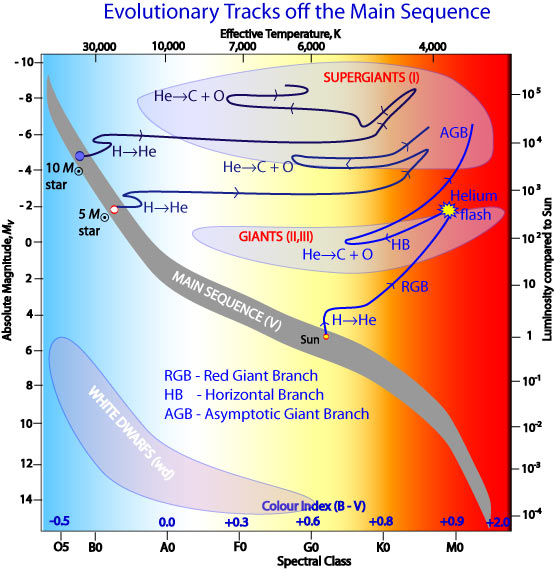
What to notice: once a Sun-like star exhausts core hydrogen, it does not drift gently. It leaves the main sequence, climbs the red giant branch, flashes helium, and later returns to the upper right on the asymptotic giant branch.
What to notice: Once a Sun-like star exhausts core hydrogen, it does not simply fade away. It leaves the main sequence, climbs the red giant branch, ignites helium, and later returns to the upper right on the asymptotic giant branch.
This is why the H-R diagram matters here. The low-mass death pathway is not a separate story from Lecture 19. It is the continuation of the same evolutionary track into the star’s final stages.
An asymptotic giant branch (AGB) star is a low- to intermediate-mass star in a late evolutionary phase with shell burning and strong mass loss.
For ASTR 101, the important idea is:
stars born below about \(8\,M_\odot\) generally follow this broad pathway toward white-dwarf formation.
The very lowest-mass stars live so long that the universe is not yet old enough for any of them to have completed the full process.
Misconception: “Running out of fuel” means the star stops doing anything.
Correction: Running out of core fuel triggers new stages of evolution, not immediate death.
The Planetary Nebula: What Are We Actually Seeing?
Before reading further, commit to an idea:
If we see a shell of gas moving outward from a hot central star, what is the simplest explanation?
- Was the gas always sitting there?
- Is it forming a new star?
- Or was it expelled by the dying star at the center?
Observable
Astronomers observe:
- a hot, compact star at the center
- an expanding shell of glowing gas
- bright emission lines from specific elements
Model
The star has shed its outer layers.
Ultraviolet light from the exposed hot core ionizes the gas. Electrons later recombine with ions and emit light at specific wavelengths, producing bright emission lines.
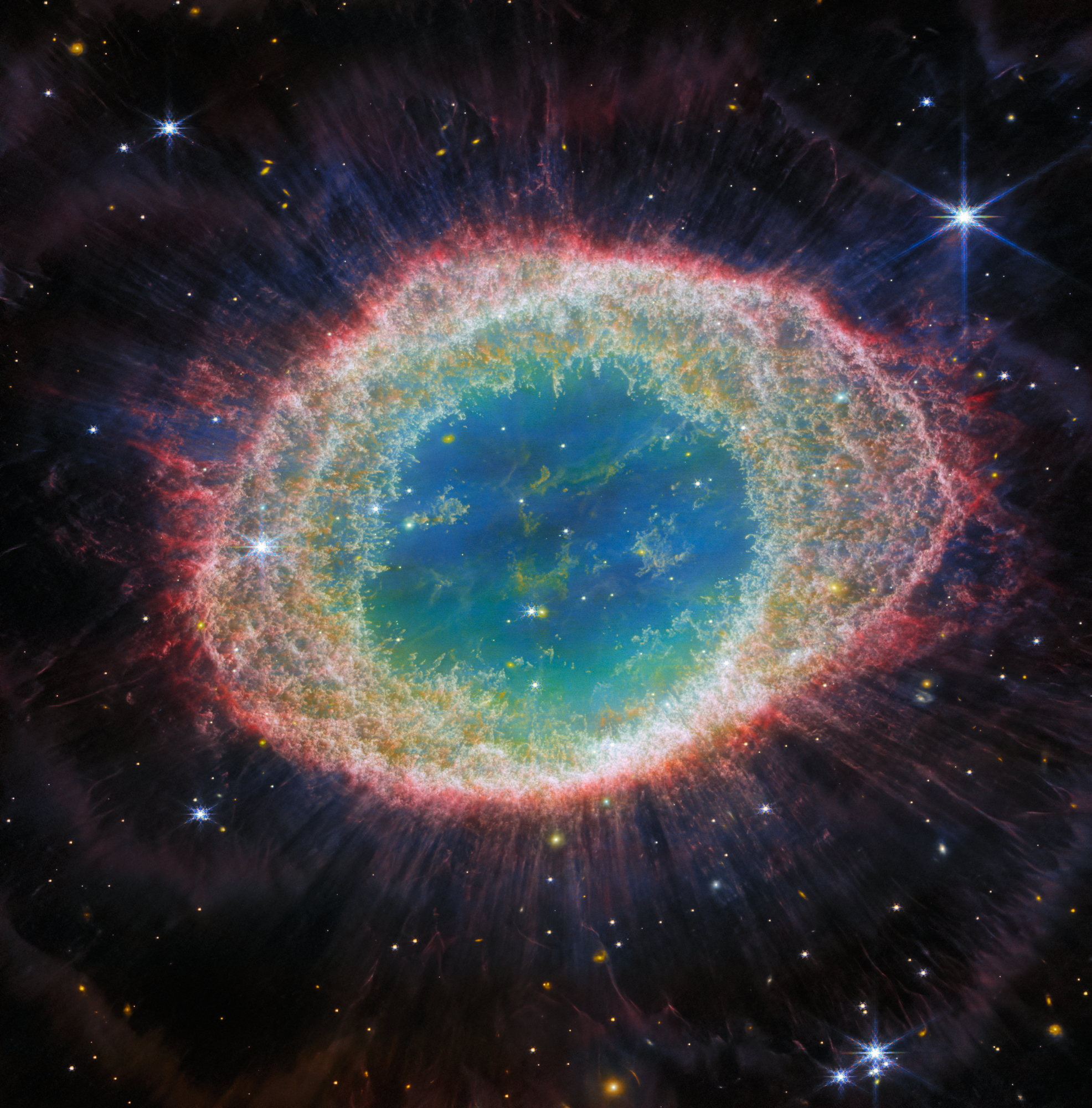
What to notice: a planetary nebula is not a fuzzy cloud with no structure. JWST resolves the shell, knots, and central cavity, making it easier to see that we are looking at gas recently shed by a dying low-mass star and lit by its hot remnant. (Credit: NASA, ESA, CSA, STScI)
What to notice: A planetary nebula is not a vague, shapeless cloud. It has structure: a shell, a central cavity, and a hot remnant star. We are seeing gas recently shed by a dying low-mass star and lit by the exposed core.
Hydrogen often contributes red emission. Doubly ionized oxygen often contributes blue-green emission. In other words, the colors in telescope images are not random decoration. They trace real atoms and real physical conditions in the gas.
Inference
A planetary nebula is:
- not a cloud collapsing to form a star
- not material that was always just sitting there
- the ejected outer layers of a dying low-mass star
A planetary nebula is direct evidence that low-mass stars lose their outer layers late in life.
Misconception: A “planetary nebula” has something to do with planets.
Correction: The name is historical and misleading. A planetary nebula is glowing gas shed by a dying star.
The Ring Nebula (M57) has a radius of about \(0.3\) light-years and is expanding at roughly \(20~\mathrm{km/s}\). How old is it approximately?
Use
\[ t \approx \frac{r}{v} \]
and make the units consistent before you calculate.
Convert to consistent units:
- Radius: \(r = 0.3~\mathrm{ly} \approx 0.3 \times 9.46 \times 10^{15}~\mathrm{m} \approx 2.8 \times 10^{15}~\mathrm{m}\)
- Speed: \(v = 20~\mathrm{km/s} = 2.0 \times 10^4~\mathrm{m/s}\)
Then
\[ t \approx \frac{r}{v} \approx \frac{2.8 \times 10^{15}~\mathrm{m}}{2.0 \times 10^4~\mathrm{m/s}} \approx 1.4 \times 10^{11}~\mathrm{s} \]
Convert seconds to years:
\[ t \approx \frac{1.4 \times 10^{11}~\mathrm{s}}{3.15 \times 10^7~\mathrm{s/yr}} \approx 4.4 \times 10^3~\mathrm{yr} \]
So the Ring Nebula is about \(4{,}000\)–\(5{,}000\) years old, which is very young on stellar timescales.
The White Dwarf: What Supports the Star Now?
A new question appears once the outer layers are gone:
If fusion has stopped, why does the remaining core not keep collapsing?
Observable
Astronomers detect:
- very hot but faint stars
- extremely high densities
- no signs of ongoing fusion
Model
A white dwarf is:
- the exposed core left behind after a low-mass star sheds its outer layers
- usually composed mostly of carbon and oxygen
- supported by electron degeneracy pressure
What is degeneracy pressure?
In ordinary stars, pressure is mainly related to heat.
In a white dwarf, the key support comes from quantum mechanics.
Electrons obey the Pauli exclusion principle: no two identical electrons can occupy the same quantum state in the same way. As matter is squeezed tighter and tighter, electrons are forced into higher-energy states. That creates a pressure that resists further compression.
The important ASTR 101 point is that this pressure does not depend on fusion continuing.
Inference
A white dwarf can remain stable without fusion because quantum mechanics provides the outward pressure support.
Misconception: Pressure in stars always comes from heat.
Correction: In ordinary stars, heat from fusion is the main support. In white dwarfs, the key support is electron degeneracy pressure, which is a quantum-mechanical effect.
A white dwarf can be very hot even though fusion has ended.
So what is keeping it from collapsing further?
Your answer should not mention ongoing fusion.
A Unifying Question: What Holds a Star Up?
Before going farther, pause and organize the physics.
At every stage of a star’s life, there is a competition:
- Gravity pulls inward
- Pressure pushes outward
So the key question is always:
What kind of pressure is supporting the object right now?
For this lecture, two forms of support matter immediately:
| Type of pressure | What produces it? | When it works |
|---|---|---|
| Thermal pressure | Heat associated with hot gas and fusion-powered stellar interiors | Ordinary stars |
| Electron degeneracy pressure | Quantum mechanics of electrons | White dwarfs |
For the moment, these are the two most important cases:
- ordinary stars are held up mainly by thermal pressure
- white dwarfs are held up by electron degeneracy pressure
The next question is the important one for massive stars:
What happens when even electron degeneracy is no longer enough?
That is the question Part 2 will answer.
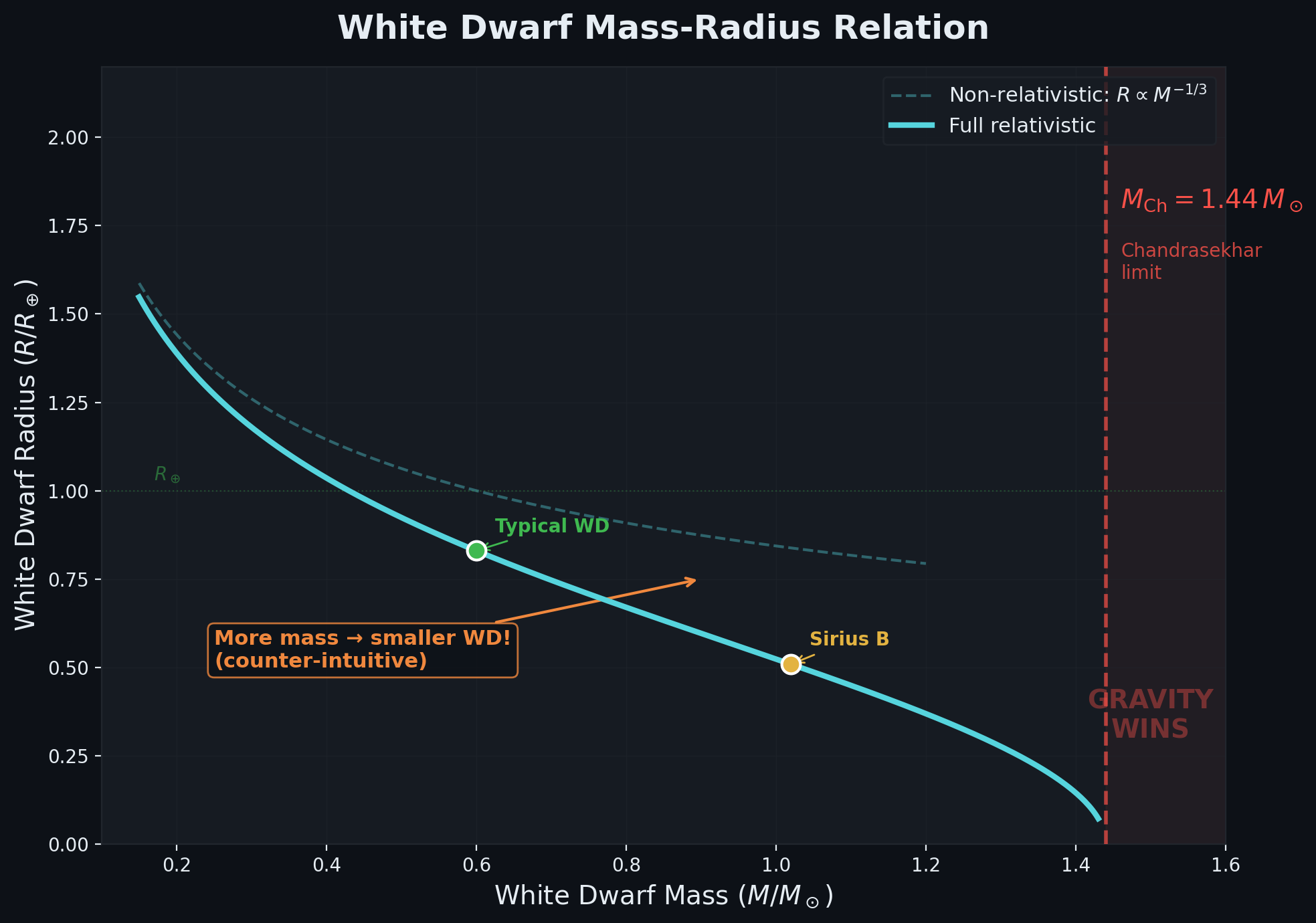
What to notice: white dwarfs obey a deeply counterintuitive rule: adding mass makes them smaller. The curve ends at the Chandrasekhar limit, where electron degeneracy can no longer hold gravity back.
What to notice: White dwarfs obey a deeply counterintuitive rule: adding mass makes them smaller. The curve ends near the Chandrasekhar limit, where electron degeneracy pressure can no longer support the star.
A useful scaling relation is:
\[ R_{\mathrm{WD}} \propto M_{\mathrm{WD}}^{-1/3} \]
Here:
- \(R_{\mathrm{WD}}\) is the white dwarf’s radius
- \(M_{\mathrm{WD}}\) is the white dwarf’s mass
What this relation means physically:
If you add mass to a white dwarf, gravity squeezes it harder, so the radius decreases.
For ASTR 101, the key lesson is the direction of the trend, not memorizing the exponent.
Do not treat this as a plug-and-chug formula.
- ordinary stars: more mass often means a larger star
- white dwarfs: more mass means a smaller remnant
That reversal is evidence that white dwarfs are supported by a different kind of physics from ordinary stars.
In 1930, Subrahmanyan Chandrasekhar calculated a startling result: there is a maximum mass that electron degeneracy pressure can support in a white dwarf.
That maximum is approximately:
\[ M_{\mathrm{Ch}} \approx 1.4\,M_\odot \]
Above this mass, a stable white dwarf is no longer possible.
For ASTR 101, this number matters because it marks a boundary:
- below it: a white dwarf can remain stable
- above it: gravity wins, and further collapse must occur
The exact value depends somewhat on composition and other details, but \(1.4\,M_\odot\) is the standard reference value.
Electron degeneracy pressure can support a white dwarf only up to about \(1.4\,M_\odot\), the Chandrasekhar limit. Above that, a stable white dwarf is no longer possible.
The Fate of Low-Mass Stars: A Summary
For a star born below about \(8\,M_\odot\) (including the Sun), the broad sequence is:
- main-sequence star
- red giant after core hydrogen runs out
- helium burning and later shell burning
- asymptotic giant branch with strong mass loss
- planetary nebula as the hot core lights the expelled gas
- white dwarf that cools over a very long time
The Sun will probably reach its white-dwarf stage in about 5 billion years.
Its remnant will be about the size of Earth and will cool for far longer than the present age of the universe.
A true black dwarf is still hypothetical because the universe is not old enough for any white dwarf to have cooled that far yet.
Low-mass stars do not usually die in supernova explosions.
They die by losing their outer layers and leaving behind a white dwarf supported by electron degeneracy pressure.
Why Are White Dwarfs Dim Even Though They Are Hot?
We use the Stefan-Boltzmann relation:
\[ L \propto R^2 T^4 \]
where:
- \(L\) is luminosity, the total energy output
- \(R\) is radius
- \(T\) is surface temperature
What this means in words:
- a larger surface area makes an object brighter
- a higher temperature also makes it brighter
Now think before calculating:
A white dwarf is hotter than the Sun, but much smaller.
Which effect should matter more?
Reasoning
For a white dwarf:
- the \(T^4\) term helps, because it is hot
- the \(R^2\) term hurts, because it is tiny
Inference
The tiny size dominates, so white dwarfs are dim even though they are hot.
The Sun’s surface temperature is about 5,800 K. A typical white dwarf has a surface temperature of about 8,000 K. Yet the white dwarf appears much dimmer than the Sun. Use the Stefan-Boltzmann law to explain why.
Compare the ratios:
\[ \frac{L_{\mathrm{WD}}}{L_\odot} \approx \left(\frac{R_{\mathrm{WD}}}{R_\odot}\right)^2 \left(\frac{T_{\mathrm{WD}}}{T_\odot}\right)^4 \]
The exact answer matters less than identifying which factor dominates.
The white dwarf is hotter:
\[ T_{\mathrm{WD}} = 8000\ \mathrm{K}, \qquad T_\odot = 5800\ \mathrm{K} \]
so the temperature factor helps the white dwarf.
But the white dwarf is tiny. Its radius is roughly Earth’s radius, while the Sun’s radius is about 100 times larger. So:
\[ \frac{L_{\mathrm{WD}}}{L_\odot} \approx \left(\frac{1}{100}\right)^2 \left(\frac{8000}{5800}\right)^4 \]
\[ \approx 10^{-4} \times (1.38)^4 \approx 3 \times 10^{-4} \]
So the white dwarf is only a tiny fraction as luminous as the Sun, despite being hotter.
The reason is that the small surface area matters more than the temperature increase.
Misconception: If a star is hotter, it must always be brighter.
Correction: Luminosity depends on both temperature and size. A very small hot object can still be dim.
Observable: We see glowing shells of gas (planetary nebulae) and hot, faint stars (white dwarfs) scattered throughout the galaxy.
Model: Low-mass stars shed their envelopes in AGB winds. The ejected gas glows under ionizing radiation from the hot core. The remaining core is a white dwarf supported by electron degeneracy pressure.
Inference: From the size and expansion speed of a nebula, we infer its age. From the temperature and luminosity of the white dwarf, we infer its composition and mass. From the abundance of white dwarfs, we infer how many stars have reached the end of their lives.
Transition: From Gentle Death to Catastrophe
So far, we have seen:
- low-mass stars lose mass gradually
- their cores remain stable as white dwarfs
Now we ask:
What changes when a star is much more massive?
The answer will involve:
- higher temperatures
- faster fusion
- and ultimately, a failure of pressure support
Part 2: The Violent Death — Massive Stars and Supernovae
Building an Onion: The Final Hours of a Massive Star
A Strategy for Understanding the Final Stages
Do not try to memorize every layer.
Instead, focus on the pattern:
- each stage burns a heavier element
- each stage is shorter than the one before
- the core builds toward iron
Stars more massive than about 8 solar masses follow a radically different evolutionary path. Instead of gently fading, they race toward catastrophe.
In Lecture 19, we saw that massive stars burn through their fuel quickly, progressing through the H-R diagram in only a few million years. But what happens at the end?
The answer involves an onion-shell structure.
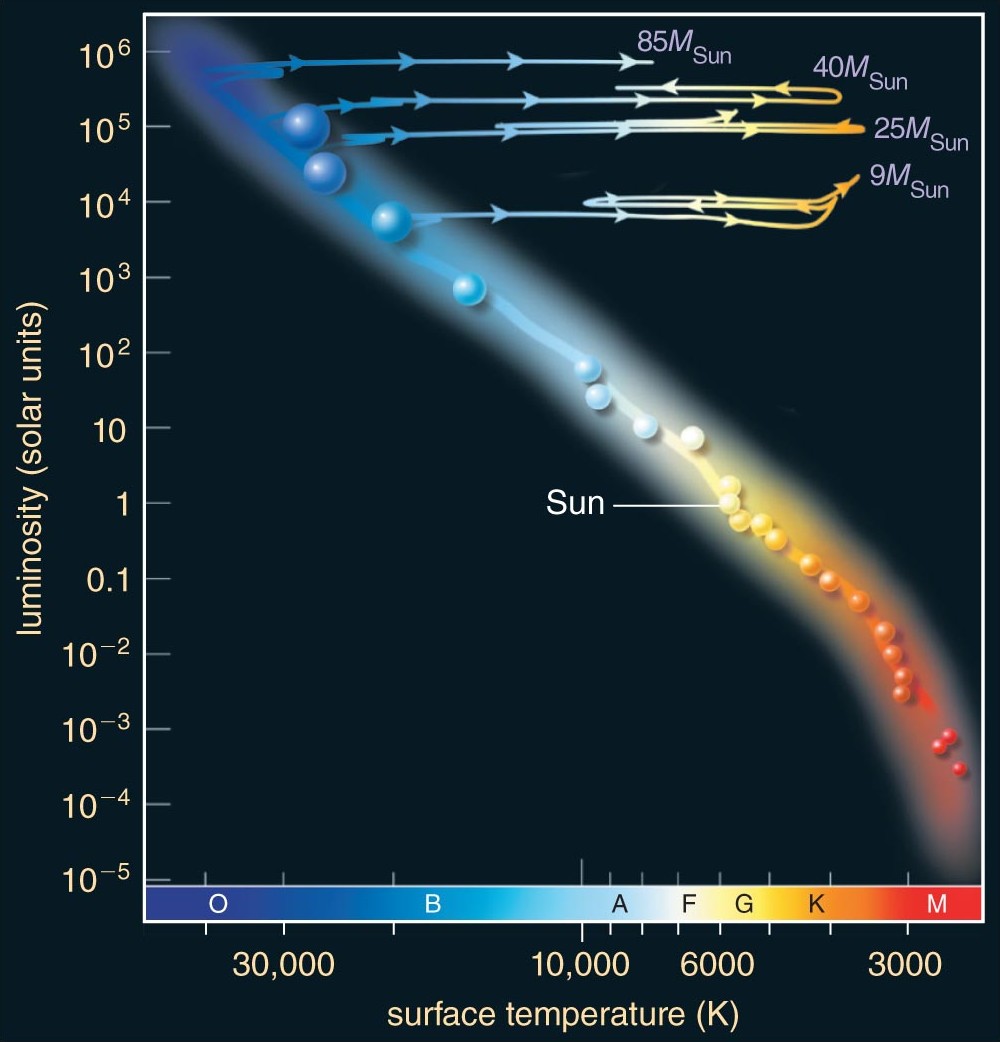
What to notice: massive stars race across the H-R diagram. Their tracks peel away from the main sequence after only a short time and loop through supergiant phases before stellar death.
For massive stars, the H-R diagram tells the same high-level story as before but at a much faster pace: they leave the main sequence quickly, cross through supergiant phases, and arrive at stellar death with much less time to spare than Sun-like stars.
WR 124 is a useful bridge figure because it reminds us that massive-star death does not begin only at the instant of explosion. Some massive stars enter violent mass-losing phases before core collapse and already surround themselves with evidence of their unstable late lives.
What to notice: some massive stars shed matter violently even before the final explosion. WR 124 is a Wolf-Rayet star surrounded by previously ejected gas, showing that mass loss is already reshaping the environment before core collapse. (Credit: NASA, ESA, CSA, STScI, Webb ERO Production Team)
Eta Carinae shows the same point in an even more dramatic way. It has not exploded yet, but it has already blasted huge amounts of gas into space. The biggest stars can become unstable long before core collapse finally arrives.
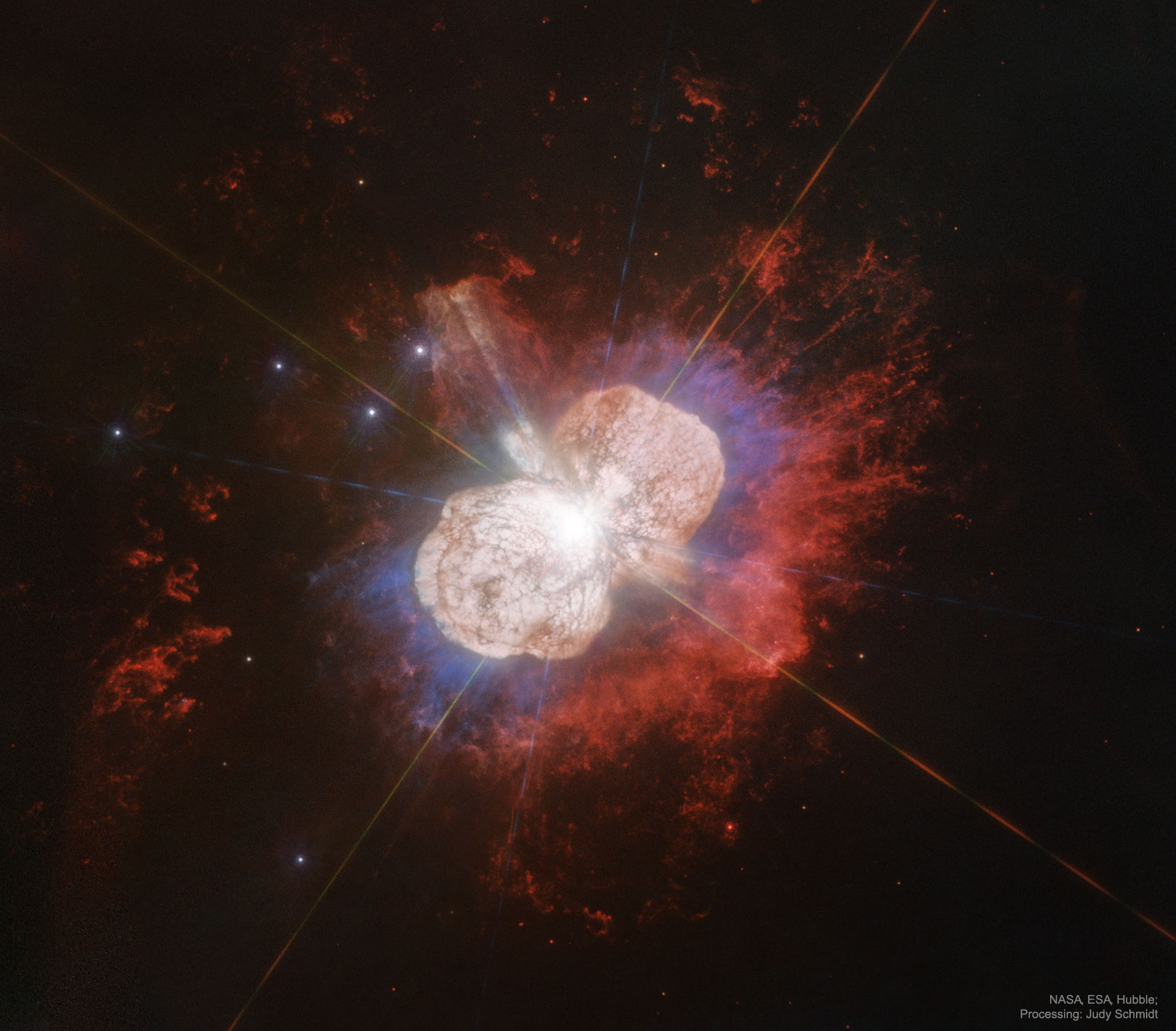
What to notice: some very massive stars are already unstable before they explode. Eta Carinae has blown off huge lobes of gas, a reminder that the most massive stars live fast, shed mass violently, and die in dramatic ways. (Credit: NASA, ESA, and the Hubble Heritage Team (STScI/AURA))
Recall that stellar fusion works only when the temperature is hot enough. Hydrogen fuses at ~10 million K. Helium fuses at ~100 million K. Carbon fuses at ~600 million K, oxygen at ~1 billion K, and so on. In a massive star’s core, as the temperature climbs, new fusion reactions start up.
Here’s the sequence:
- Hydrogen shell (outer): Still fusing H \(\rightarrow\) He
- Helium shell: Fusing He \(\rightarrow\) C, O
- Carbon shell: Fusing C \(\rightarrow\) Ne, Mg
- Neon shell: Fusing Ne \(\rightarrow\) Mg
- Oxygen shell: Fusing O \(\rightarrow\) Si, S
- Silicon shell: Fusing Si \(\rightarrow\) Fe, Ni
- Iron core: No fusion (the story ends here)
This onion has many layers because each fusion stage adds a shell of new material around the inert core of the previous stage. At any moment in the final hours before explosion, multiple fusion reactions are happening simultaneously in different shells.
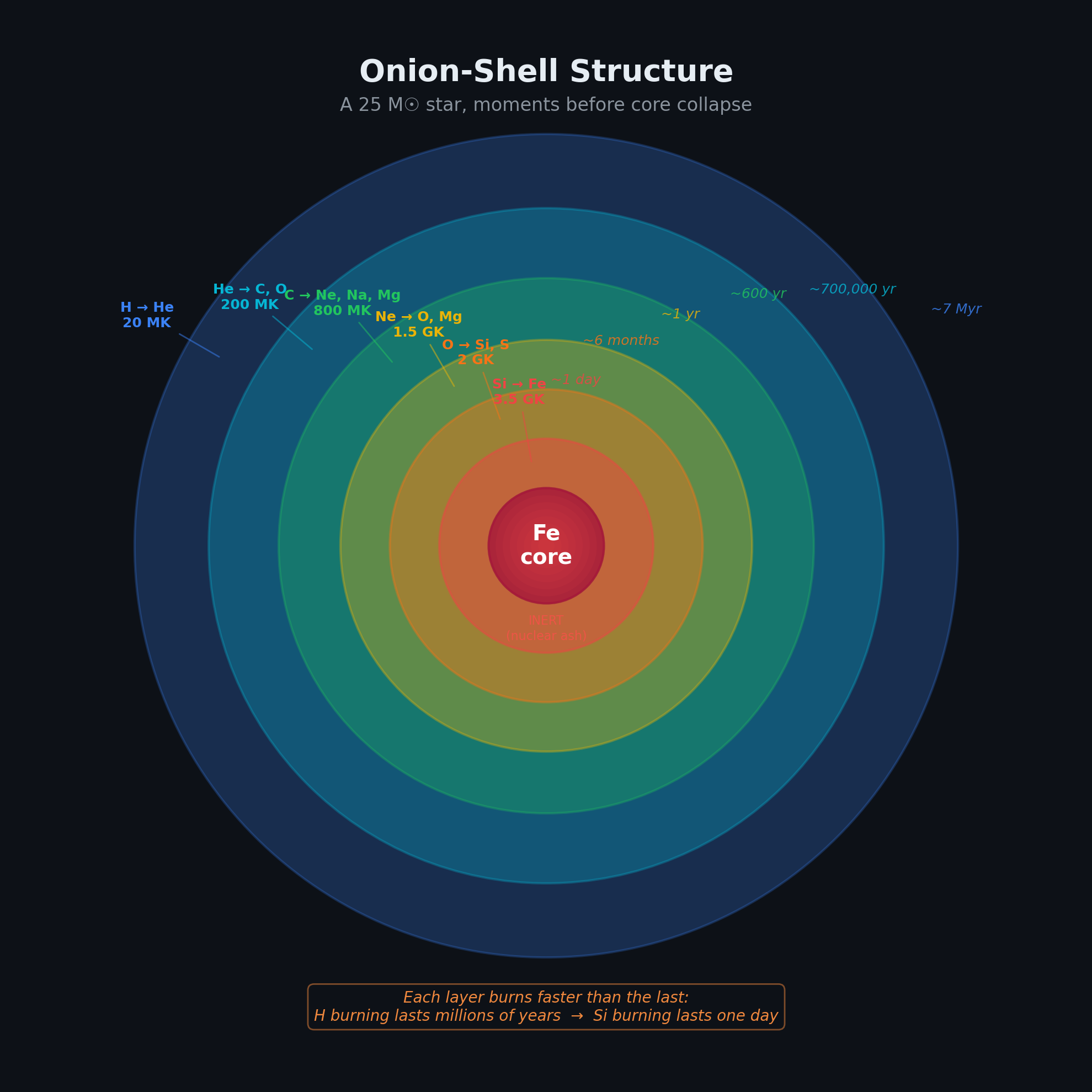
What to notice: the last stages of massive-star fusion are nested and frantic. Outer hydrogen burning lasts millions of years, but the innermost silicon-burning shell lasts only about a day before collapse.
A useful way to read that figure is as a countdown clock. In a very massive star, each new burning stage is dramatically shorter than the one before it.
| Dominant burning stage | Main fuel | Approximate duration | What to notice |
|---|---|---|---|
| Hydrogen core burning | H | about \(7 \times 10^6\) years | This is the long, relatively stable part of the star’s life. |
| Helium core burning | He | about \(7 \times 10^5\) years | Already about an order of magnitude shorter than hydrogen burning. |
| Carbon core burning | C | about \(6 \times 10^2\) years | The star has entered a genuinely rapid late-life phase. |
| Neon core burning | Ne | about \(1\) year | The countdown to collapse is now shorter than a human lifetime. |
| Oxygen core burning | O | about \(6\) months | The core is racing through its remaining fuels. |
| Silicon core burning | Si | about \(1\) day | This is essentially the final step before an iron core forms and collapse begins. |
These are order-of-magnitude values for a very massive star, not exact universal lifetimes. The precise numbers depend on the star’s initial mass and on the details of the stellar model.
This short Chandra video fits here because it treats the onion-shell picture as a physical story, not just a diagram to memorize. Watch for three linked ideas: layered burning in a massive star, the way iron changes the support problem, and the evidence that the star’s interior may have been violently rearranging itself in the final hours before collapse.
Caption: The video highlights an important refinement to the onion-shell picture. Cas A suggests that a massive star’s interior may not stay quietly layered right up to the moment of explosion. Violent mixing in the final hours can help explain the asymmetry of the remnant, the kick of the leftover neutron star, and the structure of the expanding debris.
So the late life of a massive star is not just hot. It is structurally unstable, rapidly changing, and heading toward a final support crisis.
The Iron Catastrophe: Why Fusion Stops Helping
The onion-shell story explains how the core gets to iron. Now we ask why iron changes everything.
Why does fusion release energy in the first place?
Observable
From nuclear physics and astronomical modeling, we know:
- fusing light nuclei such as hydrogen can release energy
- fusing iron does not release energy in the same way
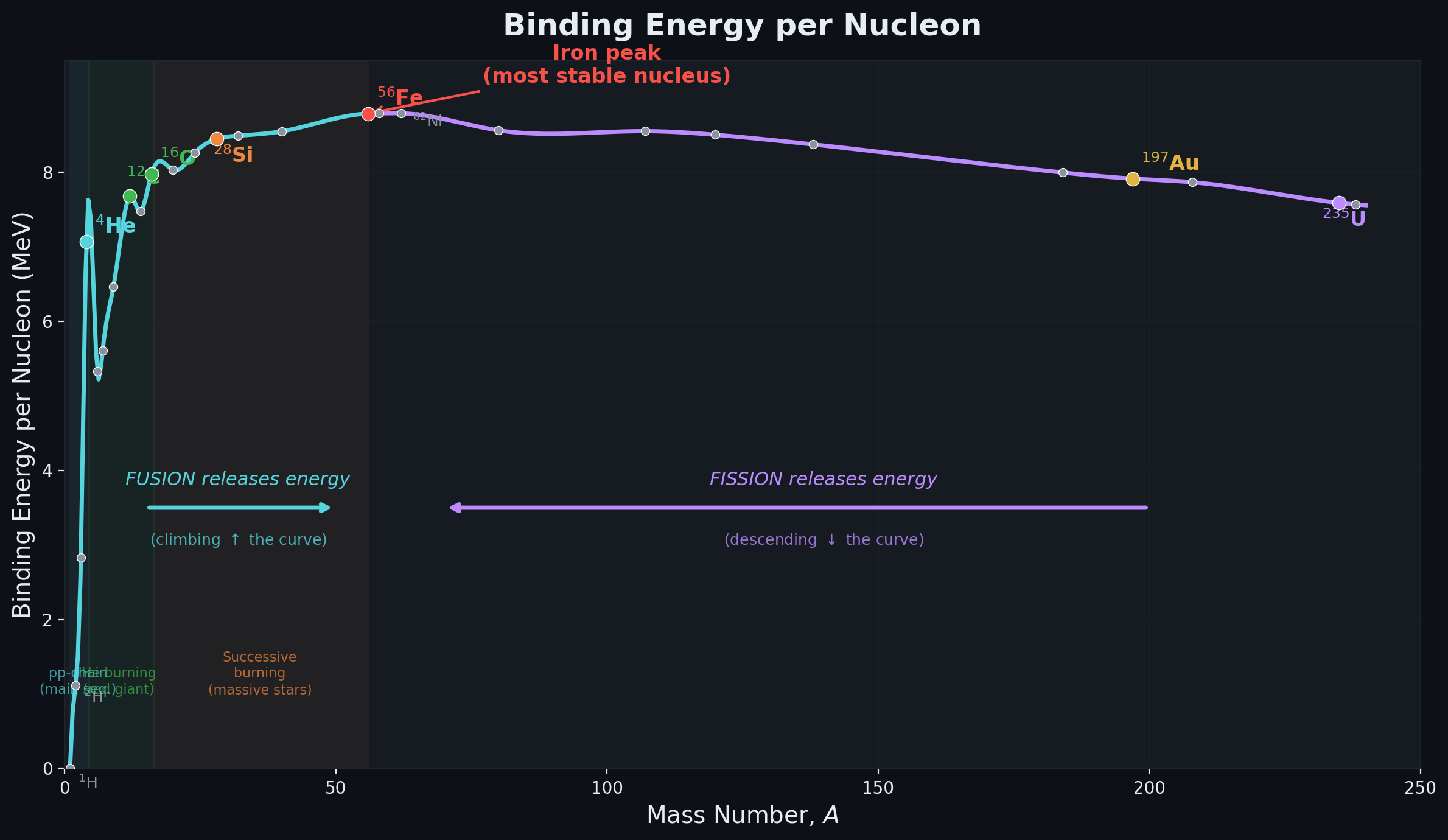
What to notice: energy is released when fusion climbs upward toward iron on the binding-energy curve. Iron sits near the peak, so pushing beyond it no longer pays out energy. That is why an iron core is a dead end for normal stellar fusion.
What to notice: Fusion releases energy when it moves nuclei upward toward the peak of the binding-energy curve. Iron sits near that peak, so fusion beyond iron no longer gives an energy payoff.
Model
Nuclei become more stable as their binding energy per nucleon increases.
That means:
- light nuclei can release energy by fusing into more tightly bound nuclei
- iron is already near the maximum stability region
A useful picture is this:
fusion is like moving downhill toward a valley of greater stability
iron is near the bottom of that valley
Inference
Fusion helps support a star only if it releases energy.
Once the core becomes iron-rich, fusion is no longer a useful energy source for pressure support.
That is why an iron core is a dead end for normal stellar fusion.
Misconception: If a star is hot enough, fusion will always support it.
Correction: Temperature alone is not enough. Fusion past iron requires energy instead of releasing it, so it cannot support the star.
If a stellar core is already extremely hot, why does that still not guarantee that iron fusion can keep the star alive?
Ask not “Can fusion happen?” but:
Would that fusion release energy or require energy?
A star remains supported only if nuclear reactions help provide energy and pressure support.
Iron is near the peak of binding energy per nucleon, so fusing iron does not provide the needed energy payoff. Even a very hot iron-rich core therefore loses its last normal fusion-powered support channel.
Core Collapse: What Actually Happens?
Once iron can no longer help support the core, the problem changes from fusion physics to collapse physics.
What happens next?
Observable
Astronomers observe supernovae that:
- brighten dramatically
- eject matter at high speeds
- leave behind compact remnants such as neutron stars, and in some cases black holes
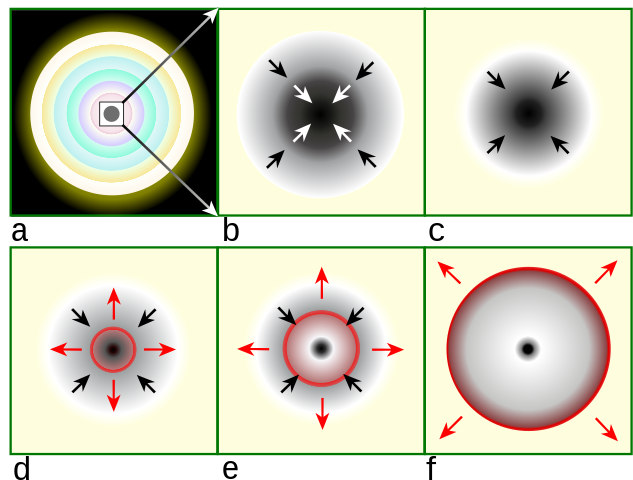
What to notice: core collapse is a sequence, not a single instant. The core implodes, compresses to nuclear density, rebounds, and drives an outward shock that becomes the supernova.
What to notice: Core collapse is a sequence, not a single instant. The core implodes, compresses to nuclear density, rebounds, and helps launch an outward shock.
Model
The standard physical picture used in intro astronomy is:
- an iron-rich core builds up
- fusion no longer supports the core
- gravity drives rapid collapse
- the inner core reaches nuclear density and stiffens abruptly
- a shock forms
- the shock loses energy and can stall
- neutrinos escaping from the hot core deposit some energy behind the shock
- that heating helps revive the shock and drive the explosion
So a core-collapse supernova is not a case of fusion suddenly becoming stronger.
It is a case where gravity first wins, collapse begins, a shock forms, and the shock still needs help to produce a successful explosion.
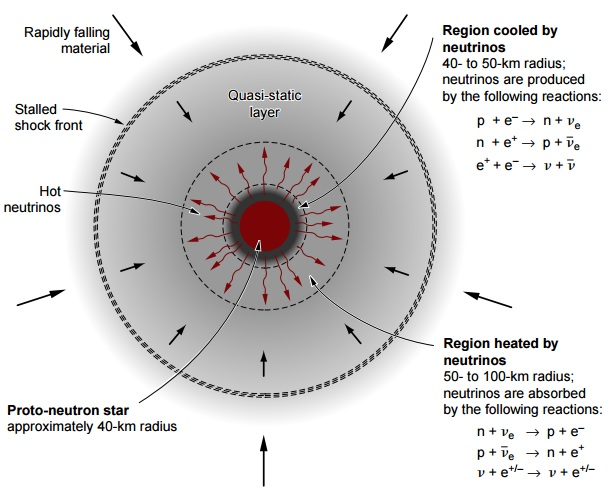
What to notice: the outgoing shock does not simply blast through on its own. A proto-neutron star forms at the center, neutrinos pour out, and a small fraction of that energy reheats material behind the stalled shock and helps revive the explosion.
What to notice: The outgoing shock does not simply coast outward on its own. In the leading ASTR 101 model, neutrinos from the hot central remnant help re-energize material behind the stalled shock.
Inference
A core-collapse supernova is best understood as gravitational collapse followed by shock formation and energy transfer, not as a simple fusion blast or a pure “bounce and explode” event.
Misconception: A supernova is just the star blowing up because fusion got stronger.
Correction: In core-collapse supernovae, the trigger is the failure of pressure support and the resulting gravitational collapse of the core.
For ASTR 101, keep these energy buckets separate:
- Total gravitational energy released in core collapse: about \(10^{46}\ \mathrm{J}\)
- Most of that energy: leaves as neutrinos
- Kinetic energy of the ejecta: about \(10^{44}\ \mathrm{J}\)
- Visible light: only a small fraction of the total energy budget
A core-collapse supernova ejecta carry about \(10^{44}\) joules of kinetic energy. The Sun’s luminosity is \(3.8 \times 10^{26}~\mathrm{W}\). How much energy does the Sun radiate in one second, and how does that compare with the ejecta energy?
For one second, the Sun’s radiated energy is just its luminosity multiplied by \(1~\mathrm{s}\).
Energy equals power times time:
\[ E_{\text{Sun}} = L_\odot t = (3.8 \times 10^{26}~\mathrm{W})(1~\mathrm{s}) = 3.8 \times 10^{26}~\mathrm{J} \]
Ratio: \[ \frac{E_{\text{SN}}}{E_{\text{Sun}}} = \frac{10^{44}}{3.8 \times 10^{26}} \approx 2.6 \times 10^{17} \]
So even the outward kinetic energy alone is about \(2.6 \times 10^{17}\) times the energy the Sun radiates in one second.
What Stops the Collapse?
This is the right moment to connect back to white dwarfs.
In Part 1, collapse stopped when electron degeneracy pressure became strong enough to support the remnant. That left behind a white dwarf.
In a massive star, the collapse goes farther. Under the enormous densities reached during collapse, matter becomes increasingly neutron-rich, and the white-dwarf stage is no longer the final stopping point.
If the collapsed core is not too massive, a new support mechanism can halt further collapse:
- neutron degeneracy pressure
- plus the stiffness of nuclear matter at extremely high density
The remnant is then a neutron star.
If even that support is not enough, collapse continues and the remnant becomes a black hole.
For this lecture, the key sequence is:
- white dwarf: electron degeneracy stops collapse
- neutron star: collapse goes farther, and neutron-rich matter provides support
- black hole: no known pressure stops collapse
Lecture 21 picks up from this point and asks what neutron stars and black holes are actually like as observable objects.
The Crab Nebula is a useful observational payoff for this whole story.
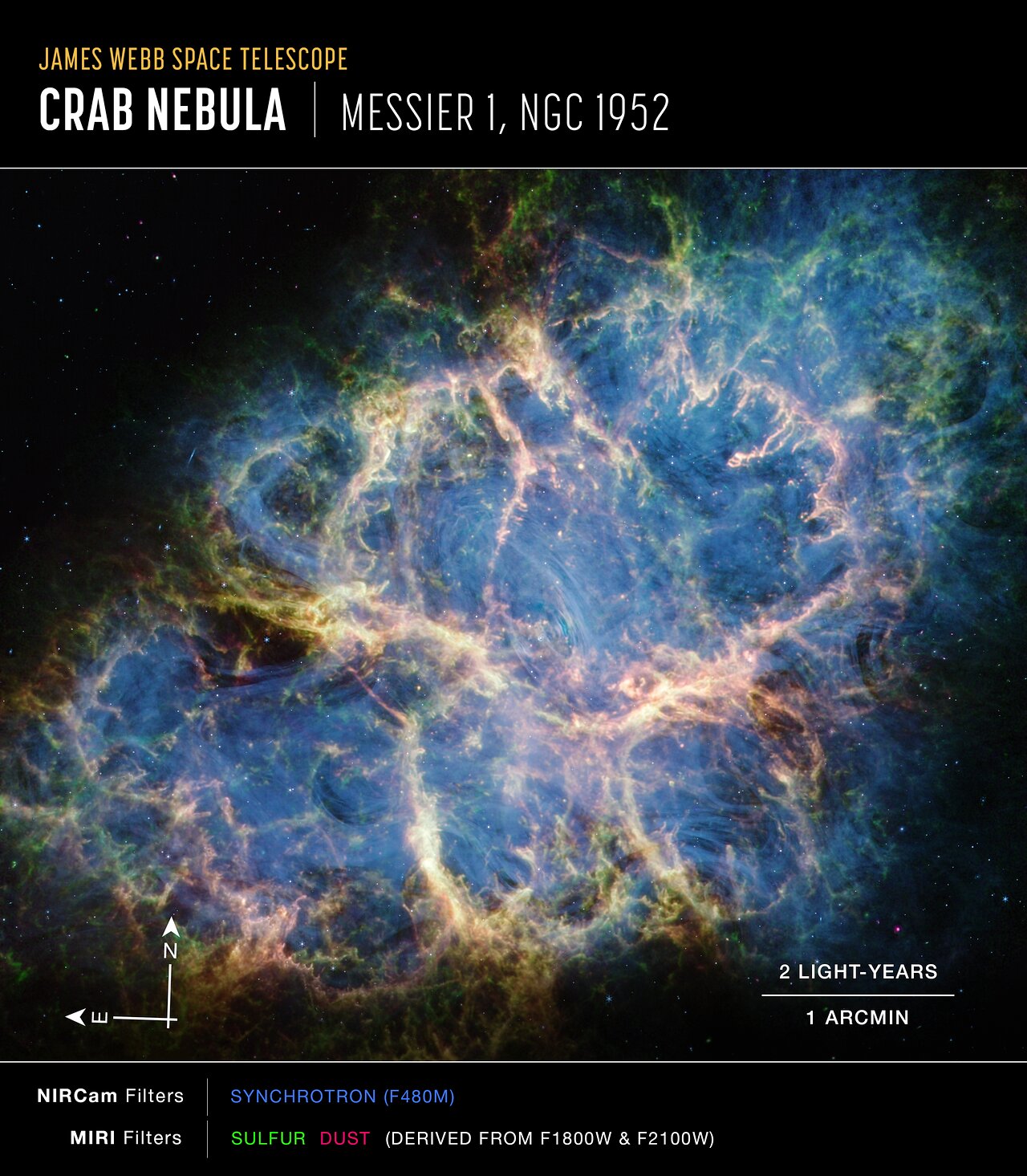
What to notice: centuries after the explosion, the Crab Nebula still preserves the wreckage of a core-collapse supernova. JWST resolves tangled filaments, dust, and synchrotron-emitting structures, reminding us that a supernova does not just produce a flash of light. It leaves behind expanding, chemically enriched debris and a compact remnant at the center. (Credit: NASA, ESA, CSA, STScI)
What we see today is not the star itself, but the long-lived aftermath: expanding supernova debris, shocked gas, and a compact remnant in the middle. In other words, the layered star, the collapse, and the explosion all leave evidence that astronomers can still read centuries later.
A core-collapse event releases about \(10^{46}\) joules in total. The Sun’s lifetime luminosity is about \(L_\odot = 3.8 \times 10^{26}~\mathrm{W}\) over \(10\) billion years. How many Sun-lifetimes of radiated energy is that total collapse energy?
First estimate the Sun’s total lifetime energy output:
\[ E_{\odot,\mathrm{total}} = L_\odot t \]
Then compare that to \(10^{46}\ \mathrm{J}\).
The Sun’s total radiated energy over a lifetime of about \(10^{10}\) years is:
\[ E_{\odot,\mathrm{total}} = (3.8 \times 10^{26}\ \mathrm{W}) \times (10^{10}\ \mathrm{yr}) \]
Convert years to seconds:
\[ 10^{10}\ \mathrm{yr} \times 3.15 \times 10^7\ \mathrm{s/yr} = 3.15 \times 10^{17}\ \mathrm{s} \]
\[ E_{\odot,\mathrm{total}} \approx (3.8 \times 10^{26})(3.15 \times 10^{17}) \approx 1.2 \times 10^{44}\ \mathrm{J} \]
\[ \frac{10^{46}}{1.2 \times 10^{44}} \approx 83 \]
So the total collapse energy is about 80 Sun-lifetimes of radiated energy, even though most of that supernova energy leaves as neutrinos rather than visible light.
Nucleosynthesis: Forging the Elements
Before reading the whole periodic table, focus on four big buckets:
- Hydrogen and much of helium: Big Bang
- Carbon, oxygen, nitrogen: stars
- Iron peak: supernova environments
- Gold, uranium, and similar very heavy elements: rapid neutron-capture events
That is the pattern to look for in the figure below.
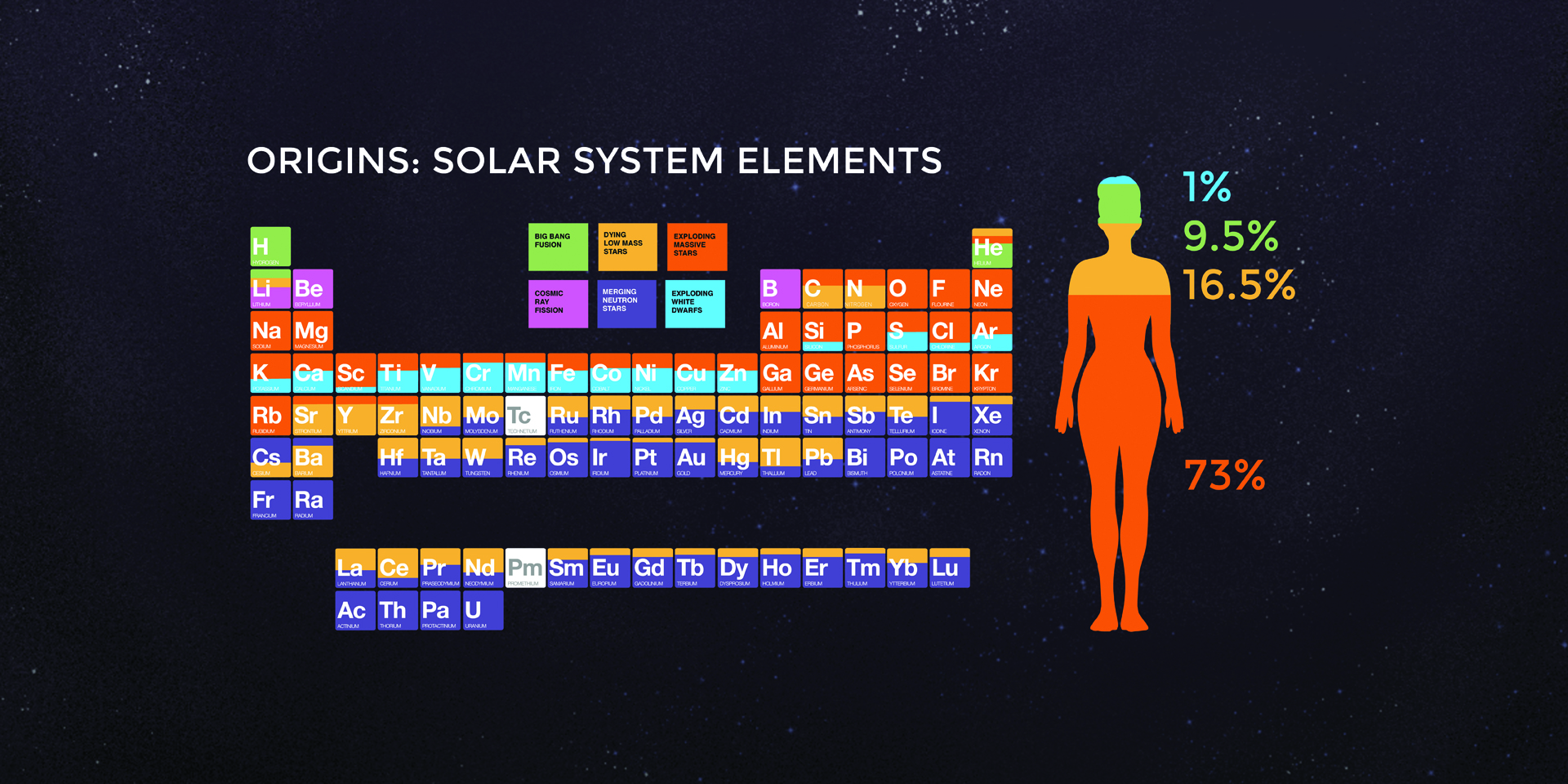
What to notice: the periodic table is a cosmic origin story. Hydrogen and much of helium are primordial, many common elements are forged in stars, and the heaviest elements require the most violent astrophysical events.
Normal stellar fusion can build elements up to roughly iron. To make many elements heavier than iron, nature needs additional processes such as neutron capture in extreme environments.
Core-collapse supernovae help enrich space in several ways. They eject the elements the star already made during its life, they synthesize additional iron-peak nuclei during the explosion, and they seed the interstellar medium with heavy elements that later become part of new stars and planets.
Misconception: All elements heavier than iron come from supernovae.
Correction: Some do, but many of the heaviest r-process elements are strongly linked to neutron-star mergers. The important ASTR 101 idea is that normal core fusion does not build those elements efficiently.
Observable: We measure spectra of supernovae, supernova remnants, old stars, and kilonovae.
Model: Nuclear reactions in stars, supernovae, and neutron-star mergers produce different element patterns.
Inference: From those abundance patterns, astronomers reconstruct where elements were made and how galaxies became chemically enriched over time.
This is why stellar death matters so much in astronomy. Stars do not just shine. They recycle the universe.
Part 3: Type Ia Supernovae — A Different Kind of Explosion
Why is this a separate category?
So far, massive stars have died through core collapse.
Now ask a different question:
Can a low-mass stellar remnant still explode?
The answer is yes, but through a completely different mechanism.
Misconception: All supernovae come from massive stars.
Correction: Type Ia supernovae come from white dwarfs in binary systems.
A White Dwarf in a Binary System
Remember: a white dwarf is the exposed remnant of a low-mass star. In a binary system, its fate can change because it can gain matter from a companion star.
A white dwarf has an initial mass of \(1.0\,M_\odot\). In one simple accretion model, it gains matter from a companion at a rate of \(0.01\,M_\odot\) per million years. If it had to reach \(1.4\,M_\odot\), how long would that take?
First find how much mass must be added, then divide by the accretion rate.
Mass to accrete: \(\Delta M = 1.4 - 1.0 = 0.4\,M_\odot\)
Accretion rate: \(\dot{M} = 0.01\,M_\odot/\mathrm{Myr}\)
Time: \[ t = \frac{\Delta M}{\dot{M}} = \frac{0.4\,M_\odot}{0.01\,M_\odot/\mathrm{Myr}} = 40~\mathrm{Myr} \]
This gives a timescale of about \(40\) million years in this one simplified channel. It does not mean all Type Ia supernovae follow the same path or the same delay time.
Why Type Ia Supernovae Explode
This is a different physical situation from core collapse.
A white dwarf is supported mainly by electron degeneracy pressure, not by the ordinary heat-pressure feedback that helps stabilize a normal star.
In a normal star:
- fusion heats the gas
- the gas expands
- expansion cools the gas
- that cooling helps regulate the burning
That is the built-in thermostat.
In a degenerate white dwarf, heating does not restore stability in the same way.
Observable
Astronomers observe explosions that are:
- extremely bright
- usually lacking hydrogen in their spectra
- associated with white-dwarf systems rather than massive hydrogen-rich supergiants
Model
A white dwarf in a binary system can be pushed toward unstable carbon burning.
In the classic ASTR 101 picture, the white dwarf gains mass from a companion until conditions become extreme enough for carbon fusion to ignite.
Because the white dwarf is supported by degeneracy pressure, the usual expansion-and-cooling feedback is much weaker than in an ordinary star:
- fusion begins
- temperature rises
- expansion does not regulate the burning in the normal way
- fusion runs away
Inference
A Type Ia supernova is a thermonuclear explosion of a white dwarf, not a core-collapse event.
The transferable lesson is simple: if you remove the normal stellar thermostat, fusion can become explosive instead of self-regulating.
A nova is different: only the newly accreted surface layer flashes, ejects gas, and the white dwarf survives. In a Type Ia supernova, the white dwarf itself is disrupted.
Why does a rise in temperature fail to stabilize fusion in a white dwarf the same way it does in an ordinary star?
Compare what heating does in an ordinary star with what heating does in matter supported by degeneracy pressure.
In an ordinary star, heating leads to expansion, and expansion cools the gas. That feedback helps regulate fusion.
In a white dwarf, degeneracy pressure is not tied to temperature in the same stabilizing way. So a temperature rise does not produce the same regulating expansion, and fusion can run away.
Astronomers now think there is more than one pathway to a Type Ia event. The classic near-Chandrasekhar accretion model is still useful in ASTR 101 because it captures the key idea of thermonuclear runaway in a white dwarf, but some events may involve white-dwarf mergers or other sub-Chandrasekhar channels.
Type Ia supernova: A thermonuclear explosion of a white dwarf in a binary system. More than one progenitor pathway may lead to this outcome.
Misconception: A Type Ia supernova is just a smaller version of a core-collapse supernova.
Correction: Type Ia and core-collapse supernovae are triggered by different physical mechanisms. Type Ia comes from thermonuclear runaway in a white dwarf; core-collapse comes from the collapse of a massive star’s core.
For ASTR 101, remember the core distinction:
- Core-collapse supernovae: gravity-driven collapse of a massive star’s core. Type II are the hydrogen-rich cases, while Type Ib and Type Ic are stripped-envelope core-collapse cases.
- Type Ia: thermonuclear destruction of a white dwarf in a binary system
Type Ia vs. Type II: A Comparison
| Property | Type II (Core-Collapse) | Type Ia (Thermonuclear) |
|---|---|---|
| Progenitor | Massive star with a collapsing core | White dwarf in a binary system |
| Trigger | Iron-core collapse after support fails | Thermonuclear runaway in a white dwarf |
| Hydrogen in spectrum | Usually present | Usually absent |
| What is left behind? | Often a neutron star or black hole | No intact white dwarf remains |
| Delay after star formation | Usually a few to tens of millions of years | Can range from hundreds of millions to billions of years |
| What it tells astronomers | Death of massive stars and chemical enrichment | Distance scale and white-dwarf explosion physics |
Both types can produce nickel-56, whose radioactive decay helps power the observed light after the explosion.
Type Ia light curves are more uniform and can be standardized for distance measurements. Type II events are more diverse because massive stars reach explosion with a wider range of envelopes and environments.
For this lecture, the main comparison is between Type Ia and Type II, but the names mix two different ideas: core-collapse is the physical family, while Type II, Type Ib, and Type Ic are spectral labels within that broader core-collapse group. Type II are the hydrogen-rich cases. Type Ib and Type Ic also come from collapsing massive stars, but they have already lost their outer hydrogen-rich envelopes before exploding.
Observable
We look for:
- hydrogen lines or their absence
- light-curve shape
- the type of stellar population hosting the event
Model
- core-collapse supernovae come from massive stars with collapsing cores
- Type Ia supernovae come from thermonuclear explosions of white dwarfs
Inference
From those observables, astronomers infer the likely explosion mechanism and progenitor system.
You observe a new supernova in a distant galaxy. The light curve shows a smooth decline. The spectrum contains strong iron and nickel absorption features but no hydrogen lines. Which type is this likely to be, and why?
Start with the spectrum: is hydrogen present or absent?
In the simplified Type Ia vs. Type II comparison used in this lecture, this is most likely a Type Ia supernova.
Reasoning:
- no hydrogen lines argues against the usual Type II case
- a smoother, more uniform light curve is characteristic of Type Ia events
- strong iron-peak signatures fit a thermonuclear white-dwarf explosion
A more advanced classification would also consider stripped-envelope core-collapse events such as Type Ib and Type Ic, which can also lack hydrogen.
The same evidence habit still works after the bright supernova has faded. Earlier in the course, we learned that atoms leave spectral fingerprints at specific wavelengths. Supernova remnants preserve that idea in a different form: X-ray line energies and element patterns can still help astronomers distinguish thermonuclear Type Ia remnants from core-collapse remnants. For the intro-level comparison in this course, that often means distinguishing Type Ia from the Type II pathway we emphasized above.
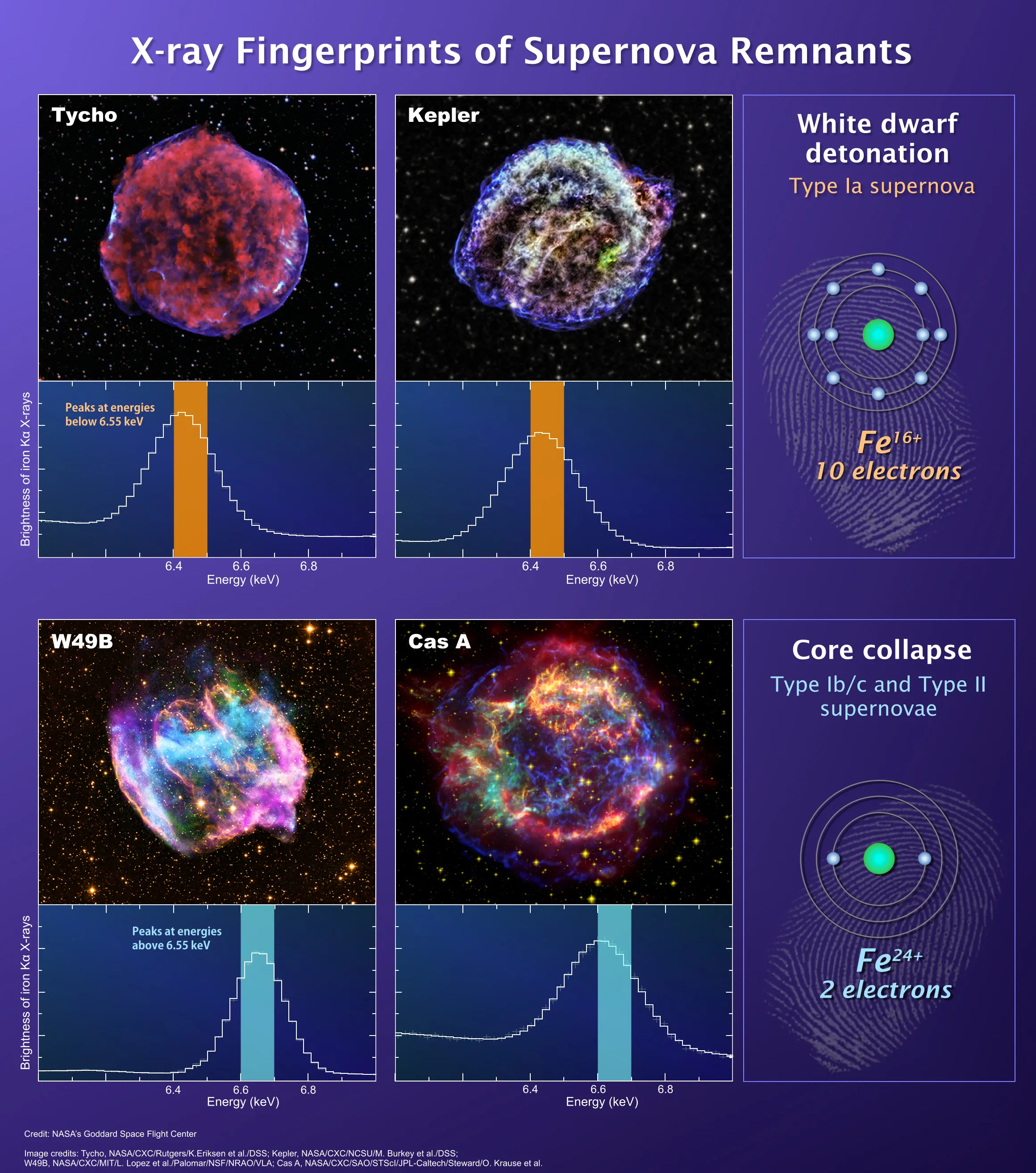
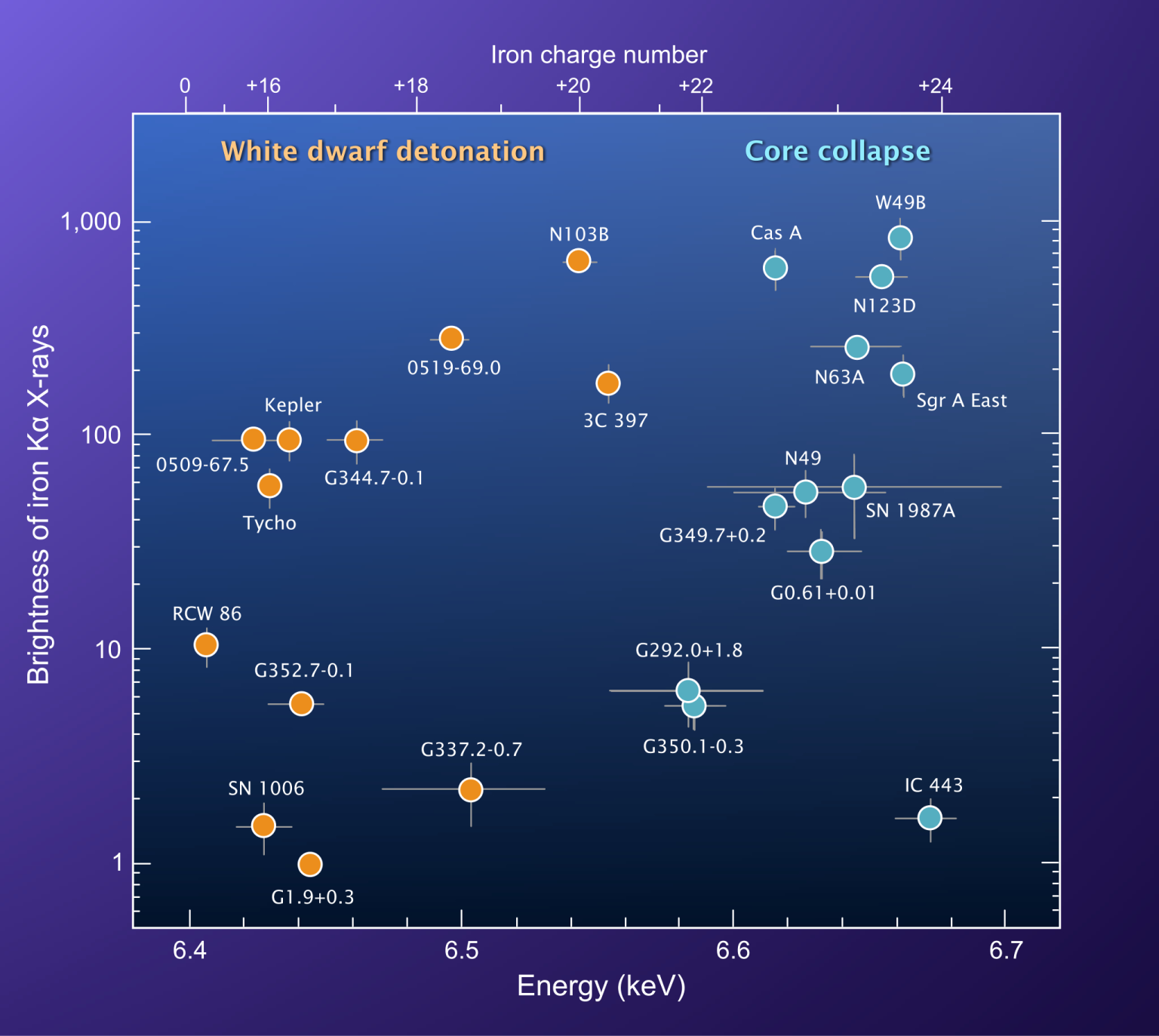
Left: Different remnants show different line patterns and iron-rich emission signatures, so the debris can still carry information about how the star exploded.
Right: Astronomers compare those remnant spectra with physical models to infer whether the original explosion was thermonuclear or core collapse.
Part 4: Chemical Enrichment — “We Are Star Stuff”
The Elements in Your Body
Nearly every atom in your body heavier than hydrogen has a stellar origin.
A useful first-pass map is:
- hydrogen and much of helium: mostly from the Big Bang
- carbon, nitrogen, and oxygen: made in stars
- iron-peak elements: strongly associated with supernova enrichment, including major contributions from Type Ia supernovae
- many very heavy elements: linked to rapid neutron-capture events such as neutron-star mergers
The point is not to memorize a giant lookup table. The deeper lesson is that the chemistry of planets, oceans, air, and life depends on earlier generations of stars that lived and died before the Sun formed.
We measure chemical abundances in stars and gas clouds. Those abundance patterns encode where matter was made and how galaxies were enriched over time. From those patterns, astronomers reconstruct cosmic history.
Misconception: “We are star stuff” means every element came from one kind of explosion.
Correction: Different elements come from different astrophysical sites. Stellar death matters because it enriches the universe through several channels, not just one.
The Big Picture — Why Mass Determines Fate
Observable
Astronomers see three broad outcomes:
- white dwarfs
- neutron stars
- black holes
Model
The outcome depends on whether any known pressure can resist gravity:
- thermal pressure in ordinary stars
- electron degeneracy pressure in white dwarfs
- neutron-rich matter and neutron degeneracy support in neutron stars
Inference
A star’s initial mass determines:
- how far fusion can proceed
- what kind of pressure can support the core
- whether collapse stops or continues
This is the same pressure-versus-gravity framework from earlier in the lecture, now applied to the full range of stellar endpoints.
The dividing line near \(8\,M_\odot\) is approximate, not exact. Real stellar deaths can also depend on composition, mass loss, rotation, and especially binary interactions.
Mass matters because it determines how hard gravity pushes the core, how far fusion can proceed, and whether any known pressure can still stop collapse.
Final Takeaway
Mass determines stellar fate because it determines how strongly gravity squeezes the core, how far fusion can proceed, and whether any form of pressure can still resist collapse.
- Low-mass stars stop at white dwarfs.
- More massive stellar cores can collapse to neutron stars or black holes.
In your own words:
- What do astronomers observe when stars die?
- What physical models explain those observations?
- What do we infer about how the universe builds elements?
If you can answer all three clearly, you understand this lecture.
Summary
Stars do not all die the same way.
Low- and intermediate-mass stars lose their outer layers late in life. Their exposed cores become white dwarfs, supported by electron degeneracy pressure. The brief glowing shell around them is a planetary nebula.
Massive stars build up iron-rich cores that can no longer gain useful support from fusion. Their cores collapse and can produce core-collapse supernovae, in which gravity, shock formation, and neutrino heating all play important roles. These explosions enrich space with heavy elements and can leave behind neutron stars or black holes.
Type Ia supernovae are different. They are thermonuclear explosions of white dwarfs in binary systems. They are not the same as novae, and modern evidence suggests that more than one binary pathway can produce them.
Stellar death matters because it returns processed material to space. The chemical abundances we measure in stars and gas clouds preserve that history, so astronomers can use them to reconstruct how galaxies became enriched over time.
Self-Assessment Checklist
Practice Problems
Solutions are available in the Lecture 20 Solutions.
Core Concepts
1. Planetary nebula timescale. A planetary nebula has a radius of 0.5 light-years and is expanding at 15 km/s. How old is it (approximately)? Compare your answer to the typical lifetimes of planetary nebulae (~10,000 years).
2. White dwarf density. The Sun’s mass is \(2 \times 10^{30}\) kg and Earth’s radius is \(6.4 \times 10^6\) m. If the Sun became a white dwarf the size of Earth, what would be its average density? Compare to water, which has density about \(10^3~\mathrm{kg/m^3}\).
3. Chandrasekhar limit. A white dwarf has a mass of \(1.5\,M_\odot\). Explain what happens. Can electron degeneracy pressure support it? What must occur next?
Working with Core Collapse
4. The iron catastrophe. Why is iron special in stellar nucleosynthesis? Explain in terms of binding energy per nucleon. Can an iron core release energy by fusing?
5. Collapse timescale. A massive star’s iron core collapses from Earth-sized (~6,400 km radius) to neutron star-sized (~20 km radius). The collapse happens in about 0.3 seconds. Estimate the average infall speed (in km/s). Compare to the speed of light (300,000 km/s).
6. Neutrino physics. Most of the energy released in a Type II supernova is carried away by neutrinos. Yet neutrinos rarely interact with matter. How, then, can neutrino heating revive the stalling shock wave? (Hint: density is extreme in the core.)
Nucleosynthesis and Element Origins
7. Where did you come from? Pick an element in your body from the list: carbon, oxygen, nitrogen, iron, calcium. Trace its origin: In what stellar environment was it created (normal fusion or supernova)? How was it dispersed into the interstellar medium? When did it enter the solar nebula?
8. Supernova energy budget. A core-collapse supernova releases about \(10^{46}\) joules of energy. About 99% is carried away by neutrinos, while about 1% goes into kinetic energy of the ejecta. How much energy goes into the motion of the ejected material? Give your answer in joules, then compare that kinetic energy to the Sun’s total lifetime output.
Comparing Supernovae
9. Type Ia vs. Type II: Observable differences. You observe two supernovae in distant galaxies. For each, you measure: (a) light curve shape, (b) spectral features, (c) ejecta velocity. List observable differences you’d expect to see between Type Ia and Type II. Why do these differences exist?
10. Standard candles. Type Ia supernovae are said to be “standardizable” in brightness — one Type Ia is roughly as bright as another. Why might this be true? (Hint: What determines the brightness? What’s similar between Type Ia events?) Why would Type II supernovae be harder to use as standard candles?
Challenge Problems
11. Reading a supernova spectrum. You observe a supernova’s spectrum. You see strong emission lines of hydrogen-alpha (656 nm), oxygen-III (500 nm), and other lines. You see no absorption features of iron or nickel. Is this more consistent with a Type Ia or Type II supernova? Explain your reasoning. What does the hydrogen emission tell you about the progenitor?
12. The fate of the Sun — detailed timeline. Construct a timeline for the Sun’s death, from the present to 10 trillion years in the future. Include: (a) when the Sun becomes a red giant, (b) when planetary nebula phase begins/ends, (c) the white dwarf cooling curve, (d) whether the Sun will ever become a black dwarf. At each stage, what is the Sun’s approximate luminosity, temperature, and size?
13. Galactic chemical enrichment (toy model). Treat this as a back-of-the-envelope estimate for one enrichment channel, not the whole iron budget of the Milky Way. The Milky Way contains about \(2 \times 10^{11}\) stars. Roughly 1 in 300 is a Type II supernova progenitor. Assume each such supernova produces \(0.1\,M_\odot\) of iron. Over 10 billion years of galactic history, how much iron would this channel contribute? Compare your result to the Sun’s mass (\(2 \times 10^{30}\) kg), and explain why this estimate should not be treated as the galaxy’s complete iron inventory.
Glossary
Asymptotic Giant Branch (AGB)
Late evolutionary stage of a low- to intermediate-mass star, characterized by shell burning and strong mass loss.
Binding energy
Energy required to separate a nucleus completely into individual protons and neutrons.
Chandrasekhar limit
Maximum mass, about \(1.4\,M_\odot\), that electron degeneracy pressure can support in a white dwarf.
Core collapse
Rapid gravitational implosion of a massive star’s iron-rich core after pressure support fails.
Degeneracy pressure
Quantum-mechanical pressure that arises because identical fermions such as electrons or neutrons cannot all occupy the same quantum state.
Ejecta
Material thrown outward in an explosion, especially in a supernova.
Electron capture
Process in which a proton and an electron combine to make a neutron.
Iron core
The dense iron-rich central region of a massive star near the end of its life. Because fusion involving iron does not provide useful energy support, this stage leads toward collapse.
Nuclear density
Extremely high density reached in collapsed stellar cores, where matter is compressed to roughly the density of atomic nuclei.
Nucleosynthesis
The formation of new atomic nuclei through nuclear reactions in stars and explosive astrophysical events.
Onion-shell structure
The layered internal structure of a massive star near the end of its life, with different fusion reactions occurring in different shells.
Pauli exclusion principle
Quantum-mechanical rule stating that no two identical fermions can occupy the same quantum state in the same way.
Planetary nebula
A glowing shell of gas expelled by a dying low-mass star and illuminated by its hot exposed core.
Progenitor
The original star or stellar system that later produces a remnant or an explosion.
Shock wave
A rapidly moving disturbance in which pressure, density, and temperature change abruptly.
Standard candle
An astronomical object whose intrinsic brightness can be estimated, allowing astronomers to infer distance from how bright it appears.
Type Ia supernova
A thermonuclear explosion of a white dwarf in a binary system. More than one progenitor pathway may lead to this outcome.
Type II supernova
A core-collapse supernova produced by the death of a massive star.
White dwarf
The compact, dense remnant left behind when a low-mass star loses its outer layers. A white dwarf is supported mainly by electron degeneracy pressure.