Lecture 18: From Gas to Stars
How the Interstellar Medium Births the Next Generation
The Big Idea
Stars form when cold, dense regions of gas and dust collapse under gravity. Those collapsing regions produce protostars, disks, and eventually the next generation of stars and planets.
This lecture asks a deeper question than “what is a star?” It asks: where does a star’s mass come from in the first place? The answer begins in the interstellar medium — the thin gas and dust between the stars — and ends with the birth of new stellar systems.
As you read, keep one throughline in mind:
cloud conditions \(\rightarrow\) collapse or stability \(\rightarrow\) protostar formation \(\rightarrow\) disk formation \(\rightarrow\) main-sequence star
Default expectation (best): Read the whole page before lecture, pausing for each check-yourself prompt.
If you’re short on time (about 20 minutes), focus on:
- the three kinds of nebulae
- why infrared observations matter
- the Jeans criterion in words
- the sequence from protostar to main sequence
Then return later for the observational signatures, summary, and challenge problems.
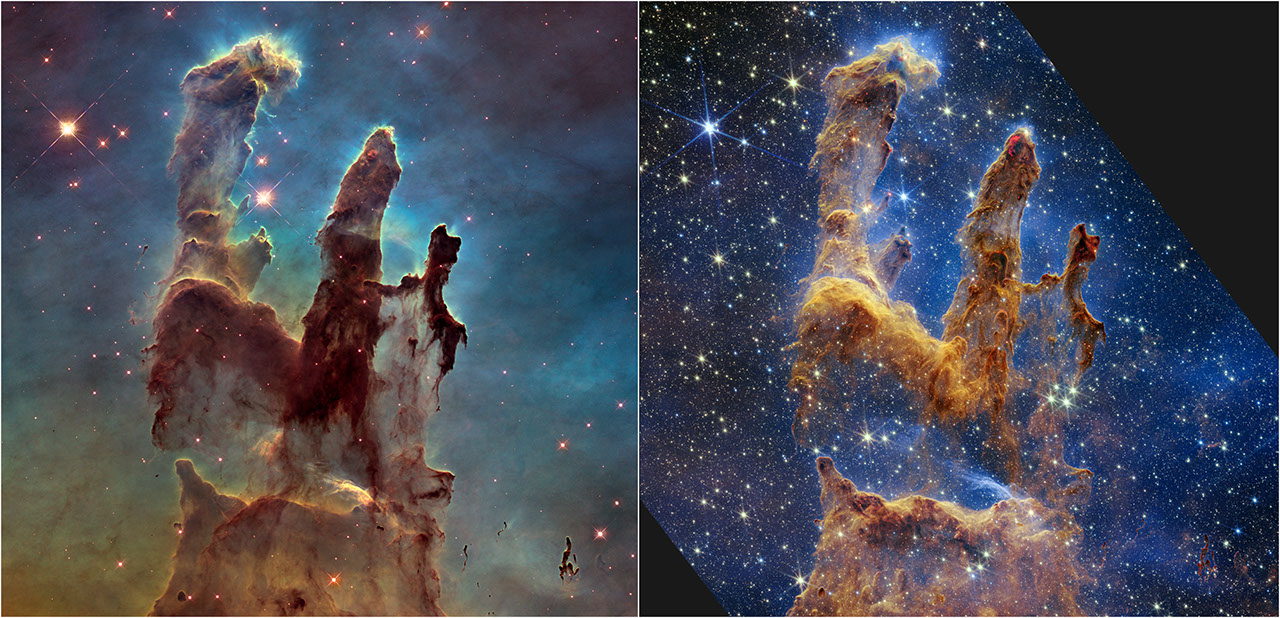
What to notice: Left (Hubble optical)—dark, opaque columns block visible light. Right (JWST infrared)—thousands of embedded newborn stars revealed. Infrared penetrates the dust that blocks optical light. (Credit: Illustration: NASA, ESA, CSA)
The Pillars of Creation are a perfect opening image for this lecture. In visible light, the pillars look like dark, opaque columns. In infrared, many hidden young stars appear. One famous region already shows the central lesson of star formation: what looks dark or empty in ordinary images can be an active stellar nursery when we observe it at the right wavelength.
Why We Are Rewinding the Story
So far in Module 2, we have mostly studied stars in the middle of their lives. We used the Sun to understand stellar structure, measured stellar properties from light, organized stars on the H-R diagram, and saw in binary systems that stellar mass is a powerful predictor of luminosity, lifetime, and fate.
But that leaves an important question unanswered:
If mass matters so much, where does a star’s mass come from?
This lecture rewinds the story to the raw material between the stars. We step away from adult stars and look at the cold gas and dust from which stars form. This is not a side topic. It is the missing origin chapter of stellar evolution.
By the end of the lecture, you should be able to explain:
- what kinds of interstellar clouds are associated with star formation
- why some clouds collapse while others do not
- why star formation usually produces many stars, not just one
- how protostars, disks, and planets emerge from collapsing gas
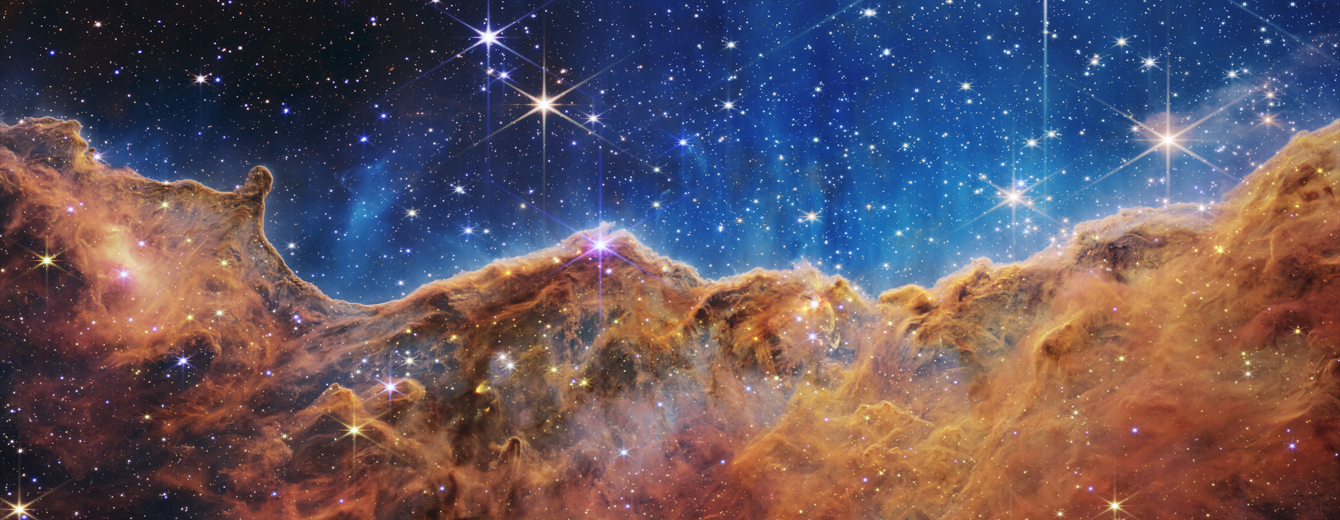
The Interstellar Medium: Anatomy of the Galaxy Between the Stars
Interstellar medium (ISM) — the gas and dust between the stars. It is very sparse, but it is the raw material from which new stars and planetary systems form.*
The space between stars is not empty. It contains a thin mixture of gas and dust spread across enormous distances.
Composition and Scale
Most of the ISM is gas, mainly hydrogen and helium. A much smaller fraction is dust: tiny solid grains made mostly of silicates and carbon-rich material. By mass, the ISM is about 99% gas and 1% dust.
Even though the ISM fills the galaxy, it is extremely thin. A typical region may contain only about 1 particle per cubic centimeter. That is far less dense than the air around you. But over distances of many light-years, even this thin material adds up to an enormous reservoir of star-forming matter.
The ISM is not the same everywhere. Some regions are hot and diffuse. Others are cold and dense. Those cold, dense regions are the ones most important for star formation.
The interstellar medium is not empty space. It is a thin but important mixture of gas and dust, and the coldest, densest parts of it are where stars form.
Nebula (plural, nebulae) — a cloud of gas and dust in space. The term historically applied to any fuzzy patch visible in a telescope, but modern astronomy distinguishes based on physical properties and observable signatures.*
Three Types of Nebulae: Reading the Cosmic Palette
Astronomers learn about interstellar clouds by asking a simple question:
How is this cloud interacting with light?
That question helps us classify three common kinds of nebulae.
Emission Nebulae: The Glowing Clouds
An emission nebula is a cloud of gas energized by nearby hot, young stars.
What you observe: A glowing cloud, often pink or red in images, around young massive stars. The Orion Nebula is a classic example.
Physical cause: Ultraviolet light from hot stars ionizes the surrounding hydrogen gas. When electrons recombine with the ions, the gas emits light at specific wavelengths.
What we infer: Hot young stars are nearby, and the surrounding gas is being energized right now.
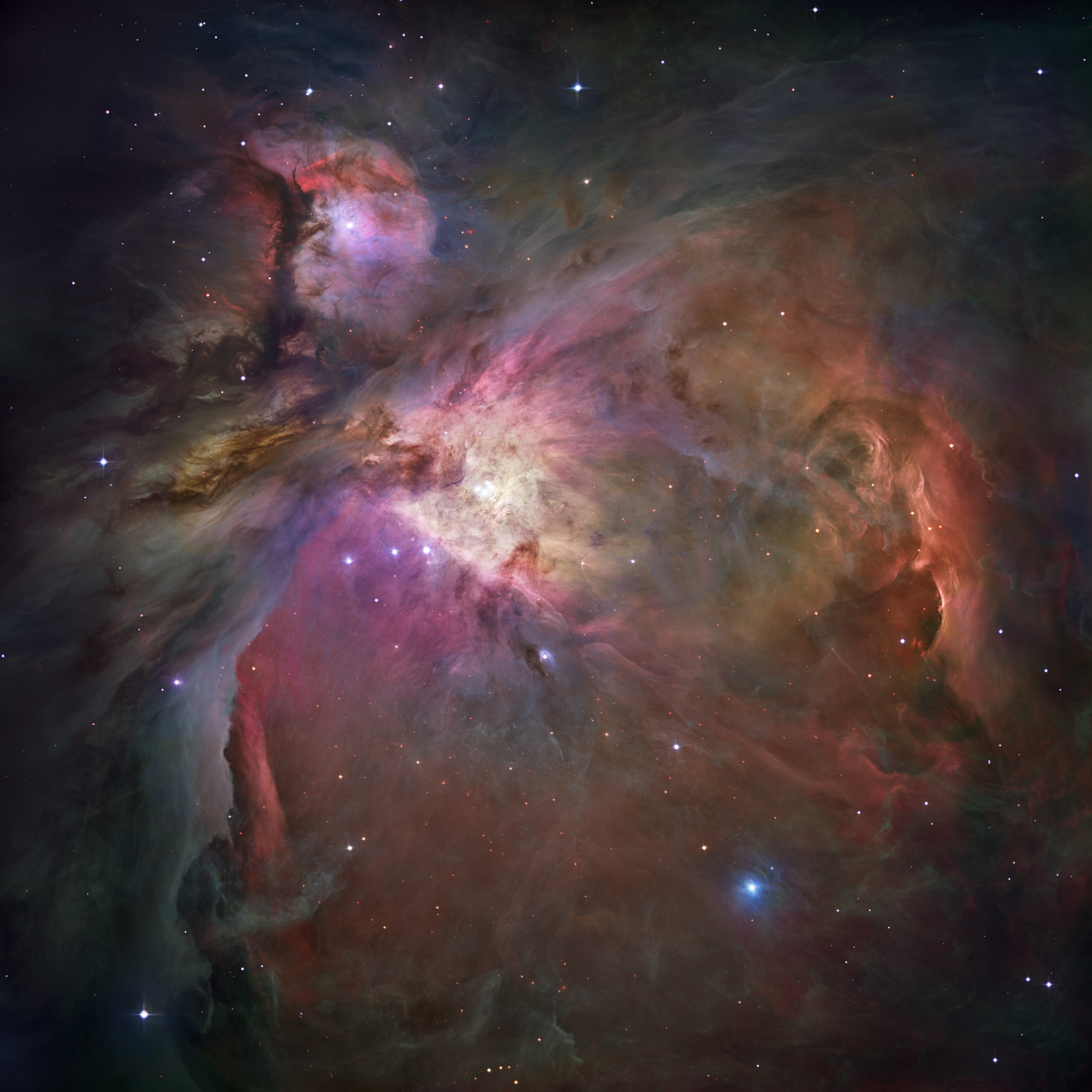
What to notice: emission nebulae are not uniform glows. Bright ionized gas, embedded young stars, and dark dust lanes all appear together, so one image already tells you that star birth happens in a messy gas-and-dust environment. (Credit: NASA/ESA/Hubble)
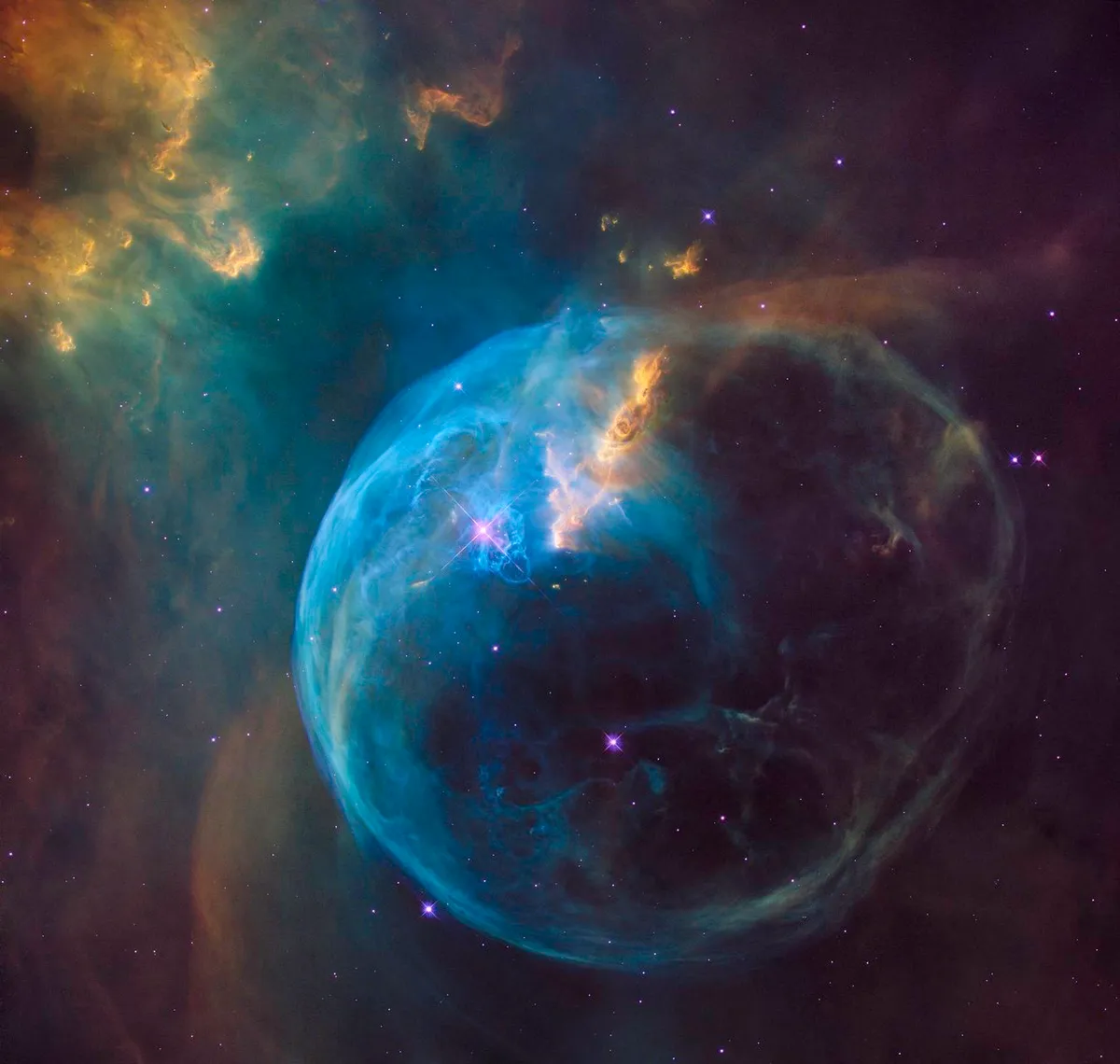
What to notice: an emission nebula can trace a shell or bubble rather than a fuzzy uniform cloud. The glowing rim marks gas being energized by hot stars, so the shape still tells you how starlight is affecting the surrounding gas.
H II region — ionized hydrogen produced where ultraviolet radiation from young, hot stars ionizes the surrounding gas. The Roman numeral II denotes singly ionized hydrogen (one electron removed).*
Reflection Nebulae: Light Scattered by Dust
A reflection nebula shines by scattered starlight rather than by glowing on its own.
What you observe: A hazy glow, often bluish, around nearby stars. The Pleiades are a famous example.
Physical cause: Dust scatters shorter-wavelength light more efficiently than longer-wavelength light, so reflected light often looks blue.
What we infer: Dust is present and illuminated by nearby stars, but the gas is not strongly ionized.
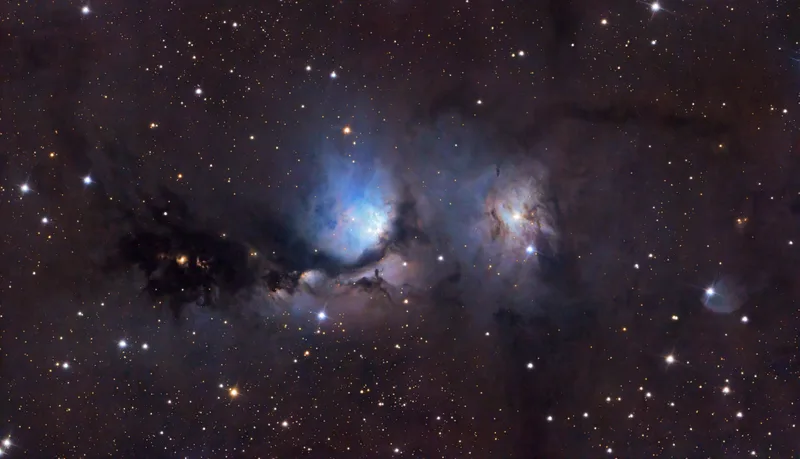
What to notice: the brightest parts of a reflection nebula appear as a blue glow around nearby stars, while the dark lanes show dust mixed through the region. The dust is scattering starlight rather than emitting strongly on its own. (Credit: Jared Bowens)
Dark Nebulae: The Cosmic Veil
A dark nebula is a dense dust cloud that blocks the light of stars behind it.
What you observe: A dark lane or silhouette in front of a brighter background. The Horsehead Nebula is a famous example.
Physical cause: Dust absorbs and scatters background visible light, while the cloud itself emits little visible light.
What we infer: The cloud is cold, dusty, and dense enough to hide what lies behind it. These are often promising star-forming regions.
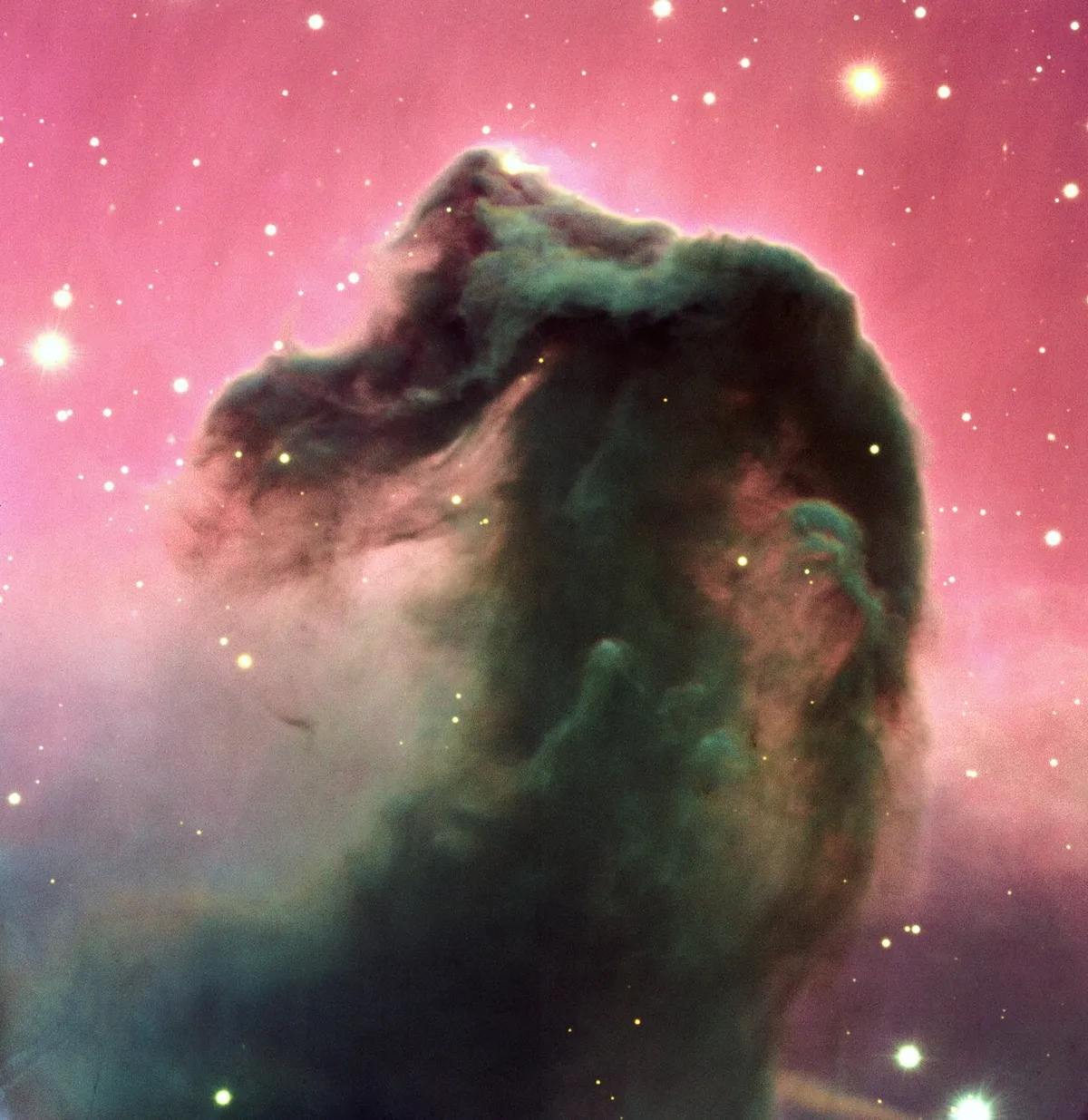
What to notice: a dark nebula stands out because it blocks the bright background behind it. The Horsehead’s silhouette shows that the cloud is dense enough to absorb and scatter visible light rather than glow brightly itself. (Credit: ESO)
The same basic ingredients — gas, dust, and starlight — can produce very different appearances. A nebula’s appearance is a clue to what physical process is happening there.
A dark nebula is not an empty region. It looks dark because dust is blocking background visible light.
Dark nebula — an interstellar cloud dense and opaque enough to block visible light from stars behind it. The darkness reveals itself through absorption rather than emission or reflection.*
Interstellar Extinction and Reddening: Why Infrared Eyes See Farther
Dust affects starlight in two related ways.
- Interstellar extinction is the overall dimming of the light.
- Interstellar reddening is the shift toward redder colors because dust removes blue light more effectively than red light.
Imagine looking at a distant star through a dusty cloud. Shorter-wavelength blue light is scattered and absorbed more strongly than longer-wavelength red light. As a result, the star appears both dimmer and redder than it really is.
This creates a major observational problem: visible light can hide star-forming regions from us.
Infrared light, however, passes through dusty regions more effectively than visible light. That is why infrared telescopes can reveal stars and structures hidden inside dusty nebulae.
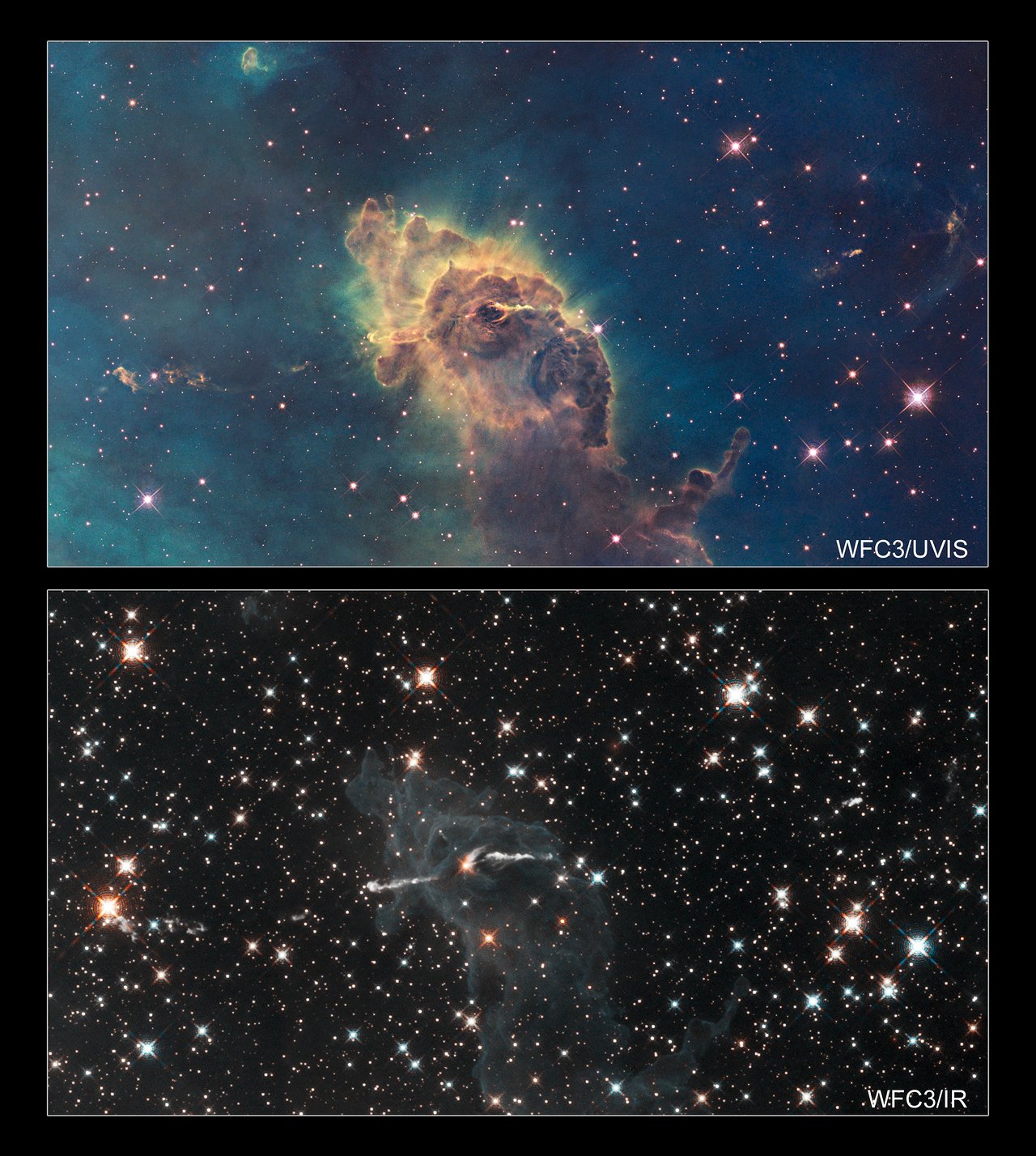
What to notice: visible light makes the dusty pillar look opaque, while infrared reveals stars and structure hidden inside and behind it. Same cloud, different wavelength, different information. (Credit: NASA/ESA/Hubble)
This gives us another Observable \(\rightarrow\) Model \(\rightarrow\) Inference chain:
- Observable: a region looks dark in visible light but reveals stars in infrared
- Model: dust blocks visible light much more strongly than infrared light
- Inference: stars can be forming inside regions that look opaque in ordinary images
Visible light does not show us everything. To study star formation, astronomers often need infrared observations to see through dusty clouds.
Two identical stars lie at the same distance, but one is seen through a dust cloud.
Before reading the answer, predict:
- Which star will look dimmer?
- Which star will look redder?
- Which effect is extinction, and which is reddening?
The star behind the dust cloud will look dimmer and redder. The dimming is extinction. The color shift toward red is reddening.
This short PBS LearningMedia / NASA resource is a strong visual companion to the infrared-star-formation discussion above.
The Giant Molecular Cloud: The Birthplace of Stars
Giant molecular cloud (GMC) — a massive accumulation of cold, dense molecular gas. These clouds are among the coldest places in the galaxy and are the main sites of star formation.*
Not all parts of the interstellar medium form stars. Star formation happens mainly in the coldest and densest clouds, called giant molecular clouds.
A giant molecular cloud is a huge, cold cloud made mostly of molecular hydrogen, along with dust and other molecules. Typical temperatures are about \(10\ \text{K}\), so these clouds are among the coldest places in the galaxy.
Why are these clouds important? Because star formation requires conditions where gravity can begin to overpower the internal support of the gas.
A giant molecular cloud does not usually collapse all at once. Turbulent motions, magnetic effects, and internal pressure can help support the cloud for a time. But that balance can be disturbed.
What Triggers Collapse?
Several processes can compress a giant molecular cloud and help push parts of it toward collapse:
- a shock wave from a nearby supernova
- a collision with another cloud
- compression as the cloud moves through a spiral arm
- winds and radiation from nearby young massive stars
The big idea is simple:
Star formation often begins when a cloud is compressed enough that gravity starts to win locally.
Stars do not usually form because an isolated cloud just “decides” to collapse on its own. Star formation is often triggered by changes in the cloud’s environment.
The Jeans Criterion: When Does Gravity Win?
Now we can ask the key physics question of the lecture:
When will a cloud actually collapse?
A gas cloud is a competition between two effects:
- gravity, which pulls matter inward
- pressure, which resists compression
For ASTR 101, the most important reasoning is:
- hotter gas \(\rightarrow\) faster particle motion \(\rightarrow\) stronger pressure support
- colder gas \(\rightarrow\) weaker pressure support
- denser gas \(\rightarrow\) stronger self-gravity in that region
Astronomers summarize this competition with the Jeans criterion.
A region of gas will collapse if its mass is greater than the Jeans mass, the threshold above which gravity can overcome pressure.
\[ \text{cloud mass} > \text{Jeans mass} \]
Jeans criterion — a cloud of gas will undergo gravitational collapse if its mass exceeds the Jeans mass, the threshold set by the balance between gravity and thermal pressure. Conceptually: colder, denser regions are easier to collapse.*
You do not need the full equation here. What matters is the pattern:
- colder regions are easier to collapse
- denser regions are easier to collapse
- hotter regions are harder to collapse
Star formation is most likely in regions that are cold, dense, and massive enough for gravity to overpower pressure.
Suppose two clouds have the same mass, but one is colder.
Before looking at the answer, predict:
- In which cloud do particles move more slowly?
- In which cloud is pressure weaker?
- Which cloud should be easier to collapse?
The colder cloud has slower particle motion and weaker pressure support, so it is easier for gravity to win. That means the colder cloud is more likely to collapse.
Suppose two clouds have the same temperature, but one is denser.
Before looking at the answer, predict:
- In which cloud is gravity stronger within a given region?
- Which cloud should be easier to collapse?
The denser cloud has stronger self-gravity in the region, so it is easier for gravity to overcome pressure. That means the denser cloud is more likely to collapse.
Fragmentation: From One Cloud to Many Stars
If a giant molecular cloud begins to collapse, it usually does not make just one star.
As parts of the cloud contract, some subregions become denser than others. Those denser subregions can become unstable on their own and begin collapsing separately. In other words, one collapsing cloud can produce many collapsing clumps.
This process is called fragmentation.
That is why star formation usually produces a cluster of stars rather than a single giant star. A large cloud can break into many self-gravitating pieces, and each piece can form a star or a small multiple-star system.
One cloud usually makes many stars because different dense parts of the cloud can collapse independently.
Why does a giant molecular cloud usually form a cluster of stars instead of one enormous star?
Because different dense regions inside the cloud can become unstable and collapse on their own. The cloud does not collapse as one perfectly uniform object.
A cloud does not fragment because it is “breaking like glass.” It fragments because different regions become dense enough to collapse independently under gravity.
Process Map: From Cloud to Star
It can be easy to lose the thread in a long story like star formation, so here is the sequence in one place:
- A cold, dense region exists inside a giant molecular cloud.
- Compression or changing conditions push part of the cloud toward collapse.
- Gravity overcomes pressure in that region.
- The cloud fragments into multiple collapsing clumps.
- A protostar forms inside one collapsing clump.
- A disk forms around the young star.
- Accretion, winds, and jets shape the young system.
- Sustained hydrogen fusion begins.
- The star reaches the main sequence, while planets may continue forming in the disk.
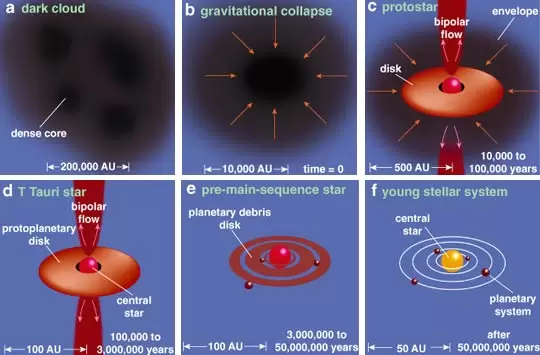
What to notice: star birth is a sequence, not a single moment. A dark cloud becomes a collapsing core, then a protostar with a disk and bipolar flow, then a T Tauri star, and eventually a young planetary system. (Credit: American Scientist)
This is not a random list of events. Each stage sets up the next one.
From Protostar to the Main Sequence: The Journey to Stellar Adulthood
Once a fragment of a collapsing cloud exceeds its Jeans mass, gravity takes over. The collapse is inexorable. But the collapse of a gas cloud into a star is not instantaneous; it unfolds in distinct stages, each observable through infrared and radio observations.
Stage 1: The Protostar and Kelvin-Helmholtz Contraction
Stage 1 is powered by gravitational contraction, not nuclear fusion.
When the infalling material reaches the center of the collapsing cloud, it forms a protostar — the nucleus of a future star. A protostar is not yet a true star because sustained hydrogen fusion has not begun, but it is hot enough to glow in the infrared. The protostar is embedded in a cocoon of infalling gas and dust, invisible to visible-light telescopes but blazing in the infrared.
As material falls inward, gravitational potential energy is converted to heat. The protostar contracts, becoming denser and hotter. This process — the gradual contraction and heating of a gas cloud under gravity — is called Kelvin-Helmholtz contraction, named after the physicists who first analyzed it in the 1850s. (It was the prevailing model for stellar heating before we understood nuclear fusion.)
The timescale for Kelvin-Helmholtz contraction depends on mass:
- For a low-mass protostar (~\(0.5\,M_\odot\)): contraction takes ~10 million years.
- For a high-mass protostar (~\(20\,M_\odot\)): contraction takes ~100,000 years.
This dramatic difference in timescale arises because massive protostars have higher luminosity; they radiate away gravitational energy and contract more quickly. A massive protostar can reach main-sequence conditions in just a few hundred thousand years, while a low-mass star takes tens of millions of years to do so. This has profound implications: massive stars finish their lives (roughly 10 million years on the main sequence) in less time than it takes a low-mass star to be born!
Protostar — an object in the early stages of stellar formation, powered by gravitational contraction rather than fusion. Embedded in a cloud of infalling material, invisible in visible light but detectable in infrared.*
Kelvin-Helmholtz contraction — the gradual heating and contraction of a gas cloud under its own gravity, the process by which a protostar approaches the main sequence.*
Stage 2: The T Tauri Phase — Accretion and Outflows
After the protostar forms, the system is still young and active. Material continues to fall inward from the surrounding disk, while strong magnetic activity helps drive winds and narrow jets outward.
This stage is called the T Tauri phase.
T Tauri stars are young stars that have not fully settled onto the main sequence. They are often characterized by:
- ongoing accretion from a surrounding disk
- strong stellar winds
- irregular changes in brightness
- narrow bipolar jets flowing away from the star
This tells us that star birth is not a quiet process. Even before long-term hydrogen fusion begins, the young system can be highly dynamic.
Protostars do not simply contract in silence until fusion begins. The path to the main sequence includes accretion, winds, jets, and changing brightness.
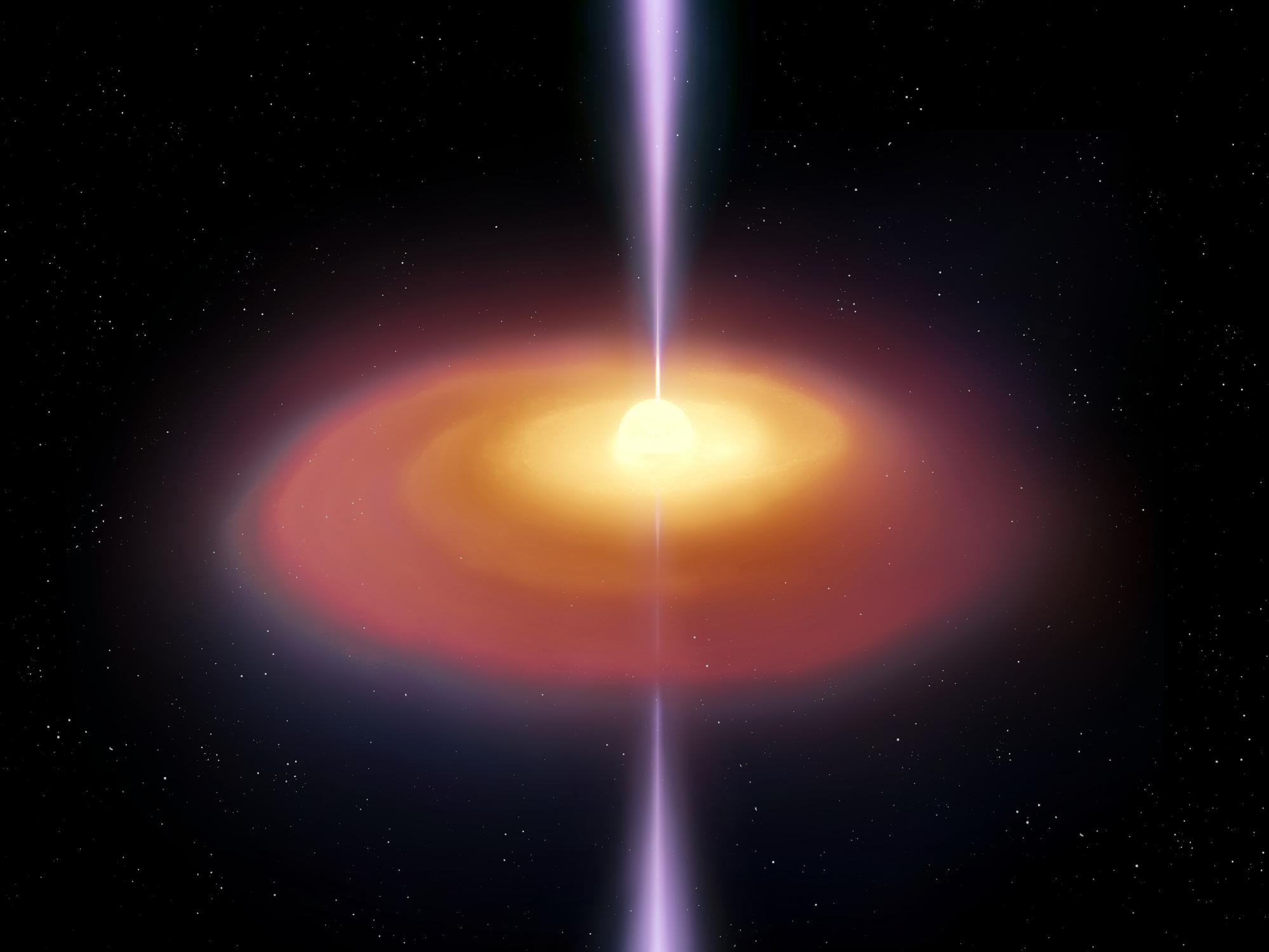
What to notice: outflows are not random. Material falls inward through a flattened disk while bipolar jets shoot outward along the rotation axis, showing that accretion and ejection happen together during stellar birth.
This is an artist’s concept showing the geometry of the system, not a direct visible-light photograph. It is useful because it helps us visualize a structure that is difficult to see directly in ordinary visible light.
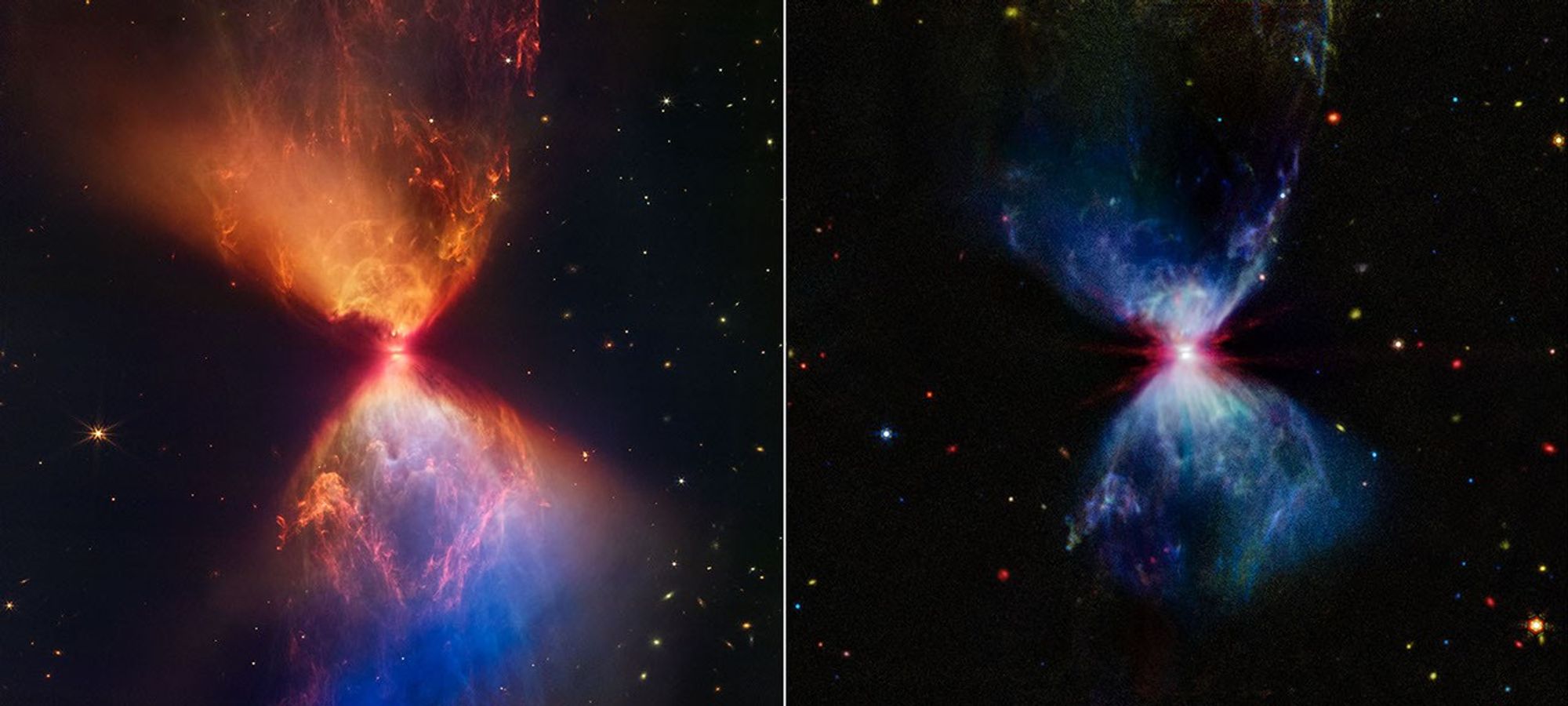
What to notice: this is the observational version of the outflow story. A young star at the center is launching bipolar flows into the surrounding gas, so star birth involves both infall and ejection.
Stage 3: The Arrival at the Main Sequence
Eventually, the core of the forming star becomes hot enough for sustained hydrogen fusion to begin.
At that point, the object makes the transition from a protostar to a true main-sequence star. The star now has a long-term internal energy source: fusion in its core.
The main idea is:
- before this stage, the object is powered mainly by gravitational contraction
- after this stage, it is powered mainly by hydrogen fusion
This is the transition that places the star on the main sequence.
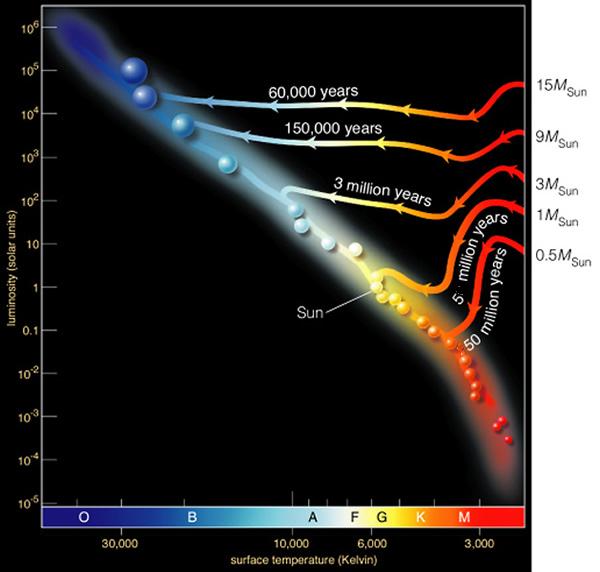
What to notice: protostars do not all take the same route to adulthood. Massive protostars plunge onto the main sequence quickly, while low-mass stars spend much longer contracting and descending their pre-main-sequence tracks.
Match each process to the correct stage of early stellar evolution:
- gravitational contraction as the main power source
- accretion plus strong outflows
- sustained hydrogen fusion
- Stage 1: gravitational contraction
- Stage 2: accretion plus strong outflows
- Stage 3: sustained hydrogen fusion
A protostar is not yet a normal hydrogen-fusing star. Its main energy source is gravitational contraction until sustained fusion begins.
Protoplanetary Disks and the Formation of Planets
The same collapse that forms a star also leaves behind a rotating disk of gas and dust around the young system.
This happens because the collapsing material usually has at least a small amount of rotation. As it contracts, that rotation becomes more important, so material does not fall straight inward from every direction. Instead, it settles into a flattened disk around the forming star.
That disk is called a protoplanetary disk.
Inside the disk:
- tiny dust grains collide and stick
- larger particles grow into planetesimals
- planetesimals merge into planets
So stars and planets are part of the same story. The star forms at the center, and planets form from leftover material in the surrounding disk.
This simulation follows the most massive star forming inside a \(50\,M_\odot\) molecular cloud. What to notice: the disk is not a decorative add-on. It grows as the star accretes, can fragment, and can be reshaped by nearby stars in the crowded environment where star clusters form.
Credit: Mike Grudic; reproduced from the classic Bate, Bonnell, and Bromm (2003) cluster-formation setup with the GIZMO code.
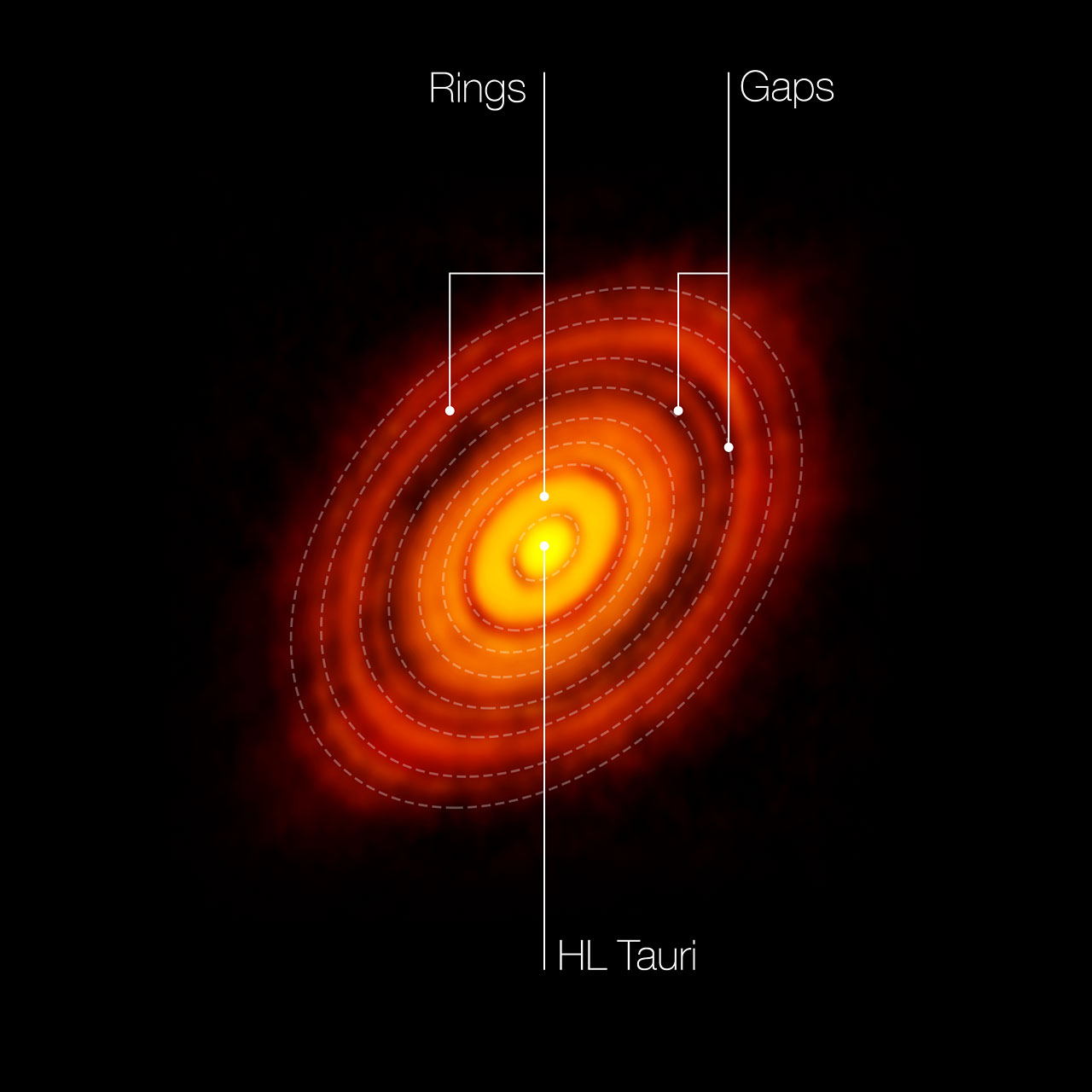
What to notice: a young disk is structured, not smooth. Bright rings and dark gaps show that planet-forming disks can develop organized patterns very early. (Credit: ALMA)
Protoplanetary disk — a flat, rotating disk of gas and dust surrounding a young star or protostar. It is the environment in which planets can form.*
Planets do not form in a separate process disconnected from star formation. They form from the disk of gas and dust left around a young star.
A protoplanetary disk is not just decorative leftover material. It is the environment in which planets can form.
Observable Signatures: How We Know Star Formation Is Happening
A core question in astronomy is not just what happens, but how we know.
Star formation is a perfect example because many of its earliest stages are hidden inside dusty clouds. Astronomers must combine observations with physical models to infer what is happening.
Observable
We detect warm dust around young objects through infrared emission. We also detect gas in star-forming clouds through molecular spectral lines, especially from molecules such as carbon monoxide (CO).
Model
We use models of collapsing clouds, dusty envelopes, disks, and outflows to predict what kinds of light those systems should emit.
Inference
By comparing the observations to the models, astronomers can infer:
- whether a protostar is present
- whether a disk is present
- whether gas is flowing inward or outward
- how warm the dust is
- which stage of star formation the object is in
- Observable: infrared glow from dust, molecular line emission from gas
- Model: collapsing cloud, protostar, disk, and outflow models
- Inference: the physical properties and evolutionary stage of the hidden young system
Why can astronomers infer the presence of a forming star even when they cannot see the object directly in visible light?
Because the hidden object still affects its environment. Warm dust emits infrared light, and surrounding gas produces spectral lines. Those observables can be matched to physical models of star formation.
Summary
The interstellar medium is the thin gas and dust between the stars. It is not empty space; it is the raw material from which new stars and planets form.
Different nebulae look different because gas and dust interact with light in different ways. Emission nebulae glow because gas is energized by hot stars. Reflection nebulae shine by scattered starlight. Dark nebulae appear dark because dust blocks background visible light.
The coldest and densest clouds in the interstellar medium are giant molecular clouds. Star formation begins when parts of these clouds become unstable and gravity overcomes internal support. That is the basic idea behind the Jeans criterion.
A collapsing cloud usually fragments into many dense clumps, so star formation often produces clusters rather than isolated stars. Individual collapsing clumps form protostars. As the young system evolves, accretion, winds, and jets appear, and a surrounding disk forms. When sustained hydrogen fusion begins in the core, the object becomes a main-sequence star.
The surrounding disk can also form planets. In this way, the birth of stars and the birth of planetary systems are part of the same larger process.
Modern astronomy studies star formation by combining observations and models. Infrared and radio observations let us detect hidden protostars, dusty disks, and molecular clouds even when visible light cannot penetrate the dust.
Star formation is the process that connects the gas between the stars to the next generation of stars and planets. It is one of the main ways matter cycles through the galaxy.
Self-Assessment Checklist
Misconception Review
Before moving on, check these common mistakes:
No. Many dark regions are dense dust clouds blocking the light from stars behind them.
No. Dust can hide star-forming regions in visible light while infrared observations still reveal them.
No. A cloud forms stars only when gravity can overcome internal support in part of the cloud.
No. Giant molecular clouds usually fragment and form many stars.
No. Planets form from the disk of gas and dust left around a young star.
Practice Problems
Solutions are available in the Lecture 18 Solutions.
Core Problems
Problem 1: Interstellar Extinction
A distant star has an apparent magnitude of \(m = 15\) mag as observed through a nearby dust cloud. If there were no dust, the star’s apparent magnitude would be \(m = 10\) mag. How many magnitudes of extinction does the dust cloud introduce? (Recall that the magnitude scale is logarithmic: a change of 1 magnitude corresponds to a brightness ratio of 2.512. This is the definition of interstellar extinction.)
Problem 2: The Jeans Criterion (Conceptual)
Two giant molecular clouds have identical temperature (\(T = 10\ \text{K}\)) but different masses: Cloud A has \(M_A = 10^5\,M_\odot\) and Cloud B has \(M_B = 10^4\,M_\odot\). Both have the same average density. Which cloud is more likely to undergo gravitational collapse? Why?
Problem 3: Kelvin-Helmholtz Contraction Timescale
A low-mass protostar (\(0.5\,M_\odot\)) undergoing Kelvin-Helmholtz contraction has a timescale of roughly 10 million years to reach the main sequence. A high-mass protostar (\(10\,M_\odot\)) has a timescale of roughly 0.1 million years (100,000 years).
Using this information, explain why massive stars have much shorter lifetimes on the main sequence than low-mass stars.
Problem 4: Protoplanetary Disk Structure
The disk around a young star has an inner radius of 0.1 AU and an outer radius of 100 AU. Assume the disk’s temperature drops as \(T(r) \propto r^{-0.5}\) (where \(r\) is distance from the star in AU). If the inner disk (at 0.1 AU) has a temperature of 1000 K, what is the temperature at the outer edge (at 100 AU)?
Problem 5: Observing a Hidden Protostar
A protostar is embedded in a dense dust cloud. The dust obscures the protostar from visible-light telescopes, but an infrared observer detects thermal emission peaking at a wavelength of \(\lambda_{\rm peak} = 20\,\mu\text{m}\). Using Wien’s law, estimate the temperature of the dust surrounding the protostar.
Recall: Wien’s displacement law: \(\lambda_{\rm peak} T = 2.898 \times 10^{-3}\,\mathrm{m\cdot K}\)
Challenge Problems
Challenge 1: Star Formation Rate in the Milky Way
The Milky Way is observed to form new stars at a rate of roughly 1–3 solar masses per year (averaged over time). If the total mass of all giant molecular clouds in the Milky Way is roughly \(10^{9}\,M_\odot\), and if all of this mass eventually forms stars, how long would it take for the ISM to be completely converted into stars?
Challenge 2: Comparing Protostars
Two protostars have the same luminosity (\(L = 10\,L_\odot\)) but different masses:
- Protostar A: \(M_A = 1\,M_\odot\)
- Protostar B: \(M_B = 10\,M_\odot\)
Without calculating anything, predict which protostar is older (closer to the main sequence). Explain your reasoning.
Challenge 3: Dust and Observability (Synthesis)
Imagine discovering a new star-forming region at a distance of 1000 pc. The region contains protostars embedded in a dense dust cloud with an optical extinction of \(A_V = 10\) magnitudes.
By how many times is the starlight from these protostars dimmed by extinction?
Given this extinction, explain why an optical telescope would be useless for studying these protostars, but an infrared telescope could still detect them.
What property of dust grains — specifically, their size relative to the wavelength of light — explains this difference?
Glossary
- ★ Accretion disk
- A rotating disk of gas and dust surrounding a protostar or young star, from which material falls inward onto the star.
- ★ Dark nebula
- A cloud of dust so dense and opaque that it blocks visible light from stars behind it. These are sites of active star formation.
- ★ Emission nebula
- A region of ionized hydrogen gas that glows in visible light due to radiation from nearby hot stars. Also called an H II region.
- ★ Giant molecular cloud (GMC)
- A massive, cold accumulation of molecular gas (typically ~10⁵ M☉, temperature ~10 K) in which star formation occurs.
- ★ H II region
- Ionized hydrogen gas surrounding hot O- or B-type stars, which emit ultraviolet radiation. The Roman numeral II denotes singly ionized hydrogen.
- ★ Interstellar extinction
- The dimming of starlight as it passes through dust clouds, caused by absorption and scattering of light by dust grains.
- ★ Interstellar medium (ISM)
- The gas, dust, magnetic fields, and cosmic rays filling the space between stars. It makes up only a few percent of the Milky Way's mass, but it is the raw material for new stars.
- ★ Interstellar reddening
- The shift in the color of starlight toward the red due to preferential scattering of blue light by dust grains.
- ★ Jeans criterion
- The rule that a cloud collapses when its mass exceeds the Jeans mass, so gravity beats thermal pressure.
- ★ Jeans mass
- The threshold mass needed for a region of gas to collapse. Colder, denser regions have lower Jeans masses.
- ★ Kelvin-Helmholtz contraction
- The gradual heating and contraction of a gas cloud under its own gravity. The process by which a protostar approaches the main sequence.
- ★ Molecular cloud
- A region of cold (~10–100 K), dense gas in which molecules (predominantly H₂) are the dominant form of hydrogen.
- ★ Nebula
- A cloud of gas and dust in space. The term originally referred to any fuzzy patch visible through a telescope.
- ★ Protoplanetary disk
- A flat, rotating disk of gas and dust surrounding a young star, where planets form through collisions and mergers of dust grains and planetesimals.
- ★ Protostar
- A forming star whose energy comes mainly from gravitational contraction, not sustained hydrogen fusion, while it remains embedded in infalling gas and dust.
- ★ Rayleigh scattering
- The preferential scattering of short-wavelength (blue) light by particles much smaller than the wavelength. This explains why the sky is blue and why reflection nebulae are blue.
- ★ Reflection nebula
- A cloud of dust and gas that shines by scattering nearby starlight. It often looks blue because dust scatters shorter wavelengths more efficiently.
- ★ T Tauri star
- A young star in the pre-main-sequence phase, characterized by irregular variability, intense stellar winds, and accretion from a surrounding disk. Named after the prototype T Tauri in Taurus.
Reading adapted from OpenStax Astronomy, Chapters 20–21, with modifications for ASTR 101 (Spring 2026).